Expat’s Guide to Living in Japan

- Japan Guides for Americans
- What Living in Japan Is Like as an American
- Pros and Cons of Living in Japan as an American
- How Americans Can Live in Japan Long Term
- Cost of Living in Japan for Americans
- Healthcare and Health Insurance in Japan
- Working in Japan as an American
- Retiring in Japan as an American
- Taxes for Americans Living in Japan
- Paperwork in Your First Months in Japan
- Raising a Family in Japan as an American
- Where Americans Live in Japan
- What to Watch in 2027 for Americans in Japan
- Your Status of Residence Shapes Life in Japan, and Your U.S. Return Comes With You
- Frequently Asked Questions about Living in Japan as an American


Living in Japan as an American means a safe, convenient daily life, a status of residence that sets how long you can stay, and two tax systems that both expect a return from you. This guide is for U.S. citizens weighing a move to Japan or settling in after one: what life there is like, how Americans stay long term, what a month costs, how healthcare works, and how Japan and the IRS each tax your income.
Americans can visit Japan without a visa for up to 90 days, but living there takes a status of residence (Japan’s term for a long-stay visa category) based on a job, a family tie, study, or a business. Japan has no retirement visa. Once you live there, Japan taxes you as a resident, and you keep filing a U.S. return every year. Our guide to Japan taxes for Americans covers how the two fit together.
This table sums up the basics for a U.S. citizen planning a life in Japan. Dollar figures in this guide use about ¥160 to the dollar, the Federal Reserve’s current rate at the time of publication.
| Topic | Japan at a Glance for Americans |
|---|---|
| Visiting without a visa | Up to 90 days for tourism, family visits, or business meetings, with no paid work |
| Living in Japan longer | A status of residence tied to work, family, study, or a business; no retirement visa |
| Residence card | Issued to residents staying longer than three months; carry it at all times |
| Health insurance | Required for residents staying longer than three months; most patients pay 30% of the bill |
| Typical monthly spending | About ¥191,500 (about $1,200) for a single working household, per Japan’s household survey |
| Americans living in Japan | About 70,000 U.S. citizens hold resident status, not counting U.S. military personnel |
| Taxes | Japan taxes you as a resident; the U.S. taxes you as a citizen, and credits prevent most double tax |
Japan Guides for Americans
Each guide below covers one part of a life in Japan in more depth. More guides will join this list as they’re published.
- Taxes: Japan taxes for Americans, from residency categories to the U.S. return.
- Moving: moving to Japan from the U.S.
- Remote work: the Japan digital nomad visa for six-month stays.
- Inheritance and gifts: the U.S.-Japan estate tax treaty and Japanese gift tax.
What Living in Japan Is Like as an American
Japan is a good place to live for many Americans, especially those who value safety, public transit, and affordable healthcare, and who can live with a language barrier and a lot of paperwork. How it feels day to day depends heavily on where you live, how much Japanese you speak, and whether you work for a Japanese employer.
Safety and Daily Convenience
Low crime, clean streets, and trains that run to the minute are the reasons Americans give most often for staying. Most daily needs sit within a short walk in Japanese cities, from convenience stores open around the clock to clinics and supermarkets, so many Americans in Tokyo or Osaka live without a car.
The Language Barrier
You can get by in central Tokyo with little Japanese, but life gets harder outside it. Leases, bank forms, city hall paperwork, and doctor’s visits usually happen in Japanese. Most Americans who stay long term study the language, and a Japanese-speaking colleague or friend helps a lot in the first months.
Work Culture and Paperwork
Japanese workplaces often expect long hours, formal hierarchy, and group decision-making, which can feel slow to Americans used to U.S. offices. Government paperwork is detailed and often done in person. Neither is a reason not to move, but both are the most common complaints from Americans who leave.
How Japanese People View Americans
Relations between the two countries are close, and Americans generally find people polite and welcoming. Social circles can take longer to build, though: friendships in Japan often form through work, school, or clubs, and many Americans find their first friends among other foreign residents.

Thinking About a Life in Japan?
Pros and Cons of Living in Japan as an American
Most Americans weigh the same tradeoffs before moving. This table sets the common advantages against the common frustrations.
| Pros | Cons |
|---|---|
| Very low crime and safe streets, day and night | Daily life outside big cities runs mostly in Japanese |
| Reliable trains and walkable cities | Paperwork is detailed and often done in person |
| Public health insurance with capped costs | Long hours are common in Japanese workplaces |
| A weak yen stretches dollar savings and income | Apartments are small, and renting often needs a guarantor company |
| Easy travel across Asia | Long flights and a 13- to 14-hour time difference from the U.S. East Coast |
Why Some Americans Leave
The Americans who leave usually point to the visa tie to a single employer, career limits without fluent Japanese, distance from family, and the feeling of staying an outsider. Planning for these before you go, through language study, a second visa option, and a budget for trips home, makes a longer stay more likely.
How Americans Can Live in Japan Long Term
A U.S. citizen can’t move to Japan just by buying a ticket. The 90-day visa-free stay covers visits only, so living in Japan means qualifying for a status of residence. Each one allows a specific activity, and your life in Japan is built around it: a work status covers your job, and a spouse status covers family life.
This table shows the statuses Americans use most and how long each lasts.
| Status of residence | Who it fits | Length of each stay |
|---|---|---|
| Engineer/Specialist in Humanities/International Services | Office, tech, and many English-teaching jobs with an employer in Japan | 3 months to 5 years, renewable |
| Highly Skilled Professional | Professionals who score 70 or more points on Japan’s points system | 5 years, with a faster path to permanent residency |
| Spouse or Child of Japanese National | Americans married to a Japanese citizen | 6 months to 5 years, renewable |
| Dependent | Spouses and children of someone on a work status | Usually set to match the family member’s stay |
| Business Manager | Founders running a business in Japan | 3 months to 5 years, renewable |
| Student | Students at a Japanese university or language school | Up to 4 years and 3 months |
| Digital nomad (Designated Activities) | Remote workers earning at least ¥10 million a year from clients outside Japan | 6 months, with no extension |
The Business Manager status now requires ¥30 million (about $187,500) in capital, at least one full-time employee, three years of management experience or a related graduate degree, and Japanese ability from you or an employee. For six-month remote work, our guide to the Japan digital nomad visa covers the requirements and taxes. For the steps of the move itself, see our guide to moving to Japan.
Japan Has No Retirement Visa
The closest option for retirees is a long-stay status for sightseeing and recreation. It’s open to people from visa-exempt countries, including the U.S., who are 18 or older and hold at least ¥30 million (about $187,500) in savings, which a married couple can combine. It lasts six months, can be renewed once for a total of one year, requires private health insurance, and doesn’t allow children to come along. The Immigration Services Agency lists the documents. Retirees who want to stay longer usually qualify through a Japanese spouse or a family member’s status.
Buying a Home Doesn’t Come With a Visa
Foreigners can buy houses, apartments, and land in Japan with the same ownership rights as Japanese citizens. Owning property, though, gives you no right to live there. You still need a status of residence for any stay longer than 90 days.
Permanent Residency and Japanese Citizenship
Japan’s permanent residency generally requires 10 years of continuous residence, with at least five on a work or family status. Highly Skilled Professionals can apply after three years, or after one year with 80 points. The Immigration Services Agency’s permanent residency guideline, revised October 1, 2026, also weighs your record of paying taxes, pension, and health insurance premiums, and your Japanese ability.
Permanent residency as an immigration status is separate from being a “permanent resident” for Japanese tax, a category based on years in Japan. Becoming a Japanese citizen generally requires giving up your other nationality. Under U.S. law, though, you lose U.S. citizenship only by formally renouncing it at a U.S. embassy or consulate, and renouncing brings its own U.S. tax steps.
Cost of Living in Japan for Americans
Japan is usually cheaper than the U.S. for daily living, and a weak yen makes dollar income go further. In Japan’s official household survey, a single working household spends about ¥191,500 a month (about $1,200) on living costs, including food, housing, utilities, and transportation.
That average runs low for most Americans. Many Japanese workers live in company housing or older apartments, so the survey’s housing share is small, and rent in central Tokyo costs far more than in regional cities. Income tax, resident tax, and social insurance premiums also come on top of living costs.
So can you live in Japan on $2,000 a month? About ¥320,000 covers the survey average with room to spare for a single person, especially outside central Tokyo. Couples, families, and anyone paying Tokyo rent should budget more. A weaker or stronger yen moves every dollar figure.
Healthcare and Health Insurance in Japan
Healthcare in Japan isn’t free, but it’s affordable once you’re insured. Residents staying longer than three months must join public health insurance: your employer’s plan if you work for a Japanese company, or National Health Insurance through your city hall if you don’t. Insured patients usually pay 30% of the bill, and a monthly cap limits large medical costs.
Premiums for National Health Insurance are based on your previous year’s income in Japan, so they start low and rise in your second year. Americans sent to Japan by a U.S. employer with a certificate of coverage under the U.S.-Japan Social Security agreement can be exempt from Japanese health insurance and need private coverage instead. Medicare generally doesn’t pay for care outside the U.S.
Working in Japan as an American
Most Americans who live in Japan work there, usually for a Japanese employer that sponsors a work status, or for a U.S. company that sends them over. Japan has worker shortages in tech, engineering, healthcare and caregiving, and hospitality, and English teaching remains the most common first job for Americans.
Your status of residence limits the work you can do, so a job change can mean changing your status. Pay often looks lower than U.S. salaries in dollars, but Japanese salaries come with employer health insurance, pension contributions, and commuting allowances. The U.S.-Japan Social Security agreement decides which country’s system you pay into, so you don’t pay both on the same pay. Our guide to totalization agreements explains how these agreements work.
Retiring in Japan as an American
Americans can retire in Japan, but there’s no visa built for it. Retirees usually live there on a spouse status, as permanent residents after years of working in Japan, or for up to a year on the long-stay status for people with ¥30 million in savings.
The Social Security Administration pays U.S. benefits to Americans living in Japan. Under the tax treaty, Social Security and pensions are taxed by the country where you live, so Japan taxes them while you’re a resident. The U.S. also keeps taxing its citizens on them, and the Foreign Tax Credit usually keeps you from paying twice. Our FAQ on the U.S.-Japan tax treaty and pensions covers Japanese pension income.
Taxes for Americans Living in Japan
Americans in Japan answer to two tax systems, but most don’t pay full tax to both. Japan taxes you as a resident, the U.S. taxes you as a citizen, and U.S. tax credits for the Japanese tax you pay usually cover what you’d owe the IRS on the same income. You still file in both countries.
Japan Taxes You as a Resident
You become a Japanese tax resident once you have a home in Japan, which for most Americans who move for work is from day one. For your first five years, Japan taxes your Japanese income plus foreign income you’re paid in Japan or send there. After that, it taxes your worldwide income. Japan also charges a local resident tax of about 10%, which starts in the June after your first January 1 in Japan.
The U.S. Keeps Taxing You
The U.S. taxes its citizens on worldwide income wherever they live, so you file a U.S. return each year once your income passes the filing threshold. If your Japanese bank accounts add up to more than $10,000 at any point in the year, you also file an FBAR (Report of Foreign Bank and Financial Accounts), a yearly report of foreign accounts filed separately from your return.
How You Avoid Paying Twice
The Foreign Tax Credit subtracts the Japanese income tax you paid from your U.S. tax on the same income. Because Japan’s rates are often at least as high as U.S. rates, the credit usually covers the U.S. tax on a Japanese salary. The Foreign Earned Income Exclusion (FEIE) instead leaves part of your foreign wages off your U.S. return, up to $132,900 on your 2026 tax return, filed in 2027, and $137,300 for 2027.
Japan also taxes inheritances and gifts, sometimes on worldwide assets. Our guides to the U.S.-Japan estate tax treaty and Japanese gift tax cover both. Japan’s rates, the five-year rule, the tax treaty, and the deadlines for both countries are in our guide to Japan taxes for Americans.

Earning in Yen and Filing in Dollars?
Paperwork in Your First Months in Japan
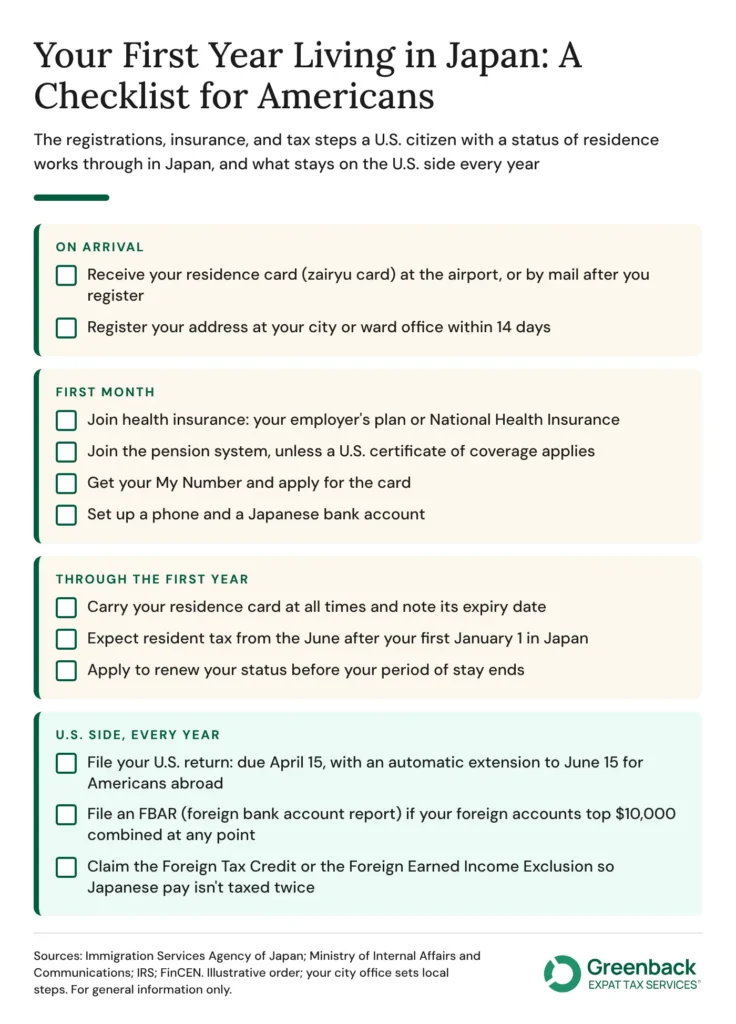
Your first weeks in Japan come with a set of registrations, and each one unlocks the next. Most Americans move through them in roughly the same order.
- Residence card (zairyu card): Issued at the airport when you land at Narita, Haneda, Kansai, Chubu, and some other airports, or mailed to you after you register your address. It’s your main ID in Japan.
- Address registration: Register your address at your city or ward office within 14 days of moving in. This puts you on the resident register and starts your health insurance and pension enrollment.
- My Number: Your 12-digit tax and social security number, assigned after you register. The My Number card also works as your health insurance card.
- Bank account and phone: Most banks ask for a residence card, a Japanese address, and a phone number, and some limit services for newer residents. Many Americans set up a phone plan first.
Opening a Japanese bank account adds a U.S. step too: accounts over the $10,000 combined threshold go on your FBAR each year.
Raising a Family in Japan as an American
Families find Japan safe and child-friendly, with a school system that differs from the U.S. in timing and structure. Japanese schools run six years of elementary school, three of junior high, and three of high school, with the school year starting in April. Foreign children can attend local public schools for free, and many American families choose international schools taught in English, which charge tuition.
A baby born in Japan doesn’t become Japanese by birth unless a parent is a Japanese citizen. American parents register the birth at the city office within 14 days, apply for the child’s status of residence within 30 days, and report the birth to the U.S. embassy or a consulate for a Consular Report of Birth Abroad and a U.S. passport. The child then needs a Social Security number to be claimed on your U.S. return.
Where Americans Live in Japan
Most Americans in Japan live in and around Tokyo, and Tokyo alone is home to about 824,000 of Japan’s 4.28 million foreign residents. Each region offers a different version of life in Japan:
- Tokyo and Yokohama: The most jobs for English speakers, international schools, and the highest rents.
- Osaka and Kyoto: Lower rents than Tokyo, a large food scene, and a slower pace in Kyoto.
- Fukuoka: A smaller, affordable city with a startup scene and short flights to Korea.
- Okinawa: Warm weather and a large U.S. military community, with fewer jobs outside it.
U.S. military members and their families in Japan live under the Status of Forces Agreement, which has its own tax and residency rules, so most of this guide applies to civilians.
What to Watch in 2027 for Americans in Japan
Several of Japan’s immigration and residence rules are changing for 2027. This table shows each change, where it stands, and what it means for Americans living in Japan.
| Change | Status | What it means for you |
|---|---|---|
| Fees for renewing or changing a status of residence | Higher fees took effect October 1, 2026 | Each renewal costs more, and the fee now rises with the length of stay granted |
| Permanent residency guideline | Revised October 1, 2026 | Missed tax, pension, or health insurance payments can count against an application |
| Visa fee schedule | Reviewed each April 1 | U.S. citizens are exempt from visa fees through March 2027; recheck after April 2027 |
| JESTA (Japan Electronic System for Travel Authorization) | Launch planned April 2028 to March 2029 | Family and friends visiting you without a visa will apply online before travel |
Japan’s tax changes for 2027, including a new defense surtax that keeps the combined surtax at 2.1%, are explained in the Japan tax guide.
Your Status of Residence Shapes Life in Japan, and Your U.S. Return Comes With You
For Americans, life in Japan is built on two pieces of planning. The first is the status of residence, which sets how long you stay, what work you do, and when permanent residency becomes possible. The second is taxes: Japan taxes you as a resident from the start, the U.S. keeps taxing you as a citizen, and the credits between them usually keep you from paying twice. Get both in place before you move, and the rest of life in Japan, from the trains to the paperwork, becomes easier to enjoy.

Ready to File Your Tax Return From Japan?
Frequently Asked Questions about Living in Japan as an American
About 70,000 U.S. citizens live in Japan as registered residents, according to the Immigration Services Agency’s count of foreign residents by nationality. The count doesn’t include U.S. military personnel stationed in Japan under the Status of Forces Agreement.
Yes. A U.S. citizen can live in Japan permanently by gaining permanent residency, which generally takes 10 years of continuous residence, or less for Highly Skilled Professionals and spouses of Japanese citizens. Becoming a Japanese citizen is also possible but generally requires giving up other nationalities.
Yes, if you qualify for a status of residence that isn’t based on work, such as a spouse of a Japanese citizen, a student, a business founder, or a remote worker on Japan’s six-month digital nomad visa. People with at least ¥30 million in savings can also stay up to one year on a long-stay status for sightseeing and recreation.
No. Foreigners can buy property in Japan with the same rights as Japanese citizens, but owning a home doesn’t give the right to live there. Stays longer than 90 days still require a status of residence.
Yes. The Social Security Administration pays benefits to U.S. citizens living in Japan. Under the U.S.-Japan tax treaty, Japan taxes those benefits while you’re a resident, and the U.S. also taxes them, with the Foreign Tax Credit usually preventing double tax.
Yes, for many single people. Japan’s household survey puts average living costs for a single working household at about ¥191,500 a month, or about $1,200, so $2,000 covers the average with room to spare. Tokyo rent, family size, taxes, and the exchange rate can push costs higher.
This article is a general guide to living in Japan for U.S. citizens. Immigration rules, fees, and tax figures change, and every situation is different, so confirm current requirements with the Immigration Services Agency, your city office, and your tax professional.



Featured In




