The New College Exodus, and the Tax Bill That Follows It Home



For decades, an American student going abroad often meant a semester in Florence and a suitcase home by Christmas. That picture is changing. More U.S. students are pursuing entire degrees overseas, spending three or four years abroad rather than a semester and, for some, staying to work after graduation.
The numbers behind the shift are substantial
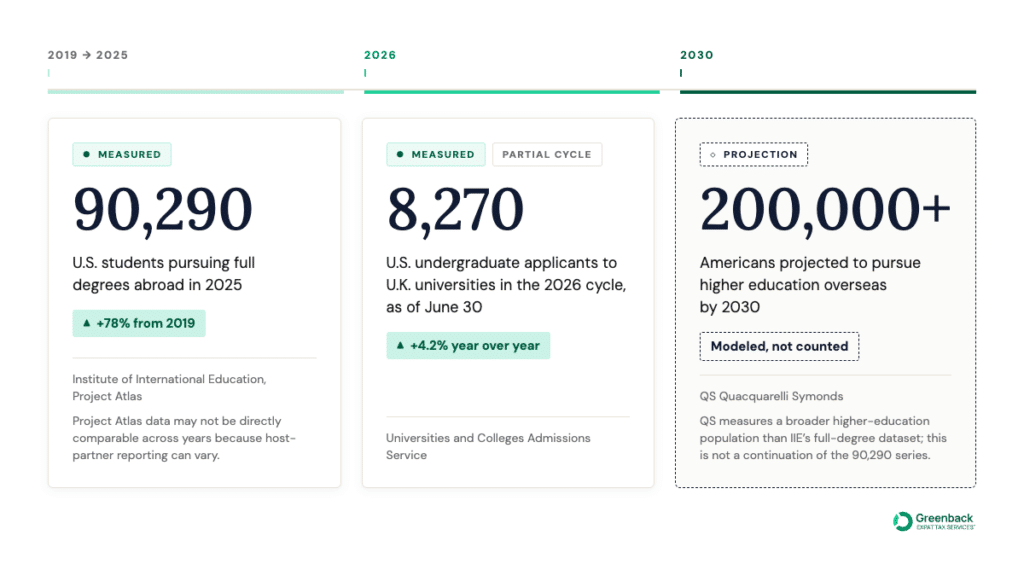
The Institute of International Education (IIE) reported through its Project Atlas initiative that 90,290 U.S. students were pursuing full degrees abroad in 2025, up from 50,723 in 2019, an increase of about 78%.* The total reached 92,105 in 2024 before dipping slightly in 2025, but remains far above its 2019 level.
Other indicators also demonstrate a sustained interest. After the November 2024 US election, international education platform Studyportals recorded a roughly fivefold spike in U.S. searches for overseas degrees. In the United Kingdom, the Higher Education Statistics Agency (HESA) reported a record 23,565 U.S.-domiciled students enrolled in higher education in 2024/25. U.S. undergraduate applications also continued to rise: the Universities and Colleges Admissions Service (UCAS) recorded 8,270 U.S. undergraduate applicants in the 2026 cycle as of June 30, up 4.2% from the year before.
The longer-term outlook points toward further growth. QS Quacquarelli Symonds (QS) estimates that more than 150,000 Americans were pursuing higher education overseas in 2024 and projects that number will exceed 200,000 by 2030. QS also reports that U.S. outbound student mobility grew at an average annual rate of 6% from 2022 to 2025. If that recent pace were to continue, Greenback estimates the number of Americans pursuing higher education overseas could approach 170,000 in 2026.*
Cost is one obvious reason families look abroad. The average annual student budget at a U.S. private nonprofit four-year college now exceeds $65,000. At the same time, many German public universities charge no general tuition, although semester fees and some state- or university-specific tuition charges still apply. Most full-time first-cycle bachelor’s programs in Europe last three or four years, compared with the typical four-year U.S. bachelor’s degree. At the same time, the number of English-taught degree programs outside the traditional English-speaking destinations has expanded sharply, tripling since 2014.
Cost is only part of the appeal. The Institute of International Education points to lower tuition, shorter time to degree, intercultural competency and multilingual skills among the reasons U.S. students pursue full degrees overseas. At the same time, the expansion of English-taught programs has made more universities accessible to American students. Together, those factors have lowered both the financial and practical barriers to earning an entire degree abroad.
*Project Atlas reporting years reflect reporting cycles in individual countries. IIE notes that data may not be directly comparable across years because host-partner reporting can vary.
*The 2026 figure is a Greenback estimate based on the 6% average annual growth rate reported by QS, not a QS forecast for 2026. QS measures a broader population of Americans pursuing higher education overseas than the full-degree students tracked by IIE Project Atlas.
Why a low-cost degree abroad can still trigger a U.S. tax bill
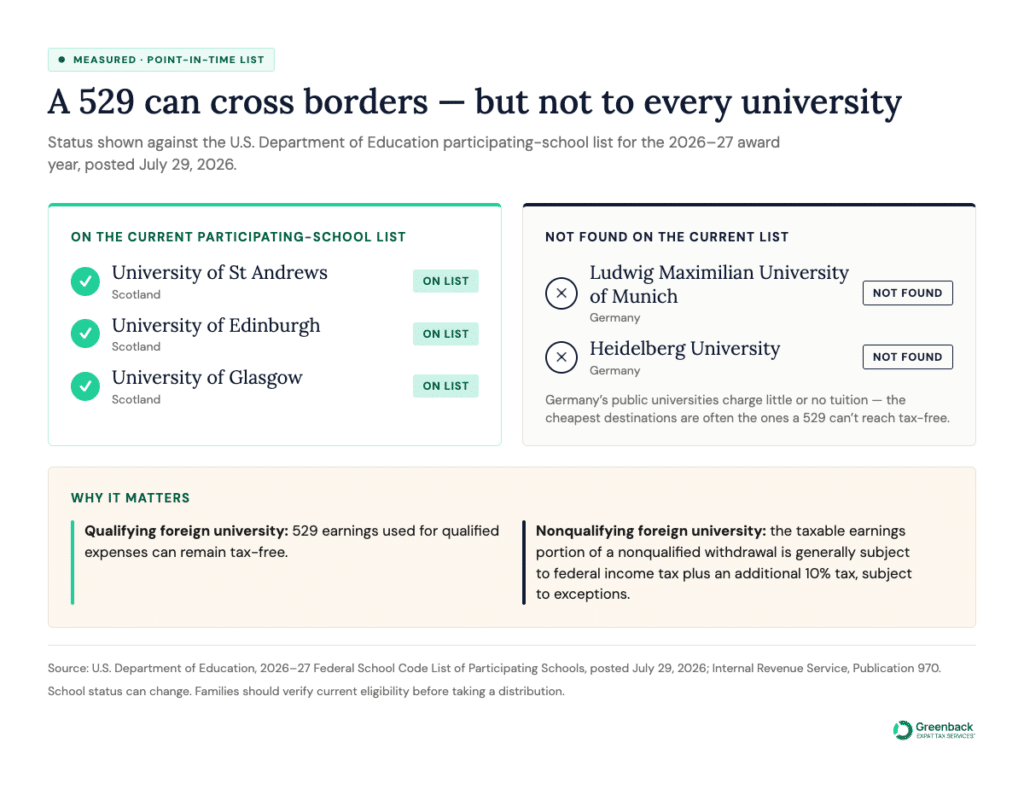
The U.S. tax system follows American students abroad, and one of the first surprises can come from a Section 529 college savings plan (529 plan). Under Internal Revenue Service (IRS) rules, a foreign university must qualify as an eligible educational institution for withdrawals used for higher-education expenses to receive tax-free treatment. For foreign universities, that generally means the school must be eligible to participate in a student-aid program administered by the U.S. Department of Education.
Knowing which universities qualify for tax-free withdrawals can clarify options for families, helping them feel more secure about their choices abroad.
For families drawn to Germany because of its low tuition, that distinction matters. Even if tuition itself costs little or nothing, families may plan to use 529 funds for qualified expenses such as books and, for students enrolled at least half time, eligible room-and-board costs. If the foreign university does not meet the U.S. eligibility requirements, the withdrawal does not receive the same tax-free treatment: the earnings portion of the nonqualified distribution is included in taxable income and is generally subject to an additional 10% federal tax. The family’s original contributions are not taxed again, and exceptions to the additional tax can apply.
The result is an unusual reversal: some of the universities that cost families the least out of pocket can be the ones where their U.S. college savings receive less favorable tax treatment.
Why a foreign bank account can create an unexpected U.S. filing requirement
A second surprise can appear as soon as a student opens a bank account overseas. Under rules administered by the U.S. Treasury Department’s Financial Crimes Enforcement Network (FinCEN), a U.S. person generally must file a Report of Foreign Bank and Financial Accounts (FBAR) when the aggregate value of their foreign financial accounts exceeds $10,000 at any point during the calendar year.
The threshold is aggregate, not per account, and the balance does not have to remain above $10,000. A scholarship payment, student loan disbursement, or transfer from parents can push a student’s foreign accounts over the threshold for even a short period, creating a filing requirement.
That can be easy to miss because an FBAR is not an income-tax return, and filing one does not itself create a tax bill. A student can have little or no taxable income and still be required to file an FBAR. Being claimed as a dependent on a parent’s return does not eliminate the requirement either: a child is generally responsible for their own FBAR, although a parent or guardian must file or sign on the child’s behalf if the child cannot do so.
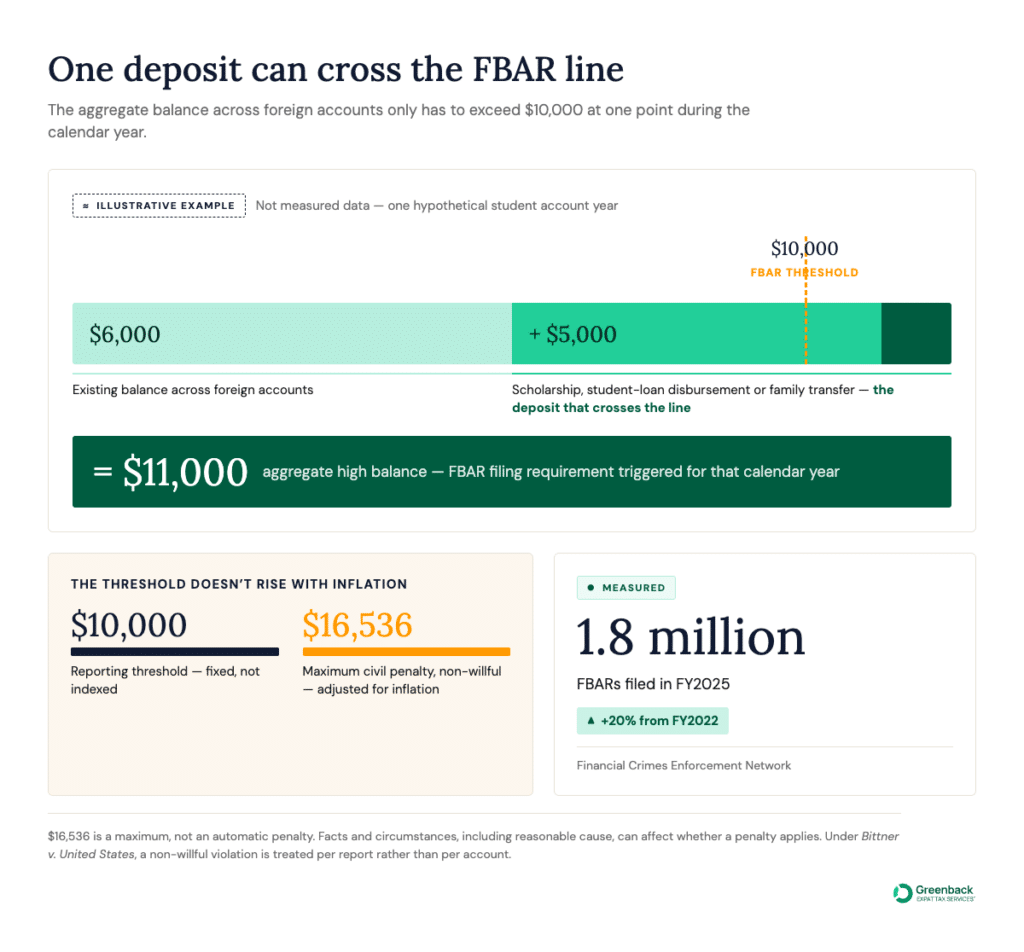
The consequences for missing the filing can be significant. The current inflation-adjusted maximum civil penalty for a non-willful FBAR violation is $16,536. Penalties are not automatic and depend on the facts and circumstances, including whether reasonable cause applies. And following the U.S. Supreme Court’s 2023 decision in Bittner v. United States, a non-willful violation is treated on a per-report rather than per-account basis.
The requirement is becoming increasingly common. FinCEN recorded approximately 1.8 million FBAR filings in fiscal year 2025, up from 1.5 million just three years earlier. While those filings cover all U.S. persons with reportable foreign accounts, not students specifically, the growth illustrates how widespread foreign-account reporting has become.
Read about US Taxes for American Students Studying Abroad
Why the wrong expat tax election can cost a family thousands
For Americans living abroad, avoiding double taxation often comes down to two major tools: the Foreign Earned Income Exclusion (FEIE) and the Foreign Tax Credit (FTC). Both can reduce U.S. tax on foreign earnings, but they work differently, and the choice can affect tax benefits elsewhere on the return.
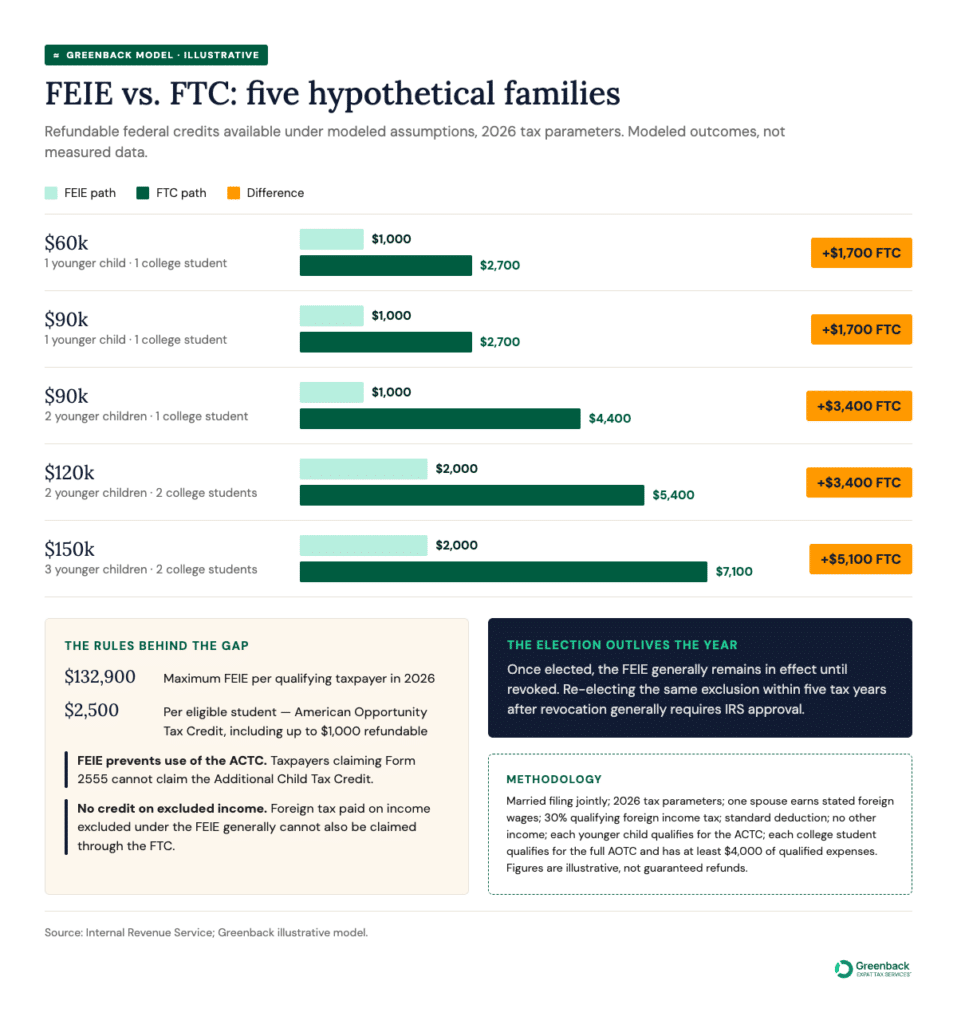
For 2026, the FEIE allows a qualifying taxpayer to exclude up to $132,900 of foreign earned income. But excluded income does not disappear for every other tax calculation. For the American Opportunity Tax Credit (AOTC), which can be worth up to $2,500 per eligible college student, income excluded under the FEIE is added back when determining whether a taxpayer falls within the credit’s income limits.
The treatment of child tax benefits differs more sharply. A taxpayer who claims the FEIE cannot claim the Additional Child Tax Credit (ACTC), the refundable portion of the Child Tax Credit. Foreign taxes attributable to income excluded under the FEIE also generally cannot be used for the FTC.
Greenback modeled five hypothetical families living in a high-tax country where foreign income taxes are sufficient to offset their U.S. income-tax liability through the FTC. In those scenarios, choosing the FTC instead of the FEIE increased the available refundable federal credits by $1,700 for a family with one qualifying younger child, $3,400 for two, and $5,100 for three.
The education credit behaves differently. Each eligible college student in the model could still generate up to $1,000 of refundable AOTC under either approach. The remaining nonrefundable portion of the credit depends on U.S. tax liability and the interaction with other credits, including the FTC.
The result is not that one expat tax strategy is universally better. It is that income, foreign taxes, family composition, and education expenses have to be evaluated together rather than choosing the FEIE based only on how much income it can exclude.
Why the tax exposure can extend long after graduation
A degree abroad does not always end with graduation. For a meaningful share of international students, the country where they study becomes the country where they begin their careers and, in some cases, remain much longer.
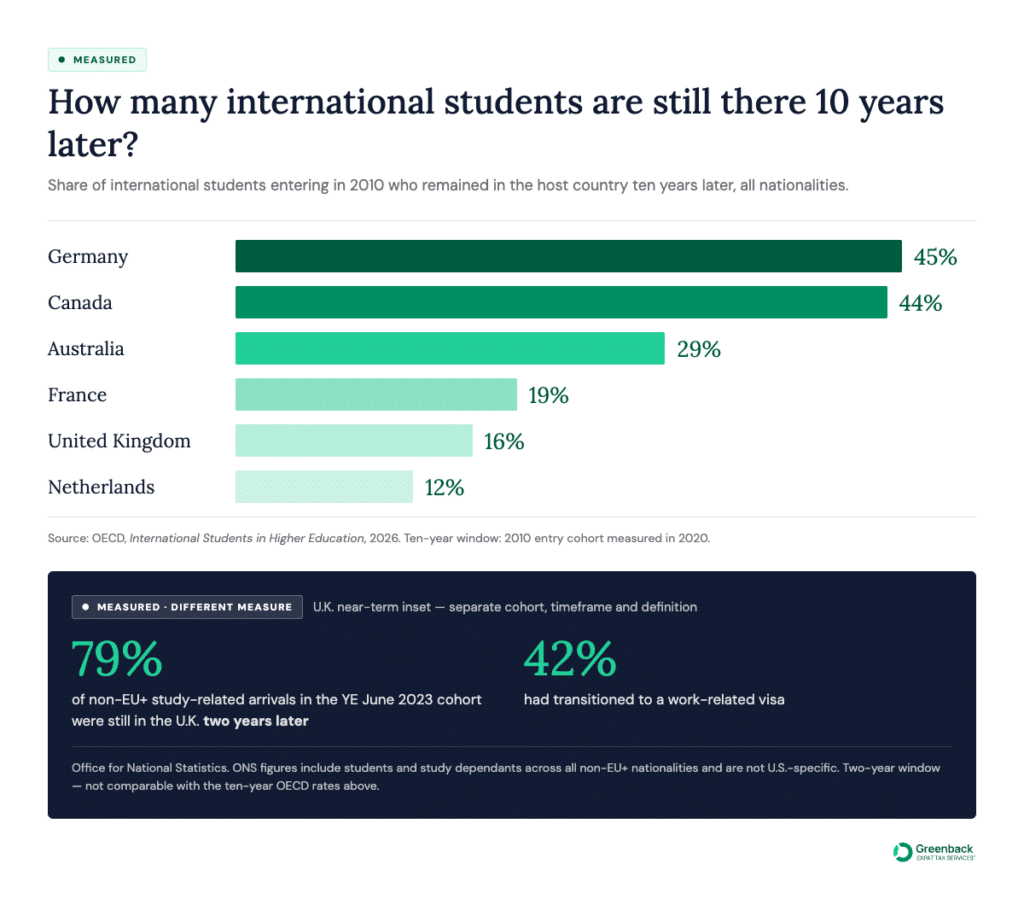
New 2026 research from the Organization for Economic Co-operation and Development (OECD) shows how widely those outcomes vary by destination. Among international students who entered in 2010, an estimated 45% in Germany and 44% in Canada were still in the country ten years later. The comparable retention rate was 29% in Australia, 19% in France, 16% in the United Kingdom and 12% in the Netherlands.
More recent U.K. data show how quickly the transition can begin. The Office for National Statistics (ONS) found that 79% of non-EU+ long-term migrants who arrived on study-related visas in the year ending June 2023 were still in the U.K. two years later. Sixty-two percent had already transitioned to another visa category, including 42% who moved to a work-related visa. The figures include students and study dependants of all non-EU+ nationalities, not U.S. students specifically.
That matters for Americans because graduating does not end their U.S. tax obligations. A student who stays abroad to work moves from a temporary educational decision into the same worldwide income tax and foreign account reporting system that applies to other Americans living overseas.
Post-study immigration policy is also changing. The U.K.’s Graduate visa currently allows most eligible graduates to remain for 2 years after completing their studies, but applications made from January 1, 2027, will generally receive 18 months instead. Doctoral graduates will continue to receive three years.
Learn more about US Tax Rules for Families with Children Studying Abroad
Are families following students abroad?
For students who remain overseas after graduation, another question follows: do their families eventually move too?
Public data do not yet provide a direct answer. We did not identify a public dataset that directly links a parent’s decision to relocate abroad with a child’s enrollment at a foreign university.
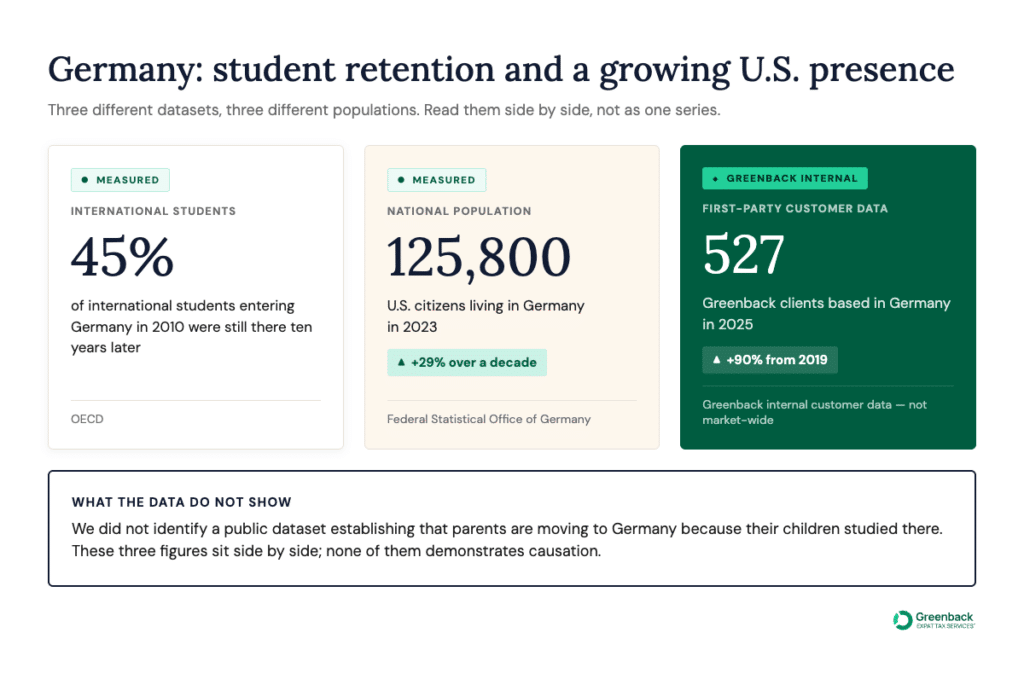
Germany offers one useful window into the broader pattern. Earlier in this report, data from the Organization for Economic Co-operation and Development (OECD) showed that 45% of international students who entered Germany in 2010 were still living there ten years later. At the same time, Germany’s Federal Statistical Office (Destatis) reported approximately 125,800 U.S. citizens living in Germany in 2023, 29% more than a decade earlier.
Greenback’s own customer data show a similar directional trend. The number of Greenback clients based in Germany increased from 277 in 2019 to 527 in 2025, a 90% increase. That growth reflects Greenback’s customer base rather than the U.S. population as a whole. It cannot be attributed specifically to students or their families, but it provides another signal of rising demand for U.S. tax support among Americans living in Germany.
Related Article: Is Continuing Education Tax Deductible for Expats?
More recent migration data point in the same direction. From January through September 2025, approximately 19,300 people moved from the United States to Germany, up 3.4% from the same period a year earlier. Over the same period, about 17,100 people moved from Germany to the U.S., making 2025 the first year since 2021 in which the flow toward Germany was larger.
Taken together, these figures show a growing American presence in a country where international students also have a relatively high long-term retention rate. They do not establish a student-to-parent migration pipeline. Whether overseas education increasingly becomes a catalyst for multigenerational moves remains an open question.
For green-card holders, a degree abroad creates a second set of risks
For U.S. citizens, studying abroad does not affect the right to return to the United States. For lawful permanent residents (LPRs), or green card holders, a multi-year degree overseas raises an additional question: how to spend years abroad without jeopardizing their permanent resident status or delaying eligibility for U.S. citizenship.
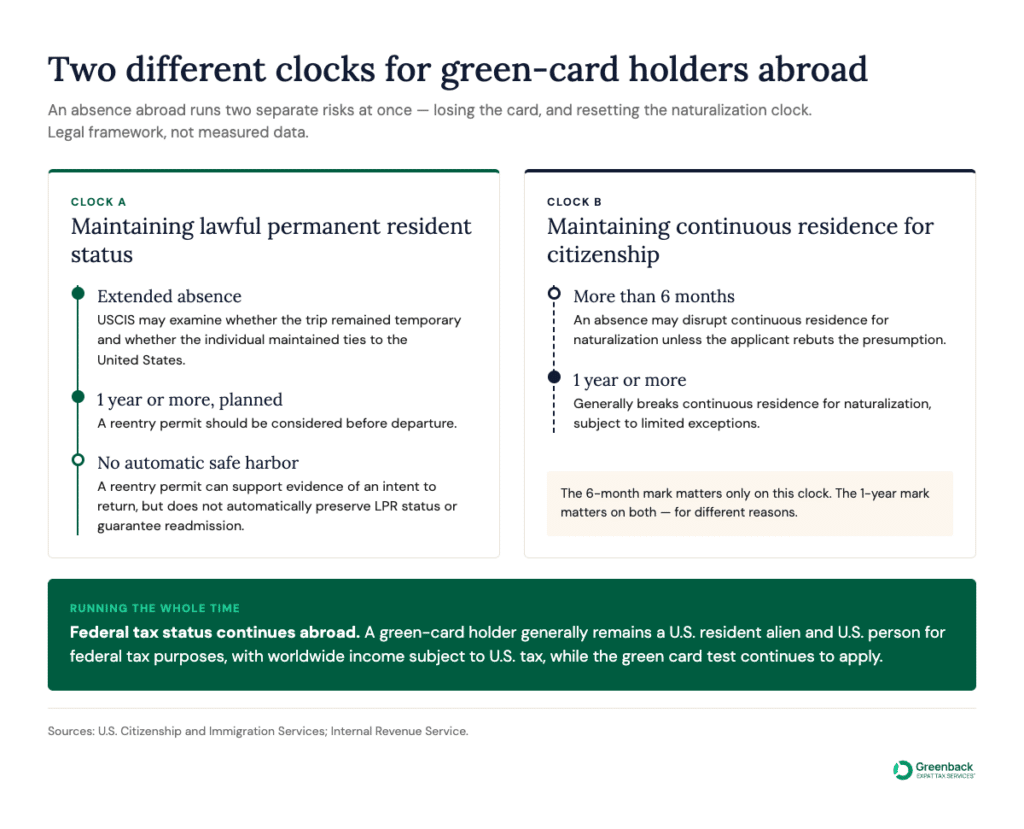
The first issue is maintaining lawful permanent resident status itself. U.S. Citizenship and Immigration Services (USCIS) may determine that an LPR has abandoned permanent residence if an extended stay abroad no longer appears to be temporary. There is no single length of absence that automatically determines abandonment; USCIS can consider the purpose and expected duration of the trip, the circumstances surrounding it, and the person’s continuing ties to the United States.
For a planned absence of a year or more, an LPR may apply for a reentry permit using Form I-131 before leaving the United States. A reentry permit can help demonstrate that an extended absence was intended to be temporary. Still, it does not automatically preserve lawful permanent resident status or guarantee readmission to the U.S.
A separate set of rules applies to continuous residence for naturalization. An absence of more than six months but less than one year may disrupt the continuous residence required for citizenship unless the applicant can overcome that presumption. An absence of one year or more generally breaks continuous residence, subject to limited exceptions. A student completing a multi-year degree abroad could therefore maintain lawful permanent resident status while still delaying their eventual naturalization timeline.
Tax status adds another layer. Under the Internal Revenue Service (IRS) green card test, a lawful permanent resident generally remains a U.S. resident alien for federal tax purposes until that status is formally abandoned, revoked, or otherwise terminated. As a resident alien, the individual is generally taxed on worldwide income in substantially the same way as a U.S. citizen, even while living abroad.
That also means a green-card holder is generally treated as a U.S. person for federal tax purposes, bringing the same kinds of international tax and reporting obligations discussed elsewhere in this report into play.
For permanent-resident families considering an overseas degree, immigration and tax planning need to happen together before the student leaves the United States.
Key takeaways for families considering a degree abroad
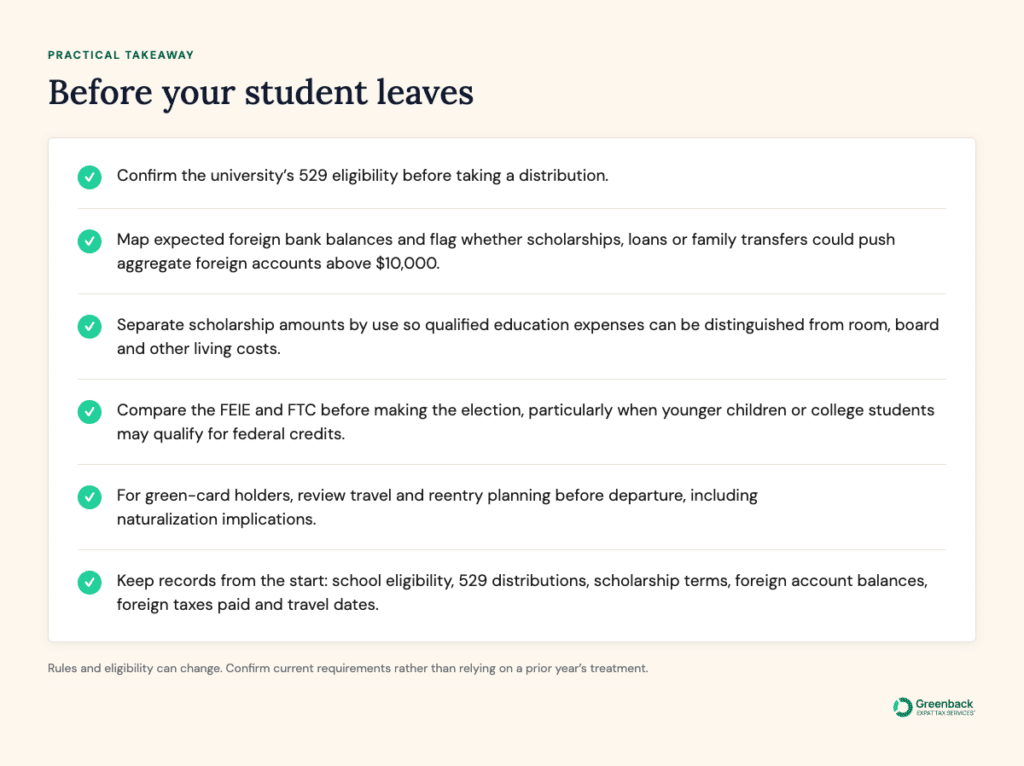
Verify the university’s 529 eligibility before taking a distribution.
A foreign university must meet U.S. eligibility requirements for 529 withdrawals used for qualified higher-education expenses to receive tax-free treatment. School status can change, so families should confirm current eligibility before moving money.
Watch the $10,000 foreign-account threshold.
A student may have an FBAR filing requirement if the aggregate value of their foreign financial accounts exceeds $10,000 at any point during the calendar year. A scholarship payment, a loan disbursement, or a family transfer can be enough to cross the threshold temporarily.
Compare the Foreign Earned Income Exclusion and Foreign Tax Credit as part of the full family return.
The Foreign Earned Income Exclusion can affect other provisions on the return, including the Additional Child Tax Credit. At the same time, foreign taxes tied to excluded income generally cannot also generate a Foreign Tax Credit. The better result depends on income, foreign taxes, family composition, and available credits.
Separate scholarship funding for tuition from funding for living costs.
Scholarships can be tax-free when used for qualifying education expenses, whereas amounts used for nonqualified expenses, such as room and board, may be taxable.
Plan long absences before a green-card holder leaves the United States.
For lawful permanent residents, extended time abroad can affect both permanent-resident status and the separate continuous-residence requirement for naturalization. Absences of more than six months can affect the naturalization clock, while longer trips may also require planning around reentry documentation.
Check the rules before the money moves or the election is made.
Many of the issues in this report are easier to manage prospectively than after the fact. Foreign-school eligibility, account balances, scholarship use, and expat tax elections can all have consequences once a transaction or filing decision has already been made.
About this report
This report was produced by Greenback Tax Services, a U.S. expat tax preparation firm. Research was conducted from June through August 2026.
The analysis combines public data from the Institute of International Education (IIE), Higher Education Statistics Agency (HESA), Universities and Colleges Admissions Service (UCAS), QS Quacquarelli Symonds (QS), Organization for Economic Co-operation and Development (OECD), U.K. Office for National Statistics (ONS), Federal Statistical Office of Germany (Destatis), U.S. Department of Education, Internal Revenue Service, Financial Crimes Enforcement Network and U.S. Citizenship and Immigration Services. It also incorporates Greenback internal customer data and an illustrative Greenback tax model.
Several measures in the report describe different populations and should not be treated as directly interchangeable. IIE Project Atlas tracks U.S. students pursuing full degrees overseas and notes that figures may not be directly comparable across reporting years because host-partner reporting can vary. QS uses a broader measure of Americans pursuing higher education overseas; Greenback’s 2026 estimate based on the recent QS growth rate is an extrapolation, not a QS forecast for that year. OECD and ONS retention measures cover international students generally rather than U.S. nationals specifically.
Greenback’s Germany customer figures describe Greenback’s own client base and are not a measure of the U.S. population in Germany. The FEIE-versus-FTC scenarios are hypothetical illustrations based on stated assumptions and 2026 tax parameters and should not be interpreted as expected outcomes for an individual taxpayer.
School eligibility, tax rules, visa policies and immigration requirements can change. This report is provided for general informational purposes and is not individual tax, legal or immigration advice.
Greenback Tax Services · greenbacktaxservices.com · Media contact: [email protected]
Sources Cited
Enrollment, demand and cost
Institute of International Education (IIE), Project Atlas — “U.S. Students Pursuing Full Degrees.” Historical and current full-degree figures; methodology notes on reporting years and host-partner comparability.
Institute of International Education (IIE) — “Project Atlas reports more than 50,000 U.S. students pursued a degree abroad.” Context on motivations including tuition, time to degree, intercultural competency and multilingual skills.
Studyportals — “What happened to student demand during President Trump’s inauguration week?” Fivefold U.S. overseas-degree search spike following the November 2024 election result.
Higher Education Statistics Agency (HESA), Higher Education Student Statistics: UK 2024/25, Figure 11 source data. U.S.-domiciled student enrollment.
Universities and Colleges Admissions Service (UCAS) — International Applicant Insights, July 22, 2026. 8,270 U.S. applicants at the June 30 point in the 2026 cycle, +4.2% year over year.
QS Quacquarelli Symonds — Global Student Flows: United States, 2026. U.S. outbound mobility, 2024 baseline, recent growth rate and 2030 forecast.
College Board — Trends in College Pricing and Student Aid 2025. 2025/26 U.S. college prices and student budgets.
German Academic Exchange Service (DAAD) — “Costs of education and living.” German state-university tuition rules and exceptions.
European Education Area — “Duration of degree studies in Europe.” Duration of first-cycle bachelor’s programs.
Studyportals / British Council — English-taught programmes outside the “Big Four.” Growth in English-taught bachelor’s and master’s programs since 2014.
529 plans and education expenses
Internal Revenue Service — Publication 970, Tax Benefits for Education. Eligible educational institutions, qualified tuition programs, AOTC and scholarship treatment.
Internal Revenue Service — “529 Plans: Questions and answers.” 529 eligible-institution requirements.
U.S. Department of Education, Federal Student Aid — 2026–27 Federal School Code List of Participating Schools, August 2026. School-level participation verification; posted July 29, 2026.
Foreign bank accounts and FBAR
Financial Crimes Enforcement Network — “Report Foreign Bank and Financial Accounts.” $10,000 aggregate threshold and basic FBAR requirements.
Financial Crimes Enforcement Network — “Filing for Child.” Responsibility for a child’s FBAR.
Financial Crimes Enforcement Network — Year in Review for Fiscal Year 2025. FY2022–FY2025 FBAR filing volumes.
31 C.F.R. § 1010.821 — Penalty adjustment and table. Current inflation-adjusted FBAR civil-penalty amounts.
U.S. Supreme Court — Bittner v. United States, 598 U.S. 85 (2023). Non-willful FBAR violations assessed on a per-report rather than per-account basis.
Foreign Earned Income Exclusion, Foreign Tax Credit and education credits
Internal Revenue Service — “Figuring the foreign earned income exclusion.” 2026 FEIE limit of $132,900.
Internal Revenue Service — Instructions for Form 2555. ACTC restriction, foreign tax credit interaction and FEIE mechanics.
Internal Revenue Service — “Choosing the foreign earned income exclusion.” FEIE/FTC and ACTC interactions.
Post-study retention and migration
Organization for Economic Co-operation and Development — International Students in Higher Education, 2026. Comparable ten-year retention rates across six countries.
U.K. Office for National Statistics — “Reason for international migration, international students update: February 2026.” Two-year retention and visa-transition data.
Germany case study
Federal Statistical Office of Germany (Destatis) — “Immer weniger Deutsche ziehen in die Vereinigten Staaten,” October 4, 2024. 125,800 U.S. citizens in Germany in 2023, +29% over ten years.
Federal Statistical Office of Germany (Destatis) — “17,8 % weniger Fortzüge in die USA von Januar bis September 2025,” November 10, 2025. 19,300 moves U.S.→Germany and 17,100 Germany→U.S. through September 2025.
Greenback Tax Services internal customer data. Clients based in Germany: 277 in 2019; 527 in 2025.
Lawful permanent residents
U.S. Citizenship and Immigration Services — Maintaining Permanent Residence. Abandonment of lawful permanent resident status and extended absences.
U.S. Citizenship and Immigration Services — International Travel as a Permanent Resident. Reentry permit and travel considerations.