Canada’s EU Associate Membership Depends on Citizenship for Americans There


European Commission President Ursula von der Leyen proposed on September 16, 2026, that Canada become the first associate member of the European Union, and Prime Minister Mark Carney welcomed the idea the next day. For Americans living in Canada, nothing changes today, and no version of the plan changes your obligation to file a U.S. return.
Canada is not joining the EU. “Associate member” has no definition in the EU treaties; a deal would likely require agreement from every EU government, and on September 22, Canada’s ambassador to the EU said the final arrangement may not bear that name. The one personal benefit discussed so far, easier movement between Canada and Europe, has been framed around Canadian citizens, which makes your citizenship the first thing to check.
Canadian Citizenship Decides Who Could Benefit
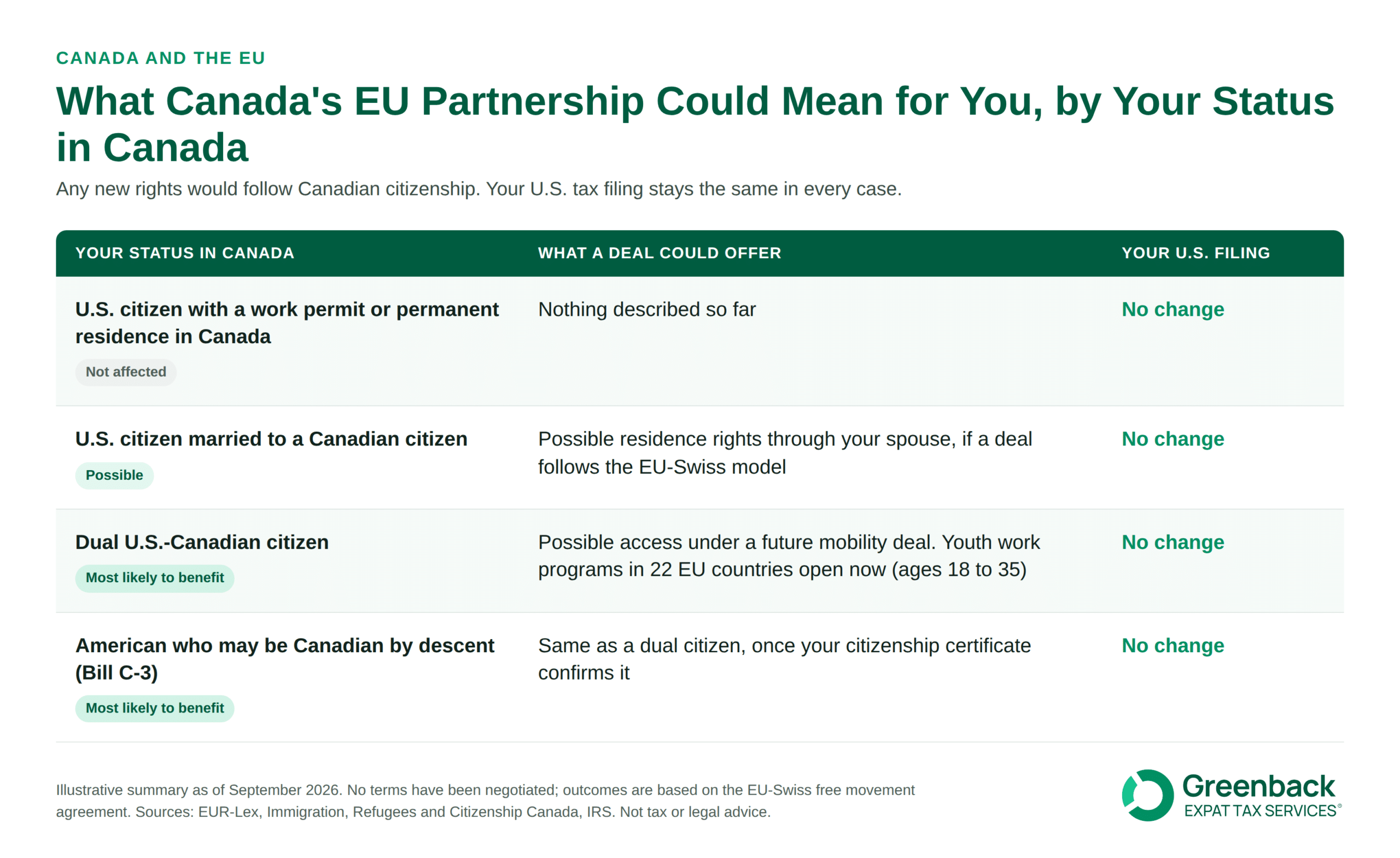
An association deal can extend the right to live and work in Europe without making anyone an EU citizen. Canadian PM Carney has called for making it easier for young Canadians and Europeans to “work, study, and live” on either side. No terms exist yet, so each outcome below is based on precedent and could change in negotiation:
- U.S. citizen with a work permit or permanent residence in Canada: Nothing described so far would reach you.
- U.S. citizen married to a Canadian citizen: You could gain residence rights through your spouse if a deal follows the EU’s Swiss model.
- Dual U.S.-Canadian citizen: You could gain access under a future mobility deal, and Canada’s youth work programs in Europe are open to you now.
- Americans who may be Canadian by descent: You would be in the same position as a dual citizen once confirmed. Our guide to Canadian citizenship by descent explains who qualifies.
In all four cases, your U.S. filing stays the same.
The Swiss Deal Covers Citizens and Their Families
The closest precedent is the EU’s free movement agreement with Switzerland. It gives EU and Swiss nationals the right to live and work in each other’s territory, and gives their family members residence rights “irrespective of their nationality,” according to EUR-Lex. If a Canada deal borrowed that design, rights would follow Canadian citizenship, and a spouse’s citizenship could matter as much as your own.
Bill C-3 Extended Citizenship by Descent
Canada’s Bill C-3 took effect on December 15, 2025, and removed the first-generation limit on citizenship by descent. Immigration, Refugees and Citizenship Canada says that, in most cases, a person born outside Canada before that date to a Canadian parent is automatically a citizen and must apply for a citizenship certificate to confirm their citizenship.
Canada Is Not Joining the EU Under This Plan
Von der Leyen made the proposal in her State of the Union address. Carney said on September 14 that Canada is “not looking to become a member” of the EU, and three days later told the European Parliament that any enhanced partnership would go to a vote in Canada’s Parliament.
Legal analysts expect an association agreement, which requires unanimous approval from EU member states and the consent of the European Parliament. Several governments were reportedly angry that they were not consulted first, and Germany suggested reconsidering the term, according to the Council on Foreign Relations. President Trump said he would impose “very serious tariffs” on Europe if he viewed the move as “a hostile act,” Reuters reported.
Trade, Tech and Defense Lead the Talks
| Being discussed | Not on offer |
|---|---|
| Critical minerals and energy | Votes in the EU Council |
| AI, research and innovation | Seats in the European Parliament |
| Defense production and the Arctic | EU citizenship |
| Easier youth mobility | Full EU membership |
The Name May Change Before the October Summit
On September 22, Canada’s ambassador to the EU, Jonathan Wilkinson, told POLITICO he is “less fussed about what we end up calling it.” Several agreements are planned for the EU-Canada summit in October, with the wider package targeted within 12 months.
Three steps would have to happen before any of these changes where you can live or work:
- A negotiating mandate: EU governments authorize talks with Canada.
- A mobility chapter: Written terms say who can live and work where.
- Final approvals: EU governments agree unanimously, the European Parliament consents, and Canada’s Parliament votes yes.
Your U.S. Filing Stays the Same Either Way
The United States taxes its citizens on worldwide income, regardless of where they live, according to the IRS. That citizenship-based taxation is set by U.S. law, and no agreement between Canada and the EU can change it. The U.S.-Canada tax treaty stays in force, and so do the reporting thresholds set by the IRS:
- FBAR: Required when your foreign accounts total more than $10,000 at any point in the year.
- Form 8938: Required for single filers abroad above $200,000 at year-end or $300,000 at any time, and $400,000 or $600,000 for joint filers.
If you later move from Canada to an EU country, the foreign earned income exclusion or the foreign tax credit generally keeps the same income from being taxed twice. EU residents should also know the EU rule requiring U.S. banks to be locally licensed to hold EU clients’ accounts.
Leaving Canada also triggers Canada’s departure tax, which applies to a deemed sale of certain property when you stop being a resident. RRSPs and TFSAs are excluded from that deemed sale but have their own U.S. rules, which are covered in our RRSP withdrawal and TFSA guides. Our guide to U.S. expat taxes in Canada covers the rules that apply today.
Canada and the EU Have Built Ties Since 2017
The earlier milestones come from Global Affairs Canada and the European Parliament.
| Date | Milestone |
|---|---|
| September 2017 | CETA trade agreement provisionally in force |
| June 23, 2025 | Security and Defense Partnership signed |
| February 14, 2026 | Canada signs on to the EU’s SAFE defense instrument |
| March 11, 2026 | European Parliament backs closer EU-Canada cooperation |
| September 16, 2026 | Von der Leyen proposes associate membership |
| September 22, 2026 | Canada’s ambassador says the name may change |
| October 2026 | EU-Canada summit, with several agreements planned |
Frequently Asked Questions
No. Canada is not an EU member, and the September 16 proposal calls for an undefined form of associate status.
No. The status does not yet exist in EU law, nothing has been signed, and Canada’s ambassador has said the final arrangement may use a different name.
EU associate membership is a proposed status, not yet defined in the EU treaties, for a partnership deeper than a trade deal. Legal analysts say it would carry no Council votes, no European Parliament seats, and no EU citizenship.
Schengen is open to EU countries and a few European partners, and Canada is not part of it. Canadians and Americans can already visit Schengen countries without a visa for up to 90 days, and both will need an ETIAS travel authorization costing EUR 20 once it starts, according to the EU.
Yes, several. The CETA trade agreement has been provisionally in force since September 2017, and Canada joined the EU’s SAFE defense instrument in February 2026.
Yes, within the age limits of 18 to 35 that vary by country. International Experience Canada offers Canadian citizens temporary work permits in 22 of the 27 EU countries. Wider live-and-work rights would depend on a future deal.
Yes. The U.S. taxes citizens on worldwide income wherever they live, so your Form 1040, FBAR, and Form 8938 obligations follow you to any EU country.
Your U.S. Filing Is Covered, Whatever the EU Decides
If you hold both passports, or just learned under Bill C-3 that you might, your U.S. return comes with you. Our accountants have deep expertise in U.S. tax filing for Americans in Canada, and no matter how late, messy, or complex your return may be, we can help.

Your U.S. Taxes Done Right, Wherever You Live Next
This article describes a proposal that has not been formalized or negotiated. Its terms may change, or it may not proceed. All figures for current law reflect rules in effect as of publication. The information in this article is for general informational purposes only and does not constitute tax, legal, or financial advice. Tax rules are complex and change frequently. Consult a qualified tax professional regarding your specific situation before taking any action.



Featured In





