IRS Interest Rates and What They Cost You on Unpaid Taxes


The IRS charges 7% annual interest on unpaid individual tax and pays 7% on refunds it holds too long. That is the rate for the current quarter, and it stays at 7% for the quarter beginning October 1, 2026. The rate is compounded daily and reset every three months. On a $4,000 balance carried for six months, 7% works out to about $143.
Interest shows up in one of three situations:
- A balance owed on a filed return: interest starts on the original due date of the tax, not the date you filed or the date a notice arrived.
- A late or catch-up filing: each prior-year return accrues interest from its own original due date until the tax is paid in full.
- A delayed refund: the same rate runs in your favor once the IRS holds your refund past its administrative window.
Below are the current rate, every quarterly rate since 2022, what interest costs on a range of real balances, and where interest ends and penalties begin.
The Current IRS Interest Rate
Individual overpayments and underpayments both carry a 7% annual rate, compounded daily, and corporate rates sit above and below it. The IRS confirmed on August 21, 2026, that these figures apply from October 1 through December 31, unchanged from the previous quarter.
| Who and what | Annual rate |
|---|---|
| Individuals, overpayments and underpayments | 7% |
| Corporations, underpayments | 7% |
| Corporations, overpayments | 6% |
| Corporate overpayment above $10,000 | 4.5% |
| Large corporate underpayments | 9% |
Almost every individual taxpayer uses the 7% line, including sole proprietors and single-member LLC owners. If you owe the IRS money, or the IRS owes you a late refund, 7% is your number. It applies whether you file a standard Form 1040 from the U.S. or file as an American abroad.
Where the Rate Comes From
The IRS does not set the rate by policy. It takes the federal short-term rate, a figure the Treasury determines each month from the yields on short-dated U.S. government debt, and adds a fixed number of percentage points depending on who you are and which direction the money is flowing.
| Category | Formula |
|---|---|
| Individuals, both directions | Short-term rate plus 3 points |
| Corporations, underpayments | Plus 3 points |
| Corporations, overpayments | Plus 2 points |
| Corporate overpayment above $10,000 | Plus 0.5 of a point |
| Large corporate underpayments | Plus 5 points |
One detail explains why a quarterly rate moves less often than the name suggests. The short-term rate is rounded to the nearest full percent before points are added, as set out in each quarterly IRS ruling. A drift of a few tenths of a percentage point changes nothing, so the individual rate has held at 7% since July and can remain there for several more quarters. The IRS publishes each new rate roughly five to six weeks before the quarter it applies to.
Every Quarterly Rate Since 2022
Interest on an old balance is not calculated at today’s rate. Each quarter the balance was outstanding, accrues at the rate in force during that quarter, so a balance from 2024 carries 8% for that stretch and 7% for the current one. The figures below come from the IRS, plus the fourth quarter of 2026 from its August announcement.
Corporate underpayments carry the same rate as individuals, so the corporate column below is the overpayment rate, which is the one that differs.
Rates From 2024 Onward
| Quarter | Individuals | Corporations |
|---|---|---|
| Q4 2026 (Oct to Dec) | 7% | 6% |
| Q3 2026 (Jul to Sep) | 7% | 6% |
| Q2 2026 (Apr to Jun) | 6% | 5% |
| Q1 2026 (Jan to Mar) | 7% | 6% |
| Q4 2025 (Oct to Dec) | 7% | 6% |
| Q3 2025 (Jul to Sep) | 7% | 6% |
| Q2 2025 (Apr to Jun) | 7% | 6% |
| Q1 2025 (Jan to Mar) | 7% | 6% |
| Q4 2024 (Oct to Dec) | 8% | 7% |
| Q3 2024 (Jul to Sep) | 8% | 7% |
| Q2 2024 (Apr to Jun) | 8% | 7% |
| Q1 2024 (Jan to Mar) | 8% | 7% |
What the Rate Has Done to a Real Balance
A $5,000 balance left unpaid since January 2022 has accrued nearly $2,000 in interest by the end of 2026, and the steepest stretch of that climb is in 2024, when the rate was 8% for all four quarters.
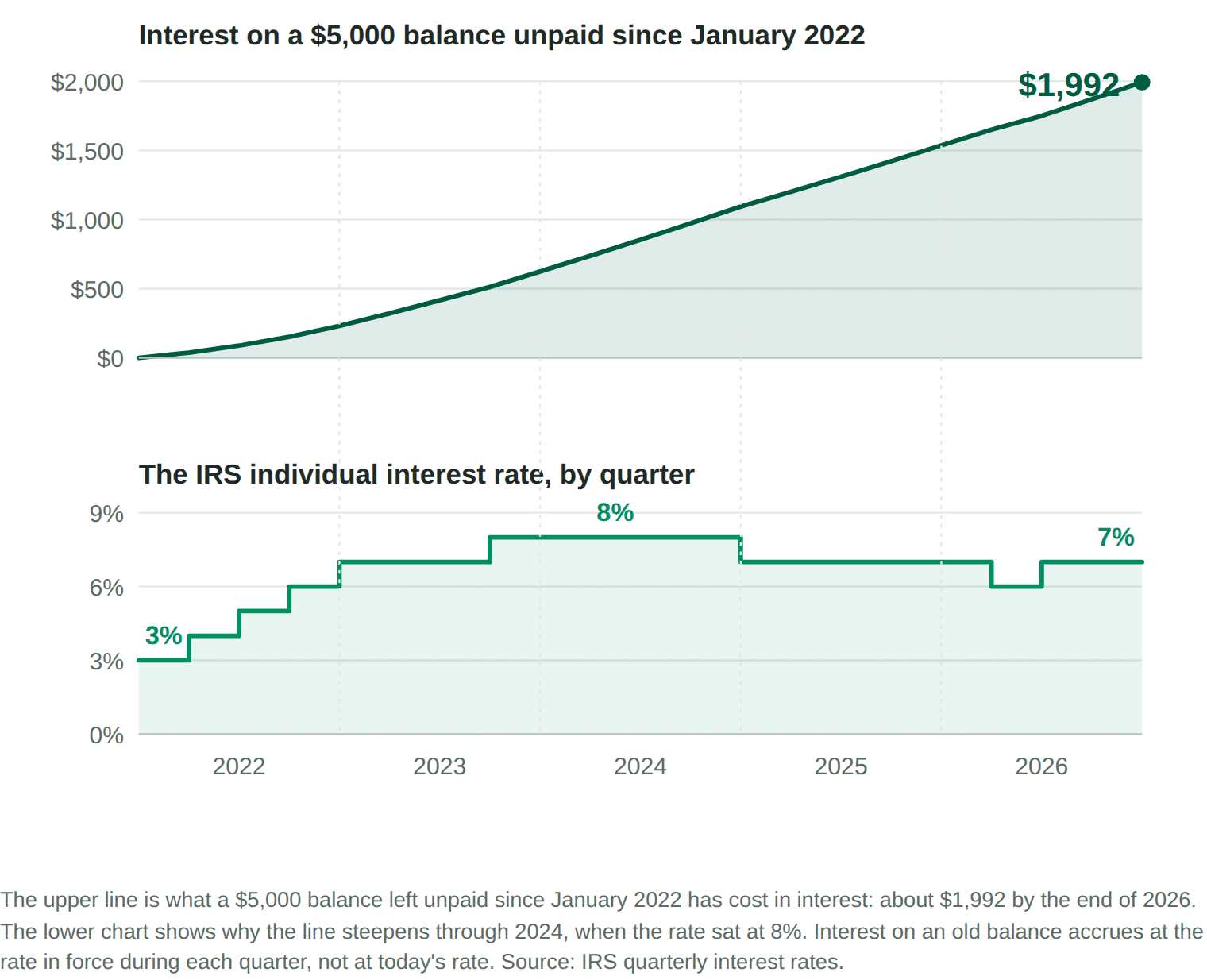
Further back, the rate rose every quarter of 2022, from 3% in the first quarter to 4%, then 5%, then 6%. In 2023, it was 7% for the first three quarters and 8% for the fourth quarter.
What Interest Costs on Your Balance
Daily compounding means each day’s interest is added to the balance, so the next day’s interest is calculated on a slightly larger figure. At 7%, the effect stays modest. Interest is close in size to the failure-to-pay penalty and well below the failure-to-file penalty when the return itself was late.
What 7% Costs on Common Balances
Here is what 7% costs if nothing is paid in the meantime:
| Balance owed | After 3 months | After 6 months | After 12 months |
|---|---|---|---|
| $1,000 | $18 | $36 | $73 |
| $2,500 | $44 | $89 | $181 |
| $5,000 | $88 | $179 | $363 |
| $10,000 | $176 | $357 | $725 |
| $25,000 | $440 | $893 | $1,813 |
Two things worth knowing about those numbers:
- Interest rarely arrives alone: a $4,000 balance unpaid for six months accrues about $143 of interest and about $120 of failure-to-pay penalty, so the two run close together. If the return was also late, the filing penalty reaches its 25% ceiling at $1,000 and dwarfs both.
- Partial payments apply immediately: the daily calculation applies to whatever remains, so no minimum payment is needed to start slowing it down. A payment sent with Form 1040-V or made directly through the IRS stops that portion from accruing the day it posts.
Interest on an IRS Payment Plan
An IRS payment plan does not carry a separate loan rate. The same quarterly rate continues to run on the unpaid balance for the life of the agreement, so a plan spreads the cost rather than lowering it. What changes with the plan is the penalty.
- The failure-to-pay penalty halves: the IRS drops it from 0.5% to 0.25% a month once an agreement is approved and you filed on time.
- What that saves: about $60 on a $4,000 balance across six months, and less if you are paying it down.
- Interest continues regardless: 7% keeps running on whatever remains, so paying above the minimum is the only lever on the interest itself.
If You Cannot Pay the Balance at All
A payment plan assumes the balance is payable within a given time. Where it is not, an offer in compromise settles the liability for less than the full amount, and interest stops on the portion that is forgiven. The bar for acceptance is high, and the application is detailed, so it is worth checking eligibility before counting on it.
Interest and Penalties Are Different Charges
Interest and penalties are calculated differently and appear as separate lines on an IRS notice. Interest at 7% compounds daily on the tax. The failure-to-pay penalty runs at 0.5% a month and the failure-to-file penalty at 5% a month, each capped at 25%, with the filing penalty dropping to 4.5% in any month the payment penalty also applies.
The Three Charges Side by Side
| Charge | Rate | Ceiling |
|---|---|---|
| Interest on unpaid tax | 7% annual, compounded daily | None |
| Failure to pay | 0.5% of unpaid tax per month | 25% |
| Failure to pay, after a notice of intent to levy | 1% per month if unpaid 10 days after the notice | 25% |
| Failure to file | 5% of unpaid tax per month | 25% |
| Failure to file, returns more than 60 days late | Minimum $525, or 100% of the underpayment if less | Applies to returns due after December 31, 2025 |
Which Charges Can Be Reduced
The distinction between the two decides what is worth challenging.
1. Penalty Relief
Penalties can be reduced for reasonable cause, and first-time relief is available to filers with a clean recent record. A request is made on Form 843 or by signed letter. Because interest accrues on penalties as well as on tax, removing a penalty removes the interest that was accruing on it.
2. Interest Reduction
Interest generally cannot be reduced for reasonable cause. The IRS lowers it only when the underlying tax or penalty is reduced, or when an unreasonable IRS error or delay caused the charge. That makes the underlying tax figure the first thing to check: an amended return that lowers the tax also lowers all three charges.
When the IRS Pays You Interest
The rate runs both ways. When the IRS holds a refund beyond its administrative window, typically 45 days, it pays interest on the overpayment at the same 7% individual rate. It is a small figure on a typical refund, but it is worth expecting rather than treating as an error.
- The clock starts on the due date: for a return filed on time, the 45 days run from the filing deadline, so filing early does not start the clock early.
- A held refund still earns it: a transcript showing IRS code 570 means the refund is frozen pending review, and the 45-day clock keeps running while it is.
- Refund interest is taxable: it counts as income in the year you receive it.
- It arrives on Form 1099-INT: once it reaches $10 or more.
Filing Late From Abroad
Interest accrues from the regular April due date, regardless of which extension you use. Americans abroad get more time to file than taxpayers at home, but none of that extra time is extra time to pay. In a multi-year catch-up, interest for each year starts at that year’s April deadline, which is why the oldest return usually carries the largest figure.
What an Extension Does to the Interest Clock
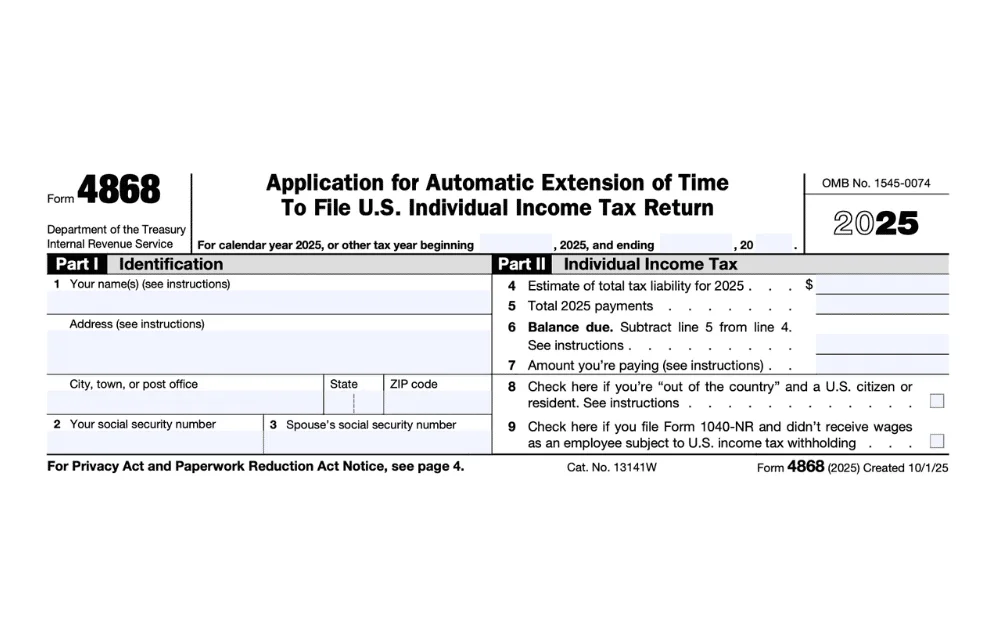
U.S. citizens and residents abroad receive an automatic two-month extension to June 15 and can request an extension to October 15 with Form 4868; a further extension beyond October 15 is available in narrow circumstances. The full set of dates sits in the expat tax deadlines guide. None of those extensions moves the payment date.
One exception is specific to filers abroad, and it is worth knowing:
- The automatic two-month extension moves one charge: the IRS assesses the failure-to-pay penalty from June 15 rather than April 15 for taxpayers who qualify, while interest still runs from April.
Interest on a Multi-Year Catch-Up
- Each year runs from its own April due date: the oldest year carries the most interest, at the rates in force back then rather than today’s.
- The total is often smaller than expected: the Foreign Tax Credit offsets U.S. tax against foreign tax already paid and frequently covers the U.S. liability in full, leaving little or no balance to accrue on.
- Where a balance does exist: Streamlined Filing Procedures are the usual route back to current for filers whose failure to file was non-willful, and the penalty relief they carry is usually the larger saving.
- Self-employed filers: check your estimated tax payments, since an underpaid quarter carries a separate charge computed at the same underpayment rate.
Frequently Asked Questions
At the current 7% annual rate, compounded daily, interest accrues at roughly 0.58% per month. On a $4,000 balance, that is about $23 in the first month, with the amount rising slightly each month as the balance grows.
Generally no. Interest is reduced only when the tax or penalty behind it is reduced, or when an unreasonable IRS error or delay caused the charge. Penalties are the part that can be reduced for reasonable cause, and doing so lowers the interest that was accruing on them.
Yes. Interest continues to accrue daily on any amount that remains unpaid. An approved plan halves the failure-to-pay penalty but does not pause interest, so paying more than the minimum shortens the total cost.
Each quarter accrues at the rate in force at the time. A balance carried since 2024 accrues at 8% for those quarters and 7% for the current one. The table and chart above carry every quarterly rate since 2022.
Each year accrues from its own original April due date, so the oldest year carries the most. Greenback’s accountants calculate the balance year by year, and the Foreign Tax Credit often leaves little or no balance on which interest can accrue.
From the original due date of the tax. Filing later, or extending to June 15 or October 15, does not move that date. Paying is what stops the accrual.
What to Do Next
Interest stops the day the tax is paid, and nothing else about it is negotiable. Which move comes first depends on where you are:
- A notice just arrived: check the tax figure before you pay anything, because interest and penalties are both calculated from it, and an error in the tax carries through to all three lines. The CP14 guide walks through each line.
- You are current but carrying a balance: pay whatever you can now rather than waiting to pay it all. The daily calculation applies to the remaining balance, so a partial payment immediately reduces tomorrow’s interest, and an approved payment plan halves the failure-to-pay penalty on top of that.
- You are several years behind: file first, pay second. The failure-to-file penalty is ten times the monthly rate of the failure-to-pay penalty, and filing the return stops it.
Greenback’s U.S. accountants work through the late years to calculate what each one really costs once the Foreign Tax Credit is applied, and tell you where you stand before you commit to anything. You can see what that costs on the pricing calculator before you start.

This article is for general informational purposes only and does not constitute tax, legal, or financial advice. IRS interest rates reset quarterly, and the current figures apply to the quarter beginning October 1, 2026. Greenback is a U.S. tax preparation firm with expertise in federal returns for taxpayers at home and abroad. Consult a qualified tax professional about your own situation before taking any action.


Featured In





