Cities and States Leading the Passport Renewal Surge

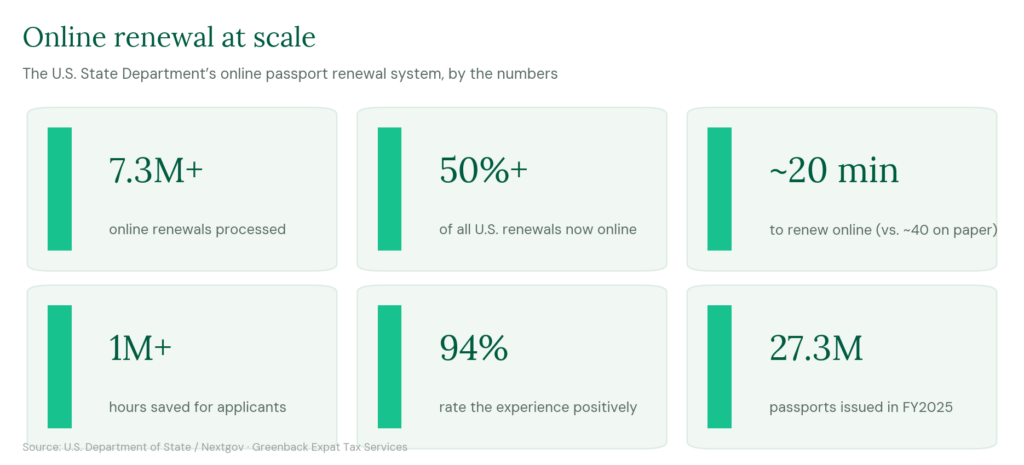
The U.S. State Department’s online passport renewal system has become one of the federal government’s biggest digital success stories. Since its official launch in September 2024, the platform has already processed more than 7.3 million renewals, now handles over half of all U.S. passport renewals, and is meeting historically high demand after a record 27.3 million passports were issued in fiscal 2025. That milestone lands at a fitting moment: as the country marks its 250th anniversary this July and summer travel reaches its yearly peak, the passport — how Americans get one, and what it’s worth — is back in the national conversation.
But Americans aren’t uniformly embracing the digital option. Google search data reveals a distinct seasonal rhythm, with search interest jumping about 61% from December to January as travelers move to renew ahead of the spring and summer rush, when processing times stretch toward their limits, and within that increased volume, overall interest varies widely from state to state.
To find out where interest in online renewal is strongest, and what’s driving it, Greenback Expat Tax Services analyzed search trends across all 50 states and major U.S. metro areas. By layering in immigration, broadband, and macroeconomic data, and insights from a 2024 survey of 1,000 Americans, we mapped the nation’s online-renewal hotspots and what they reveal about how Americans interact with modern public services.
Key Takeaways
- Online renewal has gone mainstream: 7.3M+ renewals processed, more than half of all renewals, and about 20 minutes to complete versus 40 for the old paper process.
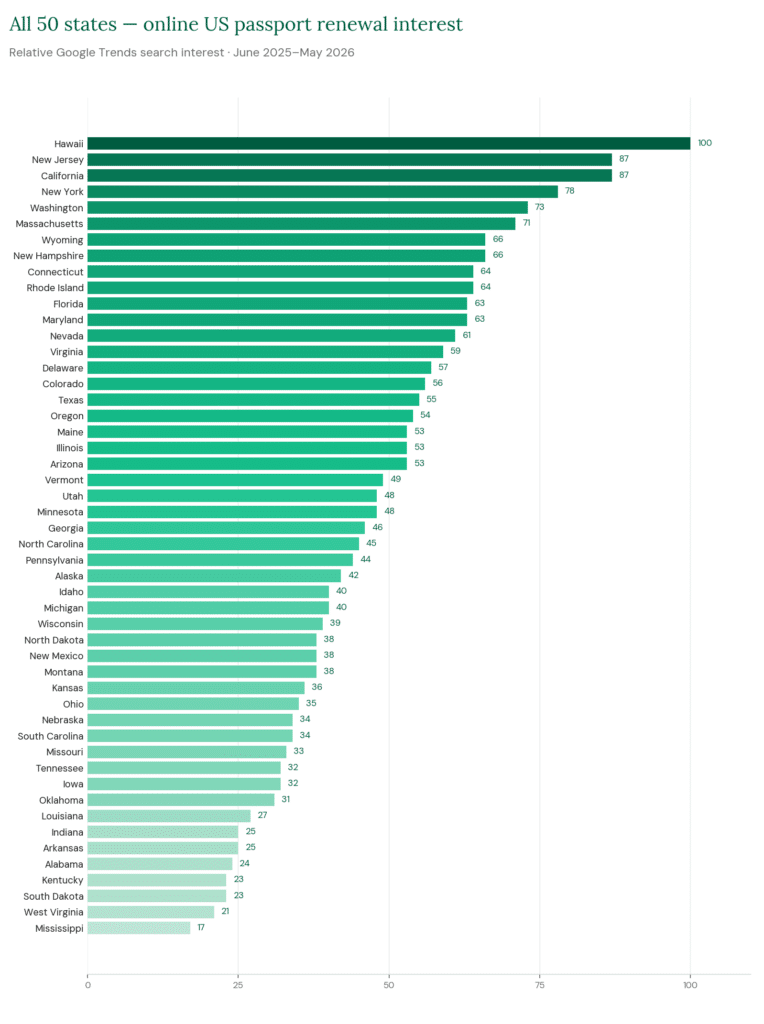
- Based on relative search interest over the past year, Americans most interested in online renewal live in Hawaii and New Jersey; Mississippi residents are the least interested.
- Interest tracks international ties: states with more immigrants and dual citizens search far more (foreign-born share, r = 0.81), and the least-connected states search least (broadband, r = 0.68) — Mississippi ranks last on all of them.
- The San Francisco and Honolulu metro areas show the most interest; searches peak every January as processing times lengthen.
- In a 2024 survey, 92% of Americans supported online renewal and 87% felt it was safe, even as trust in the federal government overall sits near record lows.
Online Renewal at Scale
The State Department first piloted online renewal in 2022, but after a series of stops and starts it paused the program indefinitely in March 2023 to rework the system and clear a pandemic-era application backlog. A public beta returned in June 2024, and the service opened to all eligible adults that September. The revamped system has since become a rare federal tech win: it now handles more than half of all U.S. passport renewals, and the department estimates the online flow, about 20 minutes versus 40 for the paper process, has saved Americans more than a million hours. In government satisfaction surveys, 94% of users rate the experience positively.
A Seasonal Rhythm That Predates the Online System
Search interest in passport renewal is strongly (and durably) seasonal. Across the past 22 years it has peaked in the first quarter in 19 of them (and in the first half of the year in 21 of 22), cresting in winter as Americans book spring-break and summer travel, then easing through the fall. The pattern predates online renewal by nearly two decades and barely shifted through the pandemic: January interest runs well above each year’s average both before and after 2020. What has changed in the last two years is the volume of searches, which are now at record highs.
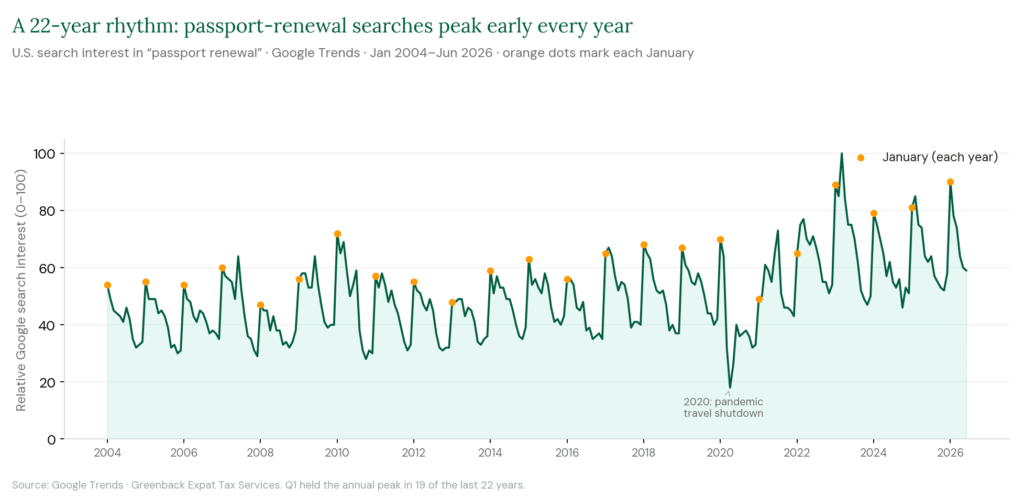
At today’s scale that winter crest is substantial: the keyword basket drew roughly 1.63 million searches in January 2025 and 1.43 million in January 2026.
Routine renewal runs about 4–6 weeks (6–8 weeks with mailing); expedited is 2–3 weeks (4–5 with mailing) for an extra $60. From January through June, times sit at the longer end of that range. Renewing online, now available for routine service, is how many Americans try to beat the queue/
Coastal States Lead in Online Passport Renewal Interest
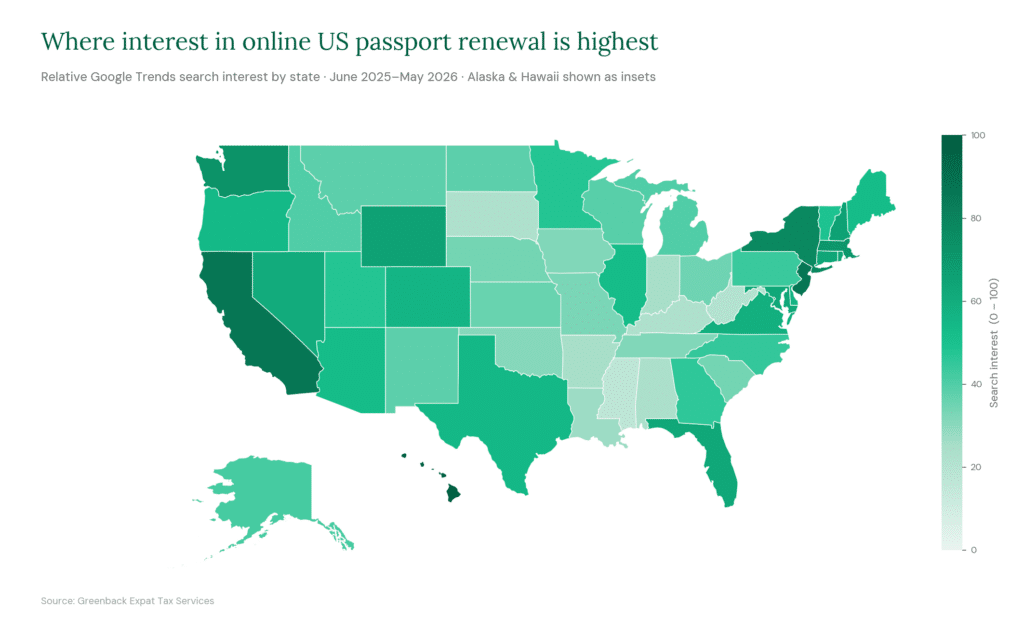
Throughout this report, “interest” means relative Google search activity, e.g., how often residents of a state search for online passport renewal, indexed from 0 to 100 and scaled to each state’s overall search volume so more populous states don’t automatically dominate. It’s a measure of search interest, not a count of completed renewals.
By that measure, residents of Hawaii, New Jersey, and California are the most interested in online US passport renewals, while those in Mississippi, West Virginia, and South Dakota are the least.
Top 10 States Searching for “Online US Passport Renewal”
| State | Interest (0-100) |
|---|---|
| 1. Hawaii | 100 |
| 2. New Jersey | 87 |
| 3. California | 87 |
| 4. New York | 78 |
| 5. Washington | 73 |
| 6. Massachusetts | 71 |
| 7. Wyoming | 66 |
| 8. New Hampshire | 66 |
| 9. Connecticut | 64 |
| 10. Rhode Island | 64 |
Bottom 10 States
| State | Interest (0-100) |
|---|---|
| 50. Mississippi | 17 |
| 49. West Virginia | 21 |
| 48. South Dakota | 23 |
| 47. Kentucky | 23 |
| 46. Alabama | 24 |
| 45. Arkansas | 25 |
| 44. Indiana | 25 |
| 43. Louisiana | 27 |
| 42. Oklahoma | 31 |
| 41. Iowa | 32 |
Who Reaches for Online Renewal First
Why are Hawaii, New Jersey, and California near the top while Mississippi and West Virginia sit at the bottom? The clearest signal is international ties. The states most interested in online renewal are correlated with those with the deepest connections abroad, i.e., states with large immigrant and dual-citizen communities and the country’s busiest international gateways. Plotting each state’s foreign-born population share against its renewal interest shows a strong relationship (Pearson r = 0.81).
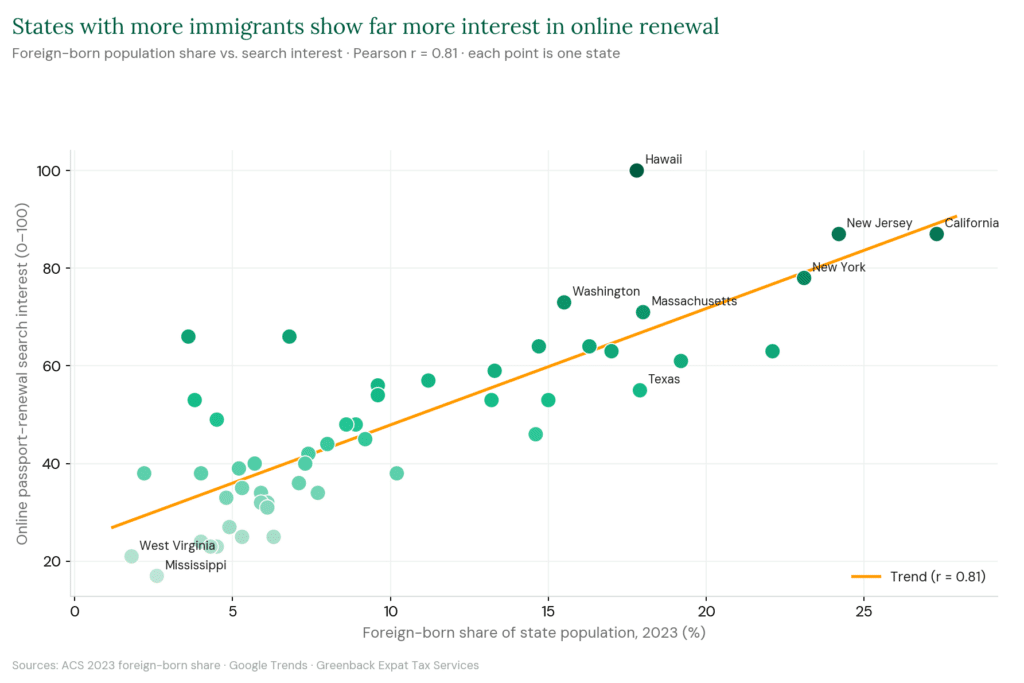
California (27% foreign-born), New Jersey (24%), and New York (23%) sit near the top of both lists, while West Virginia (1.8%) and Mississippi (2.6%) anchor the bottom of both. Geography reinforces it: eight of the ten most-interested metros, San Francisco, Honolulu, Miami, New York, Seattle, Los Angeles, San Diego, and Boston, are among the nation’s primary international air gateways, the places where passports get the most use.
Hawaii is the standout. With just ~1.4 million residents, it leads the ranking not on raw search volume but because our metric is population-scaled, and a remarkably high share of Hawaii’s searches are passport-related, reflecting its role as the U.S. Pacific gateway and its large foreign-born (18%) and military communities.
The digital-access layer
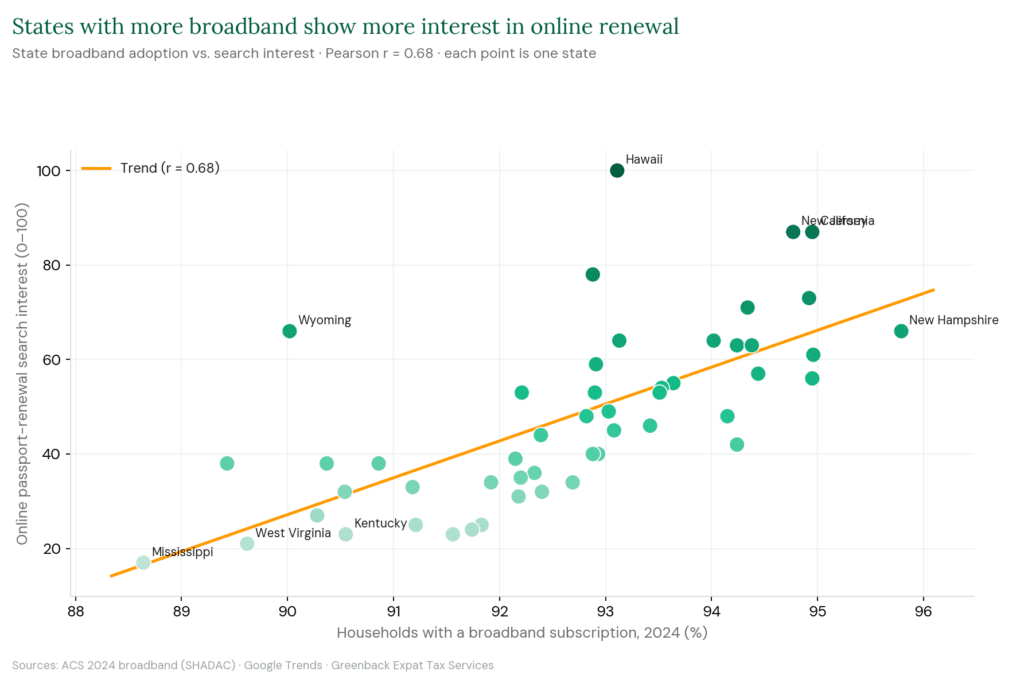
Connectivity tells the same story from another angle. State broadband-subscription rates also correlate with renewal interest (Pearson r = 0.68), and Mississippi ranks last in the nation on both, with the lowest broadband adoption (88.6%) and the lowest interest. The least-connected states are also the least engaged with this online government service.
The pattern extends to how states build digital government: roughly 73% of states and territories have now established a chief data officer, and those that have invested in dedicated digital-service teams and design systems (California’s Office of Digital Innovation among them) tend to cluster toward the higher end of interest.
Correlation isn’t causation. Foreign-born share, broadband, and income all move together (the two relationships overlap) so no single factor stands alone, and a few states buck the trend (small-population Wyoming shows more interest than its profile would predict). And on whether high-interest states also send more Americans abroad: federal estimates (FVAP) find overseas citizens originate from states roughly in proportion to population, so there’s no strong “these states export more expats” effect. It’s immigration in, not emigration out, that tracks renewal interest.
Metro Areas Driving the Digital Passport Renewal Trend
The San Francisco, Honolulu, and Miami metro areas are the most interested in renewing passports online, while the Macon and Augusta, Georgia areas are the least.
Top 10 Metro Areas
| Metro area | Interest (0-100) |
|---|---|
| 1. San Francisco-Oakland-San Jose, CA | 100 |
| 2. Honolulu, HI | 77 |
| 3. Miami-Ft. Lauderdale, FL | 76 |
| 4. New York, NY | 70 |
| 5. Seattle-Tacoma, WA | 67 |
| 6. San Diego, CA | 64 |
| 7. Los Angeles, CA | 64 |
| 8. Boston, MA-Manchester, NH | 59 |
| 9. Washington, DC | 58 |
| 10. Reno, NV | 56 |
Bottom 10 Metro Areas
| Metro area | Interest (0-100) |
|---|---|
| 162. Macon, GA | 10 |
| 161. Augusta, GA | 10 |
| 160. Springfield, MO | 11 |
| 159. Paducah, KY | 11 |
| 158. Evansville, IN | 13 |
| 157. Lafayette, LA | 13 |
| 156. Lubbock, TX | 13 |
| 155. Jackson, MS | 13 |
| 154. Tyler-Longview, TX | 13 |
| 153. Charleston-Huntington, WV | 13 |
Why Now: A Strong Dollar Meets High Passport Demand
The renewal rush is colliding with a favorable moment for Americans abroad. As of June 2026 the U.S. dollar is trading at its strongest in over a year (the dollar index near 100.7; the euro around $1.14), giving American travelers more purchasing power overseas. At the same time, the U.S. passport recently fell out of the Henley Passport Index’s top 10 for the first time in two decades (its October 2025 ranking) — still strong, with visa-free access to roughly 180 destinations, but slipping as other countries gain ground. For travelers looking to capitalize on a strong dollar, renewing online is the friction point they’re trying to eliminate.
The Bigger Picture: A Passport Under the Global Microscope
While Americans’ interest in online renewal followed a steady, seasonal path, something very different was happening outside the country. Worldwide searches for “United States passport” were flat for four years — then surged five- to six-fold starting in mid-2025.

How to read this: each line is indexed to its own pre-2025 baseline, so the chart shows growth, not relative search volume. The worldwide figure reflects global interest in the U.S. passport as a topic — distinct from U.S. renewal demand, which rose on a much smoother, seasonal path.
This wasn’t a shift in U.S. behavior, the domestic line barely moved. It was a global “what’s going on with the U.S. passport?” moment, driven by news rather than renewal demand: the passport’s widely covered fall out of the Henley top 10, visa-reciprocity moves abroad (Brazil reinstated visas for U.S. citizens in 2025), new U.S. visa fees and travel restrictions, and a wave of early-2026 “passport divide” and “Plan B passport” coverage. Over the same period, record numbers of Americans began exploring second citizenships and residencies — investment-migration applications from U.S. nationals rose more than 60% in 2025.
What Americans Told Us About Online Passport Renewals (2024 Survey)
In a 2024 survey of 1,000 US adults conducted when the online renewal system launched, Greenback explored how Americans felt about renewing passports online. We’ve kept those findings here as a point-in-time snapshot; the search-interest data above has since been refreshed to 2026.
- In that 2024 survey, 92% of respondents supported the online US passport renewal process and 87% considered it safe to use.
- More than 1 in 4 said they planned to renew online within three months.
- Top concerns were system glitches (39%), personal data security (37%), and identity theft (36%).
- Top reasons for renewing online were to feel prepared (43%), an expiring passport (37%), and upcoming holiday travel (25%).
There’s a paradox in those numbers. Americans overwhelmingly embraced this federal digital service — 92% support — even as roughly four in ten worried about data security, identity theft, or glitches, and even as public trust in the federal government overall has fallen to about 17%, near a record low (Pew Research, December 2025). Online passport renewal, in other words, is a case study in Americans embracing government technology that works, despite deep skepticism of government generally.
What’s at Stake When Adoption Lags
The geography of online-renewal interest isn’t just trivia. In lower-interest, less-connected states, travelers may be likelier to fall back on slower, paper-based renewal — raising the odds of delays as demand stays high and the online channel absorbs more of the load. Online renewal matters most for travelers on tight departure windows, those with multi-border or visa-heavy itineraries, and US expats juggling passport validity against tax-filing and residency timelines. Closing the adoption gap is partly a convenience story — and partly a digital-equity one.
Methodology
To find where interest in online US passport renewal is highest, we measured search demand using two complementary sources, covering data through May 2026. For national search volume and seasonal trends, we used Google Keyword Planner figures for a basket of related search terms — online US passport renewal, US passport renewal, passport renewal, US passport, and renew passport online — from June 2024 to May 2026. For the state and metro-area rankings, we used Google Trends relative search interest for “us passport renewal” over the trailing 12 months (June 2025–May 2026); Trends expresses interest on a 0–100 scale normalized by each location’s overall search activity, so these are relative search-interest scores and are not directly comparable to the per-capita figures in our 2024 edition, though the rankings remain broadly consistent. Metro areas are defined by Nielsen Designated Market Areas (DMAs). The long-run seasonality analysis uses Google Trends interest in “passport renewal” (United States, 2004–2026), with each year normalized to its own average to compare seasonal shape across eras. Broadband figures are 2024 American Community Survey estimates (via SHADAC) and foreign-born population shares are 2023 American Community Survey estimates; the broadband–interest and foreign-born–interest relationships are Pearson correlations across the 50 states. Operational figures (volumes, processing and time-savings) are from the U.S. State Department; passport-power and currency figures are from the Henley Passport Index and market data as of June 2026; the federal-trust figure is from Pew Research Center (December 2025). Attitudinal findings come from a separate one-time survey of 1,000 US adults conducted in 2024 and were not re-surveyed for this update. Keyword Planner volumes are reported in rounded ranges.
Sources
- Search-interest data (Greenback analysis) — Google Trends and Google Keyword Planner — Google Trends
- Passport processing times and FY2025 issuance — U.S. Department of State — travel.state.gov: Passport processing times
- Online renewal scale, time savings, and user ratings — Nextgov/FCW (May 2026) — State Department looks to build on the success of online passport renewal
- Online renewal program history: 2022 pilot and 2023 pause — ABC News — State Department launches beta program for online passport renewal
- Public beta relaunch, June 2024 — Nextgov/FCW — State Department launches limited online passport renewal
- Full public availability, September 2024 — The Washington Post — Wait times for passport renewals and applications just dropped again
- State broadband subscription rates, 2024 ACS — SHADAC / State Health Compare — Percent of households with a broadband internet subscription, by state
- Foreign-born population by state, 2023 ACS — U.S. Census Bureau — U.S. Foreign-Born Population: 2019–2023
- U.S. passport global ranking — Henley & Partners (October 2025) — Henley Passport Index / Global Mobility Report
- U.S. dollar strength, 2026 — J.P. Morgan Research — Currency volatility and dollar strength
- Public trust in the federal government — Pew Research Center (December 2025) — Public Trust in Government: 1958–2025
- State chief data officers and digital government — NASCIO (2025) — 2025 State Chief Data Officer Survey
- Passport-power decline, Brazil visa reciprocity, and second-citizenship demand — Global Citizen Solutions — The US Passport Decline in 2025
- Seasonal passport demand and record volume — U.S. Department of State, State Magazine — Unprecedented Demand
About Greenback Expat Tax Services
Greenback Expat Tax Services simplifies tax preparation for US expatriates worldwide. Our team of expert accountants combines extensive knowledge with a user-friendly digital platform to deliver hassle-free, accurate tax solutions tailored to your international lifestyle.
Fair Use Statement
You’re welcome to reference these findings on online US passport renewals for noncommercial use. Please include a link to this page to credit the source.
Featured In