UK VAT for Americans: Rates, Registration, and How It Works

- What Is UK VAT and How Does It Work?
- What Are the UK VAT Rates?
- Do Americans Pay VAT in the UK?
- When Do You Have to Register for VAT in the UK?
- How Does UK VAT Work for a U.S. Business Selling Into the UK?
- How Do You Charge, Reclaim, and File UK VAT?
- Can You Claim UK VAT on Your U.S. Tax Return?
- Frequently Asked Questions about UK VAT
- Greenback Helps Americans in the UK File Both Tax Returns With Confidence


UK VAT (Value Added Tax) is a 20% tax included in the price of most goods and services in the UK. A 5% reduced rate and a 0% rate apply to some essentials, such as home energy, most food and children’s clothes. A UK business must register for VAT once its taxable turnover goes over £90,000 in any 12-month period.
If you live in the UK, you pay VAT every time you shop, because it is already in the price. If you run a business, registering means charging VAT on your sales, reclaiming the VAT on your costs and usually filing a VAT return every quarter. A U.S. business with no base in the UK has no threshold at all and registers before its first taxable UK sale. UK VAT is not an income tax, so it does not count toward the Foreign Tax Credit on your U.S. return.
What Is UK VAT and How Does It Work?
UK VAT is a tax on spending, charged at each stage of a sale. Every VAT-registered business adds VAT to its price, then pays HMRC the VAT it collected minus the VAT it already paid on its own costs. The final customer carries the full amount, while each business in the chain hands over only its share.
1. VAT Is Collected at Every Stage of a Sale
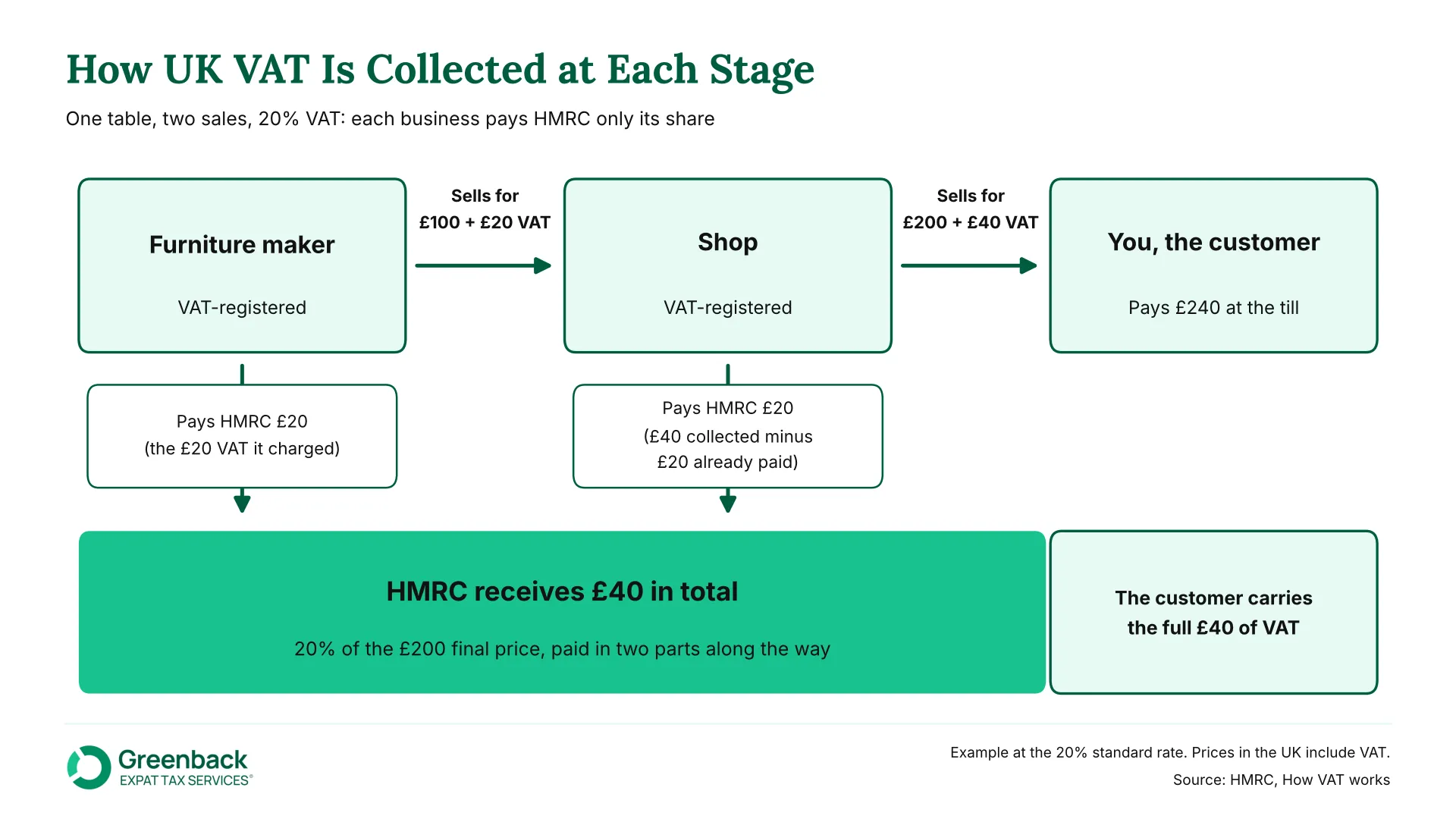
Here is how the VAT on one dining table reaches HMRC:
- A furniture maker sells the table to a shop for £100 plus £20 VAT. The maker pays HMRC £20.
- The shop sells the table to you for £200 plus £40 VAT, so you pay £240.
- The shop collected £40 from you but already paid £20 to the maker, so it pays HMRC £20.
- HMRC receives £40 in total: 20% of the £200 final price, paid in two parts along the way.
2. Prices You See Already Include VAT
UK shelf prices include VAT, so the price on the tag is the price you pay at the till. In the U.S., sales tax is added at checkout instead. For a side-by-side comparison of the two systems, see UK vs. U.S. taxes.
What Are the UK VAT Rates?
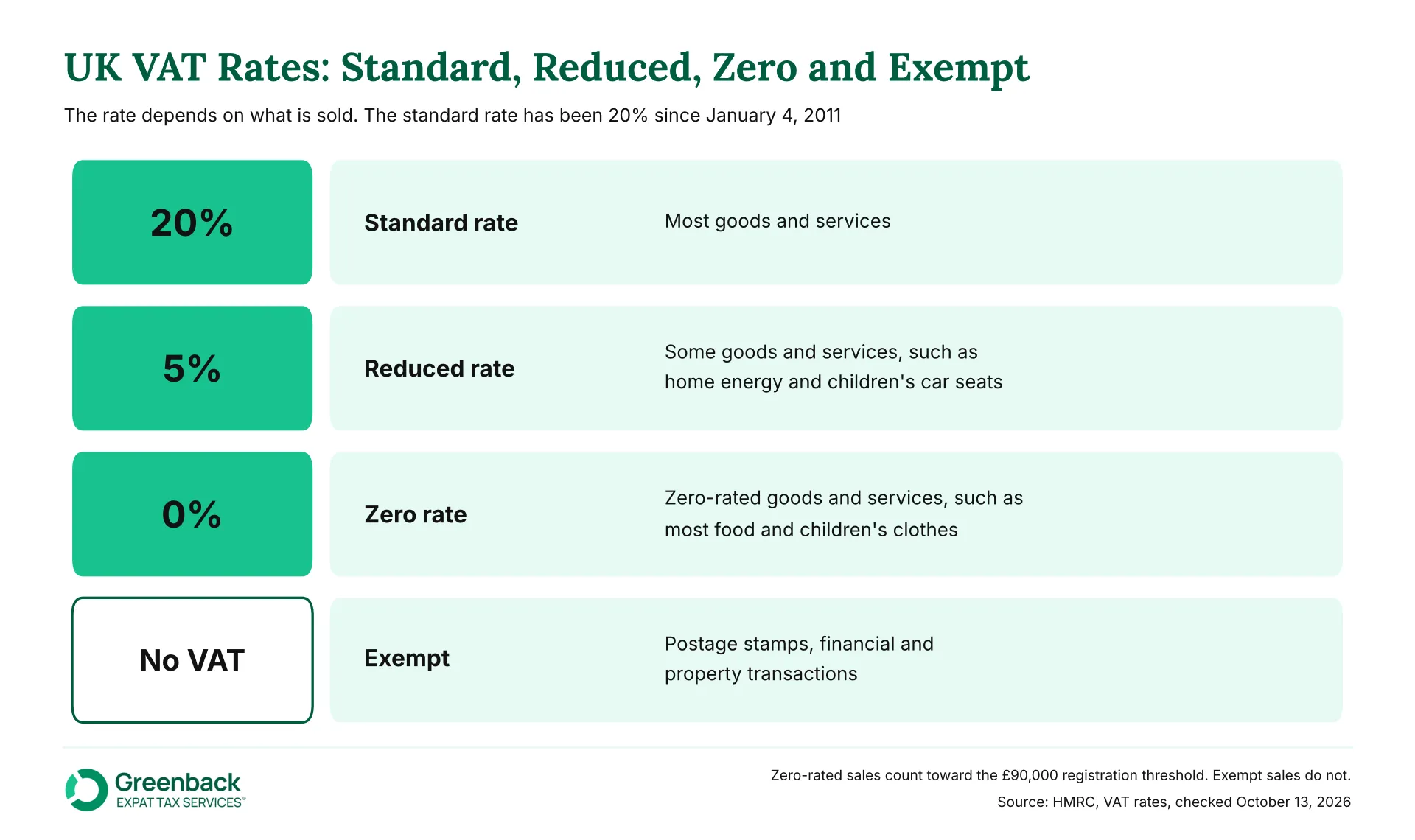
The UK has three VAT rates: 20% standard, 5% reduced, and 0% zero. The standard rate covers most goods and services, and it has been 20% since January 4, 2011. Some supplies, such as postage stamps and financial and property transactions, are exempt, unlike being zero-rated.
| Rate | VAT | Applies to |
|---|---|---|
| Standard | 20% | Most goods and services |
| Reduced | 5% | Some goods and services, such as children’s car seats and home energy |
| Zero | 0% | Zero-rated goods and services, such as most food and children’s clothes |
| Exempt | No VAT | Postage stamps, financial and property transactions |
1. Zero-Rated and Exempt Are Not the Same
A zero-rated sale is still a taxable sale, charged at 0%. It counts toward the £90,000 registration threshold, and a business making zero-rated sales can generally reclaim the VAT on its costs. An exempt sale is outside VAT altogether, does not count toward the threshold, and the VAT on costs linked to it generally cannot be reclaimed.
2. Northern Ireland Follows EU Rules for Goods
Under the Windsor Framework, Northern Ireland follows EU VAT rules for goods. If you live in Great Britain (England, Scotland or Wales), this rarely affects you. It matters if your business sells goods into or out of Northern Ireland.
Do Americans Pay VAT in the UK?
Yes, Americans pay VAT in the UK on almost everything they buy, just like anyone else. If you live in the UK, there is nothing to file because VAT is already included in the price. If you visit, you pay it too, and Great Britain no longer refunds VAT to tourists on goods they carry home.
1. Living in the UK
VAT is part of the everyday cost of living, from restaurant meals to phone plans. Most food is zero-rated, which softens the impact on groceries. How it compares to U.S. prices is covered in our guide to the cost of living in the UK.
2. Visiting or Shopping From the U.S.
Great Britain ended its tax-free shopping scheme for visitors on January 1, 2021. A shop in Great Britain can still sell VAT-free when it delivers your purchase directly to an address outside the UK. Northern Ireland still runs a tax-free shopping scheme for visitors whose home is outside both Northern Ireland and the EU, claimed on form VAT407 in the shop. HMRC explains who qualifies and how to claim.
When Do You Have to Register for VAT in the UK?
You must register for VAT when your taxable turnover goes over £90,000 in the last 12 months, or when you expect it to go over £90,000 in the next 30 days alone. Turnover means your total taxable sales, not your profit. You can cancel your registration if your taxable turnover falls below £88,000.
| Your situation | Do you register? | When |
|---|---|---|
| Taxable turnover over £90,000 in the last 12 months | Yes | Within 30 days of the end of the month you went over |
| You expect to go over £90,000 in the next 30 days alone | Yes | By the end of that 30-day period |
| Taxable turnover under £90,000 | Optional | Any time, as a voluntary registration |
| You and your business are based outside the UK | Yes, with no threshold | Before your first taxable UK sale |
1. Self-Employed Americans and Freelancers
As a sole trader, you count the turnover of all your taxable business activity together. A freelance designer billing £7,800 a month crosses £90,000 in the twelfth month, even if expenses leave a much smaller profit. Your income tax and National Insurance as a sole trader are covered in self-employed in the UK.
2. UK Limited Companies
If you trade through a company, the company registers for VAT, not you personally. The threshold works the same way. Owning a UK limited company also brings its own U.S. reporting requirements.
3. Registering Voluntarily
You can register if your business costs are below £90,000 to reclaim VAT on your business costs. The trade-off is adding 20% to your prices. That matters little when your customers are VAT-registered businesses, who reclaim it, and a great deal when you sell to individuals, who cannot.
How Does UK VAT Work for a U.S. Business Selling Into the UK?
A business based outside the UK has no VAT registration threshold, so it registers before its first taxable sale to UK customers. Low-value goods and digital services to UK consumers each have their own rules, and an online marketplace may collect the VAT for you on goods sold through it.
1. There Is No Threshold for Businesses Based Outside the UK
You must register regardless of turnover if you are based outside the UK, your business is based outside the UK, and you supply goods or services to the UK. The exception is when all of your taxable sales are zero-rated.
2. Goods Worth £135 or Less
For goods sent to UK consumers in consignments worth £135 or less, the seller charges UK VAT at the point of sale and accounts for it on its VAT return. The £135 limit applies to the whole consignment, not each item. When the sale goes through an online marketplace, the marketplace may be responsible for the VAT instead of you. Above £135, import VAT is collected when the goods enter the UK.
3. Digital Services Sold to UK Consumers
Digital services sold to UK consumers are liable to UK VAT, and a seller based outside the UK must register to account for it. This covers e-books, music, software, web hosting and pre-recorded online courses. Live webinars and courses with a live tutor are not digital services under these rules.
How Do You Charge, Reclaim, and File UK VAT?
Once registered, you add VAT to your sales, reclaim the VAT on your business costs, and pay HMRC the difference. VAT returns are usually filed every 3 months, and both the return and payment are due 1 calendar month and 7 days after the period ends. A return for January to March is due by May 7.
1. Steps After You Register
- Receive your VAT registration number from HMRC.
- Charge VAT at the right rate on your sales and show it on your invoices.
- Keep digital records of the VAT you charge and the VAT you pay.
- File each return through software that works with Making Tax Digital.
- Pay by the deadline, allowing time for the payment to reach HMRC.
2. When HMRC Owes You
If the VAT you paid on your costs exceeds the VAT you charged, HMRC refunds the difference. This can happen in the first few months of a new business with high setup costs, or for a business that makes mostly zero-rated sales.
Can You Claim UK VAT on Your U.S. Tax Return?
No, UK VAT cannot be claimed as a Foreign Tax Credit, because the credit generally covers foreign income taxes and VAT is a tax on spending. VAT a business paid and could not reclaim can be part of a deductible business expense. VAT on personal purchases has no place on your U.S. return.
1. VAT Does Not Qualify for the Foreign Tax Credit
The IRS states that, in most cases, only foreign income taxes qualify for the Foreign Tax Credit. UK income tax qualifies, which is how Americans in the UK generally avoid paying tax twice on the same income. The VAT built into your spending does not.
2. Business Owners Can Deduct VAT They Cannot Reclaim
IRS Publication 514 notes that foreign taxes that are not income taxes may be deductible when they are expenses of a trade or business. If you are a sole trader filing Schedule C, the VAT you could not reclaim is part of the cost of the expense you deduct. The VAT you reclaimed from HMRC has been refunded, so it is not part of the expense.
3. Schedule A Covers Only State and Local Sales Taxes
The sales tax deduction on Schedule A covers state and local general sales taxes, so it does not extend to UK VAT. What does carry over to your U.S. return is your income and the UK income tax on it, the same figures you report on your UK Self Assessment return.
Frequently Asked Questions about UK VAT
Yes, the UK standard VAT rate is 20%, the rate in place since January 4, 2011. The reduced rate is 5%, and the zero rate is 0%. Most goods and services are charged at 20%, with the lower rates reserved for items such as home energy, most food and children’s clothes.
No, not in Great Britain. The tax-free shopping scheme for visitors ended on January 1, 2021. A shop can sell VAT-free only when it delivers the goods directly to an address outside the UK. Northern Ireland still offers VAT refunds to visitors whose home is outside both Northern Ireland and the EU.
Generally, no. Services you supply to a business customer outside the UK are usually outside the scope of UK VAT because they are taxed where the customer is based. You need to keep evidence that the customer is in business. Services to individual customers, and certain types of services, follow different rules.
No, there is no separate U.S. filing for UK VAT. If you are self-employed, VAT you cannot reclaim becomes part of your business expenses on Schedule C, and VAT you reclaim stays out of them. Your income and UK income tax drive your U.S. return.
Greenback Helps Americans in the UK File Both Tax Returns With Confidence
VAT is part of everyday life in the UK, but unless you run a business, it never appears on a tax return. For most Americans in the UK, the returns that matter each year are the U.S. return and UK Self Assessment. Greenback’s U.S. accountants and UK-qualified accountants prepare both, so your income, your UK tax and your Foreign Tax Credit line up across the two systems.

VAT Registered? Your Income Tax Still Needs Care
This article provides general information and is not tax or legal advice. VAT rules depend on what you sell, who you sell to and where. Rates and thresholds can change. Speak with a qualified professional about your situation.




Featured In