How Long to Keep Tax Records: Rules for Americans at Home and Abroad

- How Long Should You Keep Tax Returns and Records?
- What Is the IRS 7-Year Rule?
- How Long Should Americans Abroad Keep Tax Records?
- Which Tax Records Should You Keep Permanently?
- When Can You Throw Away Old Tax Returns?
- Frequently Asked Questions about Keeping Tax Records
- Greenback Helps You Keep the Right Records and File with Confidence


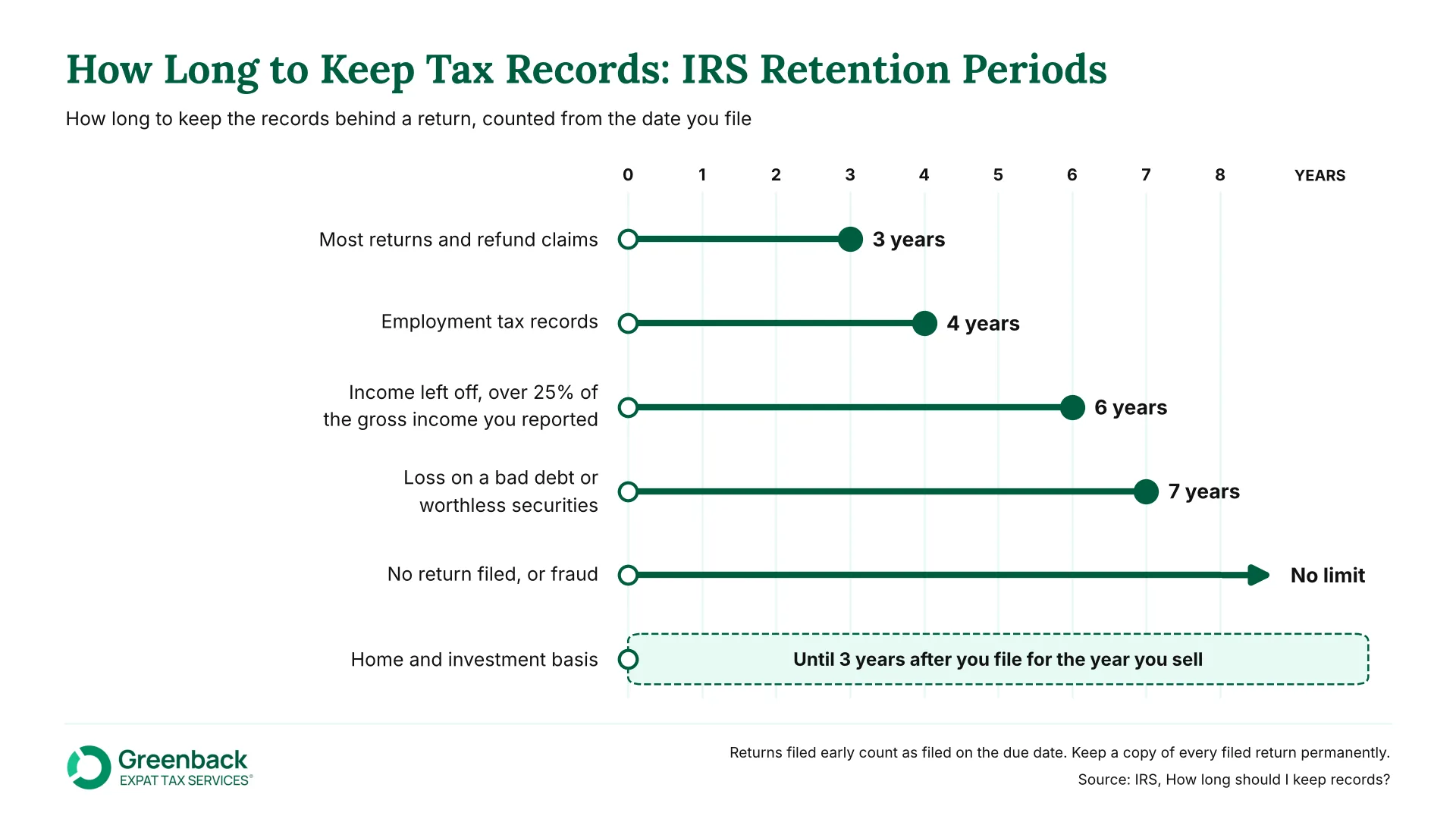
How long to keep tax returns depends on how long the IRS can review them, which is generally 3 years from the date you file. Keep the records behind each return for at least that long. Some situations call for 6 years, 7 years, or no time limit, and a copy of each filed return is worth keeping permanently.
Keep your records for 6 years if the income you left off your return is more than 25% of the income you reported. A loss claimed on worthless securities or a bad debt is subject to a 7-year holding period, and an unfiled return has no limit. If you have foreign bank accounts, keep your FBAR records for at least 5 years from the FBAR due date. Americans abroad should plan on 6 years for all their supporting records.
How Long Should You Keep Tax Returns and Records?
The IRS ties record retention to the period of limitations, the window it has to assess more tax, and you have to claim a refund. For most returns, that window closes 3 years after you file. Keep every record that supports the income, deductions, and credits on a return until its window closes, and longer in the situations in the table.
| Your situation | Keep records for | Clock starts |
|---|---|---|
| Most returns | 3 years | The date you filed, or the due date if you filed early |
| You claim a refund or credit after filing | 3 years, or 2 years after the tax was paid, whichever is later | The date you filed or paid |
| The income you left off your return is more than 25% of the income you reported | 6 years | The date you filed |
| You claim a loss from worthless securities or a bad debt | 7 years | The date you filed |
| You have employees | 4 years for employment tax records | The later of the tax’s due date or payment date |
| You did not file, or filed a fraudulent return | No limit | The clock never starts |
| You own property, such as a home or investments | Until the window closes for the year you sell | The year you sell |
These periods come from the IRS’s own recordkeeping guidance, which also tells taxpayers to keep copies of filed returns.
1. Records That Support Your Return
A filed return shows the IRS what you reported. The supporting records show where the numbers came from, and those are what an examiner asks for:
- Income records: W-2s, foreign payslips, 1099s, and statements showing interest, dividends, and sales.
- Bank and brokerage statements: for every account that paid you income or that you report.
- Deduction and credit records: receipts, Forms 1098, childcare, and education records.
- Payment records: proof of estimated tax payments and any tax paid with an extension.
2. State Tax Records
States set their own review periods, and some run longer than the federal 3 years. Check your state tax agency’s rules before you discard a state return or the records behind it.
What Is the IRS 7-Year Rule?
The IRS has no general rule requiring tax records to be kept for 7 years. The 7-year period applies only when you claim a loss from worthless securities or a bad debt deduction. Advice to keep everything for 7 years adds a year of margin to the 6-year period for large omissions. It is sensible, and the IRS does not require it.
1. Where the 7-Year Advice Comes From
Seven years is easy to remember and matches the longest timed period on the IRS’s own list. That is likely why it is repeated so widely and often mistaken for the rule itself.
2. How Far Back the IRS Can Look
The window for keeping records and the window for an IRS review are the same window, so the periods in the table also tell you how far back the IRS can audit you. Once a year’s window closes, the IRS generally cannot assess additional tax for that year.
How Long Should Americans Abroad Keep Tax Records?
Greenback recommends that Americans living abroad keep tax records for at least 6 years, longer than the IRS’s 3-year baseline. Six years covers the extended window for omitted income tied to foreign accounts and the 5-year FBAR rule, and it saves you from relying on a foreign bank or employer for copies years later. Foreign tax receipts and unfiled international forms need longer still.
1. Expat Records and How Long to Keep Them
| Record | Keep for | Why |
|---|---|---|
| FBAR records for each account: name on the account, account number, bank name and address, account type, maximum value | 5 years from the FBAR due date, and 6 is safer | FinCEN requires 5. The IRS has 6 years from the due date to assess an FBAR penalty |
| Form 8938 and statements for the assets on it | 6 years | The IRS gets 6 years if more than $5,000 of income from those assets was left off |
| Proof for the Foreign Earned Income Exclusion claimed on Form 2555: travel calendar, passport stamps, residence permits, foreign addresses, housing receipts | 6 years | Proves you met the physical presence or bona fide residence test if a year is reviewed |
| Foreign tax returns, assessments and payment receipts | 10 years | You have 10 years to claim a refund for foreign tax credits you missed, figured on Form 1116 |
| The exchange rates you used each year | Same as the returns they support, usually 3 years and 6 for Americans abroad | Shows how each foreign amount became dollars |
| Form 5471, Form 3520 and their supporting records | At least 3 years after each form is filed, and for as long as you hold the company or trust | An unfiled form keeps the whole tax year open until 3 years after it is filed |
The 5-year FBAR period is the legal minimum set out by the IRS. The other periods are Greenback’s guidance, and the third column gives the rule behind each one.
2. When a Missing Form Keeps the Year Open
If a required Form 8938, 5471, or 3520 was never filed, the IRS’s window for that entire return can stay open until 3 years after the information is filed, as the instructions for Form 8938 and Form 3520 both explain. Keep every record for that year until then. Filing the missing forms starts the clock, and for Americans whose missed filings were not willful, the Streamlined Filing Procedures are a common way to do it.
3. Planning to Renounce U.S. Citizenship
If you are thinking about giving up U.S. citizenship, Form 8854 asks you to certify that you met your federal tax obligations for the 5 years before you expatriate. Keep those 5 years of returns and records complete, because they are the proof behind that certification.
4. Save Foreign Statements Before You Close an Account
A foreign bank may stop giving you access to old statements once an account closes or you leave the country, so download what you need first. The details are in our guide to how long to keep foreign bank statements.
Which Tax Records Should You Keep Permanently?
Keep your filed tax returns permanently, along with any record that shows the cost basis of something you still own. Basis is what you paid for an asset plus what you spent improving it, and basis records matter until the window closes for the year you sell, which can be decades after you bought.
1. Your Filed Returns
A complete copy of each return takes up almost no space in PDF format. The IRS’s own transcripts reach back only a few years, so your copy is the only complete record of an older return.
2. Home, Investment and Crypto Basis
Keep purchase and sale documents, receipts for improvements, and lot records for stocks, funds, and crypto for as long as you own the asset. For property bought abroad, keep the dollar value on the purchase date as well, since foreign capital gains are calculated in dollars.
3. Retirement Accounts and Foreign Pensions
Records of nondeductible IRA contributions, reported on Form 8606, and of contributions to a foreign pension are worth keeping until every dollar has been withdrawn and that final year’s window has closed. They help show which part of a withdrawal was already taxed.
When Can You Throw Away Old Tax Returns?
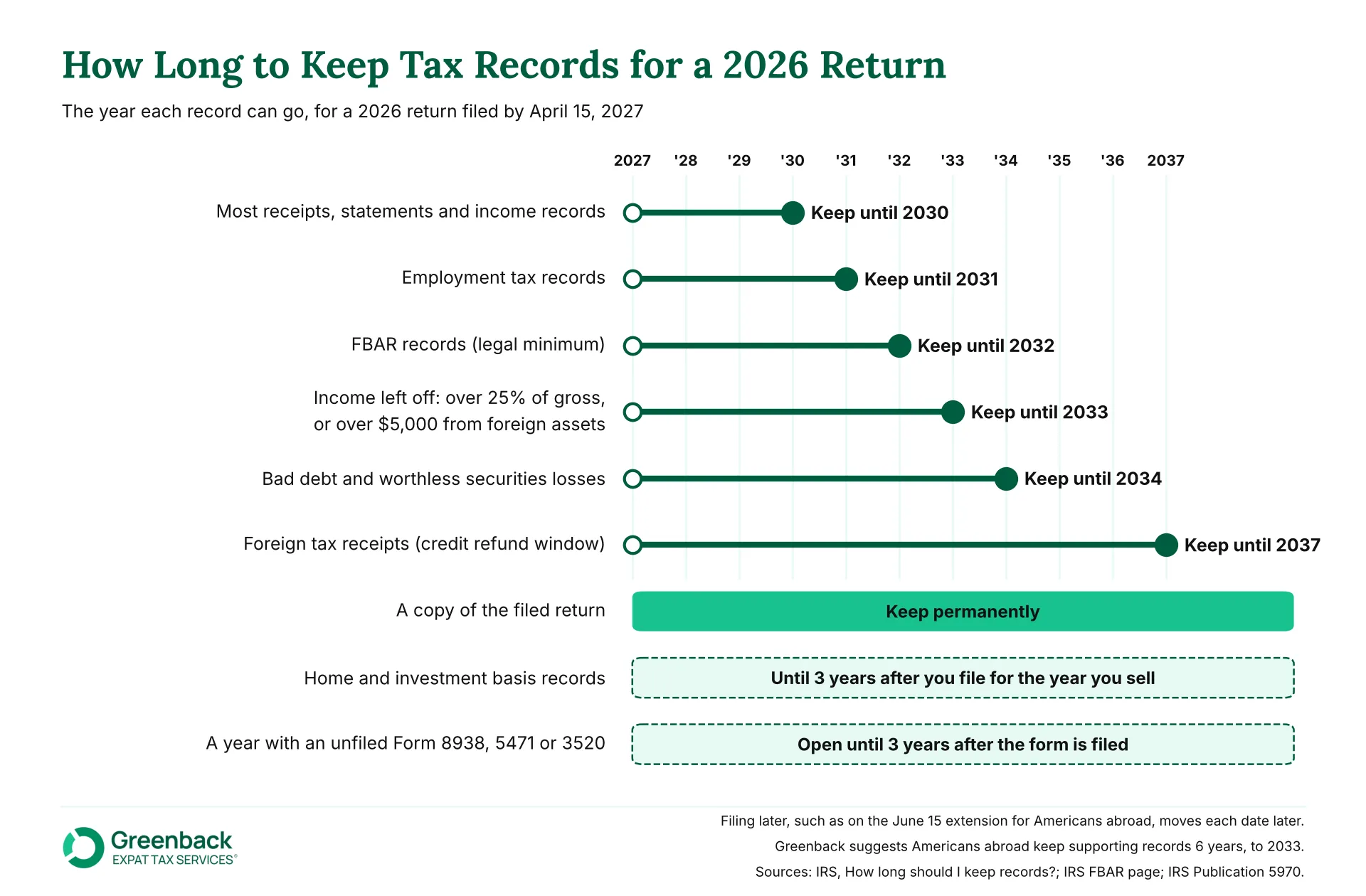
Keep the return itself, but you can throw away its supporting records once the period of limitations has closed and nothing in them supports an asset you still own. A 2026 return filed on April 15, 2027, can generally be reviewed until April 15, 2030, so its receipts and statements can be extended beyond that date if none of the longer periods apply. For the same return, employment tax records can go after 2031, FBAR records after 2032, records tied to a large omission after 2033, loss records after 2034, and foreign tax receipts after 2037.
1. Shred Anything With Personal Details
Shred, never recycle, any page carrying a Social Security number, a taxpayer ID, or an account number. The same goes for old checks and statements from closed accounts.
2. Keeping Records Digitally
The IRS accepts electronic records as long as they are complete, legible, and can be retrieved when asked for. Scan paper records into a single folder per tax year, such as “2026 U.S. Tax Return,” and keep a backup copy separate from the original.
Frequently Asked Questions about Keeping Tax Records
Yes, you can usually shred the supporting records from 20 years ago, since the review window for that year closed long ago. Keep the return itself and any record that still sets the basis of property or investments you own. Do not discard anything for a year where a return was never filed or a required foreign form is missing, because that year is still open.
Yes, keep the returns themselves. The receipts and statements behind a 10-year-old return can usually go, unless they set the basis of an asset you still own or support foreign taxes paid in a year you could still claim a credit for.
Keep U.S. bank statements until the IRS’s period of limitations for the return they support has closed, which is usually 3 years from the date you file. If you live abroad, keep them for 6 years.
The IRS can give you transcripts. A return transcript covers the current and the 3 prior years. Account transcripts and wage and income transcripts cover the current and the 9 prior years through your IRS online account. You can also order a copy of a filed return with Form 4506, for a fee.
Greenback Helps You Keep the Right Records and File with Confidence
For a return with nothing unusual on it, 3 years covers the supporting records, and after that, the return itself and any basis records are what you keep. Foreign accounts, foreign taxes, and international forms are what stretch the timeline, and they are also the records that are hardest to replace once a bank closes your account or you move on.
Greenback’s U.S. accountants help you file your return, FBAR, and international forms correctly each year, so every window closes on schedule, and you know which paperwork you can let go of.

Get Every Year Filed Right, Then Let the Paperwork Go
This article provides general information and is not tax or legal advice. Record retention periods depend on your situation, and the rules can change. Speak with a qualified tax professional before you discard records.



Featured In