Tax Rules for Minors: When Children and Teens Have to Pay or File



If you are wondering whether your child owes taxes on a summer job, a bank account, or a neighborhood side business, the basic rule is simple: U.S. tax law does not exempt anyone based on age. A 15-year-old follows the same federal tax laws as an adult.
Most teenagers with part-time jobs will not owe any federal income tax. This is because their total earnings for the year are usually below the standard deduction, the baseline amount of income the government lets you earn tax-free. Even so, your teen might still see taxes taken out of their weekly paycheck, and in some situations, a child must file a tax return even if they do not owe a single dollar.
To understand how this works, it helps to separate three different questions:
- Did taxes come out of their paycheck?
- Do they actually owe taxes for the year?
- Are they legally required to file a tax return with the IRS?
Here is what parents and working teens need to know about paychecks, tax brackets, investment rules, and filing for the 2026 tax year (returns filed in 2027).
Key Takeaways
- Income Matters, Not Age: The IRS looks at how much money a person makes and what kind of income it is, not their age. A child with investment income can owe taxes, while a teen working a grocery store job often owes nothing.
- Paycheck Deductions: Employers must take out 7.65% from an employee’s paycheck for Social Security and Medicare. This is mandatory payroll tax and can’t be refunded. Federal income tax might also be withheld, but your teen can get that money back as a refund by filing a tax return.
- The 2026 Job Income Limit ($16,100): If your child earns wages only from a regular W-2 job, they don’t have to file a federal return unless they earn more than $16,100 in 2026.
- Lower Limits for Side Jobs and Investments: If your child earns $400 or more from their own side business (like babysitting or lawn care), or receives more than $1,350 in passive investment income (like bank interest or stock dividends), they must file a return.
- The Kiddie Tax: If a child earns more than $2,700 in passive investment income, the amount over $2,700 is taxed at the parents’ higher tax rate instead of the child’s lower rate.
- Overseas Bank Accounts: If an American child holds foreign bank or savings accounts that totaled more than $10,000 at any point during the year, an annual foreign account report (FBAR) must be filed, and a parent must sign it if the child is too young.
- You Can Still Claim Them: Your child filing their own tax return does not stop you from claiming them as a dependent on your family return or receiving the Child Tax Credit.
Do Minors Pay Taxes?
Yes, minors can pay taxes. The tax code has no minimum age requirement.
What keeps most working teens from paying federal income tax is the standard deduction. The standard deduction is a fixed amount of income that is shielded from federal income tax each year. If a teenager makes less than this amount, their taxable income is zero, meaning their federal income tax bill is zero.
However, taxes can still apply if:
- Their job wages exceed the annual standard deduction.
- They earn money working for themselves rather than for an employer.
- They earn money from investments, such as interest in a high-yield savings account, dividends from stocks, or profits from selling assets.
Taxes Taken Out of a Minor’s Paycheck
When a teenager gets a regular job and receives a paycheck, the employer automatically withholds taxes. This process is called tax withholding.
There are two main types of federal taxes taken out of a paycheck:
1. FICA Taxes (Social Security and Medicare)
FICA stands for the Federal Insurance Contributions Act. It is a mandatory federal payroll tax that funds Social Security retirement benefits and Medicare healthcare coverage.
By law, an employer must withhold 7.65% from almost every employee’s paycheck:
- 6.2% goes toward Social Security.
- 1.45% goes toward Medicare.
If your teen earns $500 on a paycheck, exactly $38.25 will be deducted for FICA. FICA taxes are never refunded, even if your child only works for a few weeks and earns very little total money.
2. Federal Income Tax Withholding (Form W-4)
This is the standard income tax the federal government collects. How much is taken out depends on how your teen fills out Form W-4 when they start the job.
Payroll computer systems calculate withholding by assuming every paycheck will stay at that exact amount for all 52 weeks of the year. If a student works 35 hours a week during summer vacation, the system calculates taxes as if they work full-time year-round. It will withhold federal income tax even though the teen stops working in August and earns far less than the annual limit.
This extra withheld money is not lost. It becomes a tax refund that your child receives after filing a tax return in the spring.
Can a Teenager Claim “Exempt” on Form W-4?
When filling out Form W-4, an employee can write “Exempt” in the designated space to stop federal income tax from being deducted from their pay.
However, your teen can only legally claim exempt if they meet two specific conditions:
- They owed zero federal income tax last year.
- They expect to owe zero federal income tax this year.
Claiming exempt means their take-home pay will be higher each week because no income tax is withheld. However, it does not stop FICA taxes. Social Security and Medicare will still be deducted. The exemption is also temporary: it expires each year, so you must submit a new Form W-4 to your employer by February 15.

Need Help Setting Up Family Payroll or Side-Hustle Taxes?
Filing Thresholds for Dependents
The IRS divides income into two categories: earned and unearned.
- Earned income: Money earned by working (wages, salaries, tips, and professional fees).
- Unearned income: Money that comes from assets rather than active labor (interest from bank accounts, dividends from stocks, capital gains from selling investments, and trust distributions).
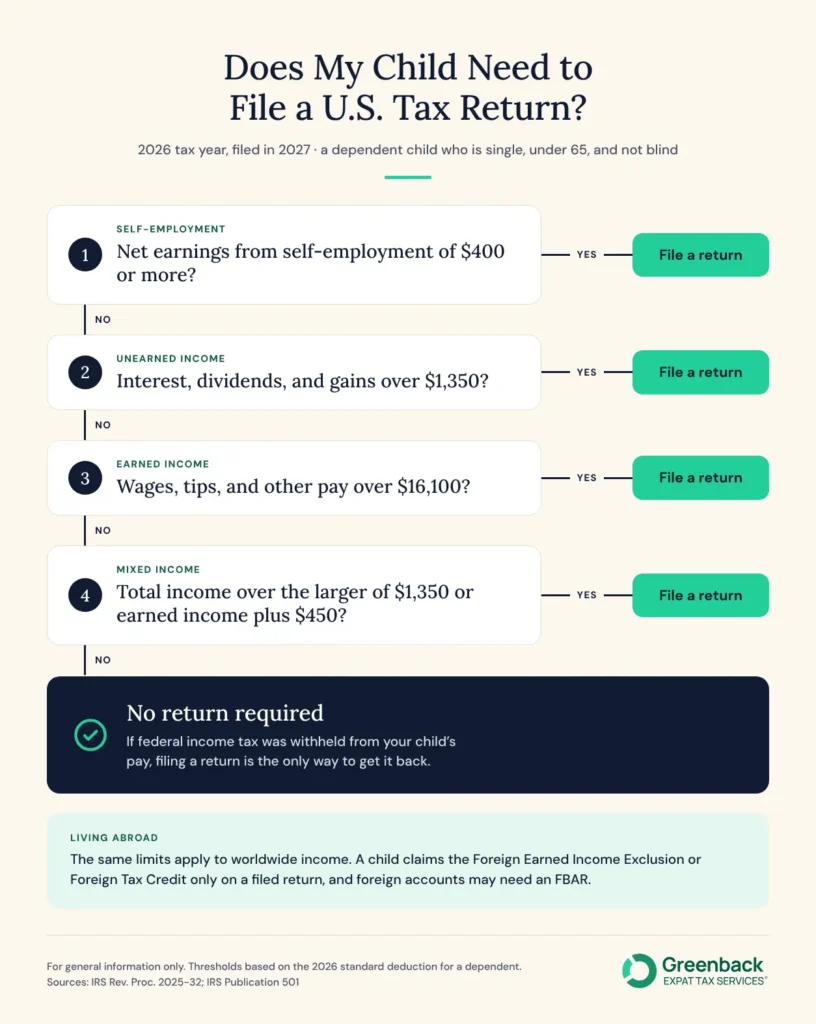
For the 2026 tax year (returns filed in 2027), a child who is claimed as a dependent has to file a federal tax return if their income crosses any of these lines:
| Income Type | 2026 Rule: You Must File If … | What It Means |
| Earned Income Only | Total job earnings are more than $16,100 | A teen with a normal W-2 job only needs to file if their total pay exceeds the standard deduction. |
| Unearned Income Only | Total investment income is more than $1,350 | Because this money was not earned through labor, the government allows a much smaller tax-free allowance. |
| Both Earned and Unearned Income | Gross income exceeds the larger of $1,350 OR earned income plus $450 | This rule prevents investment profits from hiding behind a part-time job. |
| Self-Employment Income | Net business profit is $400 or more | Running an independent side business triggers self-employment tax. |
How the Mixed Income Rule Works
When a child has both job earnings and bank interest, the calculation can be confusing.
Suppose a 17-year-old earns $12,000 working at a store and receives $500 in interest from a savings account.
- Their job income ($12,000) is well below the $16,100 limit.
- Their interest income ($500) is below the $1,350 limit.
- However, their total income is $12,500.
- Under IRS rules, their filing threshold is their earned income ($12,000) plus $450, for a total of $12,450.
- Because their total income of $12,500 is higher than $12,450, they must file Form 1040. They will pay tax only on the extra $50 (roughly $5), and filing lets them get back any income taxes their employer withheld during the year.
Self-Employment, Freelancing, and the Family Business Exception
If your child works outside of a traditional W-2 job, unique tax rules apply depending on who pays them.
The $400 Self-Employment Rule
If a teenager makes money babysitting for neighborhood families, mowing lawns, tutoring classmates, detailing cars, or selling handmade goods online, the IRS considers them self-employed.
If their net profit (total money collected minus legitimate business expenses like supplies) reaches $400 or more, they must file a federal tax return with Schedule C and Schedule SE and pay 15.3% self-employment tax. This applies even if they owe zero ordinary income tax.
One narrow exception exists: newspaper carriers under age 18 are exempt by law from paying self-employment tax on their delivery earnings. For all other side businesses, the $400 rule applies.
Learn how to file the self-employment tax in our step-by-step guide.
The Family Business Payroll Exception
Parents who own an unincorporated small business can hire their own children under a special tax-saving rule:
- If a parent operates a sole proprietorship (an unincorporated business owned by one person) or a partnership owned solely by both parents, any wages paid to their child under age 18 are exempt from Social Security and Medicare taxes.
- If the child is under age 21, the parent does not have to pay federal unemployment tax (FUTA) on those wages.
- Federal income tax withholding still applies, but as long as the child earns less than the $16,100 standard deduction, they will owe no federal income tax.
This exception does not apply if the parent’s business is set up as an S Corporation, a C Corporation, or a partnership with non-parent partners. In a corporation, the business is a separate legal entity, so the child must have standard FICA taxes deducted from their pay.
Investment Income and the “Kiddie Tax”
Parents and grandparents sometimes set up custodial investment accounts for children under laws like the Uniform Transfers to Minors Act (UTMA) or Uniform Gifts to Minors Act (UGMA). When these accounts generate dividends, interest, or capital gains, the Kiddie Tax rules apply.
Congress created the Kiddie Tax to stop wealthy families from transferring stocks and bonds to their young children just to take advantage of the child’s lower tax bracket.
For the 2026 tax year, a child’s investment income is taxed in three tiers:
- The first $1,350 is tax-free. The child’s basic dependent allowance covers this portion.
- The next $1,350 (from $1,351 to $2,700) is taxed at the child’s tax rate. This amount is taxed at the child’s low individual bracket, which is normally 10%.
- Any amount over $2,700 is taxed at the parent’s tax rate. Once investment earnings cross $2,700, the law taxes the remaining amount at whatever higher tax rate the parents pay on their own return.
The Kiddie Tax applies to children who are under age 18 at the end of the year. It also applies to 18-year-olds and full-time college students aged 19 to 23, unless the child earns enough wages from a job to pay for more than half of their own living support.
Reporting Options: Form 8615 vs. Form 8814
Families have two choices for reporting investment income:
- The child files their own return (Form 1040 with Form 8615 attached). The child reports their investment income, and Form 8615 calculates the tax on the portion above $2,700 using the parents’ tax rate. This method is required if the child also worked a job or had investment gains from selling assets.
- The parents report it on their own return (Form 8814). If the child’s only income was interest and dividends totaling between $1,350 and $13,500, the parents can elect to report that income on their own tax return, saving the time needed to file a separate return for the child.

Unsure How the Kiddie Tax Affects Your Family Return?
American Children Living Abroad
The United States uses a citizenship-based tax system. This means every U.S. citizen must file an annual tax return and report worldwide income to the IRS, no matter where they live and no matter their age.
- Foreign Earnings: If an American teenager works a part-time job in another country, they must convert those earnings to U.S. dollars and measure them against standard U.S. filing thresholds.
- The Foreign Earned Income Exclusion (FEIE): A working child living abroad can use Form 2555 to exclude up to $132,900 of foreign wages from U.S. income tax for the 2026 tax year, provided they meet the foreign residency tests. A parent’s exclusion cannot cover a child’s earnings; the child must file their own return to claim it.
- Foreign Tax Credit: If a teen pays local income taxes to a foreign government on their job or investments, they can use Form 1116 to offset U.S. tax on that same income.
- Filing Deadlines: Americans living abroad receive an automatic two-month extension to June 15 to file their federal tax returns, with an additional extension to October 15 available upon request.
Foreign Bank Accounts (FBAR) for Children
The Bank Secrecy Act requires U.S. citizens to report foreign financial accounts once balances cross a specific dollar limit. There is no minimum age for this rule. An infant or toddler with an overseas account has the exact same reporting requirement as an adult.
This filing is called the FBAR (Report of Foreign Bank and Financial Accounts, filed on FinCEN Form 114).
Our FAQ on whether a child’s foreign account needs an FBAR explains who files it.
Six Steps to Check If Your Child Needs to File
Work through these questions in order to see if your child has a mandatory filing requirement:
- Did your child earn $400 or more from their own side jobs?
If yes, they must file Form 1040 with Schedule C and Schedule SE to pay self-employment tax. - Did your child receive more than $1,350 in unearned income (interest, dividends, or capital gains)?
If yes, they must file Form 1040. (Amounts over $2,700 will trigger the Kiddie Tax using Form 8615). - Did your child earn more than $16,100 in wages from an employer?
If yes, they must file Form 1040. - Did your child have both job wages and investment income?
If yes, add their job wages plus $450. If their total combined income is greater than that number (or greater than $1,350), they must file Form 1040. - Was federal or state income tax taken out of their paychecks?
If yes, filing is not legally required if they are below the limits above, but they should file anyway to get that withheld money back as a tax refund. - Does your child hold foreign bank or savings accounts with more than $10,000?
If yes, you must file an annual FBAR (FinCEN Form 114) for them by October 15.
If you’re a U.S. citizen raising a family abroad, one filing season can cover your return and your children’s. Learn more about how we help U.S. citizens living abroad.
Dependency Rules and Signing the Return
Can You Still Claim Your Child as a Dependent?
Yes. A child filing their own tax return does not prevent you from claiming them as a dependent.
On the child’s Form 1040, a clear checkbox asks: “Someone can claim you as a dependent.” Your child simply checks that box.
Checking this box tells the IRS that the child cannot take a full, independent standard deduction. Claiming your child allows you to continue taking family tax deductions and claiming the Child Tax Credit (worth up to $2,200 for 2026) on your own return. It also preserves your eligibility for valuable family credits if you have younger children at home, such as the Child and Dependent Care Credit for daycare, nanny, or nursery expenses.
Who Signs the Child’s Tax Return?
A tax return legally belongs to the person whose name is at the top.
- If a teenager can write their own name, they should sign the Form 1040 directly.
- If a child is too young to sign, a parent or legal guardian signs the child’s name, followed by: “By [Parent Signature], parent for minor child.”
Special Rules for Divorced or Separated Parents
When parents are divorced, separated, or live apart, the IRS uses specific tie-breaker rules to decide who claims the child and which parent’s tax bracket applies.
1. Who Claims the Child as a Dependent?
Under IRS rules, the custodial parent (the parent with whom the child lived the most nights during the calendar year) has the primary legal right to claim the child as a dependent and receive associated benefits like head-of-household filing status.
- Releasing the Claim (Form 8332): Even if a divorce decree or court custody order states that the noncustodial parent can claim the child in alternating years, the IRS will reject the noncustodial parent’s claim unless the custodial parent signs Form 8332 (Release/Revocation of Release of Claim to Exemption for Child by Custodial Parent). The noncustodial parent must attach a copy of this signed form to their federal return.
- Splitting the Benefits: Form 8332 transfers the Child Tax Credit and the dependent standard deduction claim to the noncustodial parent. However, the custodial parent always retains the right to claim the Child and Dependent Care Credit and file as Head of Household, even when Form 8332 is used.
2. Which Parent’s Rate Applies to the Kiddie Tax?
If a child has unearned investment income over $2,700 that triggers the Kiddie Tax, the tax on that excess is calculated using a parent’s marginal tax rate (Form 8615). For parents who are not married or living together, the IRS looks at:
- Custodial Parent: The tax rate of the custodial parent (the parent the child lived with for more nights) is used to calculate the child’s investment tax.
- Equal Nights (Tie-Breaker): If the child lived with each parent for the exact same number of nights, the IRS uses the tax rate of the parent with the higher Adjusted Gross Income (AGI).
- Remarriage: If the custodial parent has remarried, the joint income of the custodial parent and their new spouse is used to determine the tax rate on the child’s investment earnings.

Raising Children Abroad with Overseas Accounts?
Frequently Asked Questions about Taxes for Minors
Yes. As long as your child meets the standard residency and age rules to be your qualifying dependent, their personal tax return will not affect your ability to claim them. Your child just needs to check the box on their return stating that they are claimed by someone else.
Usually not. A child’s wages always go on the child’s own return. The one exception is the parent’s election on Form 8814, which lets a parent report a child’s interest and dividends on the parent’s return. It applies only when the child’s income is solely interest and dividends and totals more than $1,350 but less than $13,500 for 2026.
A dependent child with only interest, dividends, or other investment income must file a 2026 tax return once that unearned income exceeds $1,350. Above $2,700, the extra amount can be taxed at the parent’s rate under the kiddie tax rules.
A 16-year-old should only claim exempt from federal income tax withholding if they had zero tax liability last year and expect zero tax liability this year. This keeps income tax from being deducted from paychecks, but it does not stop the mandatory 7.65% deduction for Social Security and Medicare.
Yes. State income taxes follow state laws, which do not exempt minors. States set their own standard deductions and filing limits, which are often lower than federal rules. If state taxes were withheld from your teen’s paycheck, they may need to file a state return to receive a refund.
Yes. The FBAR rules apply to all U.S. citizens regardless of age. If your child’s combined overseas bank or custodial accounts exceeded $10,000 at any point during the calendar year, an FBAR must be submitted in the child’s name, and a parent must sign on their behalf.
This article provides general information about U.S. tax rules for minors and dependents for the 2026 tax year. Every family’s situation is different, so the rules that apply to your child may vary. Greenback Expat Tax Services has expertise in U.S. tax returns for Americans at home and abroad.





Featured In


