House Bill Would Double a Parent’s U.S. Years for a Child Born Abroad


H.R. 9662, the Birthright CLAIM Act of 2026, would double the U.S. presence requirement a citizen parent must meet for a child born abroad to be a citizen at birth, from 5 years to 10. The bill is not law and changes nothing on any tax return today. Under the U.S. Code as currently written, a U.S. citizen parent needs physical presence in the United States totaling 5 years, at least 2 of them after age 14. H.R. 9662 would require 10 years, at least 4 of them after age 14, and 3 of those within the 5 years immediately before the birth. That recency requirement has no precedent in this part of the statute. Representative Greg Steube of Florida introduced the bill on July 14, 2026, with three cosponsors, and the House Judiciary Committee had taken no action on it as of September, 2026.
Only One Route to Citizenship Abroad Changes
The bill rewrites a single subsection: the one covering a child born abroad to one U.S. citizen parent and the other parent is neither a U.S. citizen nor a U.S. national.
Two other routes stay as they are. Where both parents are U.S. citizens, the statute requires only that one have resided in the United States beforehand, with no minimum length specified. Where the other parent is a U.S. national, one continuous year is enough.
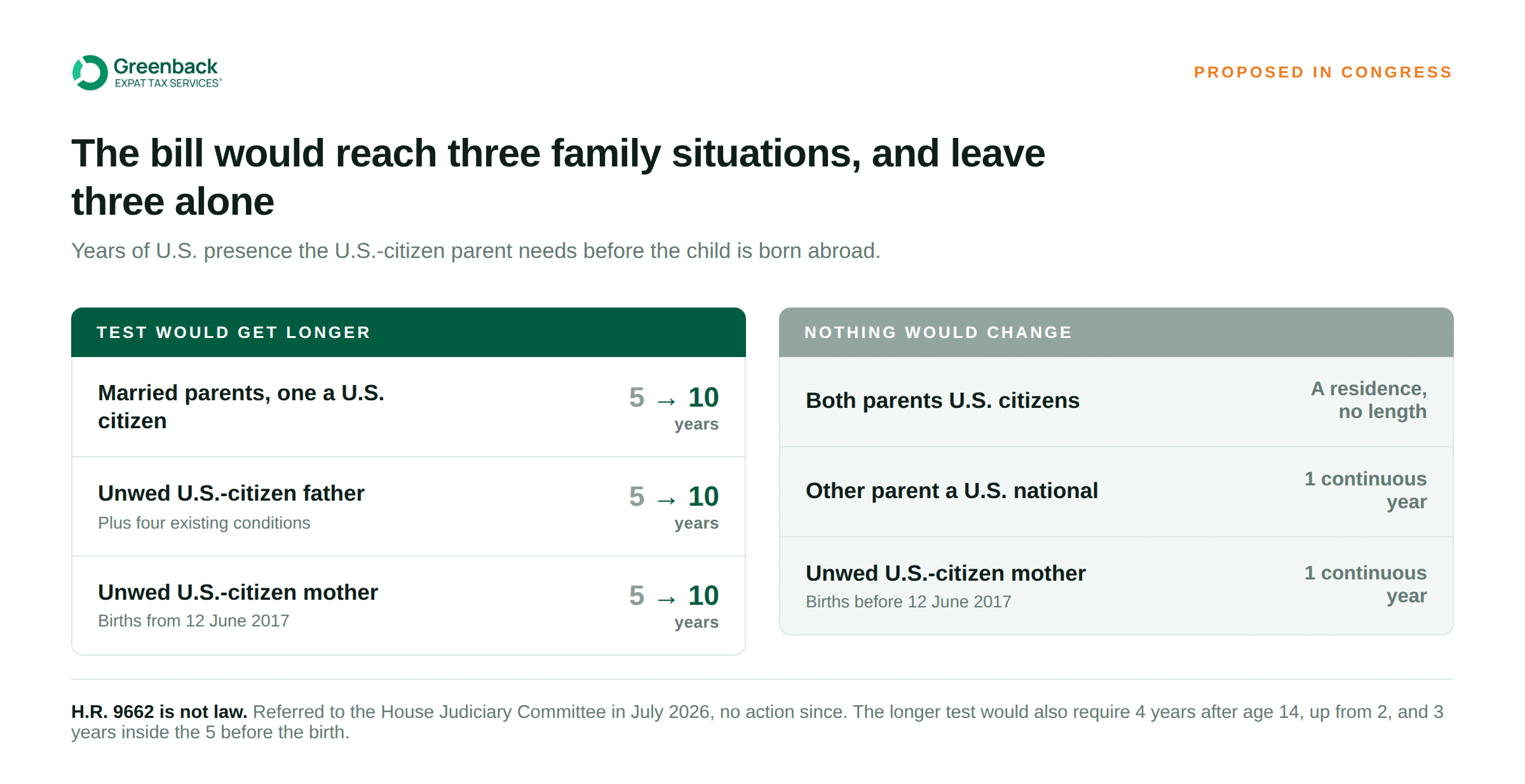
For families deciding where to give birth, the citizenship question depends on the citizen parent’s own U.S. time, regardless of the birth country.
Ten Years of Presence Would Replace Five
The statute counts a “period or periods totaling not less than five years,” so separate stretches add up. A semester at a U.S. university and two summers home go into the same total. The count stops the day the parent leaves, because only time physically in the United States or its outlying possessions qualifies.
The Government Publishing Office print of the bill strikes that language and inserts “not less than 10 years, at least 4 of which were after attaining the age of 14 years, and 3 of which were in the 5 years immediately preceding the birth of such person.”
Recency Has No Precedent Here
The 3 recent years are 3 of the 10, not 3 of the 4, and nothing requires them to fall after age 14. A ten-year total is not new by itself, since it was the rule until 1986.
Take an American who grew up in the United States, moved abroad at 22, and had a child at 26. Today she passes comfortably: 22 years of presence, eight after 14. Under the proposal, she meets the first two conditions but fails the third, because the five years before the birth span ages 21 to 26, and only one was spent in the United States. Move the birth to age 24, and she passes, with exactly three in-window years. Three years after a parent leaves, the requirement can no longer be met.
DNA Testing Applies to U.S. Births Only
The bill’s DNA and paternity requirements do not apply to births outside the country, and the scope is easy to misread. It creates a new section covering only a person “born in the United States to a mother who is not lawfully present” who claims citizenship through a citizen or permanent resident father. A birth abroad runs through a different subsection, which the new section does not reach as drafted.
Unwed Parents Land in the Same Subsection
An unmarried U.S.-citizen father faces the same presence test as a married one, plus four conditions: a blood relationship proved by clear and convincing evidence, U.S. nationality at birth, a written agreement to support the child until 18, and legitimation or acknowledgment of paternity before 18.
An unmarried U.S.-citizen mother once needed only one continuous year of presence. The Supreme Court ended that in 2017, holding the difference between mothers and fathers unconstitutional and applying the longer requirement to both mothers and fathers. The State Department draws the line at the decision date: the one-year rule covers births up to June 11, 2017, and the five-year test covers births from June 12, 2017. So a change confined to one subsection applies to unwed fathers, unwed mothers, and married parents in which the other parent is neither a U.S. citizen nor a U.S. national.
Consular Reports Document Status at Birth
The State Department issues a Consular Report of Birth Abroad to document that a child was a U.S. citizen at birth, and issues it only for children under 18. It is not a birth certificate.
Where one parent is not a U.S. citizen, or the citizen parent cannot attend, the State Department may require Form DS-5507, on which that parent records the periods of time they spent in the United States. Where the child was born out of wedlock to a U.S.-citizen father, the same form applies, and he must sign it in front of a consular officer, a U.S. notary, or a local official who registers births.
Citizenship acquired at birth does not depend on the report being filed. What filing late costs is proof, because those periods get harder to establish. In many countries, a Social Security card from abroad can also be requested at a U.S. embassy or consulate.
Filing Duties Begin at the Income Threshold
A child who is a U.S. citizen has U.S. filing obligations from the first year their income crosses the threshold, wherever they live, and whether or not they have ever set foot in the country. The United States uses citizenship-based taxation, which is why a presence test decides a tax question at all. An accidental American is exactly this: a citizen from birth who may never have lived in the country. The same child gets a U.S. passport, consular protection, the right to live and work in the country, and the credits and treaty positions dual citizens rely on.
Your Own Records Establish the Claim
- Add up the qualifying time before the appointment, not at it: School, work, and long visits all count, and the citizen parent has to prove them.
- Check the after-14 requirement on its own: It is a separate count from the ten-year total, not a subset that takes care of itself.
- Keep the documents that show physical presence: School and university transcripts, IRS tax transcripts, employment records, and old passports with entry stamps are what establish those periods.
- Apply for the Consular Report of Birth Abroad promptly: Evidence becomes harder to gather over time, and the report is issued only while the child is under 18.
- Ask an immigration attorney about citizenship itself: It is a nationality-law determination for the State Department, not a tax matter. Our answer for people who find out late and have never filed covers the tax side.
The Bill Has No Effective Date and No Hearing
H.R. 9662 contains no effective date and no applicability clause in any of its three sections. That silence stands out because the last amendment to this requirement settled the question in writing. When it was reduced from 10 years to 5 in 1986, Public Law 99-653 stated that the change “shall apply to persons born on or after November 14, 1986.” This bill has no equivalent line, so whether a court or the State Department would read it as prospective is a question for a nationality lawyer.
Congress.gov shows it referred to the House Judiciary Committee the day it was introduced, July 14, 2026, and nothing since. There is no Senate companion, no committee report, and no scheduled hearing.
Frequently Asked Questions
Yes. Every period of physical presence counts toward the total, including childhood. The catch is the second condition: under current law, at least two must fall after your fourteenth birthday, and this bill would raise that to four.
A Consular Report of Birth Abroad is issued only while the child is under 18, so that is the practical deadline for this document. The citizenship itself does not lapse. What gets harder is the evidence, because transcripts and old passports scatter over time.
Yes. Honorable service in the U.S. Armed Forces, employment with the U.S. Government, and employment with an international organization all count, as do periods spent overseas as the dependent unmarried child of someone in one of those roles. That exception is untouched in the bill as introduced.

This article describes a bill that has been introduced in the House of Representatives and referred to a committee. It is not law, and its provisions may change or fail to pass. Whether U.S. citizenship passed to a particular child is a nationality-law determination made by the U.S. Department of State, and this article is not legal advice on that question. The information in this article is for general informational purposes only and does not constitute tax, legal, or financial advice. Tax rules are complex and change frequently. Consult a qualified tax professional with expertise in cross-border reporting regarding your specific situation before taking any action.



Featured In





