U.S. Expatriation Reporting Hits Its Highest Level in Six Years


Four times a year, the U.S. government publishes the names of people whose loss of U.S. citizenship or long-term permanent resident status has been reported to the Treasury. The Federal Register list is one of the few public windows into expatriation. It is frequently used as a proxy for how many Americans are giving up their citizenship, even though it is not a true renunciation count.
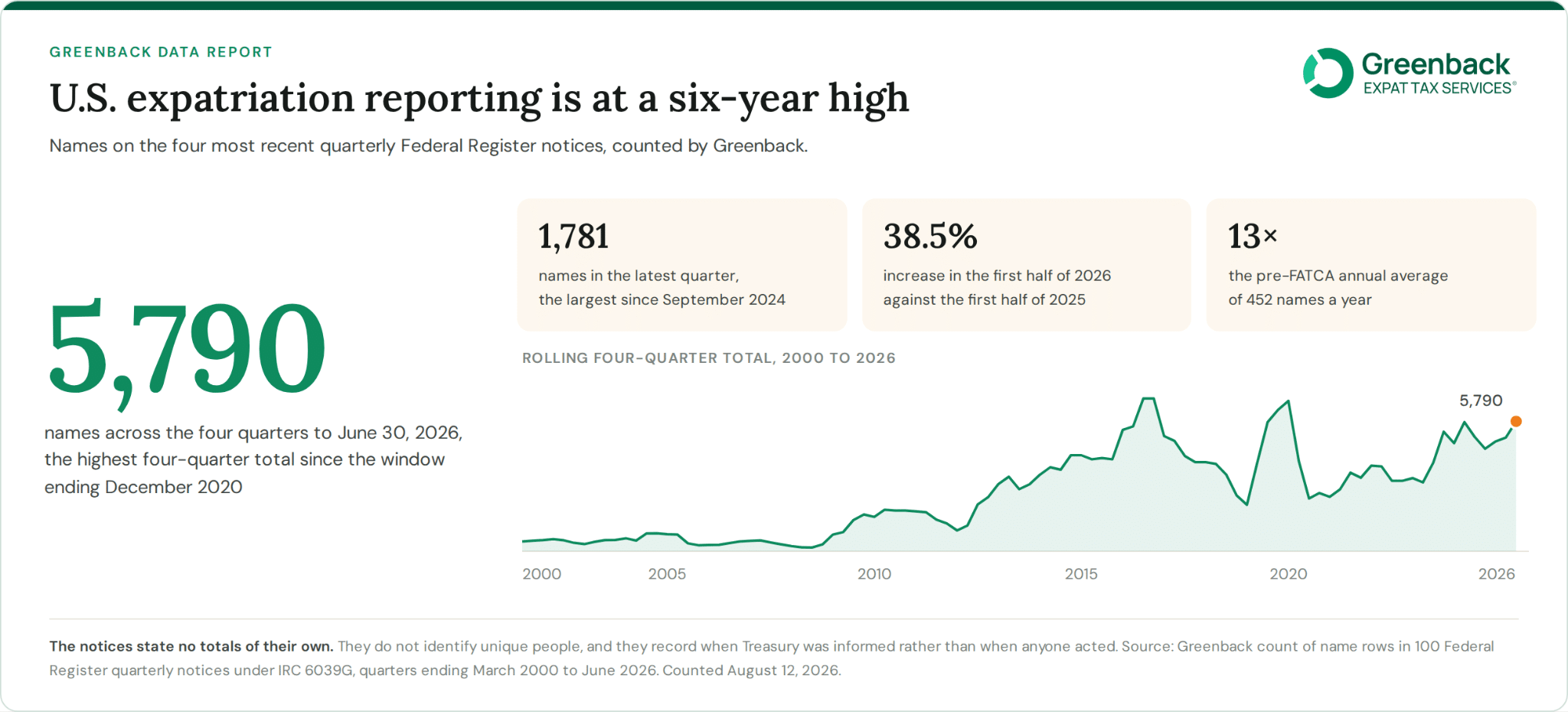
Over the past four quarters, 5,790 individuals appeared in the Treasury’s notices, the highest four-quarter total since 2020. The increase was especially sharp in the second quarter of 2026: 1,781 names were published, up 68.5% from the same quarter last year. That brought the first-half total to 3,243, up 38.5% year over year.
There are important limits to what those numbers tell us. The list reflects when Treasury receives information about an expatriation, not necessarily when it happened, so quarterly totals can lag the underlying decisions. It also includes certain long-term green card holders ending their U.S. residency for tax purposes, as well as former U.S. citizens.
To put the current rise into context, Greenback analyzed quarterly notices spanning more than two decades, historical State Department records reaching back to 1962, and 804 public comments submitted on the recent rule that reduced the consular renunciation fee.
The Rise Isn’t Coming From a Single Quarter
The upward trend is not the artifact of a single anomalous notice. Three of the past four releases topped 1,400 names each, pushing the trailing four-quarter total to 5,790, a sustained volume the Treasury has not reported since the end of 2020.
| Quarter ending | Published | Names listed |
| June 30, 2026 | July 23, 2026 | 1,781 |
| March 31, 2026 | April 22, 2026 | 1,462 |
| December 31, 2025 | January 23, 2026 | 954 |
| September 30, 2025 | November 17, 2025 | 1,593 |
| June 30, 2025 | July 23, 2025 | 1,057 |
Quarterly counts can move around considerably because the Federal Register reflects when the Treasury receives expatriation information, not necessarily when the underlying action occurred. Looking across four consecutive quarters helps smooth some of that administrative timing.
The latest notice is still notable on its own. The 1,781 names reported for the quarter ending June 30, 2026, made it the largest quarterly count since September 2024, when 2,123 names were listed.
The increase also shows up in the year-over-year comparison. The first two quarters of 2026 contained 3,243 names, compared with 2,342 over the same period in 2025, an increase of 38.5%. That makes the current rise broader than a single quarterly spike, although the reporting lag means the Federal Register cannot tell us exactly when the underlying expatriations occurred.
A Longer View Changes the Story
Look only at the modern Federal Register record, and the 2000s read like the natural resting state of American expatriation: seven complete years that averaged 452 published names, never rose above 762, and once fell to 231. That decade is the baseline against which almost every comparison of renunciation is measured, including ours.
Historical records tell a very different story
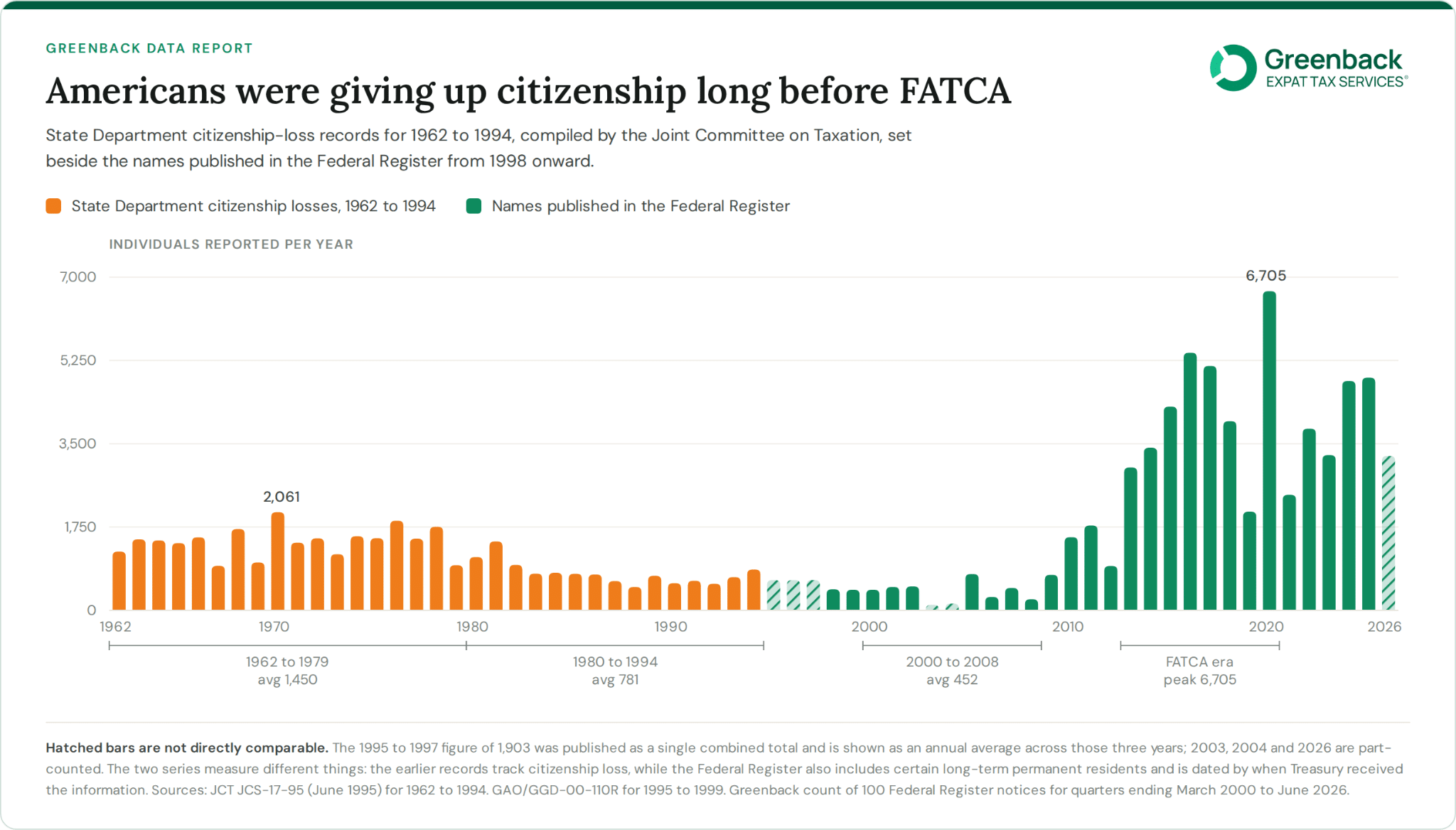
Decades before the modern quarterly lists existed, State Department records compiled by the Joint Committee on Taxation documented 37,818 Americans giving up U.S. citizenship between 1962 and 1994, an average of 1,146 per year. Citizenship losses were especially high throughout the 1960s and 1970s, averaging roughly 1,450 annually and peaking at 2,061 in 1970.
From 1980 through 1994, the average fell to roughly 781 per year. By the 2000s, the Federal Register counts were lower still.
The two datasets are not directly interchangeable. The earlier State Department figures track citizenship loss, while the modern Federal Register notices also include certain long-term green-card holders and reflect when the Treasury receives expatriation information rather than when the underlying action occurred. But the longer record makes one thing clear: Americans were giving up citizenship in substantial numbers decades before FATCA or today’s offshore reporting rules. The very low counts of the 2000s were not representative of the longer pre-FATCA history.
The Eras of Expatriation
Comparing today’s rolling four-quarter total of 5,790 with the 2000 to 2008 Federal Register average produces a striking 13-fold difference. But the longer history shows that this is a surge from an unusually low period, rather than from a typical pre-FATCA baseline.
- 1962 to 1979: Citizenship losses averaged roughly 1,450 per year and reached 2,061 in 1970.
- 1980 to 1994: The average fell to roughly 781 annually.
- 1995 to 1997: Early Federal Register publications incorporated prior-period citizenship losses, making individual-year totals difficult to interpret. The Government Accountability Office noted that figures for these years “are not distinguished by year because the IRS published the total number of expatriates for all 3 years in 1997.”
- 2000 to 2008: Federal Register counts averaged just 452 names annually across the seven complete years available.
- 2010 to 2018: Published counts climbed sharply during the period surrounding FATCA’s implementation, reaching 5,409 in 2016.
- 2019 to present: Counts fell to 2,071 in 2019, jumped to a Federal Register era record of 6,705 in 2020, and have remained elevated and uneven since. The latest rolling four-quarter total stands at 5,790.
The modern rise makes for a great headline, but the longer record complicates the usual story. High levels of citizenship loss are not new. What stands out historically is how quiet the 2000s were before the modern increase began.
There Is No Single Renunciation Count
The Federal Register list is commonly cited as a proxy for the number of Americans who renounce their citizenship. But no single federal dataset provides a comprehensive real-time count of U.S. citizenship renunciations.
Instead, Treasury and the State Department track different parts of expatriation:
- Treasury and the Federal Register: Publishes names reported under Internal Revenue Code Section 6039G. The list includes former U.S. citizens as well as certain long-term permanent residents who end their U.S. residency for tax purposes. It reflects when Treasury receives the information, not necessarily when the expatriation occurred, and the notices do not publish an aggregate total or unique identifiers.
- State Department: Tracks citizenship-loss activity through the consular process, including Certificates of Loss of Nationality.
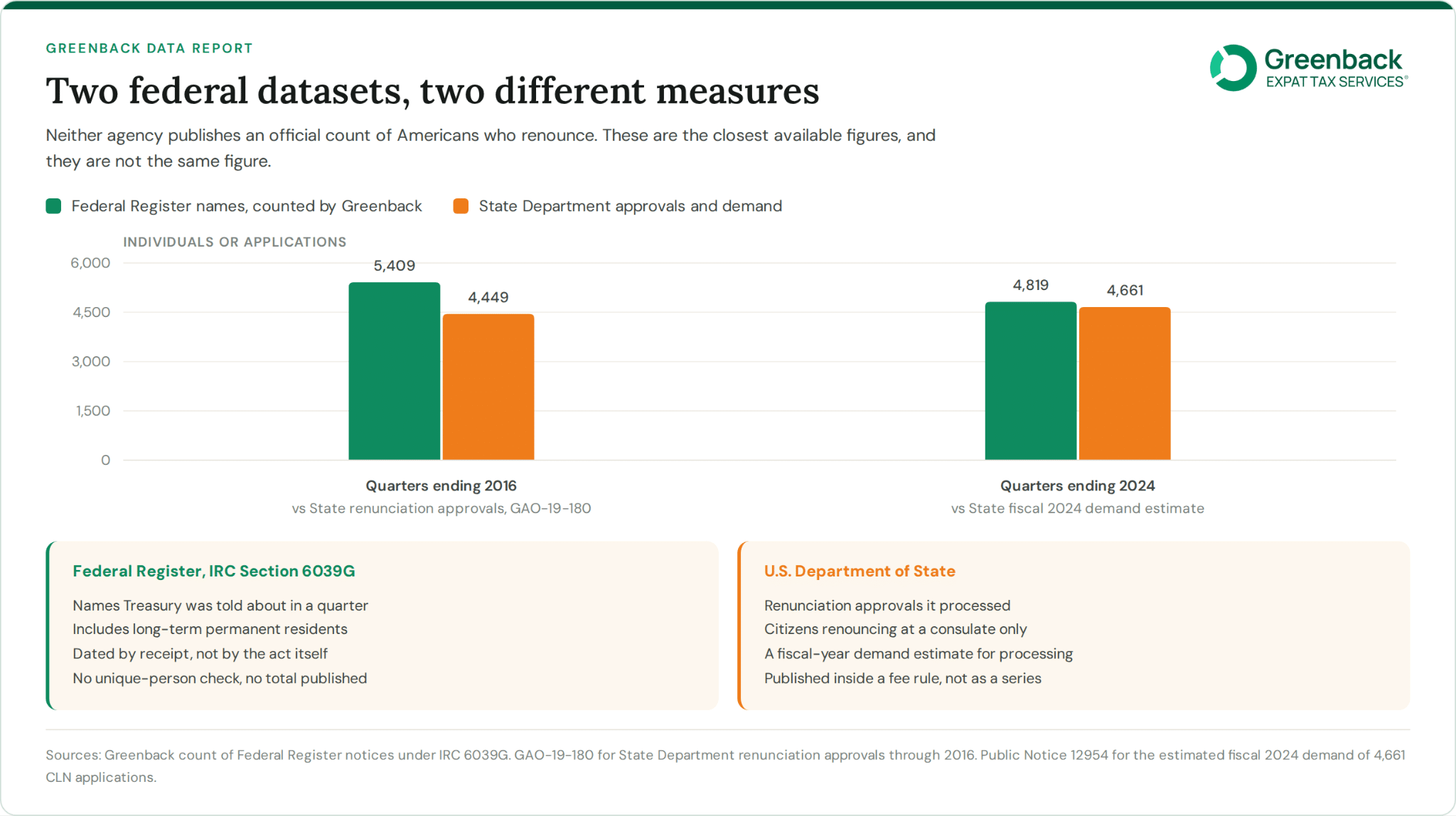
Because the two systems measure different populations and different stages of the process, their figures do not match. In 2016, the State Department reported 4,449 approved citizenship renunciations, while Greenback counted 5,409 names across the four Federal Register notices covering that year, a difference of nearly 1,000.
The gap was smaller in 2024, although the comparison is less direct. The State Department estimated the fiscal 2024 demand for Certificate of Loss of Nationality processing at 4,661 applications, while Federal Register notices covering quarters ending in calendar 2024 contained 4,819 names.
Neither figure is wrong. They measure different things. State Department data provide a narrower view of citizenship-loss processing, while the Federal Register captures a broader group of expatriates reported to Treasury. That is why this report refers to names published rather than treating the Federal Register total as a literal count of Americans who renounced citizenship.
Why We Don’t Calculate a Renunciation Rate
It may seem simple to divide the Federal Register count by an estimate of the number of Americans living abroad. But the numerator and denominator do not describe the same population.
- Different populations: The Federal Register includes certain long-term green card holders, whereas estimates of Americans abroad generally count U.S. citizens.
- Different timing: The Federal Register reflects when Treasury receives expatriation information, not necessarily when the underlying action occurred.
The data can show how published expatriation counts change over time, but it cannot support a precise annual percentage of Americans renouncing their citizenship.
Interest in Renouncing Was Rising Before the Fee Changed
The State Department first proposed lowering the consular renunciation fee from $2,350 to $450 in October 2023. The change did not take effect until April 2026, creating a two-and-a-half-year period when a major reduction had been publicly proposed but was not yet available.
During that window, multiple indicators of interest in renunciation moved higher.
This sequence does not prove causation. The public proposal may have influenced the timing of some decisions, just as tax obligations, political developments, or personal circumstances may have. A search query, a survey response, and a Treasury listing also cannot be linked to the same person. The data can show what was happening while the fee reduction worked its way through the rulemaking process.
More Expats Said They Were Considering Renunciation
Greenback’s annual Expat Trends Survey recorded a clear shift between 2023 and 2025. In 2025, 49% of surveyed U.S. expats said they planned to renounce citizenship or were seriously considering it, up from 30% in 2024 and 20% in 2023.
The reasons changed as well:
- 2024: Tax compliance was the most frequently cited factor (75%), followed by strong ties to another country (58%) and dissatisfaction with the direction of the U.S. government (55%).
- 2025: Dissatisfaction with the direction of the government became the leading factor, while 83% of respondents still described U.S. tax filing requirements as stressful.
The surveys point to a mix of motivations rather than a single explanation. Tax and reporting burdens remained prominent, alongside political concerns and people’s lives and ties outside the United States.
Search Interest Pointed in the Same Direction
Search activity moved in the same window. Worldwide monthly searches for “renounce us citizenship” reached roughly 8,100, up 37% on the previous year, while U.S. searches rose 17% to about 2,900 a month.
The 20-year record is what gives those figures meaning. The term barely registered before 2008, climbed through 2011, spiked sharply in 2012, then held well above its early levels through the 2010s. It spiked again in late 2021 and reached its highest level in the series in 2025.
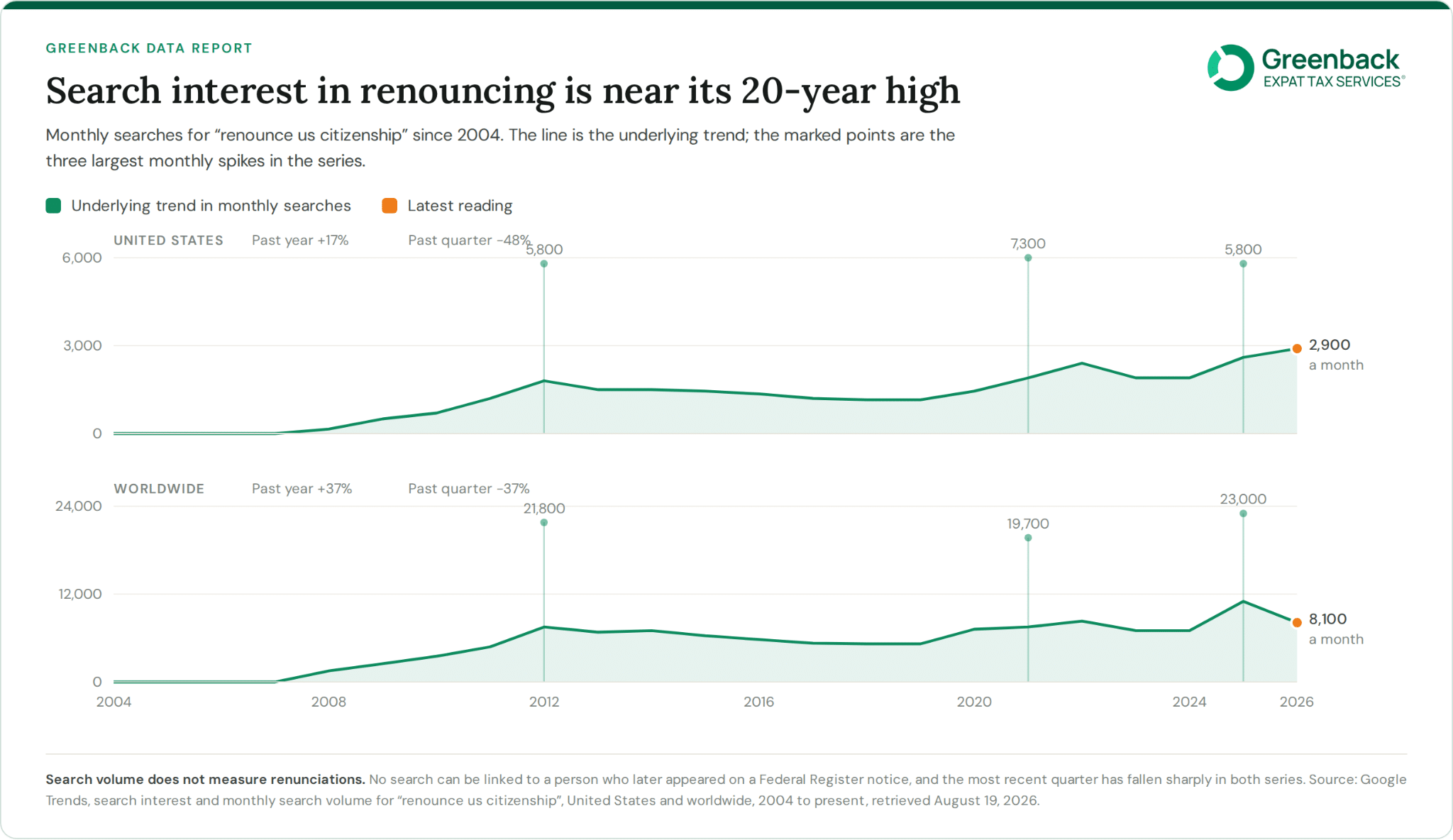
The most recent quarter has eased, down 48% in the U.S. and 37% worldwide. So the shape is a long climb with a sharp recent pullback, and the peaks came more than a year after the fee reduction was proposed and before it took effect.
Search volume does not measure renunciations, and no search can be linked to a person who later appeared on a Federal Register notice. What it shows is that public attention rose during the years when the lower fee had been proposed but was not yet available.
The Fee Change Is Not a Clean Before-and-After
By the time the $450 fee took effect in April 2026, the proposal had been public for more than two years. During that period, more surveyed expats said they were considering renunciation, search interest climbed to the highest level in its 20-year record, and Federal Register counts eventually rose.
That makes it difficult to treat April 2026 as a clean dividing line. The prospect of a lower fee was already part of the picture, alongside changing political sentiment, tax and reporting burdens, and individual circumstances. Future Federal Register notices can show whether published counts change after the lower fee became available, but they still will not tell us why any individual chose to expatriate.
The Renunciation Fee Rose 422%, Then Fell 81%
For more than a decade, the cost of formally documenting a renunciation was one of the most visible barriers in the process. The State Department raised the fee from $450 to $2,350 in September 2014, then returned it to $450 in April 2026.
| Period | Fee | What the Department said |
| Before September 2014 | $450 | Set below the cost of service |
| September 2014 to April 2026 | $2,350 | Raised on rising demand and processing cost |
| From April 2026 | $450 | Returned to the earlier level |
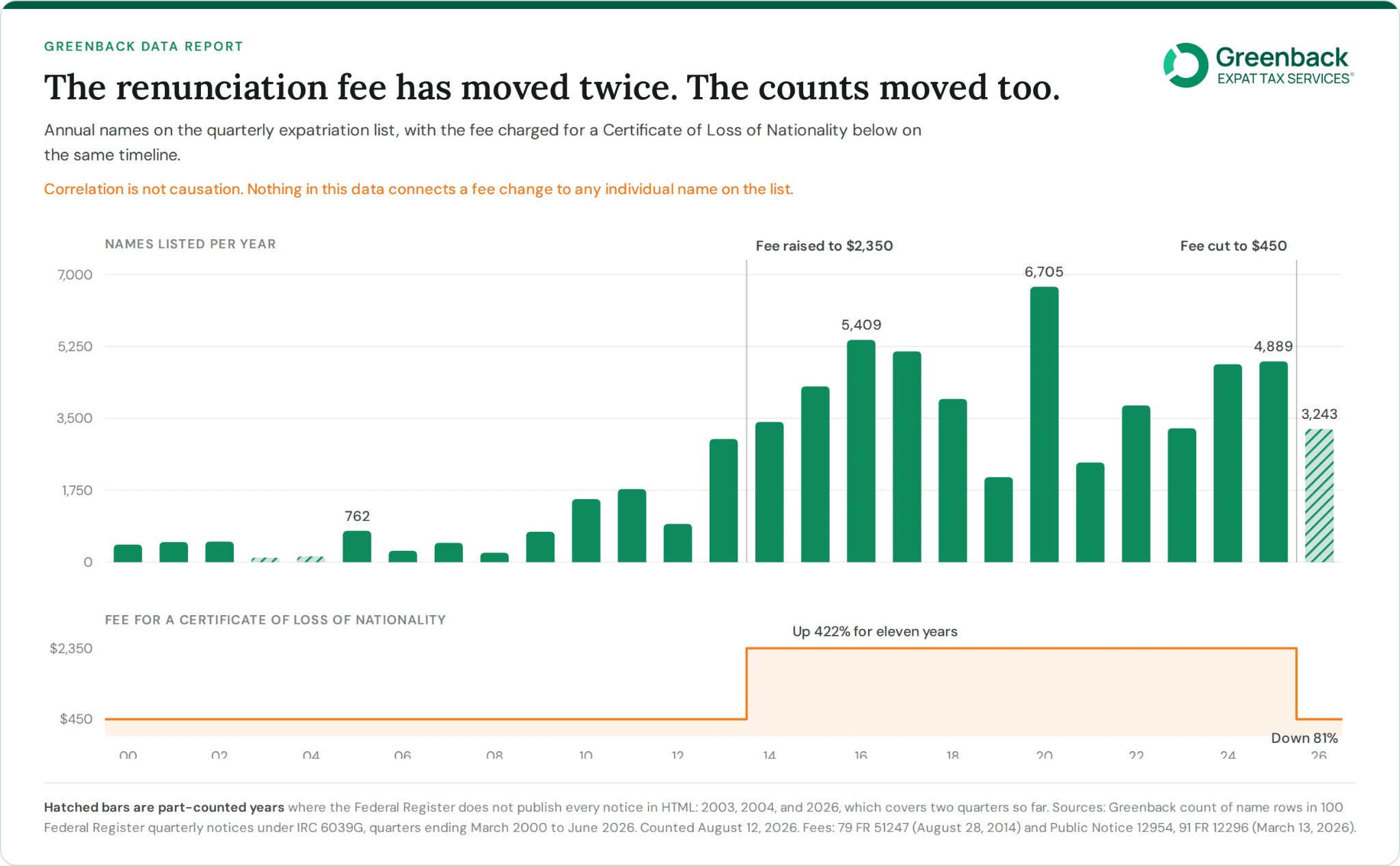
When the State Dept raised the fee in 2014, it cited growing demand and the cost of processing renunciations. The Department said the existing $450 charge covered less than one-quarter of the cost to the government of providing the service.
Nine years later, the State Department proposed reversing that increase. The final rule returned the fee to $450, estimated fiscal 2024 demand at 4,661 applications, and projected that the lower fee would reduce annual revenue by about $8.9 million.
The proposal drew 910 public comments. But those comments reveal something the fee history alone does not: most people who wrote to the government were not primarily arguing about the cost of renouncing. They were using the proceedings to discuss the broader tax, reporting, and financial burdens they associated with remaining a U.S. citizen while abroad.
What 804 Public Comments Reveal
When the State Department proposed lowering the renunciation fee, it invited public comment. Greenback analyzed the 804 written comments in the federal rulemaking record to see what people said about the proposal and the broader experience of maintaining U.S. citizenship abroad.
The State Department says it received 910 comments on the proposed fee reduction. Public comments available in the record total 805 submissions, 804 of which contain written text, and the rule does not reconcile the discrepancy. The proposed rule also invited comments by email, a channel that never appears in the docket.
These comments are not a representative survey of Americans abroad. They reflect people who chose to respond to the proposed rule. But they provide hundreds of first-person accounts of the tax, financial, and practical issues people associated with U.S. citizenship overseas.
The Docket Was About Much More Than the Fee
Very few commenters argued that the $2,350 fee should remain. Only five comments Greenback analyzed opposed reducing it.
But support for a lower fee was almost beside the point. 95.5% of the comments raised a broader grievance about the U.S. tax system, closely matching the State Department’s own finding that 880 of the 910 comments it received expressed frustration with worldwide taxation or the cost of compliance.
People were being asked about the cost of giving up U.S. citizenship. Much of what they chose to talk about instead was the cost and complexity of keeping it.
More Than Half the Comments Reused Template Language
Organized campaigns played a major role in the response. Greenback used two methods to identify repeated language. Both methods classified 414 comments, or 51.4%, as template-derived, while either method identified 449, or 55.8%.
Three campaign templates accounted for most of the repeated language:
- Democrats Abroad template: 266 comments matched the template the organization publicly provided.
- Accidental Americans template: 139 comments matched a repeated template associated with positions the State Department attributed to L’Association des Américains Accidentels.
- Residence-based taxation template: 21 comments shared a smaller repeated text pattern; its specific sponsor could not be established.
The State Department itself acknowledged that many comments were drawn wholly or partly from templates supplied by advocacy groups. Its analysis reports how many commenters raised particular issues. Greenback’s analysis adds another layer: which positions were concentrated in the repeated template language and which remained common in the original comments.
That distinction changes the picture.
| Issue | All comments | Original comments |
| Proposed $63.25 fee | 18% | 2% |
| Remote renunciation | 17% | 1% |
| Comparisons with other consular fees | 35% | 7% |
| FATCA | 33% | 23% |
| FBAR | 8% | 16% |
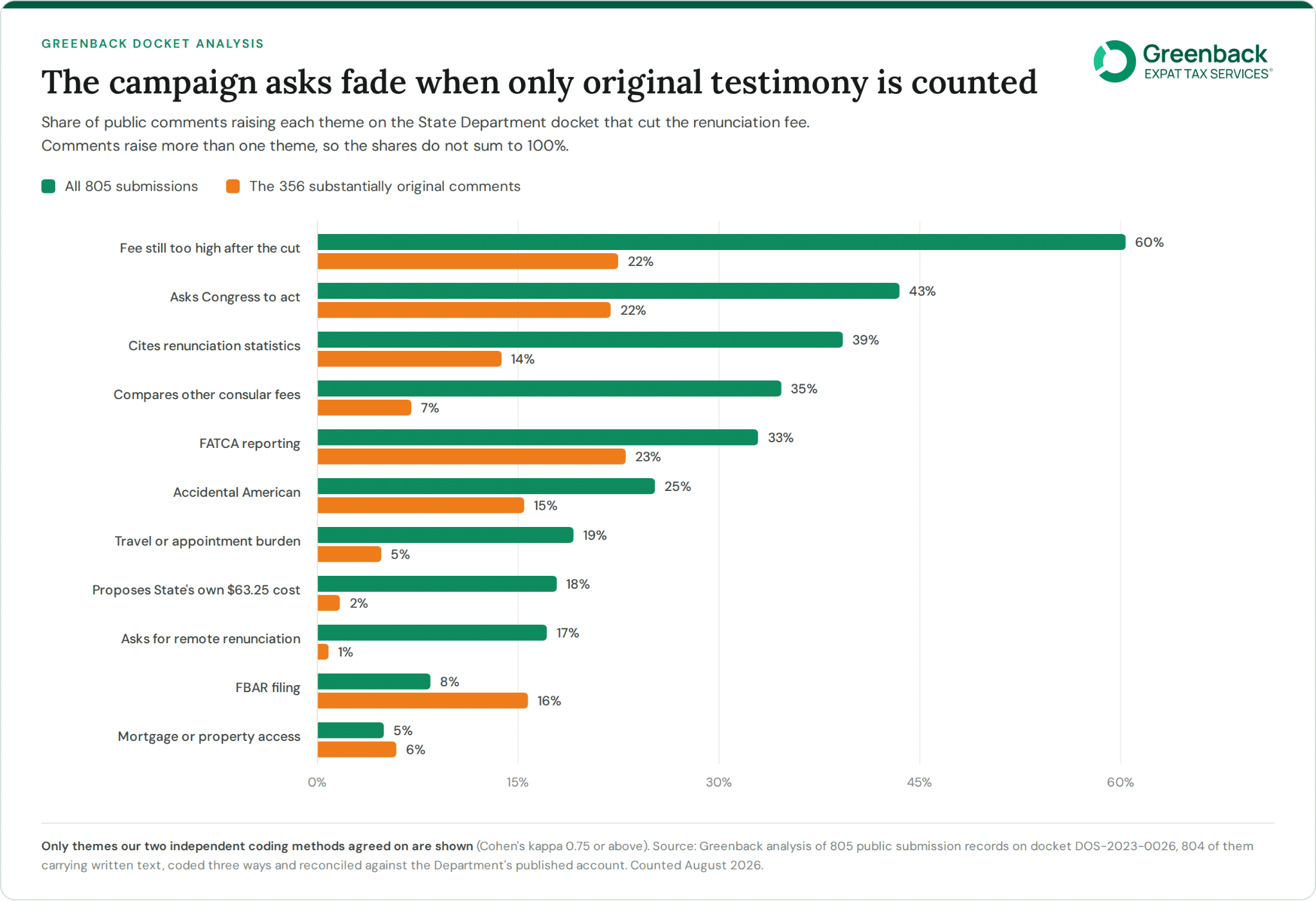
The difference is most pronounced for the fee-specific proposals. The $63.25 fee appears in 18% of all comments but only 2% of original comments; remote renunciation falls from 17% to 1%, and comparisons with other consular fees fall from 35% to 7%. FATCA remains prominent in the original comments, while FBAR concerns are becoming more common. Nearly half of the comments matched to the identified templates also contained personal testimony, often added under a “My Story” section. The templates provided a structure for participation, and many used it to describe their own experiences.
For Some Commenters, Annual Compliance Costs Exceeded the New Fee
Forty-four commenters put a dollar figure on what they said they spent each year to remain compliant with U.S. tax obligations. Across 48 states, the median annual cost was about $1,200, more than twice the new $450 renunciation fee.
One commenter asked:
“Why should a US citizen living in another country and not engaging in money laundering have to pay $1,000 or more annually for an IRS-certified tax preparer to declare that (s)he owes no money to the US government?”
Another compared the two costs directly:
“I would have renounced my U.S. citizenship years ago were it not for the high fee involved, but I would quickly do that if the fee were lowered to $450 U.S., about what I’ve been paying my accountant every year.”
Some Commenters Weren’t Planning to Renounce
Not everyone who responded was considering giving up U.S. citizenship. Some commenters said they intended to keep their citizenship but still used the proceeding to describe tax, banking, or compliance burdens they believed should change. Others wrote about the experiences of family members or, more broadly, of Americans abroad.
Their presence reinforces the broader pattern in the comments: the fee proposal became a forum for concerns about the treatment of Americans abroad, not just a debate over the price of renunciation.
What the Data Cannot Tell Us
Taken together, the data point to three broader findings:
- First, the current increase is documented, but it looks different in a longer historical context. The latest four-quarter Federal Register total is the highest since 2020, yet earlier State Department records show that Americans were giving up citizenship in substantial numbers decades before FATCA. What stands out historically is how unusually quiet the 2000s were before the modern rise.
- Second, interest in renunciation was changing while the lower fee was still working its way through the rulemaking process. More expats reported considering renunciation, search interest climbed to the highest levels in its 20-year record, and Federal Register counts later increased. The $450 fee did not take effect until April 2026, more than two years after it was first proposed.
- Third, the public comments show that the debate extended well beyond the renunciation fee itself. Most commenters raised broader complaints about the U.S. tax system, and Greenback’s template analysis found that several specific fee proposals were concentrated in organized campaign language while concerns about FATCA, FBAR, and recurring compliance burdens remained prominent in original comments.
What the data cannot establish is why the latest Federal Register counts increased. The datasets measure different people at different points in time. A search cannot be connected to a survey response, a public comment, or a later Federal Register entry. And because Treasury records receipt of expatriation information rather than when the underlying action occurred, the quarterly lists cannot be cleanly matched to a political event or policy change.
One political development is worth watching alongside the next notice
On April 28, 2026, Representative Dina Titus introduced the Commission on Americans Living Abroad Act of 2026, H.R. 8561, which would create a ten-member presidential commission, capped at six members from any one party, to study how federal laws affect U.S. citizens abroad, including the financial reporting requirements that shape access to banks. It has been referred to seven House committees without changing the law, and it shows that the compliance and financial-access problems described in the comment record have congressional attention.
It is also too early to know what effect, if any, the lower $450 fee will have. Only one published quarter so far ends after the April 2026 change, and the history of the Federal Register series shows that individual quarters can vary substantially. The next several notices will provide more evidence, but they still will not reveal the motivations behind individual expatriations.
Considering renunciation?
Giving up citizenship can have significant tax consequences, including Form 8854 requirements and possible covered-expatriate status. Covered-expatriate status can also matter later: certain gifts or bequests from a covered expatriate to a U.S. citizen or resident may trigger tax under Section 2801, and final regulations apply to covered gifts and bequests received on or after January 1, 2025, with U.S. recipients reporting the tax on Form 708. See our guides to the renunciation process, the exit tax, Form 8854, and getting caught up on U.S. filings.

Born a U.S. citizen, built your life elsewhere
Greenback Methodology
Federal Register expatriation data:
Greenback counted the names published in the 100 Quarterly Publications of Individuals Who Have Chosen To Expatriate notices covering quarters from March 2000 through June 2026. Together, those notices contain 64,849 published names. Annual totals are assigned to the year of the covered quarter, rather than to the publication date, and rolling four-quarter totals sum four consecutive reported quarters.
Some earlier notices, including several from 2003 and 2004, are available only as scanned documents rather than searchable HTML. Years with missing quarters are considered incomplete and are not used in comparisons that require a full calendar year. The Federal Register publishes names rather than an official total, so all figures in this report are Greenback’s counts of the individual entries.
Historical citizenship-loss data:
To place the modern Federal Register series in a longer context, Greenback also used State Department citizenship-loss figures compiled by the Joint Committee on Taxation for 1962 through 1994. Those records document 37,818 instances of citizenship loss over the period.
The historical and modern series are not directly interchangeable. The earlier State Department figures measure citizenship loss, while the Federal Register also includes certain long-term permanent residents and reflects the timing of the Treasury’s receipt of expatriation information. The 1995 to 1997 period is treated as a reporting transition because early Federal Register publications included citizenship losses from prior periods.
Public comments:
Greenback analyzed 804 written comments available in the federal rulemaking record for the State Department proposal to reduce the renunciation fee. The comments were reviewed for recurring themes, specific financial claims, and repeated template language.
To distinguish coordinated advocacy from independently written testimony, Greenback compared comments against identified template language and analyzed separately those that did not substantially reproduce the templates. Where different review methods did not agree closely enough to support a reliable count, the report describes the finding qualitatively rather than assigning a percentage. Twenty submissions include attachments; seven of those could not be read and are coded based solely on their metadata. Every quoted passage was verified as an exact substring of its source comment. The comments are self-selected and should not be interpreted as representative polling of Americans abroad. Costs and other personal experiences described by commenters are self-reported and were not independently verified.
Survey and search data:
Greenback’s 2023 to 2025 Expat Trends surveys are used as measures of stated attitudes among the expats who responded, not as estimates of all Americans abroad. Search data is used only as an indicator of changes in public interest over time. Neither can be connected to an individual Federal Register entry or used to establish why someone ultimately expatriated.
Sources
Federal Register
- The full collection of quarterly expatriation notices: https://www.federalregister.gov/quarterly-publication-of-individuals-who-have-chosen-to-expatriate
- Latest notice, quarter ending June 30, 2026, published July 23, 2026: https://www.federalregister.gov/documents/2026/07/23/2026-14841/quarterly-publication-of-individuals-who-have-chosen-to-expatriate
U.S. Department of State
- 2014 fee increase rule, raising the fee to $2,350 effective September 6, 2014: https://www.federalregister.gov/documents/2014/08/28/2014-20516/schedule-of-fees-for-consular-services-department-of-state-and-overseas-embassies-and
- October 2023 proposed fee-reduction rule: https://www.federalregister.gov/documents/2023/10/02/2023-21559/schedule-of-fees-for-consular-services-fee-for-administrative-processing-of-request-for-certificate
- March 2026 final rule, Public Notice 12954, effective April 13, 2026, with the analysis of comments, the fiscal 2024 demand estimate, and the revenue projection: https://www.federalregister.gov/documents/2026/03/13/2026-04931/schedule-of-fees-for-consular-services-fee-for-administrative-processing-of-request-for-certificate
- Regulations.gov public comment record, docket DOS-2023-0026: https://www.regulations.gov/docket/DOS-2023-0026
Government Accountability Office
- GAO/GGD-00-110R, Information Concerning Tax-Motivated Expatriation, for the 1995 to 1999 transition and the 1995 to 1997 combined reporting: https://www.gao.gov/products/ggd-00-110r
- GAO-19-180, Foreign Asset Reporting, for State Department renunciation approvals from 2011 through 2016: https://www.gao.gov/products/gao-19-180
Joint Committee on Taxation
- JCS-17-95, Issues Presented By Proposals To Modify The Tax Treatment Of Expatriation, June 1995, containing the State Department citizenship-loss data for 1962 through 1994: https://www.jct.gov/publications/1995/jcs-17-95/
Google Trends
- Search interest and monthly search volume for “renounce us citizenship”, United States and worldwide, 2004 to present, retrieved August 19, 2026: https://trends.google.com/trends/explore?date=all&q=renounce%20us%20citizenship
Greenback Expat Tax Services
- 2025 Expat Trends Survey: https://www.greenbacktaxservices.com/blog/expat-trends-survey/
- 2024 Annual Expat Survey: https://www.greenbacktaxservices.com/blog/2024-us-expat-survey-insights/
This article is for informational purposes and is not tax advice. Figures cited were verified against the Federal Register, the State Department, the Government Accountability Office, the Joint Committee on Taxation, Congress.gov, Google Trends, and Greenback survey sources. Greenback Expat Tax Services is a U.S. tax preparation firm with expertise in the returns of Americans living outside the United States.
Featured In





