Form 8832 for Expats Explained: Choosing Your Business Tax Classification
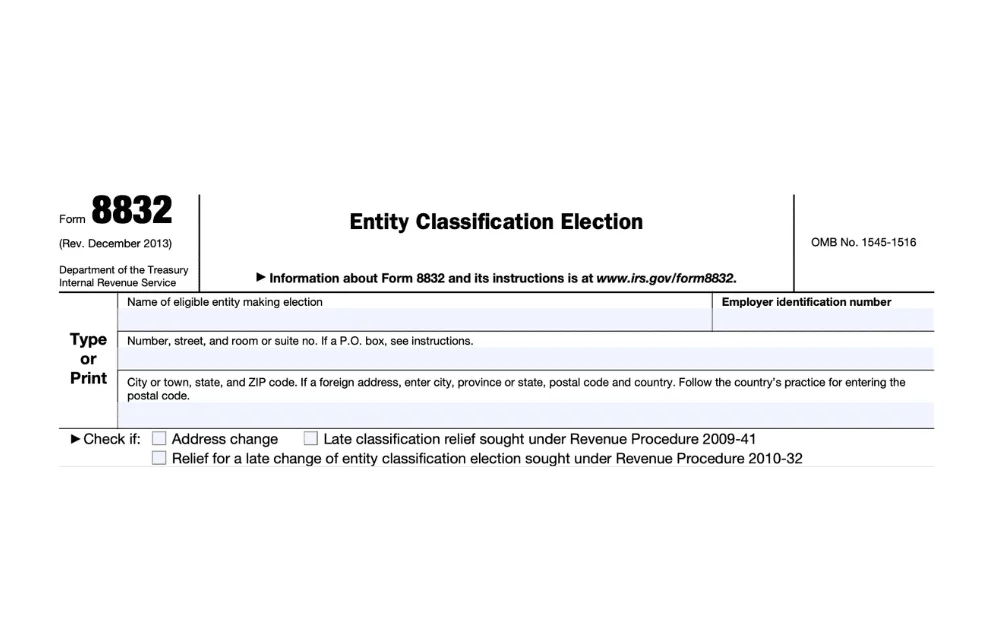


Form 8832 lets eligible businesses choose how the IRS classifies them for tax purposes, specifically as a corporation, partnership, or disregarded entity. Filing is completely optional, and if you’re satisfied with your business’s default classification, there’s no need to file.
According to the IRS, Form 8832 is used by eligible entities to elect a classification other than their default classification. The most common reasons to file are:
- Reducing self-employment tax by electing corporate treatment for an LLC
- Simplifying reporting for a foreign entity by electing disregarded entity status
- Avoiding complex CFC rules by changing how the IRS views your foreign business structure
- Aligning U.S. tax treatment with how your business is classified in your host country

Not Sure If Changing Your Tax Classification Makes Sense?
Here’s how default classifications work, when changing yours makes sense, and why this decision matters even more for Americans with businesses abroad.
What Is Form 8832?
Form 8832, officially titled “Entity Classification Election,” is a one-time IRS form that allows eligible business entities to choose their federal tax classification. This is sometimes called the “check-the-box” election because you’re literally checking a box on the form to tell the IRS how to treat your business.
The three classification options are:
- Corporation (taxed at the entity level with potential double taxation on distributions)
- Partnership (income passes through to owners’ individual returns)
- Disregarded entity (entity is ignored for tax purposes; income reports directly on the single owner’s return)
If you don’t file Form 8832, the IRS applies default classification rules based on your entity type and where it was formed. Many businesses operate just fine under their default status. The form only matters when the default doesn’t align with your tax goals.

Form 8832 is not used to elect S corporation status. That requires Form 2553.
What Are the Default Classification Rules?
The IRS assigns a default tax classification to every business entity based on two factors: where it was formed and how many owners it has. These defaults apply automatically unless you file Form 8832.
Domestic Entities (Formed in the U.S.)
| Entity Type | Default Classification | Tax Treatment |
|---|---|---|
| Single-member LLC | Disregarded entity | Income reported on owner’s Form 1040 (Schedule C) |
| Multi-member LLC or partnership | Partnership | Files Form 1065; owners report on Schedule K-1 |
| Corporation (Inc., Corp.) | Corporation | Not eligible for Form 8832 (classification is fixed) |
Foreign Entities (Formed Outside the U.S.)
Foreign default rules depend on whether owners have limited liability under local law:
| Entity Structure | Default Classification | Why |
|---|---|---|
| Single owner, no limited liability | Disregarded entity | Similar to a sole proprietorship |
| Two+ owners, at least one without limited liability | Partnership | At least one owner has personal exposure |
| All owners have limited liability | Corporation | Mirrors a standard corporation structure |
This is where it gets critical for expats. Most foreign business entities (like a UK Ltd, German GmbH, or French SARL) provide limited liability to all owners. That means the IRS treats them as corporations by default, triggering Form 5471 filing requirements, potential CFC rules, and GILTI income inclusions.
Filing Form 8832 to elect disregarded entity status for a single-member foreign entity can dramatically simplify your reporting. Instead of Form 5471 and CFC calculations, you’d file Form 8858 and report income on Schedule C.

Certain foreign entities are classified as “per se” corporations under Treasury Regulations 301.7701-2(b)(8) and cannot use Form 8832 to change their classification. The IRS maintains a specific list by country. Common examples include a Japanese Kabushiki Kaisha (KK), a German Aktiengesellschaft (AG), and a Brazilian Sociedade Anonima (SA). Your entity must be confirmed as “eligible” before filing.
Who Can (and Cannot) File Form 8832?
Eligible to File
- Domestic LLCs (single or multi-member)
- Domestic partnerships
- Foreign LLCs and partnerships
- Foreign eligible entities not on the IRS per se corporation list
- Foreign entities that previously elected corporate status and want to change back (subject to the 60-month rule)
Not Eligible to File
- Domestic corporations (Inc., Corp.) formed under state incorporation statutes
- Foreign per se corporations listed in Treasury Regulations 301.7701-2(b)(8)
- Tax-exempt organizations
- REITs (Real Estate Investment Trusts)
- Entities seeking S corporation status (use Form 2553 instead)
When Should I File Form 8832?
Form 8832 has no fixed deadline because it’s optional. You can file it when your business is first formed, or at any point during its lifetime. However, timing matters.
Effective Date Rules
When you file Form 8832, you choose an effective date for your new classification. That date must fall within:
- 75 days before the filing date, or
- Up to 12 months after the filing date
If you don’t specify a date, the effective date defaults to the day the IRS receives the form.
The 60-Month Rule
Once the IRS accepts your election, you generally cannot change your classification again for 60 months (five years). There are limited exceptions, including situations where more than 50% of ownership changes hands. An expat tax specialist can advise whether an exception applies to your situation.
Late Election Relief
If you missed your intended effective date, Part II of Form 8832 allows you to request late election relief. You’ll need to explain why the election wasn’t filed on time and demonstrate that you and all affected parties acted consistently with the intended classification from the requested effective date. Revenue Procedure 2009-41 outlines the specific requirements.
Why Does This Decision Matter More for Expats?
For Americans living and working abroad, the entity classification election can have outsized consequences. The wrong default classification can trigger complex and expensive reporting requirements, while the right election can simplify your filing and potentially save thousands.
Scenario 1: Foreign LLC Defaulting to Corporation
You form a single-member LLC in the UK to run your consulting business. All members have limited liability under UK law, so the IRS defaults this entity to a corporation. Without Form 8832, you would need to:
- File Form 5471 annually (the IRS estimates 30+ hours to prepare)
- Calculate GILTI (Global Intangible Low-Taxed Income) on your business profits
- Navigate Subpart F income rules
- Face $10,000 penalties per year for each missed Form 5471
With Form 8832: You elect disregarded entity status. Now you report business income on Schedule C, file the simpler Form 8858, and avoid the CFC/GILTI rules entirely.
Scenario 2: Reducing Self-Employment Tax
You run a profitable freelance business through a domestic single-member LLC. By default, it’s a disregarded entity, meaning all profits flow to your Schedule C and you pay 15.3% self-employment tax on the full amount (even after using the Foreign Earned Income Exclusion to eliminate income tax).
With Form 8832: You elect C corporation status. Now you can pay yourself a reasonable salary (subject to self-employment tax) and retain remaining profits in the corporation at the 21% corporate rate, potentially reducing your overall tax burden. This strategy requires careful planning and is not always beneficial, so consult a tax professional first.
Scenario 3: Multi-Member Foreign Business
You and a partner own a business in Costa Rica. All owners have limited liability, so the IRS classifies it as a foreign corporation by default. You’d both need to file Form 5471.
With Form 8832: You elect partnership status. Now the entity files as a foreign partnership, and you’d file Form 8865 instead. Depending on your situation, this may simplify reporting or better align with how the business is treated locally.
How Do I File Form 8832?
Form 8832 is filed by mail. You cannot e-file it. Here’s what you need:
- Business name, address, and EIN (Employer Identification Number)
- Owner information (name and taxpayer identification number for single-owner entities)
- Election type (initial classification for new entities, or change for existing ones)
- Effective date (within the 75-day/12-month window)
- Consent signatures from each owner (or an authorized officer)
Where to Mail
| Your Location | Mail Form 8832 To |
|---|---|
| U.S.-based filers | Kansas City, MO 64999 or Ogden, UT 84201-0023 (depends on state; see IRS instructions) |
| Americans living abroad | Department of the Treasury, Internal Revenue Service, Ogden, UT 84201-0023 |
The IRS should respond within 60 days. If accepted, attach a copy of Form 8832 to your federal income tax return for the first tax year the election is effective.
File Form 8832 via certified mail with return receipt. This gives you proof of the filing date, which matters for establishing your effective date.
Get Expert Help with Your Entity Classification
Choosing the right tax classification for your business is one of the highest-impact decisions you can make as an expat business owner. The wrong default can cost you thousands in unnecessary taxes and compliance burdens. The right election can simplify your filing and reduce your tax liability.
If you own a business abroad, our CPAs and Enrolled Agents can evaluate your entity structure, determine whether Form 8832 makes sense for your situation, and handle the filing. If you’re self-employed, we can help you weigh the pros and cons of different classifications against your specific income and tax situation.
If you’re ready to be matched with a Greenback accountant, click the get started button below. For general questions about expat taxes or working with Greenback, contact our Customer Champions.

Your Business Structure Determines Your Tax Bill
This article is for informational purposes only and does not constitute legal or tax advice. Entity classification decisions have significant and sometimes irreversible tax consequences. For guidance on your specific situation, contact Greenback to speak with an expat tax specialist.
Related Resources
- What Tax Forms Do I Need to File for My Foreign Business?
- Starting a Business Overseas: Tax Guide for U.S. Citizens
- Form 5471: Filing Requirements for Foreign Corporations
- Form 8858: Foreign Disregarded Entity Reporting
- Form 8865: Foreign Partnership Filing Requirements
- What Is a Controlled Foreign Corporation (CFC)?
- Do U.S. Expats Pay Self-Employment Tax?
- Foreign Earned Income Exclusion
- U.S. Expat Tax Forms: What You Need to File
- U.S. Expat Tax Deductions and Credits