IRS Notice CP14 Means You Have an Unpaid Balance Due

- What an IRS Notice CP14 Means
- What Each Section of the CP14 Notice Says
- CP14 Variants and What Each One Signals
- Why the IRS Sent You This Notice
- What to Check Before You Pay
- How to Pay the Balance on a CP14
- Payment Plans When You Cannot Pay in Full
- How to Dispute a CP14 Bill
- What Happens After a CP14 Goes Unpaid
- What a CP14 Means If You Live Abroad
- Frequently Asked Questions

An IRS Notice CP14 is the first bill the IRS sends after it processes your tax return and finds a balance still owed. It states the tax due, any penalties assessed, and the interest accrued to date, and it asks for payment within 21 calendar days of the notice date, or within 10 business days if the balance is $100,000 or more. A CP14 is a bill. No audit is underway, and no levy has been authorized.
Most CP14 notices arrive for one of four reasons:
- You filed but did not pay in full: Your return showed a balance due, and the payment you sent did not cover it.
- The IRS recalculated your return: A math correction or a figure that did not match IRS records raised the amount owed.
- A payment has not posted yet: The money left your account, but it had not been applied to the account when the notice was generated.
- Penalties and interest accrued after filing: The tax was underpaid after the April due date, so penalties and interest accrued between filing and processing.
Below is what to check before you pay anything, how to pay or set up a plan, how to dispute an amount you believe is wrong, and what happens if the notice goes unanswered.
What an IRS Notice CP14 Means
A CP14 is the opening step in the IRS collection process. It tells you the IRS has assessed a balance on your account and is formally requesting payment. The IRS describes it: you owe money on unpaid taxes. Nothing about receiving one implies wrongdoing or triggers an examination.
The 21-day figure comes from the tax code itself. Under section 6601(e)(3), when the IRS makes notice and demand for payment, interest stops accruing for the period after the notice date on any amount paid within 21 calendar days, or within 10 business days when the balance is $100,000 or more. Paying within that window prevents additional interest from accruing on the amount you send.
What Each Section of the CP14 Notice Says
A CP14 runs to roughly six pages and follows the same order every time. Page one carries almost everything that matters: a header block, a headline stating the balance and the due date, and a Billing Summary itemizing how the IRS arrived at that number. The pages behind it explain payment options, penalties, and interest.
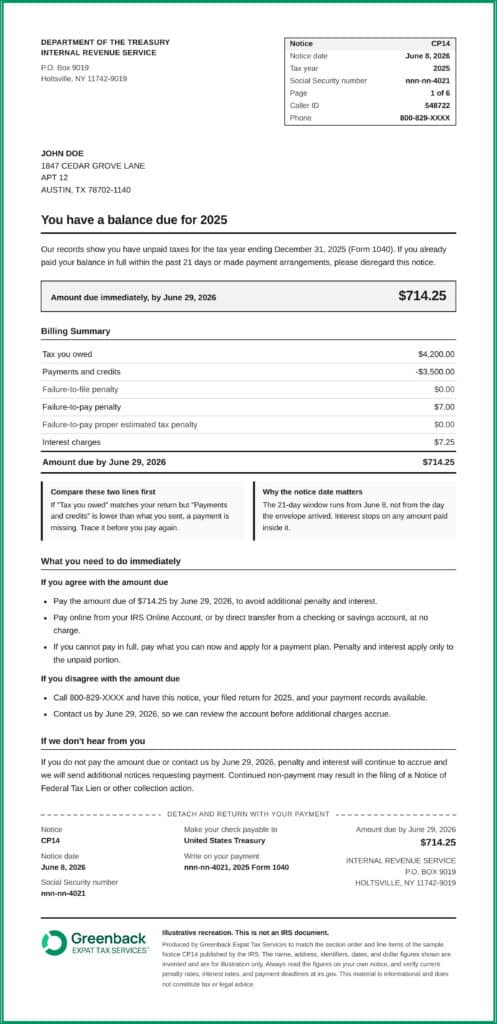
The header block sits in the upper right and repeats on every page. It carries the notice number, the notice date, the tax year the balance belongs to, the last digits of your Social Security number, the page number, and a caller ID the IRS uses to route your call. Two of these matter most. The notice date is the starting point for the 21-day window, and the tax year tells you which return to pull for comparison.
The Billing Summary is where to spend your time, and it always runs the same lines in the same order: the tax you owed, your payments and credits, a failure-to-file penalty, a failure-to-pay penalty, a failure-to-pay estimated tax penalty, interest charges, and the total due at the bottom. Lines that do not apply to you show as zero.
Read that block against your own return line by line, because the comparison tells you which conversation you are having. If “Tax you owed” matches your return and “Payments and credits” is lower than what you sent, a payment is missing; the fix is to trace it. If “Tax you owed” is higher than your return, the IRS adjusted something, and the question is whether the adjustment was right.
The remaining pages run in a set order: what you need to do immediately, what to do if you disagree with the amount due, payment options covering plans and offers in compromise, your account balance and payment history, what happens if the IRS does not hear from you, a penalties section describing each charge, a section on removal or reduction of penalties, and an interest section with the rate table. The toll-free number appears in the IRS Help section.
CP14 Variants and What Each One Signals
Several notices share the CP14 stem, and a letter after the number does not mean you received a different kind of bill. The CP14D, CP14E, CP14F, CP14G, and CP14J all carry the same core message as a plain CP14: you filed a return with a balance due and did not pay it by the return due date. Two of them, the CP14C and the CP14IA, signal something specific about your account.
| Notice | Why you received it |
|---|---|
| CP14 | You filed a return with a balance due and did not pay it in full |
| CP14C | The same balance, but your address of record is in a federally declared disaster area, so your payment date has been postponed |
| CP14D | You filed with a balance due and did not pay by the return due date |
| CP14E | You filed with a balance due and did not pay by the return due date |
| CP14F | You filed with a balance due and did not pay by the return due date |
| CP14G | You filed with a balance due and did not pay by the return due date |
| CP14IA | You owe a balance and recently received correspondence about a payment plan |
| CP14J | You filed with a balance due and did not pay by the return due date |
The suffix indicates how the IRS generated and routed the notice, so for the lettered versions, your response is the same as the one this guide describes: check the figures against your return, then pay, set up a plan, or call the number on the notice to dispute it.
Two exceptions are worth knowing. If you received a CP14C, the date on the cover sheet governs, not the date on the CP14 enclosed behind it, and that postponed date runs until the disaster declaration expires. If you received a CP14IA, you likely already have a payment plan in place, so the priority is to keep that plan current and respond to any requests the IRS makes for more information.
Why the IRS Sent You This Notice
The IRS issues a CP14 once a return has been processed and the assessed tax exceeds the amount credited to the account. The trigger is arithmetic. A return filed on time with a balance left unpaid produces the same notice as a return the IRS adjusted upward.
Timing explains why so many of these land in late spring and early summer. Returns filed near the April deadline will be processed over the following weeks, and the notices will follow. For the 2025 tax year filed in 2026, that wave runs from roughly May through July, with a second, smaller wave after the October extension deadline.
The version that surprises people most is an underpayment of estimated tax during the year, which leaves a balance at filing, even when the return itself is correct.

Your CP14 Doesn’t Have to Be Confusing
What to Check Before You Pay
Do not pay a CP14 until you have compared it against your own records. The IRS has acknowledged processing errors in which correctly made payments were not applied to the right account, and paying twice is considerably harder to unwind than confirming once. Comparing the tax year, the assessed amount, and your own payment records takes about fifteen minutes.
- Match the tax year. Confirm the year on the notice is the year you think it is. Balances from an earlier year surface later than people expect.
- Compare the tax figure to your return. Open your filed copy and check the amount owed on the return against the tax line on the notice. A difference means the IRS adjusted something.
- Trace your payment. Find the bank record, confirmation number, or canceled check. Note the date it cleared and the account it came from.
- Check your IRS online account. Payments appear there under the Social Security number that made them, which is where a missing payment usually turns up.
- Separate penalty and interest from tax. These are listed apart from the tax for a reason. Penalty relief is available on the penalty portion, but not on the tax.
Joint filers should pay particular attention to step four. The IRS has reported a processing issue in which a payment made online by the secondary spouse did not post to the joint account, resulting in a balance-due notice for a couple who had paid in full and on time.
If the payment is confirmed but the notice still shows a balance, our Tax Q&A on why a CP14 arrives after you have already paid covers what to check and when to call.
How to Pay the Balance on a CP14
If the notice is correct, paying the full amount by the due date closes it and stops further penalties and interest. Payment through your online IRS account or by direct transfer from a bank account carries no fee and posts fastest, which matters when the 21-day window for avoiding further interest is already running. Card payments work but carry a processing fee charged by the provider.
Two charges keep running until the balance reaches zero, and they are worth separating because they behave differently.
| Charge | Rate | Cap | Note |
|---|---|---|---|
| Failure to pay penalty | 0.5% of unpaid tax per month or part month | 25% of unpaid tax | Charged in full monthly increments, even if you pay mid-month |
| Interest | Federal short-term rate plus 3 percentage points, set quarterly | No cap | 7% for the quarter running July 1 through September 30, 2026 |
The IRS sets the penalty rate and republishes the interest rate every quarter, so the rate in the table applies only to the quarter named in the table. Interest runs from the original due date of the return, not from the notice date, which is why an April balance already carries months of interest by the time the CP14 arrives.
Paying something is better than paying nothing. Both charges apply to the unpaid balance, so a partial payment shrinks the base on which they are calculated.
Payment Plans When You Cannot Pay in Full
The IRS approves payment plans for filers who meet the balance limits and have filed all required returns, and applying online takes minutes. Setting one up before the notice due date is what protects you: an approved agreement reduces the failure-to-pay penalty from 0.5% to 0.25% per month and generally pauses the account’s progress through the collection notices.
| Plan | Balance limit | Length | Setup fee |
|---|---|---|---|
| Short-term payment plan | Under $100,000 in tax, penalties and interest | 180 days or less | $0 |
| Long-term plan, direct debit | $50,000 or less in tax, penalties and interest | Monthly, beyond 180 days | $29, waived for low-income applicants |
| Long-term plan, other payment method | $50,000 or less in tax, penalties and interest | Monthly, beyond 180 days | $69, reduced to $43 for low-income applicants |
All required returns must be filed before the IRS will approve a plan. If you have unfiled years, that is the first thing to resolve, and the back taxes guide covers the sequence. Where you cannot realistically pay the balance at all, an offer in compromise is a separate path with its own qualification test.
Interest continues to accrue during a payment plan. The plan reduces the penalty rate and keeps collection paused; it does not freeze the balance.
How to Dispute a CP14 Bill
If your records show the tax was paid, or the assessed amount does not match your return, call the toll-free number printed on the notice with your proof of payment in front of you. Do not use a general IRS number. The number on the notice reaches the unit holding the account. Having the documentation ready is what makes a first-call resolution possible: the notice, your filed return for that year, and the bank record showing the payment date and amount.
When the IRS adjusts a figure on your return, and you disagree with the adjustment, the fix is usually an amended tax return, which corrects the figure on the record. And where the tax is correct but the penalty is the problem, penalty relief is a separate request: the IRS grants first-time abatement of the failure to pay penalty where the same return type was filed on time for the prior three years with no penalty assessed in that period, and Form 843 is the written route when a call does not resolve it.
What Happens After a CP14 Goes Unpaid
An unpaid CP14 escalates in predictable steps, each one announced in advance. The IRS follows it with reminder notices CP501 and CP503, then CP504, which states an intent to levy wages, bank accounts, or a state tax refund, and finally LT11 or Letter 1058, the final notice carrying collection due process hearing rights. Engaging early keeps the most options open.
| Notice | What it is | What it means |
|---|---|---|
| CP14 | First balance due notice | A bill. No enforcement authority attached |
| CP501 and CP503 | Reminder notices | Balance still open. Warning that a lien may be filed |
| CP504 | Notice of intent to levy | The IRS states it intends to levy wages, bank accounts, or a state tax refund |
| LT11 or Letter 1058 | Final notice of intent to levy | Carries the right to a collection due process hearing |
A CP14 is several steps removed from anything being seized, and at every step, a payment plan or a resolved dispute generally halts the sequence. A CP14 also differs from a CP2000, which proposes a change based on income reported to the IRS that does not match your return. A CP2000 is a proposal you can respond to; a CP14 is an assessment already made.
What a CP14 Means If You Live Abroad
The balance, the penalty, and the interest all apply the same way when you live outside the U.S. What changes are the mail and the calendar, and both can compress an already short response window.
Notices are sent to the address of record and can take weeks to reach a foreign address, so a 21-day interest window may be partially elapsed before the envelope arrives. Paying electronically through your IRS online account removes the mail from the return trip, and keeping your address current with the IRS prevents the delay in the first place.
The deadline overlap causes the other common surprise. U.S. citizens and resident aliens abroad get an automatic two-month extension to June 15 to file, and can extend further to October 15. But the IRS is explicit that the extension applies to filing, not to paying: interest runs on any tax unpaid after the regular April due date, regardless. A return filed in June with a balance due therefore already carries two months of interest, and the CP14 that follows reflects it. The extensions guide covers how the dates stack.
One thing worth checking before you pay a CP14 from abroad: whether the underlying balance should exist at all. The Foreign Tax Credit offsets U.S. tax against foreign tax already paid on the same income, so the credit generally offsets much or all of the U.S. liability for filers taxed at meaningful rates in their country of residence. A balance due can indicate that the credit was not claimed or was claimed incompletely. If whole years are missing, streamlined filing is the program built for catching up, and filing late covers what to expect.

Behind on More Than One Year?
Frequently Asked Questions
A CP14 is a bill, and receiving one does not mean you are in trouble. It carries no enforcement authority and does not indicate an audit. It is resolved by paying the balance or setting up a payment plan, both of which can be done online in a few minutes.
Your payment most likely had not posted when the notice was generated, or was applied to a different account. Check your IRS online account under the Social Security number that made the payment, since joint filers sometimes find a payment sitting under the secondary spouse’s number. If the payment is confirmed, call the number on the notice with your bank record ready.
If the balance stays unpaid, the IRS sends reminder notices CP501 and CP503, then CP504, which states an intent to levy wages, bank accounts, or a state tax refund. A final notice, LT11 or Letter 1058, carries collection due process hearing rights. Setting up a payment plan at any point generally halts the sequence.
Yes. An approved plan reduces the failure-to-pay penalty from 0.5% to 0.25% per month and pauses collection. Still, interest continues to accrue on the unpaid balance at the quarterly rate until it reaches zero. Paying more than the minimum shortens the plan and reduces total interest.
Often, yes. The IRS grants a first-time abatement of the failure-to-pay penalty when the same return type was filed on time for the prior three years and either no penalty was assessed during that period, or one was later abated. You can request it by calling the number listed on the notice, and the IRS will review your compliance history without requiring supporting documents.
This article is for informational purposes only and does not constitute tax or legal advice. Penalty rates, interest rates, payment plan thresholds, and fees are set by the IRS and change over time; the interest rate cited applies only to the quarter stated. Your situation may differ from the general cases described here. Consult a qualified tax professional with expertise in U.S. tax matters before acting on anything in this guide.



Featured In