IRS Schedule 3-A: Who It’s For, How It Works & Filing Instructions

- What Is Schedule 3-A (Form 1040)?
- Who Has to File Schedule 3-A?
- How Do You Fill Out Part I of Schedule 3-A?
- What Does Line 8 Ask, and Who Answers Yes?
- How Is Line 8 Different From the New Question on Form 1040?
- What Does Schedule 3-A Mean for Americans Abroad and Mixed-Status Families?
- When Would Schedule 3-A Take Effect?
- Frequently Asked Questions about Schedule 3-A
- Greenback Helps You File With Confidence as the Rules Change


IRS Schedule 3-A (Form 1040) is a new draft tax form that checks whether you can receive the refundable portion of four tax credits. It applies only if you claim the earned income credit, the additional child tax credit, the refundable American opportunity credit, or the refundable adoption credit. The form asks one question: are you or your spouse a U.S. citizen, U.S. national, or qualified alien?
If you are a U.S. citizen, answer “Yes” on Schedule 3-A, and your refund does not change. Schedule 3-A is still a draft for the 2026 tax year, based on proposed regulations that are not final. If the regulations are finalized by December 31, 2026, Schedule 3-A would apply to 2026 returns filed in 2027.
This guide explains what the schedule is, who files it, how each line works alongside Form 1040, and what it means for Americans abroad and mixed-status families.
What Is Schedule 3-A (Form 1040)?
Schedule 3-A, titled “Federal Public Benefit,” is a two-part IRS schedule that attaches to your tax return. Part I works out how much of four credits would be refunded to you. Part II asks whether you or your spouse is a U.S. citizen, U.S. national, or qualified alien. The IRS has released it only as a draft, marked “not for filing,” and you may also see it written as Schedule 3A.
Refundable tax credits can pay you money even when you owe no tax. The amount paid to you beyond your tax bill is what Schedule 3-A calls the “refunded portion.”
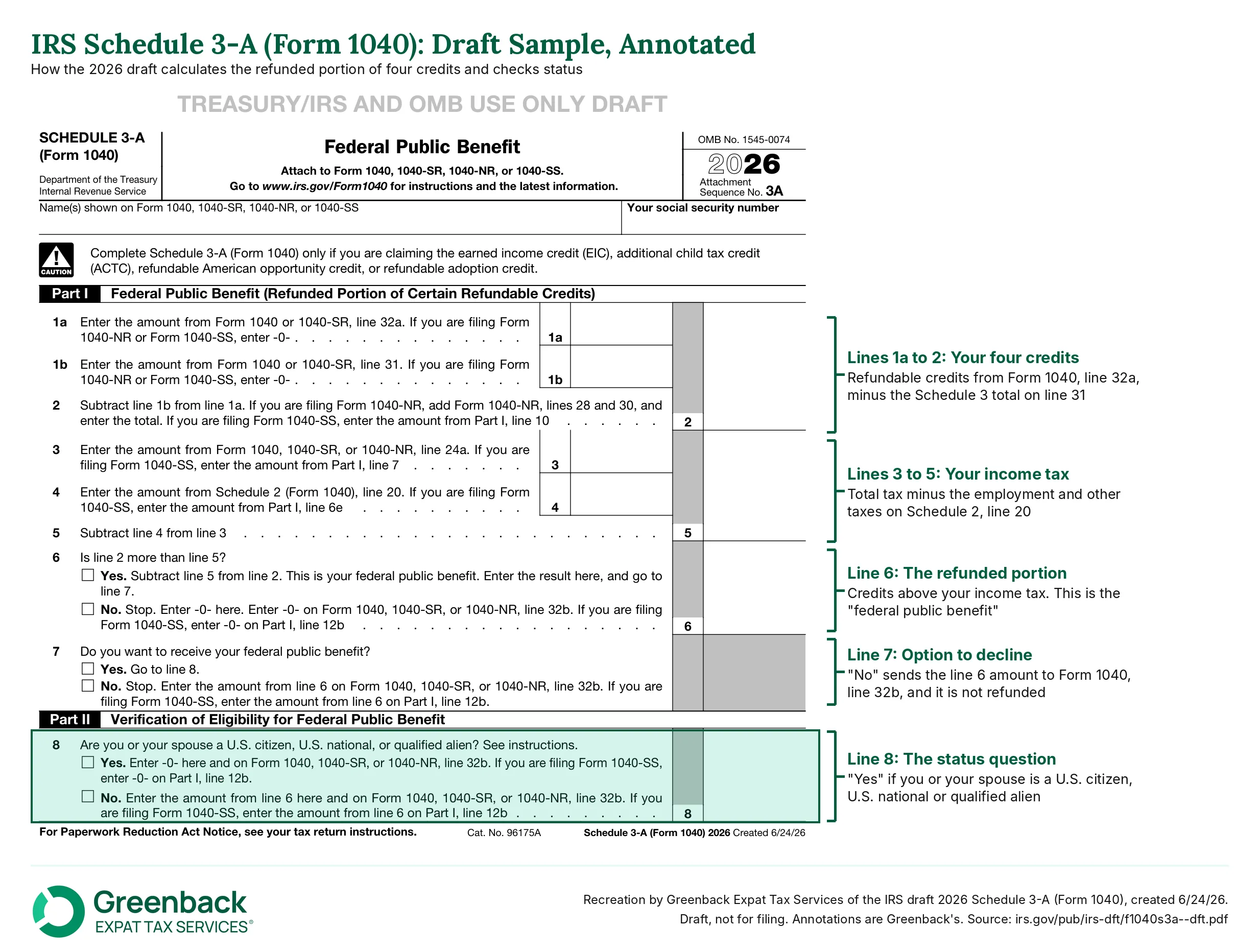
1. Why the IRS Created It
Schedule 3-A comes from proposed regulations (REG-119882-25) that Treasury and the IRS released on August 19, 2026. The regulations would treat the refunded portion of four credits as a “federal public benefit” under a 1996 law, the Personal Responsibility and Work Opportunity Reconciliation Act (PRWORA). Under that law, federal public benefits go only to U.S. citizens, U.S. nationals, and qualified aliens. Treasury’s stated aim is to apply that rule to refundable tax credits. We covered the proposal when it was announced in IRS proposes a citizenship declaration for refundable credits.
2. Schedule 3-A Is Not the Same as Schedule 3
Schedule 3 and Schedule 3-A are two separate attachments to Form 1040. The first, titled “Additional Credits and Payments,” reports nonrefundable credits such as the Foreign Tax Credit, along with other payments and refundable credits. Schedule 3A, titled “Federal Public Benefit,” is a new draft for 2026 that works out the refunded portion of four refundable credits and asks one status question. In short, Schedule 3 lists the credits and payments you claim, and Schedule 3-A decides whether the refundable part of four credits is paid to you. They connect at one point: line 1b of Schedule 3-A subtracts the Schedule 3 total carried to Form 1040, line 31.
3. Where It Fits on the Draft Form 1040
Form 1040 Schedule 3-A feeds one new line on the draft 2026 Form 1040: line 32b. If you answer “Yes” on Schedule 3-A, line 32b is zero, and your refund is figured as usual. If you answer “No,” your refunded portion goes on line 32b and is deducted from your refund.
Who Has to File Schedule 3-A?
You file Schedule 3-A only if you claim at least one of four refundable credits. If you claim none of them, you do not need it. Filing it does not reduce your refund if you are a U.S. citizen, U.S. national, or qualified alien, or if your spouse is one on a joint return.
| Credit | Where it comes from | Draft Form 1040 line |
|---|---|---|
| Earned income credit | Form 1040 | 27a |
| Additional child tax credit | Schedule 8812 | 28 |
| Refundable American opportunity credit | Form 8863, line 8 | 29 |
| Refundable adoption credit | Form 8839, line 13 | 30 |
Only the refunded portion is ever at stake. Whatever your answer on line 8, these credits can still bring your income tax down to zero.
1. Most Americans Abroad Using the Foreign Earned Income Exclusion Will Not Need It
If you claim the Foreign Earned Income Exclusion on Form 2555, the four credits apply very differently:
- Additional child tax credit: not allowed if you file Form 2555.
- Earned income credit: not allowed if you file Form 2555. It also requires your qualifying child to live with you in the United States for more than half the year, or, with no qualifying child, that you live there for more than half the year.
- Refundable American opportunity credit: can still apply, including at certain foreign universities. Up to 40% of it is refundable. See our Form 8863 guide.
- Refundable adoption credit: can still apply, with up to $5,000 refundable per child. See the adoption tax credit for U.S. expats.
2. Families Using the Foreign Tax Credit Often Have the Largest Refundable Portion
Americans who use the Foreign Tax Credit can claim the additional child tax credit. Foreign taxes often bring their U.S. income tax to zero, so the entire refundable amount counts as the refund. For a U.S. citizen, line 8 is “Yes,” and the refund is paid in full. The child tax credit rules are in our Form 8812 guide.
How Do You Fill Out Part I of Schedule 3-A?
Part I finds your refunded portion in three steps. Add up the four credits (lines 1a to 2), find your income tax (lines 3 to 5), then subtract the tax from the credits (line 6). Whatever is left is the refunded portion. The IRS has not yet released the Schedule 3-A instructions, so these filing steps follow the draft Schedule 3-A PDF posted by the IRS.
| Line | What you enter | Example: family abroad |
|---|---|---|
| 1a | Form 1040, line 32a | $2,700 |
| 1b | Form 1040, line 31 (the Schedule 3 total) | $0 |
| 2 | Line 1a minus line 1b: your four credits | $2,700 |
| 3 | Form 1040, line 24a: total tax | $0 |
| 4 | Schedule 2, line 20: certain employment and other taxes | $0 |
| 5 | Line 3 minus line 4: your income tax | $0 |
| 6 | Line 2 minus line 5, if more than zero: the refunded portion | $2,700 |
1. A Citizen Family in Germany With $2,700 Refunded
Jordan and Sam are U.S. citizens working in Germany. They use the Foreign Tax Credit, which brings their U.S. income tax to zero. They claim a $1,700 additional child tax credit for their daughter, the 2026 refundable amount per child, and a $1,000 refundable American Opportunity Credit for their son’s university education. Their refunded portion on line 6 is $2,700. They answer “Yes” on line 8, so the full $2,700 is refunded.
2. Line 7 Lets You Decline the Refunded Amount
Line 7 asks whether you want to receive the refunded portion. Answering “No” means the amount on line 6 is not paid to you. A taxpayer who qualifies has no reason to answer “No.”
3. Line 4 Leaves Only Income Tax
Line 4 takes out the taxes listed on Schedule 2, line 20, such as household employment tax and Additional Medicare Tax, so that line 5 shows the income tax the credits are measured against. The self-employment tax is listed elsewhere on Schedule 2 and is not included. See our Schedule 2 guide for the full list.
What Does Line 8 Ask, and Who Answers Yes?
Line 8 asks whether you or your spouse is a U.S. citizen, U.S. national, or qualified alien. U.S. citizens, green card holders, refugees, and asylees answer “Yes,” and their refund does not change. If no one on the return qualifies, the answer is “No,” and the refunded portion is not paid, though the credit still lowers your tax.
| Status | Answer on line 8 |
|---|---|
| U.S. citizen or U.S. national | Yes |
| Green card holder (lawful permanent resident) | Yes |
| Refugee, asylee, or parolee for at least one year | Yes |
| Most temporary visa holders, such as H-1B or L-1 | Not on the qualified alien list |
| Married filing jointly, with one spouse who answers Yes | Yes, for the whole return |
1. Who Counts as a Qualified Alien
“Qualified alien” is a legal term from PRWORA, defined in 8 U.S.C. 1641. It includes:
- Permanent residents: green card holders.
- Refugees and asylees: people admitted as refugees or granted asylum.
- Parolees: people paroled into the United States for at least one year.
- Other listed groups: people granted withholding of removal, conditional entrants, Cuban and Haitian entrants, citizens of Compact of Free Association nations living in the U.S., certain battered spouses and children, and T visa holders.
Most temporary (nonimmigrant) visa categories, such as H-1B or L-1, are not on the list.
2. On a Joint Return, One Spouse Is Enough
If one spouse on a joint return is a U.S. citizen, U.S. national, or qualified alien, the proposed regulations treat the other spouse as qualifying too. The answer on line 8 is then “Yes” for the whole return.
3. Married Filing Separately
A U.S. citizen filing separately answers “Yes” based on their own status. The proposed regulations’ spouse rule applies only to joint returns and does not address separate returns. A noncitizen filing separately should not assume that a citizen spouse’s status applies to them until the final instructions address it.
4. Status Is Fixed When You File the Return That First Claims the Credit
Your status counts on the day you file the return that first claims the credit for that year, whether you file early, on time or late. Changing status later and filing an amended return does not change the result for a credit you already claimed. If you claim the credit for the first time on an amended return, your status on that filing date is the one used.
5. Your Answer Is a Declaration Under Penalty of Perjury
Your answer on line 8 is a declaration under penalty of perjury. If you do not make the declaration, none of the refunded portion is paid.
How Is Line 8 Different From the New Question on Form 1040?
The draft 2026 Form 1040 adds its own citizenship question on page 1, and it uses a broader test than Schedule 3-A. Form 1040 asks whether you are lawfully authorized to work in the U.S. Schedule 3-A asks whether you are a qualified alien. Someone on an H-1B visa can answer “Yes” on Form 1040 and “No” on Schedule 3-A.
| Question | Wording on the draft form | Who answers |
|---|---|---|
| Form 1040, page 1 | “a U.S. citizen, U.S. national, or an alien lawfully authorized to work in the U.S.” | You, and your spouse separately if filing jointly |
| Schedule 3-A, line 8 | “a U.S. citizen, U.S. national, or qualified alien” | You or your spouse, once for the return |
What Does Schedule 3-A Mean for Americans Abroad and Mixed-Status Families?
For most Americans abroad, Schedule 3-A changes nothing. A U.S. citizen answers “Yes” on line 8 and keeps the full refund, whether their spouse is a citizen or not. The schedule only reduces a refund when no one on the return is a U.S. citizen, U.S. national, or qualified alien.
1. A U.S. Citizen Married to a Nonresident Spouse
You answer “Yes” on line 8 whether you file a joint return, after electing to treat your spouse as a U.S. resident, or a separate return. Your filing status still decides which credits you can claim:
- American Opportunity Credit: not available if you file separately.
- Earned income credit: generally not allowed if you file separately.
- Adoption credit: generally requires a joint return.
- Additional child tax credit: allowed on a separate return.
2. Visa Holders With U.S.-Citizen Children
A family on H-1B or L-1 visas can be resident aliens for tax purposes and still answer “No” on line 8, unless one spouse is a qualified alien. If they claim the additional child tax credit for a U.S.-citizen child, they keep the part of the credit that lowers their income tax. Only the amount above their income tax would not be refunded.
3. ITIN Households Are Already Outside These Credits
Households without Social Security numbers already cannot claim these credits, so Schedule 3-A does not change their position. The child tax credit requires a Social Security number for the child and for at least one spouse on a joint return, as covered in child tax credit with an ITIN or SSN. The earned income credit requires Social Security numbers too. See our Form W-7 guide for ITINs and our Child Tax Credit for Expats guide for the credit rules.
When Would Schedule 3-A Take Effect?
The 2026 Schedule 3-A is not yet in effect. It would take effect once the proposed regulations are finalized, for tax years ending on or after that date. If the regulations are finalized by December 31, 2026, they would cover 2026 returns filed in 2027.
Until then, the form stays a draft, and the proposed regulations do not include language allowing taxpayers to rely on them.
| Step | Status as of October 13, 2026 |
|---|---|
| Proposed regulations published | August 20, 2026 |
| Comment period | Closed October 5, 2026 |
| Public hearing (October 14) | Canceled; no requests to testify |
| Final regulations | Not yet published |
| Final Schedule 3-A and instructions | Not yet released |
Source: Federal Register, checked October 13, 2026.
Frequently Asked Questions about Schedule 3-A
Not yet. Schedule 3-A is a draft, and the regulations behind it are only proposed. It would apply to 2026 returns only if the regulations are finalized by December 31, 2026. The final Schedule 3-A instructions and 2026 Form 1040 instructions will confirm whether you need it.
No, a U.S. citizen’s refund does not change. If you claim one of the four credits, complete the schedule and answer “Yes” on line 8 so nothing is taken from your refund. On a joint return, one citizen spouse covers the whole return.
No, a green card holder’s refund does not change. Lawful permanent residents are qualified aliens, so they answer “Yes” on line 8. The normal rules for each credit, such as Social Security number requirements, still apply.
Yes, the credit still lowers your income tax, down to zero. Only the amount above your tax is not refunded. For example, with $1,200 in income tax and $3,000 in these credits, you would still use $1,200 of the credits, and the remaining $1,800 would not be paid.
No. Despite the similar names, they are different IRS forms. Schedule 3-A is new for 2026 and applies only when you claim one of four refundable credits: the Earned Income Credit, Additional Child Tax Credit, American Opportunity Credit, or adoption credit.
Greenback Helps You File With Confidence as the Rules Change
Schedule 3-A is still a draft, and the final form or instructions may change before 2026 returns are filed. For most Americans abroad, the questions that matter come first: which credits you can claim, whether the Foreign Earned Income Exclusion or the Foreign Tax Credit works better for your family, and how your filing status affects both.
Greenback’s U.S. accountants, with expertise in expat returns, track these changes and prepare your return so that every credit you qualify for is claimed correctly.

New Forms, Same Careful Filing
This article provides general information and is not tax or legal advice. Schedule 3-A and the proposed regulations described here are drafts and may change before they are final. Speak with a qualified tax professional about your situation.



Featured In