Portugal Digital Nomad Visa (D8): Requirements, Income and How to Apply

- D8 Visa at a Glance
- Income Requirements for the D8 Visa
- Portugal's D8 Visa: Temporary Stay or Residence
- Who Qualifies for the D8 Visa
- D8 Visa Documents for Americans
- How to Apply for a D8 Visa From the United States
- D8 Visa Costs and Fees
- How Long You Can Be Away on a D8 Visa
- Bringing Your Spouse and Children on a D8
- Taxes for Americans on a D8 Visa
- Keeping Your D8 Status Over Time
- Portugal Digital Nomad Visa FAQs


Portugal’s digital nomad visa, also called the D8 or the remote work visa, is the visa most Americans use to live in Portugal while they keep working remotely. You don’t have to be a traveling “nomad” to qualify. Remote employees of U.S. companies and freelancers with clients outside Portugal can both apply.
For 2027, you’re expected to need at least €3,880 a month in remote-work income, up from €3,680 in 2026. You apply through a Portuguese consulate’s visa partner in the U.S. On the residence version of the visa, you then finish the process in Portugal with AIMA, the immigration agency that issues your residence card.
- Income: at least €3,880 a month in 2027 (expected), averaged over your last three months, plus extra for each family member.
- Two versions: a Temporary Stay visa for up to a year, or a Residence visa that leads to a residence permit.
- Permit length: two years at first, then three-year renewals, with permanent residence possible after five years.
- Taxes: living in Portugal on a D8 very likely makes you a Portuguese tax resident, and you keep filing U.S. returns too.
This guide covers the requirements, documents, costs and family rules, and how both countries tax the income you use to qualify. To compare the D8 with other visas, see our guide to Portugal visas for Americans. For life in Portugal more broadly, see our overview of living in Portugal as an American.
What’s changed for 2027: The income requirement is expected to rise to €3,880 a month with Portugal’s new minimum wage. Since October 2025, most residents wait two years before bringing family through family reunification, with exceptions for minor children. Since May 19, 2026, Americans need 10 years of legal residence for citizenship, up from five. Since September 11, 2026, AIMA must decide residence permit applications within 90 days, and Temporary Stay applicants need a return ticket. AIMA’s residence permit fees were last updated on March 1, 2026.
D8 Visa at a Glance
| Question | What Americans should know |
|---|---|
| Is the D8 Portugal’s digital nomad visa? | Yes. “D8” is the common name for Portugal’s remote-work visa. |
| Who is the D8 for? | Remote employees and freelancers paid by employers or clients outside Portugal. |
| Income needed in 2027 | €3,880 a month (€11,640 over three months), expected. The final figure comes with Portugal’s 2027 minimum wage decree. |
| 2026 figure, for reference | €3,680 a month (€11,040 over three months). |
| Can passive income qualify? | No. The D8 is built for active work. If a pension or investments fund your move, the D7 visa is usually the better fit. |
| Which version should you choose? | The Residence visa if you might stay longer than a year; the Temporary Stay visa for a trial year. |
| How long is the Residence visa valid? | Four months, with two entries, to travel to Portugal and finish your residence permit. |
| Who issues the residence permit? | AIMA, Portugal’s Agency for Integration, Migration and Asylum. |
| First permit and renewals | Two years at first, then renewals of three years each. |
| Is 183 days a D8 rule? | No. 183 days is a Portuguese tax residency test. The D8 rule limits how long you’re away. |
| Permanent residence | Possible after five years of legal residence. |
| Citizenship | Possible after 10 years of legal residence for Americans. |
Income Requirements for the D8 Visa
The D8 income requirement is four times Portugal’s monthly minimum wage, so it rises each year with the wage. Consulates check the average of your last three full months of remote-work income.
| 2027 (expected) | 2026 | |
|---|---|---|
| Minimum wage | €970 | €920 |
| D8 monthly requirement | €3,880 (about $4,317) | €3,680 (about $4,095) |
| Three-month total | €11,640 (about $12,952) | €11,040 (about $12,284) |
2027 figures assume the €970 minimum wage in Portugal’s 2027 budget proposal. They become final with the government’s decree. Dollar amounts are estimates at the European Central Bank reference rate of $1.1127 per euro on November 11, 2026, rounded to the nearest $10; consulates assess the euro amounts.

As of November 19, 2026, Portugal hasn’t published its 2027 minimum wage decree, which usually comes out in late December. If you’re applying in early 2027, plan around €3,880 and check the final figure before you submit. We’ll update this guide once it’s published.
How the Three-Month Average Works
Your income doesn’t need to be the same every month, which helps freelancers with uneven months. Say you earned €3,300, €4,300 and €4,100 over your last three months. That averages €3,900 a month, so you clear the 2027 figure even though one month fell short.
Income that counts for the D8
To qualify, your income needs to come from work you’re actively doing for employers or clients outside Portugal, and you need to show it will keep arriving after you move.
- Salary: pay from an employer outside Portugal. Bring pay stubs and bank statements showing the deposits.
- Freelance and contract income: payments from clients outside Portugal. Bring contracts, invoices and the matching bank deposits.
Savings show you’re financially stable, but they won’t meet the D8 income requirement on their own, and neither will pensions or dividends. If passive income is what funds your move, the D7 visa is usually the better fit.
Extra income for each family member
If your spouse or children are moving with you, you’ll also need to prove you can support them. Each family member adds to the amount you show each month, on top of your own €3,880 (2027, expected). You can cover the extra with higher income or with savings.
| Family member | 2027 (expected) | 2026 |
|---|---|---|
| Each additional adult (50% of the minimum wage) | €485 a month (about $540) | €460 a month (about $510) |
| Each child (30% of the minimum wage) | €291 a month (about $320) | €276 a month (about $310) |
Portugal’s D8 Visa: Temporary Stay or Residence
The D8 comes in two versions, and you choose one when you apply. Both have the same income requirement, but the version you pick decides how long you can stay and whether your time in Portugal counts toward long-term status.
| Temporary Stay visa | Residence visa | |
|---|---|---|
| Best for | A trial year in Portugal | Making Portugal your home |
| How long it lasts | Up to one year in total, extensions included | Four months, with two entries, to get you to your AIMA appointment |
| What comes next | Nothing; it ends when the year is up | A two-year residence permit, renewable for three years at a time |
| Housing you’ll need | Shorter-term lodging is usually accepted | Usually a 12-month lease or a home you own |
| Counts toward permanent residence and citizenship | No | Yes |
The Temporary Stay visa can’t be stretched past one year, even with an extension, and it doesn’t turn into a residence permit. You also can’t switch to the Residence visa from inside Portugal; you’d have to apply again through a consulate, generally back in the U.S. If there’s any chance you’ll stay longer than a year, apply for the Residence visa from the start.
If your trial year turns into a longer stay
If you want to stay in Portugal longer than your Temporary Stay visa allows, apply for the Residence visa before it runs out. You can’t apply from inside Portugal, so plan around a trip back to the U.S.:
- Start the slow documents about four months before your year ends: the IRS residency certificate, and an FBI check timed to be less than 90 days old at your appointment.
- Book a VFS appointment in the U.S. The checklist asks for proof of a U.S. address to confirm your consulate, so keep an address you can document, or ask your consulate what to use if you gave yours up.
- Apply, then return to Portugal on the new visa and attend your AIMA appointment.
Time on the Temporary Stay visa doesn’t count toward permanent residence or citizenship; your count starts with the Residence visa. A trial year can also make you a Portuguese tax resident already, so plan your taxes for that first year too.
Who Qualifies for the D8 Visa
The D8 is for people who keep working for employers or clients based outside Portugal after they move. Consulates look for three things:
- Remote work that continues: an employment contract with a company outside Portugal plus a letter confirming you can work from Portugal, or contracts with clients outside Portugal.
- Enough income from it: at least €3,880 a month in 2027 (expected), averaged over your last three months, with more for each family member.
- Proof of where you’re a tax resident now: for Americans, that’s an IRS residency certificate (Form 6166).
Income from Portuguese employers or clients doesn’t count toward qualifying, although you can take local work once you hold a residence permit.
If your income is mostly passive
A pension, Social Security, rent or dividends point to the Portugal D7 visa, which is usually simpler and has a much lower income requirement. Our D7 guide walks through how to choose when you have both kinds of income.
If you want residence in Portugal without moving there full time, Portugal’s Golden Visa is built for that: it’s based on a qualifying investment, and it requires far less time in the country.
D8 Visa Documents for Americans
You’ll submit your documents through VFS Global, which handles Portugal’s visa applications in the U.S. Consulates check five things: who you are, your background, where you’ll live, your remote work and your income. Check the checklist for your consulate before you book. VFS posts them, and Portugal’s official visa portal lists the requirements for each visa type.
1. Start with the slow ones
Two documents take the longest, so order them first.
- IRS residency certificate (Form 6166): proves you’re a U.S. tax resident. You request it with Form 8802, and it usually takes 45 to 60 days.
- FBI Identity History Summary with an apostille: state and local police checks aren’t accepted. Allow 4 to 10 weeks for the check and the apostille, and time it so it’s still recent at your appointment; many consulates want it issued within the last 90 days.
What’s an apostille? An apostille is an official certificate confirming that a U.S. public document, like your FBI check, is genuine, so Portugal will accept it without further checks. The U.S. Department of State issues apostilles for federal documents such as the FBI check.
2. Plan where you’ll live
The U.S. checklist doesn’t ask for a lease or a Portuguese bank account. Your personal statement names the area where you plan to live and the type of housing (a rental, a home you buy or a family home). On the Residence visa, AIMA asks for proof of your address in Portugal at your appointment.
A Portuguese tax number (NIF) isn’t on the checklist either, but you’ll need one to sign a lease or open a bank account, so it’s worth getting early. Our guide to the Portugal NIF explains how to get one from the U.S.
3. Identity and application forms
Next, fill out Portugal’s visa application and gather the basics that show who you are and why you’re moving.
- Portugal’s national visa application form, completed and signed. It’s Portugal’s standard form for long-stay visas, used for both versions of the D8. Your VFS center links to it, and Portugal’s official visa portal has it too.
- Passport valid for at least three months beyond your planned stay, plus a copy.
- Two passport photos.
- Proof of your U.S. address, such as a driver’s license or lease, to show you’re applying in the right consulate’s jurisdiction.
- A short personal statement explaining why you’re moving, where you’ll live and how your work continues from Portugal.
Temporary Stay visa only: you also need a return or onward ticket, a requirement added by Law 62/2026 in September 2026.
4. Proof of remote work and income
This is the heart of your application.
- Remote employees: your employment contract or your employer’s declaration confirming the job, and three months of pay stubs.
- Freelancers and contractors: client contracts, service agreements or your company’s articles of association, plus three months of invoices.
- Everyone: three months of bank statements showing the deposits.
5. Travel health insurance
You’ll need travel insurance covering medical expenses, urgent care and repatriation until you’re settled. For healthcare after you arrive, see our guide to healthcare in Portugal for Americans.

Plan your U.S. taxes before you move.
How to Apply for a D8 Visa From the United States
You get the visa through VFS Global before you leave. On the Residence visa, you then finish your residence permit with AIMA after you arrive. Most people should plan for three to five months from gathering documents to holding the visa, and a few more months in Portugal for the residence card. Busy consulates and AIMA backlogs can stretch either stage.
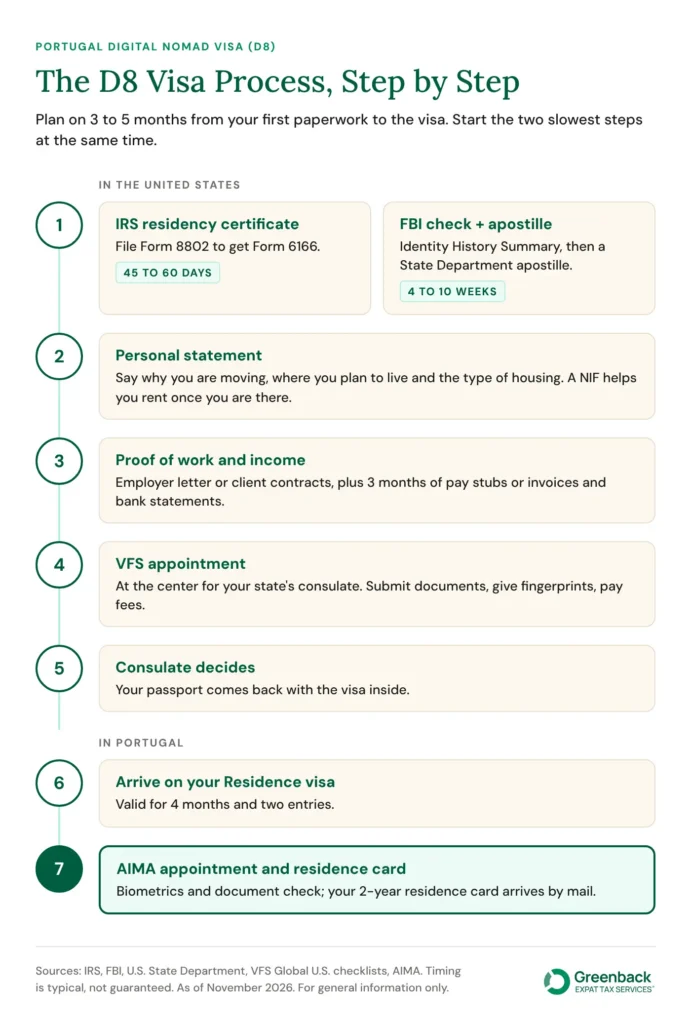
- Prepare your file (about 1 to 3 months)
Order your IRS residency certificate and FBI check first, then gather three months of income records and write your personal statement.
- Submit through VFS Global
Create an account on the VFS portal, complete the form, pay the fees and book an appointment at the center that serves your state; you can’t book at another center for an earlier date. At the appointment, you hand in your file, give fingerprints and a photo, and leave your passport for the visa.
- Wait for a decision (generally about 60 days)
The consulate decides; VFS only handles intake. It can take longer in busy months or if the consulate asks for more documents.
- Travel to Portugal
On the Residence visa, you have four months and two entries to get to Portugal and attend AIMA. Your AIMA appointment is usually set before you arrive.
- Attend your AIMA appointment (Residence visa only)
Bring your original documents, recent bank statements, proof of your address in Portugal and proof of health coverage. You give final biometrics and pay the residence permit fee, and AIMA mails your two-year residence card. By law, AIMA must decide within 90 days of your application, or within 120 days in exceptional cases.
You can’t apply from inside Portugal. You can visit as a tourist for up to 90 days in any 180-day period to look at neighborhoods and apartments, but you’ll still submit your application from the U.S.
Applying from outside the United States
If you already live legally in another country, apply through the Portuguese consulate or VFS center there. You’ll need proof of your legal status in that country, such as a residence permit or long-stay visa.
D8 Visa Costs and Fees
The main official costs are the consular visa fee and, on the Residence visa, AIMA’s residence permit fees.
Government and processing fees
- Consular visa fee: €110 per applicant, charged as $127.11 at U.S. visa centers.
- VFS Global service fee: $43.91 per application, plus optional courier or SMS fees.
- AIMA residence permit fees (Residence visa only, paid in Portugal): €247.30 per person (about $275) for your first permit, an application analysis fee of €133.00 plus a card fee of €114.30. Filing through AIMA’s digital channels costs 25% less (€185.60). AIMA updates its fees every March 1, so check the amounts before your appointment.
Other costs to budget for
- FBI background check ($18) and its apostille ($20)
- Form 8802 for your IRS residency certificate ($85)
- Your NIF, if you use a representative or online service
- Travel health insurance
- Certified translations of documents that aren’t in Portuguese
Fees as of November 2026. The AIMA conversion uses the European Central Bank rate of $1.1127 per euro on November 11, 2026.
How Long You Can Be Away on a D8 Visa
The Residence visa is for people making Portugal home, so the law limits how long you can be away. Your temporary residence permit can be canceled if you’re outside Portugal without a valid reason for more than:
- 6 months in a row, or
- 8 months in total during the permit’s validity.
Over a two-year first permit, that means living in Portugal for at least 16 of the 24 months. Remote work makes travel tempting, so keep a simple log of your trips.
Planning a long absence? Longer absences can be excused for serious personal, work or health reasons. Talk to AIMA before you travel, and keep records of the reason.
The Temporary Stay visa has no minimum time in Portugal, but it ends after one year either way.
Bringing Your Spouse and Children on a D8
Your spouse or partner and dependent children can join you, but the timing depends on Portugal’s family reunification rules.
Who counts as family
- Spouse or partner: a legal spouse or a partner in a documented de facto union.
- Minor children: biological or adopted children under 18.
- Adult children: unmarried children over 18 who depend on you financially and study full time.
- Parents: your parents or your spouse’s parents who depend on you financially.
The two-year rule under Lei 61/2025
Under Lei 61/2025, in force since October 23, 2025, residents generally need a valid residence permit for two years before bringing family to Portugal through family reunification. The exceptions:
- Minor children: no waiting period.
- A spouse or partner who shares a minor child with you: no waiting period.
- A spouse or partner with no minor children in common: the wait drops to 15 months if you lived together for at least 18 months before you entered Portugal.
- Adult children and parents: the two-year rule applies.
Applying as a household
If you plan to move together, ask your consulate whether family members can apply for their own visas at the same time as yours. Each consulate handles this a little differently, and the answer will shape your timeline and budget. You’ll also show extra income for each family member: €485 a month per additional adult and €291 per child for 2027 (expected), or €460 and €276 for 2026.
Taxes for Americans on a D8 Visa
A D8 Residence visa makes Portugal your home, so you’ll very likely become a Portuguese tax resident. As a U.S. citizen, you also keep filing with the IRS. What you owe in each country depends on how both of them tax the remote income you used to qualify.
The 183-day rule is a tax rule
The 183-day rule decides Portuguese tax residency. It isn’t part of the D8 immigration rules. You’re a Portuguese tax resident if you spend more than 183 days in Portugal in any 12-month period starting or ending in the year, or if you have a home there that you use as your habitual residence. That can apply on a Temporary Stay visa too. For the full rules, see our guide to Portugal tax residency.
Portuguese tax on your remote income
As a tax resident, you report your worldwide income in Portugal, including the salary or client payments that qualified you for the D8. Portugal’s progressive rates run from 12.2% to 48% for 2026 income.
Portugal’s Non-Habitual Resident (NHR) regime closed to new applicants on January 1, 2024. Its replacement, IFICI, covers income from specific qualifying professional activities, and most remote workers for foreign employers don’t qualify.
Portugal’s 2027 budget, with its final vote on November 24, 2026, sets the brackets for 2027 income and includes proposals to end or review IFICI. We’ll update these figures once it’s published.
Your U.S. filings continue
You keep filing Form 1040 every year and reporting your worldwide income. Two tools keep you from paying full tax twice on the same income: the foreign tax credit and the foreign earned income exclusion. Our comparison of the FEIE and the foreign tax credit shows which one usually works better when Portugal taxes your salary, and our guide to digital nomad taxes covers the U.S. rules for remote workers.
For deadlines, account reporting and how the U.S.–Portugal treaty applies, see our guide to U.S. expat taxes in Portugal.
Social Security for remote workers
The U.S.–Portugal totalization agreement keeps you from paying into both Social Security systems at once:
- Remote employees: if your U.S. employer sends you to work from Portugal, it can request a certificate of coverage from the Social Security Administration. That keeps you in the U.S. system, generally for up to five years.
- Freelancers: if you’re self-employed, you generally pay into Portugal’s Social Security system once you live there.
Example: a remote worker’s first year in Portugal
Maya, 34, is a product designer for a company in Denver. She moves to Porto on a D8 Residence visa in early 2027, earning $6,000 a month (about €5,390), comfortably above the €3,880 requirement.
- In Portugal: she spends most of 2027 in Porto, so she’s a Portuguese tax resident. She files a Portuguese return (Modelo 3) for 2027 between April and June 2028, reporting her U.S. salary.
- In the U.S.: she files Form 1040 as usual. Because Portugal taxes the same salary, she can generally claim a foreign tax credit for the Portuguese tax.
- Social Security: her employer requests a certificate of coverage, so she stays in U.S. Social Security and doesn’t pay into Portugal’s system.
- Account reporting: her Portuguese account holds more than $10,000, so she files an FBAR (FinCEN Form 114).
Maya files in both countries, and the tax credit keeps her from paying full tax twice on her salary.
If you later take a job with a Portuguese employer or Portuguese clients, the tax and Social Security picture changes. Our guide to working in Portugal as an American covers that switch.

Working remotely from Portugal?
Keeping Your D8 Status Over Time
For remote workers, the big question at each renewal is whether your work still qualifies. Here’s what each milestone asks of you on the Residence version.
| Year | What happens | What to have ready |
|---|---|---|
| Year 0 | Residence visa, then your AIMA appointment | The visa, proof of address, health coverage |
| Year 2 | First renewal, for three years | Ongoing remote income, your address, your travel history |
| Year 5 | Permanent residence becomes possible | A2 Portuguese, means of support, a clean record |
| Year 10 | Citizenship becomes possible for Americans | A language and culture test, a clean record |
What AIMA checks at renewal
Renewal is where changes in your work show up, so file before your card expires with:
- Proof your remote income still qualifies. Changed employers or picked up new clients? Bring the new contracts with your recent pay stubs or invoices.
- Your address in Portugal: a current lease, deed or utility bills.
- Your travel history, which AIMA compares against the limits on time away.
- Your standing with Portugal’s tax authority and Social Security, plus a clean criminal record.
Permanent residence and citizenship
Five years on residence permits opens the door to permanent residence. You’ll need A2-level Portuguese, means of support and housing, and no prison sentence of more than one year in your last five years in Portugal. Once you have it, the D8’s remote-income rule no longer applies to you.
Citizenship comes at 10 years of legal residence for Americans and adds a language and culture test. Portugal allows dual citizenship, so your U.S. passport stays. Our guide to Portuguese citizenship for Americans walks through the requirements.

Get your U.S. taxes right from your first year in Portugal.
Portugal Digital Nomad Visa FAQs
For 2027, you’re expected to need at least €3,880 a month, four times Portugal’s minimum wage, averaged over your last three months. That becomes final with the government’s minimum wage decree. In 2026, the figure is €3,680 a month.
The rules are clear: show remote work, enough income over your last three months, and a clean record. The harder part is timing the paperwork. Your FBI check must be less than 90 days old when you apply, and the IRS residency certificate can take two months. Meeting every requirement doesn’t guarantee approval, so submit a complete file.
Yes. The D8 is Portugal’s visa for people who work remotely for employers or clients outside Portugal. If you want a job with a Portuguese employer, you’ll need a different work visa tied to a Portuguese job offer.
Yes, on a D8 visa. Your U.S. employer confirms the job with an employment contract or a declaration, and your pay must average at least four times Portugal’s minimum wage. Living in Portugal will likely make you a Portuguese tax resident, and your employer may be able to request a certificate of coverage so you stay in U.S. Social Security.
Usually, in both countries. If you spend more than 183 days in Portugal in any 12-month period starting or ending in the year, or keep a habitual home there, you’re a Portuguese tax resident and report your worldwide income in Portugal. As a U.S. citizen, you also file a U.S. return every year, and the foreign tax credit generally keeps you from paying full tax twice on the same income.
Portugal still issues D7, D8 and Golden Visas to Americans, and the D8 works the way it has since 2022, with an income requirement that rises each year with the minimum wage. Other rules have tightened: since October 2025, most residents wait two years to bring family through reunification, and since May 2026, citizenship takes 10 years of legal residence, up from five.
Not to live there. Americans can visit Portugal without a visa for up to 90 days in any 180-day period. Living there longer takes a residence visa such as the D8 or D7, which you apply for from the U.S. before you move.
The D8 is based on income, not savings. The U.S. checklist asks for proof that your monthly income averaged at least four times Portugal’s minimum wage over your last three months; it doesn’t set a minimum bank balance. Savings can still help if your family is coming, since you can use them to show support for each family member.
The D8 is for active income from remote work. The D7 is for passive income, such as a pension, Social Security, rent or dividends, and has a much lower income requirement. If you have both, the D8’s much higher threshold makes the D7 worth checking first.
Only within one year. The Temporary Stay visa and any extension together can’t go past one year, and the visa doesn’t lead to a residence permit. If you think you’ll stay longer, apply for the Residence visa from the start.
Most people should plan for three to five months from gathering documents to holding the visa. The IRS residency certificate and the FBI check with its apostille take the longest, so start them first.



Featured In




