Portuguese Citizenship for Americans: Requirements and Pathways

- Six Ways to Qualify for Portuguese Citizenship
- Citizenship Through Residence Takes 10 Years
- What Citizenship Gives You That Residence Doesn't
- What You Need to Naturalize
- Citizenship Through a Parent, Grandparent or Great-Grandparent
- Citizenship Through Marriage or a Partnership
- Children Born in Portugal
- Portugal Has No Citizenship-by-Investment Program
- How to Apply, What It Costs and How Long It Takes
- Dual Citizenship and Your Taxes
- Planning a 10-Year Timeline Starts With Your Visa
- Portugal Citizenship FAQs
- Related Resources


How you qualify for Portuguese citizenship, and how long it takes, depends on your ties to Portugal. With no family ties, you qualify by living there legally for 10 years. With a Portuguese parent, grandparent or spouse, it can take far less time, and in some cases no time in Portugal at all. Portugal doesn’t sell citizenship, so investing or buying property doesn’t shorten the wait.
These rules took effect on May 19, 2026, when Portugal’s revised nationality law (Lei Orgânica 1/2026) replaced the old five-year standard. The government approved the regulation that sets the new language, culture and civics test and the income requirement on October 29, 2026. It hadn’t been published as of mid-November, so the exact test format and income threshold are still to come.
Citizenship is one part of a bigger move, and our Portugal guide for American expats covers the rest, from visas to healthcare.
Six Ways to Qualify for Portuguese Citizenship
Portuguese citizenship comes through naturalization, descent, marriage or birth in Portugal, and descent works differently for parents, grandparents and great-grandparents. Most Americans qualify through residence, but if you have Portuguese family or a Portuguese spouse, check those options first, because they can save you years.
| How you qualify | Time living in Portugal | Test and checks |
|---|---|---|
| Living in Portugal (naturalization) | 10 years | Language and culture test, civics, clean record, income |
| A Portuguese parent | None | None |
| A grandparent who was Portuguese from birth | None | Language and culture test, civics, clean record |
| Marriage or a partnership of more than 3 years | None | Clean record; your ties to Portugal may be reviewed |
| A great-grandparent who was Portuguese from birth | 5 years | All naturalization requirements; approval is discretionary |
| Birth in Portugal | A parent’s 5 years of legal residence | A declaration by the parents |
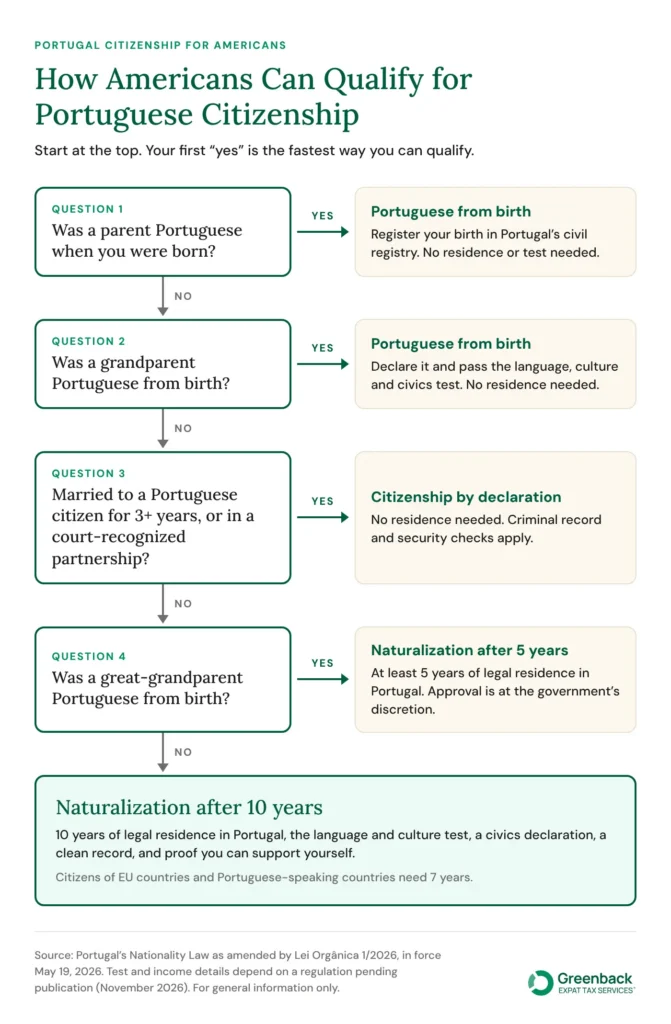
Citizens of EU countries and Portuguese-speaking countries such as Brazil need seven years of residence; every other nationality, including Americans, needs 10.
Citizenship Through Residence Takes 10 Years
Americans who qualify through residence need 10 years of legal residence in Portugal before they can apply to naturalize.
The visa you move on starts the count. Most Americans use the Portugal D7 visa for retirement or passive income, the D8 digital nomad visa for remote work, or the Golden Visa for investors. Our overview of Portugal visas for Americans compares them.
How Portugal Counts Your 10 Years
- Legal residence counts. The law counts time spent under a lawful residence title or visa. Confirm your start date with a lawyer before you apply, because the time between arriving on a visa and receiving your residence card can matter.
- Waiting time on an application doesn’t count. A 2024 rule that started the clock on the day you applied for residence was repealed in 2026.
- Breaks are allowed. You can add up separate periods of legal residence, as long as your 10 years fall within a 12-year window.
- Earlier applications keep the old rules. If your nationality application was already pending on May 19, 2026, it is decided under the five-year rule. Having lived in Portugal for five years by then isn’t enough; the application itself must have been filed.
Permanent Residence Comes at Year 5
Permanent residence is a separate status from citizenship, and you can apply for it after five years. It doesn’t reset your citizenship count: the years you hold it still count toward your 10. To qualify, you need five years of temporary residence, basic Portuguese at A2 level, means of support and housing, and no prison sentence of more than one year in your last five years in Portugal.
Permanent residence lets you live and work in Portugal indefinitely without renewing a temporary permit. You can be away for up to 24 months in a row, or 30 months within any three years, before it can be canceled. Golden Visa holders who move to permanent residence are exempt from those absence limits.
What Citizenship Gives You That Residence Doesn’t
Permanent residence covers what many Americans need: the right to stay in Portugal for good. Citizenship, however, adds five things a residence card can’t give you:
- The right to live and work anywhere in the EU, plus Iceland, Liechtenstein, Norway and Switzerland, with no visa.
- No absence limits. You can leave Portugal for years without losing your status.
- Citizenship for your children. Children born after you become Portuguese can be registered as Portuguese wherever they’re born.
- A vote in Portuguese and European Parliament elections.
- A Portuguese passport, which opens visa-free or visa-on-arrival travel to most of the world and gives you a second source of consular help.
What You Need to Naturalize
Naturalization has five requirements, and all of them must be met on the day you apply.

Waiting on one regulation: the government approved the rules for the new test and the income requirement on October 29, 2026. They still need the President’s signature and publication in the Diário da República, and they hadn’t been published as of mid-November 2026. Until they are, the test format and the income threshold aren’t known. No other change to the nationality law is pending, and the 10-year rule itself is settled. We’ll update this section when the regulation is published.
1. Ten Years of Legal Residence
Americans need 10 years of legal residence in Portugal (seven for citizens of EU and Portuguese-speaking countries), held under lawful residence titles such as a D7, D8 or Golden Visa permit. The years can be split up, as long as they fall within a 12-year window.
2. Language, Culture, History and National Symbols
Under the old rules, applicants proved A2-level Portuguese, usually with the CIPLE exam. The 2026 law widened this. You must now show, through a test or certificate, sufficient knowledge of:
- The Portuguese language
- Portuguese culture and history
- National symbols, such as the flag and anthem
Whether a CIPLE certificate alone will still cover the language part depends on the new nationality regulation that sets the test format, which the government approved on October 29, 2026 and hasn’t yet published. Citizens of Portuguese-speaking countries are presumed to meet the language part, but the culture and history parts apply to them too.
3. Civic Knowledge and a Declaration
You need basic knowledge of the fundamental rights and duties of Portuguese citizens and how the Portuguese state is organized. You also sign a solemn declaration of commitment to the principles of a democratic state under the rule of law.
Both come from the Portuguese Constitution, which the Diário da República publishes in an official English version: fundamental rights and duties are in Part I, and the organization of the state is in Part III. The pending regulation will set out exactly what the civics knowledge covers and how it’s tested.
4. A Clean Record
A final conviction with an actual prison sentence of more than three years for a serious crime presumptively bars naturalization. The crimes in scope are terrorism, violent or organized crime, crimes against state security, and helping people enter Portugal illegally. In that case, the Public Prosecutor weighs the facts, including how long ago the crime happened, and you can challenge the decision in court.
You prove your record with criminal record certificates from your country of birth, your country of nationality and every country you lived in after age 16. For Americans, that means an FBI Identity History Summary plus any foreign police certificates, each with an apostille and a certified Portuguese translation.
5. Supporting Yourself
You must show you can support yourself. The law sets no euro figure; the new nationality regulation approved on October 29, 2026 (not yet published) defines the requirement, and the government has described it as showing stable income. The income you proved for your D7 or D8 visa years earlier doesn’t carry over, because the registry looks at your situation when you apply for citizenship.

Ten Years of Residence Means Ten U.S. Tax Returns
Citizenship Through a Parent, Grandparent or Great-Grandparent
Portuguese family ties can shorten the process or skip residence entirely. The closer the relative, the less you need to do.
Through a Portuguese Parent
If your mother or father was Portuguese when you were born, you are Portuguese from birth once your birth is entered in the Portuguese civil registry. You don’t need to live in Portugal or take a test, and you can register from the United States.
Through a Portuguese Grandparent
If a grandparent was Portuguese from birth and never lost that nationality, you can declare that you want to be Portuguese and be recognized as Portuguese from birth yourself. A grandparent who became Portuguese through naturalization doesn’t qualify.
You don’t need to live in Portugal. Under the current law, though, grandchildren must meet most of the naturalization requirements: the language, culture and history test, civic knowledge, the democratic-values declaration, and the record and security checks.
Through a Portuguese Great-Grandparent
Great-grandchildren can’t claim citizenship from abroad. If a great-grandparent was Portuguese from birth, the government may grant naturalization after five years of legal residence in Portugal, half the usual 10. Even then, approval is discretionary, and every other naturalization requirement still applies.
Beyond that, more distant ancestors don’t qualify you.
| Your ancestor | Time living in Portugal | Test and checks |
|---|---|---|
| Parent | None | None |
| Grandparent, Portuguese from birth | None | Test, civics and record checks |
| Great-grandparent, Portuguese from birth | At least 5 years | All naturalization requirements |
In each case, you’ll need birth and marriage certificates that trace the line to your Portuguese relative. Foreign documents need an apostille and a certified Portuguese translation.
Citizenship Through Marriage or a Partnership
If you have been married to a Portuguese citizen for more than three years, you can declare that you want to be Portuguese while the marriage lasts. A partnership (união de facto) of more than three years qualifies too, once a Portuguese court has recognized it. There’s no residence requirement.
Even so, you still need clean record and security checks. For two years after your citizenship is registered, the Public Prosecutor can challenge it if you have no real connection to Portugal, judged against the same language, culture, civics and income standards as naturalization. However, that challenge isn’t available once the marriage or partnership has lasted more than six years, or if you have a child together who is Portuguese.
If a marriage is later annulled, a spouse who married in good faith keeps the citizenship.
Children Born in Portugal
Being born in Portugal doesn’t make a child Portuguese automatically. Here is how it works when both parents are foreign citizens:
- A parent with five years of legal residence at the birth: the child can be Portuguese from birth if the parents declare that the child wants to be Portuguese.
- A parent with less than five years at the birth: the child can naturalize later, once that parent reaches five years of legal residence and the child is enrolled in school where required. This application is free.
- A parent who was also born in Portugal and lives there: the child is Portuguese from birth.
If either parent is Portuguese, the child is Portuguese from birth.
Registering a U.S. Citizen Child
If at least one parent is a U.S. citizen, register the birth with the United States as well. The State Department issues a Consular Report of Birth Abroad when the U.S. citizen parent meets the U.S. physical-presence rules for passing on citizenship.
- Book an appointment with the U.S. Embassy in Lisbon.
- Apply for the Consular Report of Birth Abroad on Form DS-2029, with the child’s Portuguese birth certificate and proof of the U.S. parent’s time in the United States.
- Apply for the child’s U.S. passport and a Social Security number from abroad at the same appointment.
Portugal Has No Citizenship-by-Investment Program
Portugal’s Golden Visa is a residence permit for investors, so it counts toward the 10 years of legal residence like any other permit. You still need every other naturalization requirement, from the language and culture test to the record checks.
Similarly, buying property doesn’t lead to citizenship. Real estate stopped qualifying for the Golden Visa in October 2023, and owning a home in Portugal gives you no residence rights on its own.
Portugal also closed its naturalization option for descendants of Sephardic Jews to new applicants in 2026. Applications filed before the law changed are still decided under the earlier rules.
How to Apply, What It Costs and How Long It Takes
Portugal’s civil registry, the Instituto dos Registos e do Notariado (IRN), decides citizenship applications. AIMA, the agency that issues residence permits, has no role in the decision. AIMA’s backlogs affect how quickly you get a residence card, while IRN’s caseload sets the pace of a citizenship decision.
Steps to Apply
- Confirm how you qualify:
residence, descent, marriage or a partnership, or birth in Portugal.
- Gather your documents:
with apostilles and certified Portuguese translations for foreign records.
- File the application:
online through a Portuguese lawyer or solicitor, by mail to the Central Registry Office in Lisbon, or in person at a nationality desk in a civil registry office.
- Pay the fee:
€250 for adults.
- Track your case:
on the nationality status page with the code you receive after filing.
- After approval, apply separately for your Citizen Card and Portuguese passport.
Documents Most Adults Need
The documents depend on how you qualify. Most adult applicants need:
- A valid passport
- A birth certificate, apostilled and translated into Portuguese
- An FBI Identity History Summary and police certificates from other countries you lived in after age 16, apostilled and translated
- Proof of your legal residence in Portugal (for naturalization)
- Your language and culture test result or certificate (for naturalization and the grandparent option)
- Birth and marriage records that prove your family line or your marriage (for descent and marriage)
Cost
The government fee is €250 for adults (about $278 at the ECB rate of $1.1127 per euro on November 11, 2026). Declarations for children under 18 who claim citizenship through a parent are free. In addition, budget for apostilles, translations, background checks and a lawyer if you use one.
Processing Time
Portugal’s Ministry of Justice reported 690,480 citizenship applications pending at IRN on June 30, 2026, up 38% from a year earlier. About a quarter of them are residence-based applications like the ones most Americans file. IRN has said decisions can take up to three years, and the ministry has added staff to work through the backlog. As a result, plan for two to three years or more from filing.
Incomplete files and requests for more documents add time, so file a complete application.
Dual Citizenship and Your Taxes
Becoming Portuguese gives you a second passport. Your U.S. citizenship and your tax situation stay as they were.
Keeping Your U.S. Citizenship
Portugal doesn’t ask you to give up U.S. citizenship, and U.S. law allows dual citizenship. When you travel, U.S. law requires you to enter and leave the United States on your U.S. passport; you use your Portuguese passport in Portugal and the rest of the EU.
Giving up U.S. citizenship is a separate, voluntary process. Our guide to renouncing U.S. citizenship explains what it involves, including the U.S. exit tax.
Citizenship and Tax Residency Are Separate
Portugal taxes people based on tax residency. You become a Portuguese tax resident if you spend more than 183 days in Portugal in any 12-month period that starts or ends in the tax year, or if you keep a home there that you use as your habitual residence. Our guide to Portugal tax residency covers both tests.
| Status | What it gives you | Makes you a Portuguese tax resident? |
|---|---|---|
| Temporary residence | The right to live in Portugal on a specific permit | Not by itself |
| Permanent residence | The right to live and work in Portugal indefinitely | Not by itself |
| Portuguese citizenship | Full nationality, an EU passport, the vote | Not by itself |
| Tax residency | Portuguese tax on your worldwide income | Yes |
Your U.S. Filings Continue
The United States taxes its citizens wherever they live, so a second passport doesn’t end your U.S. filing. You keep filing Form 1040 each year and reporting foreign accounts on the FBAR when they total more than $10,000 at any point in the year. Our page on tax obligations as a dual citizen covers the U.S. rules, and the guide to U.S. expat taxes in Portugal shows how foreign tax credits and the U.S.-Portugal treaty prevent most double taxation.
Your Social Security benefits can be paid to you in Portugal, and the two countries have a Social Security agreement; see how Social Security works for Americans abroad. If you fell behind on U.S. filings while living abroad, the Streamlined Filing Compliance Procedures let non-willful filers catch up without penalties.

Filing U.S. Taxes From Portugal
Planning a 10-Year Timeline Starts With Your Visa
Most of the work toward citizenship happens years before you apply. Four steps keep the decade on track:
- Choose the visa that fits your life. Our guide to moving to Portugal from the U.S. covers the options and the first months. If you’re retiring, see how Portugal taxes pension income in our guide to retiring in Portugal.
- Keep records of your time in and out of Portugal. Absence limits apply to residence permits, and you’ll need to prove your legal residence when you apply.
- Start learning Portuguese early. The language and culture test applies to residence-based applicants and to grandchildren, and A2 Portuguese is needed for permanent residence at year 5.
- Keep your U.S. filings current every year. A clean U.S. tax record is one less thing to sort out when your citizenship application is filed.

Make Your Move to Portugal With Complete Tax Peace of Mind
Portugal Citizenship FAQs
For Americans applying through legal residence, it’s 10 years. Five years was the rule for applications filed before May 19, 2026. Citizens of EU countries and Portuguese-speaking countries need seven years.
Yes. Portugal allows dual citizenship and doesn’t ask you to renounce your U.S. citizenship, and U.S. law allows dual citizenship too.
Children and grandchildren of Portuguese citizens can be recognized as Portuguese from birth without living in Portugal; grandchildren must also pass the language, culture and civics requirements. Great-grandchildren can apply only through naturalization, after at least five years of legal residence in Portugal, and approval is discretionary. More distant ancestors don’t qualify you.
Descent is fastest if a parent or grandparent was Portuguese from birth, because there is no residence requirement. Marriage or a court-recognized partnership with a Portuguese citizen comes next, after three years. For Americans without either, naturalization takes 10 years of legal residence.
No. Portugal doesn’t grant citizenship for an investment. The Golden Visa gives investors a residence permit, and time on it counts toward the 10 years of legal residence Americans need before they can apply to naturalize.
The government fee for an adult application is €250, about $278. Budget separately for apostilles, certified translations, FBI and other background checks, and a lawyer if you use one.
The language part has been an elementary A2 level, focused on everyday conversation. The 2026 law added a requirement to show knowledge of Portuguese culture, history, national symbols and civic institutions. The format of that test depends on a regulation approved on October 29, 2026 that hadn’t been published as of mid-November.
No. A 2024 rule that started the clock on the date you applied for residence was repealed in 2026. Only periods of legal residence count.
No. Portugal taxes you as a resident only if you spend more than 183 days there in any 12-month period that starts or ends in the tax year, or keep a home there that you use as your habitual residence. U.S. citizens keep filing U.S. returns either way.
The information in this article is for general informational purposes only and does not constitute tax, legal, or immigration advice. Portuguese nationality law is administered by the Portuguese government and IRS rules apply independently. Consult a qualified Portuguese immigration lawyer and a U.S. expat tax professional regarding your specific situation before taking any action.
Related Resources
- Moving to Portugal From the U.S.: Visas, Costs, and Tax Planning
- The Expat’s Guide to Living in Portugal
- Retiring in Portugal: Costs, Taxes, and Life for Americans
- U.S. Expat Taxes in Portugal Explained: Filing, Rates, and Treaty Benefits
- U.S. Expat Tax Deadlines for Americans Living Abroad
- Streamlined Filing Procedures Explained
- Foreign Tax Credit Explained
- Foreign Earned Income Exclusion (FEIE) Guide
- FBAR Explained: Filing Requirements, Deadlines, and Penalties for U.S. Expats
- Digital Nomad Taxes for U.S. Citizens
- Bona Fide Residence vs. Physical Presence Test



Featured In


