Form 8938 for U.S. Expats Explained: FATCA Foreign Asset Reporting

- What Is Form 8938?
- Who Has to File this Form?
- Form 8938 Filing Thresholds
- What Are the Penalties for Failing to File this Form?
- What’s the Difference Between Form 8938 and the FBAR?
- What Information Is Reported on Form 8938?
- How Do I File Form 8938? (Step-by-Step)
- Want Help Filing Form 8938? We Can Help!


Form 8938 (Statement of Specified Foreign Financial Assets) is the IRS form you attach to your Form 1040 to report foreign financial assets under the Foreign Account Tax Compliance Act (FATCA). U.S. expats must file Form 8938 if their foreign financial assets exceed $200,000 on December 31 or $300,000 at any point during the year (single filers living abroad). For married couples filing jointly abroad, the thresholds are $400,000 and $600,000, respectively. These thresholds are significantly higher than the FBAR threshold of $10,000.
According to the IRS, Form 8938 covers a broader range of assets than the FBAR, including foreign bank accounts, foreign brokerage and investment accounts, foreign stocks and securities held directly (not in an account), interests in foreign entities, and foreign-issued life insurance or annuity contracts with cash value. Penalties for not filing start at $10,000 and can reach $50,000 for continued non-compliance. The most common points of confusion for expats:
- Form 8938 vs. FBAR: They are separate requirements filed to different agencies; you may need both
- Foreign real estate: Owned directly in your name, it’s NOT reportable; owned through a foreign entity, the entity interest IS reportable
- Filed with your tax return: Attached to Form 1040, due by your filing deadline (June 15 for expats, October 15 with extension)
- Income must match: Any income from reported assets must also appear on the correct schedules of your return
Here’s who must file, the exact thresholds by filing status and residency, how Form 8938 differs from the FBAR, and step-by-step filing instructions. For a side-by-side comparison with the FBAR, see our FBAR vs. FATCA guide.
What Is Form 8938?
Form 8938 is an informational IRS tax form created as part of the Foreign Account Tax Compliance Act (FATCA), which was passed into law in 2010. The form alerts the IRS that an individual owns certain types of foreign assets.
US persons who own foreign financial assets valued above certain thresholds must file this form to report those assets. Common examples of foreign financial assets include:
- Foreign bank accounts
- Foreign brokerage accounts
- Foreign financial instruments
- Foreign insurance and annuity contracts with cash value
- Shares in foreign hedge funds and private equity funds
- Ownership interests in foreign corporations, partnerships, or LLCs.
This form is required under the rules of the Foreign Account Tax Compliance Act. FATCA is designed to prevent taxpayers from hiding their assets and income overseas to avoid taxation.

While this form is similar to the FBAR, they are not the same. Understanding the differences can be crucial for expat tax compliance. Read our guide on FATCA vs FBAR
Who Has to File this Form?
The threshold for filing Form 8938 depends on your residency and filing status.
For US persons living in the US, the thresholds for filing are:
- Single or Married Filing Separately: You must file Form 8938 if the total value of your foreign assets is greater than $50,000 on the last day of the tax year or more than $75,000 at any point during the year.
- Married Filing Jointly: You must file Form 8938 if the total value of the foreign assets you and your spouse own is greater than $100,000 on the last day of the tax year or more than $150,000 at any point during the year.
For US persons living outside of the US, the thresholds for filing are much higher:
- Single or Married Filing Separately: You must file Form 8938 if the total value of your foreign assets is greater than $200,000 on the last day of the tax year or more than $300,000 at any point during the year.
- Married Filing Jointly: You must file if the total value of the foreign assets you and your spouse own is greater than $400,000 on the last day of the tax year or more than $600,000 at any point during the year.
Refer to the table below for a summary of these rules.
Form 8938 Filing Thresholds
| Single | Married Filing Jointly | Married Filing Separately | |
| Living inside the US | $50,000 on the last day of the year or $75,000 at any point during the year | $100,000 on the last day of the year or $150,000 at any point during the year | $50,000 on the last day of the year or $75,000 at any point during the year |
| Living outside US | $200,000 on the last day of the year or $300,000 at any point during the year | $400,000 on the last day of the year or $600,000 at any point during the year | $200,000 on the last day of the year or $300,000 at any point during the year |
What Are the Penalties for Failing to File this Form?
Failing to file Form 8938 when required can result in severe penalties. The standard penalty is a fine of $10,000 per year. If the IRS notifies taxpayers that they are delinquent, they will have 90 days to comply. Until the taxpayer files the form 8938, they may be fined an additional $10,000 for every 30 days of noncompliance, up to a maximum of $50,000. (This $50,000 maximum does not include the original $10,000 per year.)
On top of this, the IRS says that “underpayments of tax attributable to non-disclosed foreign financial assets will be subject to an additional substantial underpayment penalty of 40%.”
In very rare instances, criminal penalties may also apply. The moral of the story is that you should always file this form when required.
What’s the Difference Between Form 8938 and the FBAR?
Form 8938 and FinCEN Form 114 (commonly known as the Foreign Bank Account Report or FBAR) are both used by US taxpayers to report foreign financial assets, but they have some key differences.
| Details | Form 8938 | FinCEN Form 114 (FBAR) |
| Who Must File: | US citizens, resident aliens, and certain non-resident aliens and specified domestic entities with foreign financial assets exceeding certain thresholds | US persons (citizens, resident aliens, trusts, estates, domestic entities) with one or more foreign financial accounts exceeding $10,000 in aggregate at any time during the calendar year |
| Reportable Assets: | Foreign financial accounts and other foreign non-account assets, such as: Foreign stocks or securities not held in a financial account, Foreign partnership interests, Foreign mutual funds, Foreign hedge funds and private equity funds, Certain foreign-issued life insurance or annuity contracts | Foreign financial accounts and other foreign non-account assets, such as: Foreign stocks or securities not held in a financial account, Foreign partnership interests, Foreign mutual funds, Foreign hedge funds and private equity funds Certain foreign-issued life insurance or annuity contracts |
| Filing Deadline: | Due along with the annual income tax return (including extensions) | April 15, with an automatic extension to October 15 |
| Where to File: | Submitted to the IRS along with your income tax return | Filed electronically through FinCEN’s BSA E-Filing System |
| Penalties: | Up to $10,000 for failure to disclose, with additional penalties up to $50,000 for continued failure after IRS notification; potential criminal penalties | Non-willful violations: up to $10,000 per violation. Willful violations: the greater of $100,000 or 50% of the account balance per violation; potential criminal penalties |
What Information Is Reported on Form 8938?
Form 8938 requires that the filer report information about foreign accounts and assets, including:
- The account number
- The name and address of the financial institution that maintains the account
- The highest value in the account during the year
- The joint account owner’s name, if applicable
You will also list any income earned from each account during that year. This income should match what you report on Schedule B (interest and dividends) of your income tax return.
How Do I File Form 8938? (Step-by-Step)
Filing Form 8938 becomes much more manageable when you break it into simple steps. This form is submitted as part of your federal tax return, so everything you report must align with the information on your Form 1040. The path below helps you move through the process with clarity and confidence.
Step 1. Confirm Whether You Meet the Filing Threshold
Form 8938 only applies if your foreign assets exceed specific FATCA exemption thresholds. These limits vary based on your filing status and whether you live abroad. Many expats fall above the FBAR threshold but below the Form 8938 threshold, which is why not everyone files both.
If your total foreign financial assets are below the applicable limit, Form 8938 is not required.
Step 2. Gather the Required Information About Each Asset
Before filling out the form, collect:
- Institution names and addresses
- Account numbers
- Highest balance during the year
- Year-end balance
- Ownership type (individual, joint, or through an entity)
- Whether the asset produced income
Year-end statements from banks and investment providers usually contain all the information you need.
Step 3. Convert Asset Values to U.S. Dollars
You must report values in U.S. dollars using an approved exchange rate. Most taxpayers use U.S. Treasury or IRS year-end rates. You do not need daily balance data. A reasonable estimate backed by statements is enough.
Step 4. Determine Whether the Assets Generated Income
If any account or investment produced interest, dividends, capital gains, or other income, you must report that income on the correct schedules of your return. Form 8938 only discloses the asset. It does not replace reporting income.
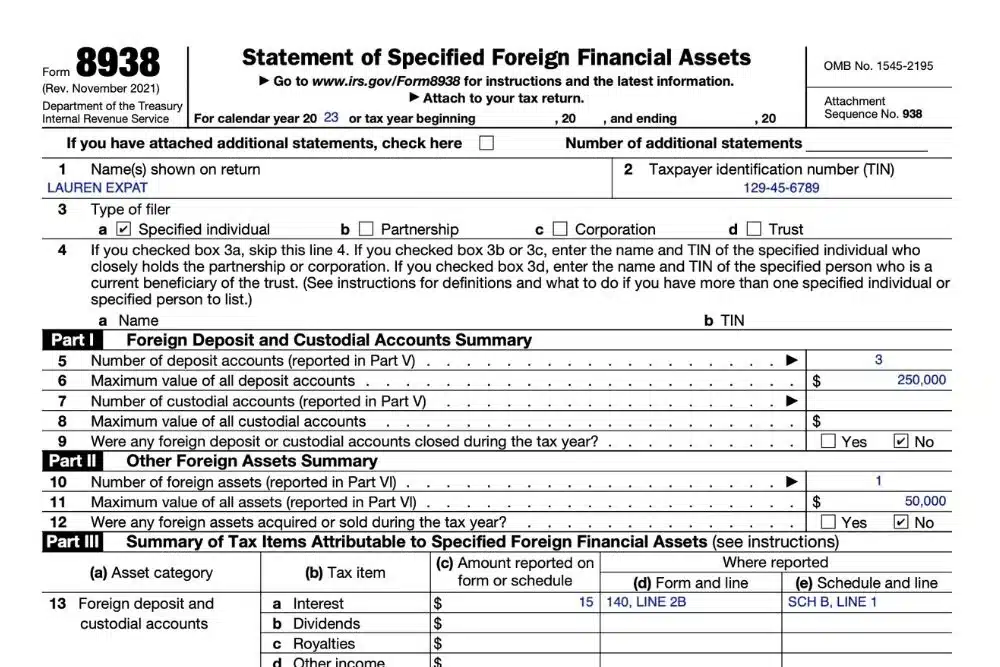
Step 5. Complete the Applicable Parts of Form 8938
The form is structured in sections based on the type of asset and how it is owned. You may need to complete:
- Part I: Foreign financial accounts
- Part II: Other foreign assets such as pensions, investment products, or ownership interests
- Part III: Income related to these assets
- Part IV–VI: Joint ownership and assets held by foreign entities
The key is consistency: describe the asset, list the highest value, and note whether it produced income.
Step 6. Attach Form 8938 to Your Form 1040
Form 8938 cannot be filed separately. It must be attached to your tax return. If your accountant prepares your return, they will include the form for you. If filing yourself, attach it to your electronic or paper return.
Step 7. Keep Your Supporting Documentation
You do not need to send statements to the IRS, but you must retain them. Keep all supporting records for at least three years. This is especially helpful for expats who hold accounts across several countries.
Step 8. File by the Standard U.S. Expat Deadlines
Form 8938 follows the same deadlines as your return:
- Automatic extension to June 15 for expats
- Option to extend further to October 15
If your assets span multiple countries, involve foreign pensions, PFICs, or shares in foreign companies, the requirements can get more complex. Many expats find real relief when a specialist handles the reporting for them.
Want Help Filing Form 8938? We Can Help!
We hope this guide has helped you understand the requirements and instructions for Form 8938. However, expat taxes are nothing if not complex. If you still have questions, we have the answers you need. In fact, we can even prepare and file Form 8938 on your behalf.
Have questions about the process or next steps? Contact us, and one of our Customer Champions will happily address all your concerns. If you’re ready to be matched with a Greenback accountant, click the get started button below.




Featured In





