IRS CP5071, 5071C and CP5071F Notices: What They Mean and What to Do



An IRS CP5071 notice is a letter that asks you to verify your identity and tax return before the IRS processes your return. The CP5071 series includes Letter 5071C and CP5071F, and the IRS treats all three the same way. The IRS sends one when it receives a return filed under your Social Security number (SSN) or Individual Taxpayer Identification Number (ITIN). It’s a routine check, not an audit or a bill. The IRS holds the return, and any refund, until you respond.
If you filed the return, you verify it, and the IRS continues processing. If you didn’t file it, you tell the IRS when you verify, because someone may have used your information. Most letters let you verify online or by phone. After you verify online, the IRS says to wait 2 to 3 weeks before checking your refund, and processing can take up to 9 weeks. Our guide to U.S. expat taxes covers the return itself.
Living abroad adds a few wrinkles: mail takes longer, some letters ask for a call or a visit, and the IRS sends a separate letter, 5447C, to foreign addresses. Each is covered here, along with how to spot a scam and when your refund should arrive.
What Does an IRS Notice CP5071 Mean?
A CP5071 notice means the IRS has a Form 1040-series return filed under your SSN or ITIN and wants to confirm that you filed it before it can continue processing. The notice asks you to verify two things: that you’re the taxpayer, and that the return is yours.
The CP5071 Series Includes CP5071, 5071C and CP5071F
The IRS treats CP5071, 5071C, and CP5071F as a single series with one set of instructions. It doesn’t publish a difference between the three versions, and the response is the same whichever one you received: verify online if your notice offers it, or call the number printed on it.

What Does a 5071C Letter Mean?
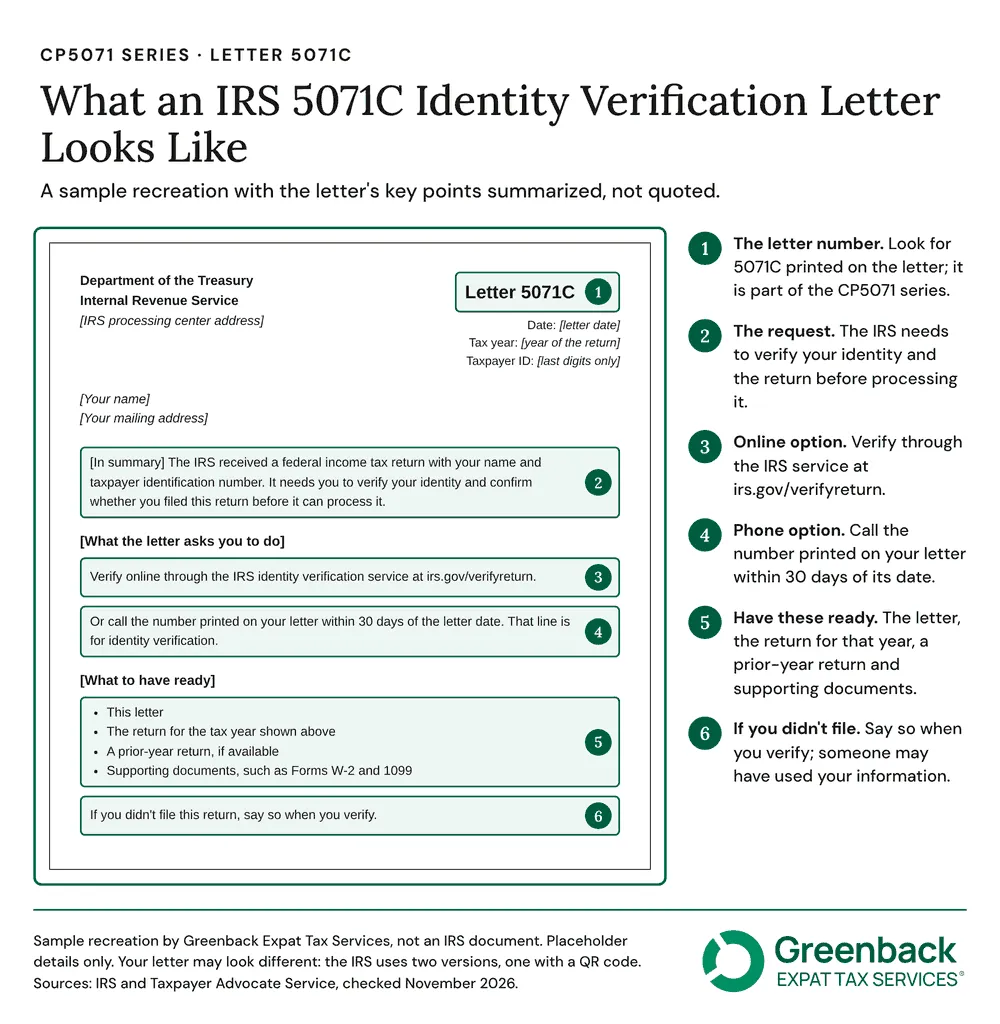
Letter 5071C is the most widely issued IRS identity verification letter, and it means the IRS needs you to confirm that you filed the return sent under your SSN or ITIN. It’s part of the CP5071 series, so it carries the same meaning and the same next steps as a CP5071 notice. Until you respond, the IRS won’t finish processing the return or issue a refund.
A 5071C Letter Asks You to Verify Online or by Phone
A 5071C letter gives you two ways to respond: online through the IRS identity verification service, or by phone. For the phone option, the letter asks you to call within 30 days from the date of the letter, using the number printed on it. That number is for identity verification, so it may not be able to give you refund status.
Two Versions of the 5071C Letter Are in Use
The IRS currently sends two versions of Letter 5071C, and both are genuine. One uses an updated format with a QR code. The steps are the same in either version, so a letter that looks different from a friend’s or from an older sample can still be real.
Is a CP5071 or 5071C Letter Bad?
No, a CP5071 or 5071C letter isn’t bad news on its own. It isn’t an audit; it doesn’t say you owe money, and it doesn’t prove your identity was stolen. The real cost is time: the return, and any refund, waits until you verify, so responding promptly keeps things moving.
Is My CP5071 or 5071C Letter Real or a Scam?
A real CP5071 or 5071C letter arrives by mail and points you to IRS.gov or a phone number printed on the letter. The IRS normally contacts you first by mail, and a social media message is never from the IRS. The safest check is to type irs.gov/verifyreturn into your browser yourself instead of following a link in an email or text.
| Real IRS letter | Likely a scam |
|---|---|
| Arrives by mail through the U.S. Postal Service | Arrives unexpectedly by text, email or a social media message |
| Points you to IRS.gov or the number printed on the letter | Points you to a link or number that doesn’t match IRS.gov |
| Asks you to verify your identity and the return | Asks for personal or financial information, or demands payment now |
| Explains your options for responding | Rushes or threatens you |
A Letter That Looks Fake Needs an Independent Check
If anything about the letter doesn’t match IRS.gov, don’t call the number or scan the code on it. Sign in to your IRS online account at IRS.gov instead, or use the phone numbers listed for calling from outside the U.S. The QR-code version of Letter 5071C is real, but scan it only on a letter that arrived by mail.
Why Is the IRS Asking Me to Verify My Identity?
The IRS asks you to verify your identity when it receives a return associated with your SSN or ITIN and wants to confirm it before processing. A letter doesn’t mean you did anything wrong. Your next step depends on whether you filed the return.
1. If You Filed the Return, Verify So Processing Continues
If the return is yours, verifying lets the IRS finish processing it. Have a copy of the return in front of you, because the IRS will ask about it.
2. If You Didn’t File, Tell the IRS When You Verify
If you didn’t file the return, say so during verification, because someone may have filed a return using your information. Once you’ve verified, you don’t need to file Form 14039, Identity Theft Affidavit, unless the IRS tells you to. To help keep it from happening again, you can request an IP PIN, explained in the section on avoiding a CP5071 next year.
Which IRS Identity Letter Did You Get, and How Do You Respond?
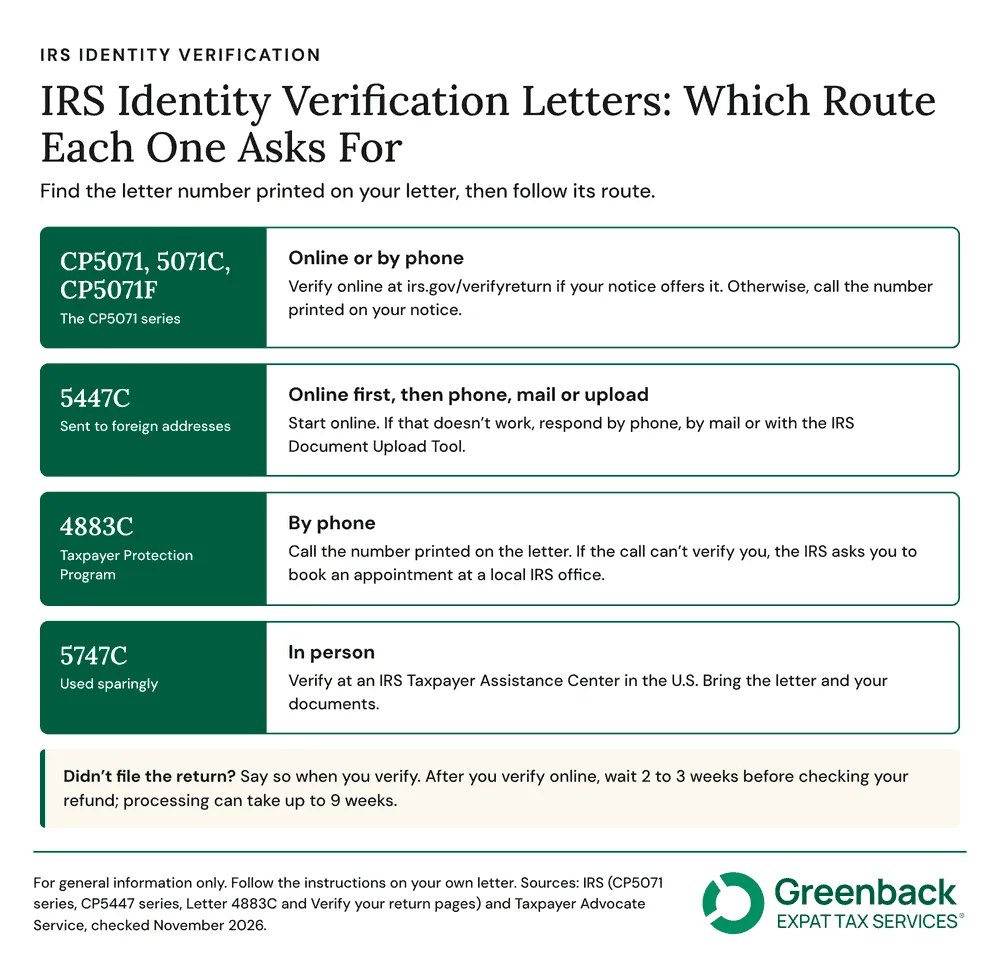
The letter number printed on your letter tells you how the IRS wants you to verify. Letters in the CP5071 series can usually be answered online or by phone; a 5447C goes to foreign addresses; a 4883C asks you to call; and a 5747C asks for an in-person visit. Follow the route printed on your own letter.
1. CP5071 Series Letters Can Be Answered Online or by Phone
For CP5071, 5071C, or CP5071F, start online at the ‘IRS Verify Your Return’ service if your notice offers it. If you can’t verify online, call the number printed on your notice. The IRS says the service covers only the CP5071 series and Letter 5447C.
2. Letter 5447C Goes to Foreign Addresses
Letter 5447C is the identity verification letter the IRS sends to taxpayers with a foreign address. It belongs to its own series (CP5447, 5447C and CP5447F) and asks the same question as a CP5071. You verify online first, and if that doesn’t work, the IRS lets you respond by phone, by mail, or through its Document Upload Tool.
3. Letter 4883C Asks You to Call the Number on It
A 4883C letter asks you to call the Taxpayer Protection Program number printed on it. If the IRS can’t verify your identity on the call, it will ask you to schedule an appointment at a local IRS office and bring your documents. After you verify, the IRS says your refund can take up to 9 weeks.
4. Letter 5747C Asks for an In-Person Visit
A 5747C letter asks you to verify in person at an IRS Taxpayer Assistance Center, and the IRS uses it sparingly. If you live abroad, a practical approach is to plan the visit around your next trip to the U.S. and keep the letter and your documents together.
How Do You Verify Your Identity for the IRS From Abroad?
You can verify from abroad the same way you would in the U.S.: online if your letter offers it, or by phone. Mail can take weeks to reach you, calls to a U.S. number may require time zone planning, and in-person routes require a U.S. visit. Our FAQ on responding to an IRS notice from abroad covers notices in general.
1. Your Letter and Return Are the Key Documents
Before you start, gather the letter and the return it refers to. The IRS asks for:
- Your letter: the CP5071-series notice or other identity letter.
- The return for the year on the letter: a copy of the return as filed. If someone prepared it for you, ask them for a copy.
- A prior-year return, if available: to help confirm your identity.
- Supporting documents: such as Forms W-2 and 1099, or Schedule C or F if you have them.
2. You Can Call From Outside the U.S.
Start with the number printed on your letter. If you can’t find your letter, check your IRS online account. The IRS Taxpayer Protection Program line is 800-830-5084 in the U.S., and from outside the U.S., the number is 267-941-1000.
3. Someone Can Help, but You Take Part
A helper can join or make the call, depending on the paperwork. A representative with Form 2848, Power of Attorney, on file can call the IRS for you, and the IRS encourages you to be available on the call. Without Form 2848, you and your helper must call together, and you must take part in the call.
How Long After Verifying Your Identity Will You Get Your Refund?
After you verify online, the IRS says to wait 2 to 3 weeks before checking your refund, and it can take up to 9 weeks to process your return. If you verified by phone, the IRS says the refund can also take up to 9 weeks. For refund status, use Where’s My Refund; the number on your letter is for identity verification. Here’s how the wait usually unfolds:
- You verify online through the IRS Verify Your Return service.
- Weeks 2 to 3: check your refund status on the IRS Where’s My Refund tool or in your IRS online account.
- Up to week 9: the IRS finishes processing the return and issues any refund.
Your Return Goes Back Into Processing
Once you’ve verified, your return resumes normal processing. You don’t need to send anything else unless the IRS asks, and any refund is issued once processing finishes. Our guide to tax refunds for expats covers how refunds reach you abroad.
Your Transcript May Show a Hold While You Wait
Your IRS account transcript may show code 971 when the letter goes out, code 570 while processing is on hold, and code 571 releases that hold. These codes appear for many reasons, so they don’t always point to identity verification. Our article on how long a code 570 hold lasts explains what to expect, and our FAQ on obtaining an IRS tax transcript from abroad shows how to do so.
After 9 Weeks, Your IRS Account Is the First Place to Check
If 9 weeks have passed since you verified your refund and it still hasn’t arrived, check Where’s My Refund and your IRS online account first. If a new letter arrives, follow its instructions. For questions about the verification itself, call the number on your letter.
How Can You Avoid a CP5071 Letter Next Year?
An Identity Protection PIN (IP PIN) helps protect your SSN or ITIN on future returns. It’s a six-digit number, issued each year, that goes on any return filed under your SSN or ITIN, and anyone with an SSN or ITIN who can verify their identity can request one. Our guide to the Identity Protection PIN walks through getting one. Filing with information that matches IRS records also helps, as our guide to why the IRS says your information doesn’t match explains.
How Can a Tax Professional Help With a CP5071 or 5071C Letter?
You can verify your identity yourself, but a tax professional can make it easier. A preparer can confirm which letter you have, give you a copy of the return as filed and its supporting documents, call the IRS for you with Form 2848 on file or join your call without one, and help with any follow-up letters. Greenback’s expat tax consultation is a good place to start if you’d like help.
Frequently Asked Questions about CP5071 and 5071C Letters
The IRS pages for the CP5071 series don’t state a response deadline, but a 5071C letter asks you to verify by phone within 30 days of the letter’s date. The IRS won’t process the return or issue a refund until you respond, so it’s best to verify as soon as you can.
No, a CP5071 or 5071C letter isn’t an audit. It asks you to confirm your identity and that you filed the return under your SSN or ITIN. Once you verify, the IRS continues processing the return.
Yes, if your CP5071-series notice or Letter 5447C offers online verification, you can verify through the IRS Verify Your Return service at irs.gov/verifyreturn. If you can’t verify online, follow the instructions on your letter, which usually means calling the number printed on it.
If you can’t find your IRS identity verification letter, check your IRS online account. You can also call the IRS Taxpayer Protection Program at 800-830-5084, or 267-941-1000 from outside the U.S.
A CP5071 or 5071C Letter Can End With One Verification
For most people who filed the return, a CP5071 or 5071C letter can be resolved once you verify who you are and that the return is yours, and the IRS resumes processing. The letter number indicates the route, and the IRS timeline shows when to check your refund. If you’re a U.S. citizen living abroad and an IRS letter has reached you late or asks for something you can’t do from where you live, help is available. Learn more about how we help U.S. citizens living abroad.

IRS Letters, Handled With Care
This article is for general information only. IRS letters, routes, and timelines can change, so follow the instructions on your own letter. Please consult a qualified tax professional about your specific situation.



Featured In


