The Discretionary Extension: Another Tax Extension After October 15


The discretionary extension is a second tax extension available to U.S. taxpayers living abroad, and it moves your filing deadline from October 15 to December 15. The IRS calls it discretionary because the agency decides whether to grant it. You request it by letter, and the letter has to reach the IRS by October 15.
October 15 is a decision point. If your return will not be finished in time, you have a route to two more months, and the request itself is short. One condition comes with it: the extra time is for filing, not for paying, so paying a sound estimate before October 15 keeps the cost of those two months down to interest alone.
The discretionary extension is worth considering when:
- Your foreign tax figures have not arrived: Many countries issue assessments and year-end statements after October 15, and the Foreign Tax Credit depends on those numbers.
- Your return grew more complicated after you filed Form 4868: A property sale, a new business interest, or a mid-year move changes what it needs.
- You are catching up on more than one year: Several returns take longer to assemble than one.
Below are the dates, how the letter works, and how payment is handled.
The Discretionary Extension Moves Your Filing Date to December 15
Taxpayers who are out of the country can request an additional two months beyond the Form 4868 deadline, moving the filing date to December 15 for calendar-year filers. The IRS sets this out in Publication 54, revised December 2025, as a discretionary extension available in addition to the six-month extension.
What Does Discretionary and Additional Mean
Two words there carry weight. Discretionary means the IRS decides. You are asking, and the agency can say no. Additional means it sits on top of the six-month extension you already hold, which is why the wording assumes Form 4868 came first.
Where It Sits Among the Four Extensions
It is the third step in a sequence. An automatic two-month extension takes taxpayers abroad to June 15 with no form required; Form 4868 takes you to October 15; and a discretionary request takes you to December 15. A fourth route, Form 2350, serves a different purpose and is covered below. Our tax extensions Q&A sets the four side by side, and the full calendar of U.S. filing dates that apply overseas is in our expat tax deadlines guide.
Who Cannot Use It
One exclusion is explicit. Publication 54 states that the discretionary two-month additional extension is not available to taxpayers who have an approved extension of time to file on Form 2350.
How to Request the Discretionary Extension
No form exists for the discretionary extension. Publication 54 instructs U.S. taxpayers abroad to send the IRS a letter explaining why they need an additional 2 months. That letter must reach the IRS by October 15, the extended due date for calendar-year filers. The letter is the entire application.
The Five Steps
- Write the letter before October 15. The date the letter must reach the IRS is the same October 15 you are trying to move, so the request must be made while your current extension is still in effect.
- Say why you need the additional two months. A few specific sentences about what you are waiting for, such as a foreign tax assessment, do more than a general request for time.
- Include the details that identify your return. Treasury regulations require a written, signed application, so add your name, address, taxpayer identification number, the tax year, and your signature.
- Send it to the address where you file your return. Publication 54 does not name a separate address for the letter. The mailing address for your return appears in the Form 1040 instructions.
- Pay what you can before you send it. The section below explains why this step matters more than the letter.
What to Put in Your Extension Request Letter
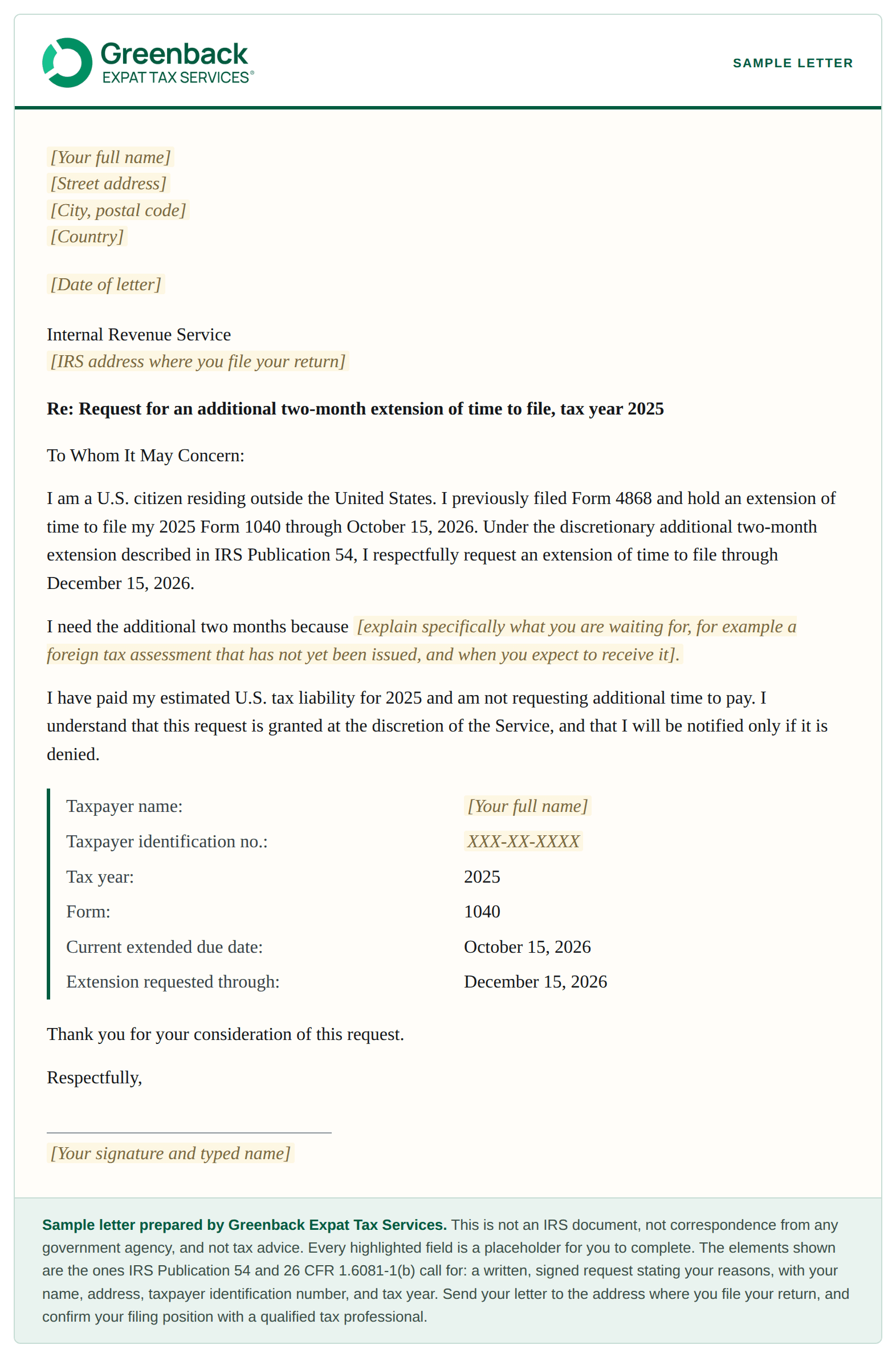
Publication 54 does not provide a form, so the letter itself is the application, and the sample below shows the elements it must include. Every highlighted field is a placeholder for your own details.
What Happens After You Send the Letter
The IRS will not send you an approval. Publication 54 states that you will not receive any notification unless your request is denied, so keep working toward December 15 unless you receive a denial. If one does, file as soon as you can, since interest and any failure to pay penalty are calculated from the original due dates
The Discretionary Extension Extends Filing Time Only
Every U.S. filing extension, including the discretionary extension, extends the time to file. None extends the time to pay. The IRS states it plainly: even if you are allowed an extension, you will have to pay interest on any tax not paid by the regular due date of your return. Interest is set quarterly and compounds daily.
What the Extra Two Months Cost in Interest
The IRS published individual underpayment rates of 6% for the second quarter of 2026 and 7% for the third, and set the rate at 7% again for the quarter beginning October 1, 2026.
Here is what that looks like on a $4,200 balance. Suppose you pay nothing until you file. At those rates, interest comes to roughly $141 by October 15 and roughly $192 by December 15. The two extra months add about $51 in interest.
The Failure to Pay Penalty and the 90% Rule
The failure-to-pay penalty applies separately. The IRS charges 0.5% of the unpaid tax for each month or part of a month it remains unpaid, up to 25%. On that same $4,200, that would be $168 by December 15.
There is a way to keep that penalty off the table. The IRS Internal Revenue Manual states that reasonable cause will be presumed for the period of the extension if at least 90% of the tax shown on the return was paid on or before the due date for payment, and the remainder is paid with the return. The Treasury regulation behind that presumption frames it around the automatic six-month extension, so if you are leaning on it all the way to December, confirm the point with your accountant.
How the Foreign Tax Credit Changes Your Estimate
When you work out what to pay, the Foreign Tax Credit offsets U.S. tax against foreign tax already paid, so the credit typically covers the U.S. liability in full. Our comparison of the Foreign Earned Income Exclusion and the Foreign Tax Credit covers how to choose between them.
Form 2350 Is a Separate Route With a Different Purpose
Form 2350 exists for one situation: you expect to qualify for the Foreign Earned Income Exclusion, but you will not have met the bona fide residence or physical presence test by the time your return is due. It buys time to reach the test. The IRS sets your new date based on when you expect to qualify.
Why the Two Routes Do Not Combine
That difference is why the two routes do not combine, and why an approved Form 2350 rules out the discretionary extension. If you are counting days toward the exclusion, the physical presence test explains the 330-day requirement, and our Form 2350 guide covers when it is the better choice.
What to Do If You Will Not Make Any of These Dates
If you miss December 15, file as soon as you can and pay what you can toward the balance. The failure-to-file and failure-to-pay penalties are both calculated on unpaid tax, so a year with no balance due generally carries neither penalty. Separate reporting requirements such as the FBAR have their own rules.
Where to Start
The Streamlined Filing Compliance Procedures require that you come forward on your own, which is why starting early keeps that option open. On the figures, the IRS charges a failure-to-file penalty of 5% of the tax due for each month or partial month a return is late, up to 25%.
Our guide to filing U.S. taxes late from abroad covers penalties, reporting requirements, and catch-up options. If you have several years outstanding, the support available to late filers is a reasonable place to start.
Frequently Asked Questions
It is an additional two-month extension of time to file, available to U.S. taxpayers out of the country, which moves the filing deadline to December 15 for calendar-year filers. You request it by letter by October 15, and the IRS decides whether to grant it.
Yes. The discretionary extension is the route to take, and the letter must reach the IRS by October 15. The IRS will contact you only if the request is denied.
No. Publication 54 describes it as discretionary, which means the IRS grants it at its own judgment. A specific reason in your letter, such as a foreign tax assessment that has not yet been issued, is more useful than a general request for more time.
No. Every extension available to taxpayers abroad extends only the time to file, and interest on unpaid tax runs from April 15 in every case. Paying at least 90% of your total tax by the due date for payment, and the balance with your return, is the condition the IRS attaches to its presumption of reasonable cause for the extension period.
Probably not on the October 15 timetable. Treasury regulations require the application to be filed on or before the due date of the return; without Form 4868, your due date is June 15. The regulations also state that no extension is allowed under that section, except in undue hardship cases, until an automatic extension has already been allowed. Ask a tax professional about your own facts before the date passes.

There Is Still Time to Get This Right
This article is for informational purposes only and does not constitute tax advice. The rules that apply to U.S. taxpayers living abroad depend on your circumstances, including your country of residence, income sources, and filing history. IRS interest rates are set quarterly and change. Please consult a qualified tax professional with expertise in U.S. expatriate taxation before making decisions about extensions, payments, or filing positions.



Featured In