FBAR: What It Is, Who Must File & How To Report Foreign Accounts

- What Is the FBAR?
- Do I Need to File an FBAR?
- FBAR Real-World Examples
- How to File Your FBAR
- FBAR Filing Deadlines for 2026
- What If I Haven't Filed an FBAR?
- FBAR Penalties: What You Need to Know
- FBAR vs. FATCA (Form 8938): What's the Difference?
- Special FBAR Situations
- Common FBAR Mistakes to Avoid
- Next Steps: Getting Your FBAR Right
- Let Greenback Handle Your FBAR Filing
- Frequently Asked Questions


You must file an FBAR (Foreign Bank Account Report) if you are a U.S. person and the combined value of your foreign financial accounts exceeded $10,000 at any point during the year. The FBAR is filed separately from your tax return through FinCEN’s BSA E-Filing System and does not create any additional tax liability.
According to FinCEN, the FBAR applies to:
- U.S. citizens, green card holders, and resident aliens with foreign bank, investment, or pension accounts
- Anyone with signature authority over a foreign account, even if they do not own the funds
- The $10,000 threshold is aggregate — all foreign accounts combined, even if no single account exceeds $10,000
The FBAR deadline for the 2025 tax year is April 15, 2026, with an automatic extension to October 15, 2026. Here is exactly who needs to file, how to do it, and what happens if you are behind.
Ensure Your FBAR is Filed Correctly — Get Expert Help!
What Is the FBAR?
The FBAR (Foreign Bank Account Report) is an annual form that U.S. expats, Green Card holders, and U.S. citizens (who have foreign bank accounts) must file if their combined foreign account balances exceed $10,000 at any point during the year. It’s submitted to the U.S. Treasury’s Financial Crimes Enforcement Network (FinCEN) and is separate from your tax return, helping you stay compliant and avoid penalties for unreported foreign accounts.
Created under the Bank Secrecy Act, the FBAR helps prevent tax evasion by requiring transparency about offshore assets. But here’s what matters most: filing an FBAR doesn’t mean you owe taxes. It’s purely informational.
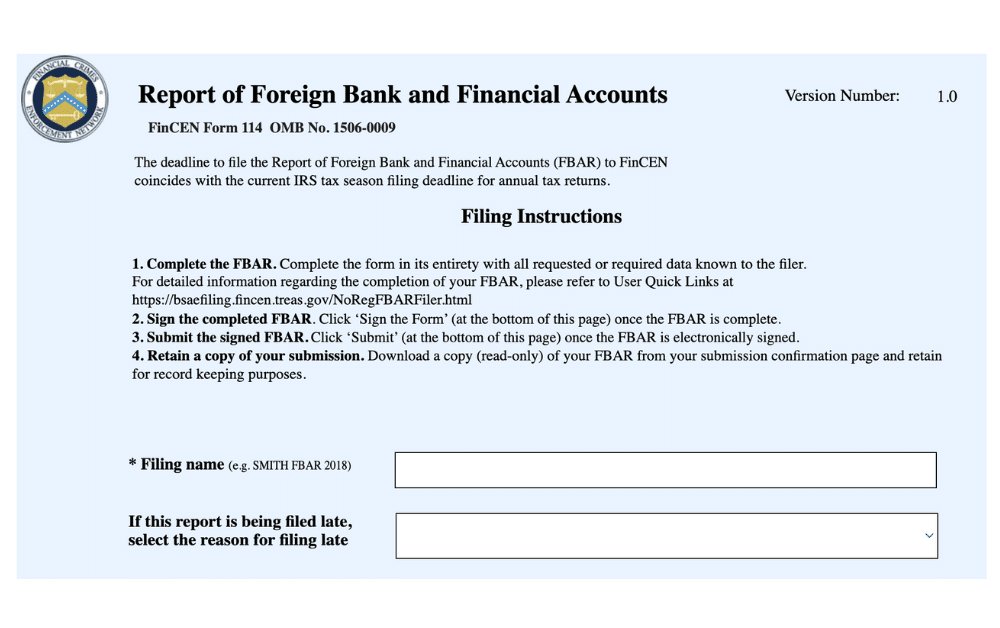
The form itself, officially known as FinCEN Form 114, requests basic information about your foreign accounts, including where they’re held, account numbers, and the maximum balance during the year, expressed in U.S. dollars.
Since 2012, all FBARs have been required to be filed electronically through the BSA E-Filing System. Many of our CPAs and Enrolled Agents are expats themselves, living in 14 time zones, and they’ve filed this form thousands of times. They have the knowledge and patience to guide you through the process.
Do I Need to File an FBAR?
You must file an FBAR if you meet all three criteria:
- You’re a U.S. person: This includes U.S. citizens, green card holders, resident aliens, trusts, estates, and U.S.-formed entities
- You have foreign financial accounts: This includes bank accounts, brokerage accounts, mutual funds, and certain insurance policies with cash value
- Your accounts exceeded $10,000 total at any point during the year: The requirement triggers even if your balance exceeded the threshold for a single day
What Counts Toward the $10,000 Threshold?
Reportable accounts include:
- Foreign bank accounts (checking, savings, certificates of deposit)
- Investment and brokerage accounts held at foreign institutions
- Mutual funds and unit trusts
- Foreign retirement and pension accounts (with some exceptions)
- Life insurance policies with cash surrender value
- Accounts where you have signature authority, even if you don’t own the funds
Not reportable:
- Accounts held at U.S. military banking facilities
- IRA or 401(k) accounts at U.S. institutions that invest in foreign assets
- Social Security payments deposited in foreign accounts (the account itself is reportable, but Social Security isn’t “income” for FBAR)
FBAR Real-World Examples
Example 1: Digital Nomad with Multiple Accounts
Sarah works remotely and lives in Portugal. She has:
- €3,500 in a Portuguese checking account
- £4,200 in her old UK savings account
- $3,800 in a Mexican investment account
Her combined total is approximately $11,800. Even though no single account exceeds $10,000, Sarah must file an FBAR because her aggregate total crosses the threshold.
Example 2: Retiree with Foreign Pension
James retired to Spain and continues to receive a UK pension. He has €15,000 in a Spanish bank account. James needs to file an FBAR because his account exceeds $10,000. His UK pension account may also be reportable depending on whether he has access to the funds.
Example 3: Corporate Expat with Signature Authority
Michelle works for a U.S. company in Singapore and has signing authority on her employer’s Singapore bank account, which holds $500,000. Even though Michelle doesn’t own these funds, she must report the account on her FBAR because she can direct transactions.
How to File Your FBAR
Filing an FBAR is straightforward once you’ve gathered your account information. Here’s what you need:
Required Information:
- Account numbers for all foreign accounts
- Names and addresses of the financial institutions
- Maximum account value during the year (highest balance at any point)
- Type of account (bank, securities, other)
Currency Conversion: Convert all foreign currency balances to U.S. dollars using the U.S. Treasury’s exchange rate for December 31 of the reporting year. You can find these rates at the Treasury’s website.
Filing Process: Submit your FBAR electronically through the BSA E-Filing System. The system walks you through each required field.
FBAR Filing Services: We Handle the Details for You
Learn more: Complete guide to FinCEN Form 114
FBAR Filing Deadlines for 2026
The FBAR deadline for the 2025 tax year is April 15, 2026, with an automatic extension to October 15, 2026. You don’t need to request this extension; it is automatically applied to all filers.
Important distinctions:
- FBAR deadline: April 15, 2026 (automatic extension to October 15, 2026)
- Tax return deadline for expats: June 15, 2026 (can extend to October 15, 2026 with Form 4868)
These are separate deadlines because the FBAR is filed with FinCEN, not the IRS. An extension for your tax return doesn’t extend your FBAR deadline, and vice versa.
What If I Haven’t Filed an FBAR?
First, don’t panic. Millions of Americans have past-due FBAR forms. The most important thing is to get compliant now, before the IRS contacts you.
The IRS offers two main programs to help you catch up without paying penalties:
Delinquent FBAR Submission Procedures
This program is exclusively for catching up on FBARs if you’re current on your tax returns. You qualify if:
- The IRS hasn’t contacted you about delinquent FBARs
- You’ve properly reported all foreign income on your tax returns
- Your failure to file was non-willful (you didn’t know about the requirement or received incorrect advice)
The process: File all missing FBARs for up to 6 years back and include a statement explaining why they were not filed. If approved, the IRS waives all penalties.
Learn more: Filing past-due FBAR forms
Streamlined Filing Compliance Procedures
Use this program if you’re behind on both tax returns and FBARs. You’ll file:
- Three years of tax returns
- Six years of FBARs
- A certification that your failure to file was non-willful
If you live outside the U.S. for 330 days or more per year, there are typically no penalties. U.S. residents face a 5% penalty on unreported account balances.
We’ve helped thousands of expats get caught up through these programs. Many were relieved to discover they could become compliant without the penalties they feared.
Learn more: Everything you need to know about Streamlined Filing
FBAR Penalties: What You Need to Know
While we don’t want to create anxiety, understanding potential penalties helps you appreciate the importance of timely filing. The good news is that if you come forward voluntarily before the IRS contacts you, you can usually avoid penalties entirely through the programs mentioned above.
Non-willful violations (honest mistakes):
- Up to $16,536 per year for unfiled FBARs
- The IRS typically shows leniency for first-time filers with reasonable cause
- Recent Supreme Court rulings (Bittner case) clarified that penalties apply per form, not per account
Willful violations (intentional non-compliance):
- Greater of $165,353 or 50% of the account balance per violation
- Potential criminal charges in extreme cases (rare)
What counts as “reasonable cause”?
- You weren’t aware of the FBAR requirement
- You received incorrect professional advice
- You made a good-faith effort to comply
We’ve served over 23,000 expats, and many came to us worried about penalties after discovering they hadn’t filed FBARs. Through the proper catch-up programs, the vast majority avoided penalties entirely.
Learn more: Complete guide to FBAR penalties
FBAR vs. FATCA (Form 8938): What’s the Difference?
The U.S. government has two separate requirements for reporting foreign assets, which can be confusing for many expats. Here’s how they differ:
Quick Comparison
| FBAR (FinCEN Form 114) | FATCA (Form 8938) | |
| Filing Threshold | $10,000 aggregate | $200,000 (single expats) / $400,000 (married expats) |
| Who Must File | Individuals and entities | Individuals only |
| Where to File | FinCEN (separate from tax return) | IRS (attached to tax return) |
| What’s Reported | Foreign financial accounts | Foreign financial assets (broader category) |
| Deadline | April 15 (auto-extension to Oct 15) | Same as tax return deadline |
Key insight: You can hold an asset inside an account. In this case, it’s reportable on both forms. However, if you hold an asset individually (such as direct ownership in a foreign company), it’s only reported on Form 8938.
Many expats need to file both forms for the same accounts. The reporting thresholds differ, and they are directed to various agencies.
Learn more: FBAR vs. FATCA: Complete comparison
Special FBAR Situations
Joint Accounts with Non-U.S. Spouses
If you have joint accounts with your non-U.S. spouse, both of you must report the account if you both have signing authority. However, spouses can file one joint FBAR if:
- All foreign accounts are jointly owned
- Neither spouse has separate foreign accounts
- Both spouses sign Form 114a (authorization form)
You don’t need to report your non-U.S. spouse’s individual accounts if you have no signing authority over them.
Learn more: FBAR filing rules for joint accounts with non-U.S. citizens
Business Owners and Signature Authority
If you own a business with foreign accounts or have signature authority over employer accounts, special rules apply:
- Business accounts count toward your personal $10,000 threshold
- You must report accounts where you have signature authority, even if you don’t own the funds
- Consolidated FBAR filing may be available for parent companies with subsidiaries
Learn more: Consolidated FBAR filing for businesses
Children with Foreign Accounts
If your child has foreign accounts exceeding $10,000, you must file an FBAR on their behalf. This includes:
- Custodial accounts you opened for them
- Trust accounts where they’re beneficiaries
- Joint accounts you hold with your child
Parents must file using the child’s name and Social Security Number, even if the child doesn’t need to file a tax return.
Common FBAR Mistakes to Avoid
Based on working with expats, here are the most common mistakes we see:
- Mistake 1: Thinking the FBAR is only for wealthy people: The $10,000 threshold is low. Many expats hit it simply by maintaining regular checking and savings accounts.
- Mistake 2: Assuming your foreign bank reports for you: While some banks share information with the U.S. through FATCA, that doesn’t eliminate your personal FBAR filing requirement.
- Mistake 3: Not reporting accounts under $10,000 when the total exceeds the threshold: You must report all foreign accounts if your aggregate total exceeds $10,000, even if individual accounts are below the threshold.
- Mistake 4: Forgetting about old accounts: That UK savings account from your previous job? If it still had funds during the year and your total exceeded $10,000, it’s reportable.
- Mistake 5: Overlooking retirement and pension accounts: Foreign retirement accounts are generally reportable if you can access the funds. This trips up many retirees.
Next Steps: Getting Your FBAR Right
- If you’re current on FBAR filing: Continue filing annually by the April 15 deadline (or use the automatic October 15 extension). Keep records of all foreign accounts for at least 5 years.
- If you need to file for the first time, gather your account statements showing the year’s maximum balances. File through the BSA E-Filing System or work with a qualified expat tax professional.
- If you’re behind on filing: Don’t wait. The longer you delay, the more complicated it becomes. Use the Delinquent FBAR Submission Procedures or Streamlined Filing Compliance Procedures to get caught up penalty-free.
- If you’re unsure what applies to your situation, contact us. One of our Customer Champions can help you understand your obligations and connect you with an experienced CPA or Enrolled Agent who specializes in expat taxes.
Let Greenback Handle Your FBAR Filing
Many of our CPAs and Enrolled Agents are expats themselves, living in 14 time zones. They experience firsthand the challenges of living abroad and have the knowledge and patience to help you navigate complicated U.S. tax requirements.
FBAR filing services: Starting at $125 for up to 5 accounts. We handle everything from gathering information to electronic filing.
Ready to get started? Click below to be matched with a Greenback accountant, or contact our Customer Champions if you have questions about the process.
FBAR Filing Done Right — Avoid Penalties, Get Expert Help
The information provided here is for general guidance only and should not be construed as legal or tax advice. FBAR requirements can be complex, and individual situations vary. For specific advice about your situation, please consult with a qualified tax professional.
Frequently Asked Questions
The FBAR exists to help the U.S. government detect and prevent tax evasion, money laundering, and other financial crimes involving offshore accounts. Created under the Bank Secrecy Act, it is a reporting requirement only. Filing an FBAR does not mean you owe additional taxes; it simply informs the U.S. Treasury that you hold foreign financial accounts. The form goes to FinCEN (Financial Crimes Enforcement Network), not the IRS, though the IRS enforces penalties on FinCEN’s behalf.
Penalties depend on whether the IRS considers your failure willful or non-willful. For non-willful violations (honest mistakes or lack of awareness), the penalty is up to $16,536 per report per year, as clarified by the Supreme Court’s 2023 Bittner v. United States ruling. For willful violations (intentional non-compliance), the penalty is the greater of $165,353 or 50% of the account balance per violation, plus potential criminal charges. However, if you come forward before the IRS contacts you, catch-up programs typically result in zero penalties. Learn more in our complete guide to FBAR penalties.
The following accounts do not need to be reported on your FBAR: accounts held at U.S. military banking facilities abroad, correspondent or nostro accounts maintained by banks, IRAs and 401(k)s at U.S. institutions (even if they invest in foreign assets), and accounts owned by government entities. Foreign retirement accounts (such as UK pensions, Canadian RRSPs, or Australian superannuation) are generally reportable if you have access to the funds. Cryptocurrency held in a foreign exchange may also trigger FBAR requirements if the exchange holds fiat currency. When in doubt, it is safer to report an account than to omit it. Learn more about FBAR vs. FATCA reporting differences.
The IRS identifies unreported foreign accounts through several channels: FATCA data reported directly by foreign banks to the IRS, information-sharing agreements with foreign governments, mismatches between your Schedule B (which asks if you have foreign accounts) and your FBAR filing history, whistleblower tips, and cross-referencing with other international reporting forms like Form 8938. Checking “No” on Schedule B’s foreign account question when you do have foreign accounts is one of the most common red flags. The IRS has also increased enforcement resources targeting high-income non-filers with foreign accounts.
The IRS evaluates willfulness based on your overall conduct, not just whether you knew about the FBAR requirement. Factors that suggest willfulness include: checking “No” on Schedule B when you have foreign accounts, actively concealing accounts or moving funds to avoid detection, ignoring advice from a tax professional to file, and failing to disclose accounts to your tax preparer. Courts have also ruled that “willful blindness” (deliberately avoiding learning about the requirement) can be treated as willful. Factors that support non-willfulness include: reasonable reliance on professional advice, a good-faith effort to comply, and lack of awareness of the FBAR requirement. If you are behind, coming forward voluntarily through the Delinquent FBAR Submission Procedures before the IRS contacts you is the strongest evidence of non-willfulness.
There are two main catch-up programs. The Delinquent FBAR Submission Procedures are for people who are current on their tax returns but missed FBAR filings. File up to 6 years of past-due FBARs with a reasonable cause statement, and the IRS typically waives all penalties. The Streamlined Filing Compliance Procedures cover both late tax returns and late FBARs: you file 3 years of returns and 6 years of FBARs with a non-willfulness certification. Expats living abroad for 330+ days typically pay zero penalties. U.S. residents face a 5% penalty on unreported account balances. Both programs require that the IRS has not already contacted you about the missing filings.