Foreign Housing Exclusion Calculator: Step-by-Step Estimate



To estimate your foreign housing exclusion, cap your housing costs at your location’s limit and subtract the base housing amount, with both figures prorated to your qualifying days. On your 2026 tax return, filed in 2027, the base is $21,264 ($58.26 per day) and the general limit is $39,870 ($109.23 per day), so most locations cap out at $18,606 for a full year. High-cost cities have higher limits. Our foreign housing exclusion guide explains who qualifies and which costs count.
This foreign housing exclusion calculator works in six steps, with a worksheet graphic and two examples. Your estimate makes a difference only if your foreign earned income is higher than your FEIE limit. Every figure here is an estimate, rounded to the dollar.
How Do You Calculate the Foreign Housing Exclusion Step by Step?
You calculate the foreign housing exclusion by counting your qualifying days, adding up your housing costs for those days, capping them at your location’s limit, and subtracting the base housing amount for the same days. For employees, the result is the exclusion. These six steps follow the logic of Part VI of Form 2555.
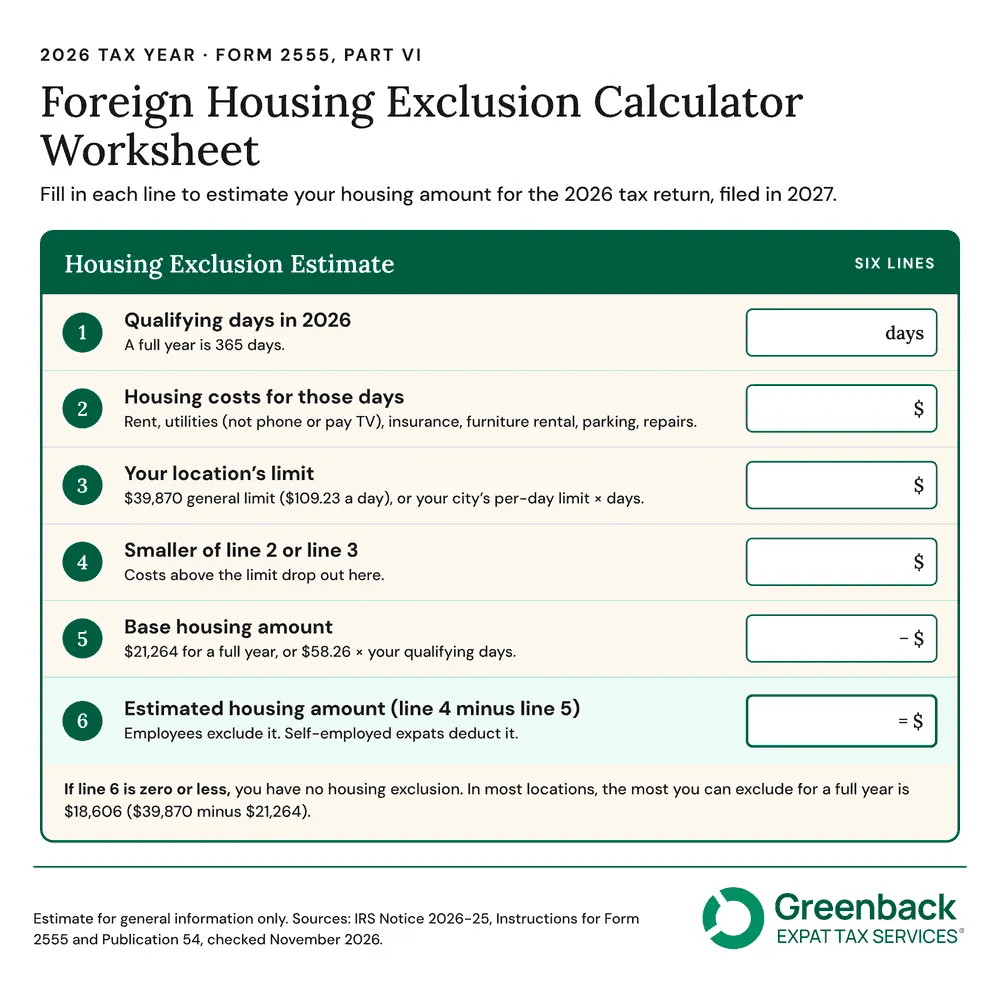
1. Your Qualifying Days Come First
Count the days of 2026 that fall in your qualifying period under the Physical Presence Test or the Bona Fide Residence Test. A full year is 365 days. Every other number in the calculation depends on this one.
2. Only Housing Costs From Those Days Count
Add up your qualified housing costs for your qualifying days only: rent, utilities other than telephone and pay television, property and renter’s insurance, furniture rental, residential parking, and household repairs. See the full list of qualified housing expenses before you add them up.
3. Your Location Sets the Limit on Costs
Find your location’s limit for 2026. Many high-cost cities have their own limit, such as $68,600 in London, while most other places use the general $39,870 limit. The United Kingdom also sets $44,200 for cities it doesn’t name separately, and a few other countries have similar rows. Our 2026 city limits table lists 20 common expat cities. For part of a year, multiply the per-day limit by your qualifying days.
4. The Smaller of Your Costs or the Limit Is What Counts
Compare your housing costs from Step 2 with your limit from Step 3. Only the smaller amount goes forward. Costs above the limit drop out here, before the base comes off.
5. The Base Housing Amount for Your Qualifying Period Comes Off
Subtract the base housing amount for your qualifying period: $21,264 for a full year, or $58.26 times your qualifying days. If the result is zero or less, you have no housing exclusion, and the FEIE alone covers your foreign earned income up to its limit. A positive result is your estimated housing amount.
6. Your Employer-Provided Share Becomes the Exclusion
If all your foreign-earned income is salary, your entire housing amount is your housing exclusion. If you also have self-employment income, only the salary portion is excluded; the rest becomes the foreign housing deduction, which has its own limit.
How Is the Foreign Housing Exclusion Prorated for Part of a Year?
For part of a year, the foreign housing exclusion uses per-day figures: each full-year amount divided by 365, then multiplied by your qualifying days. The base, your location’s limit, and the FEIE limit are all prorated the same way, so a move in July roughly halves each one.
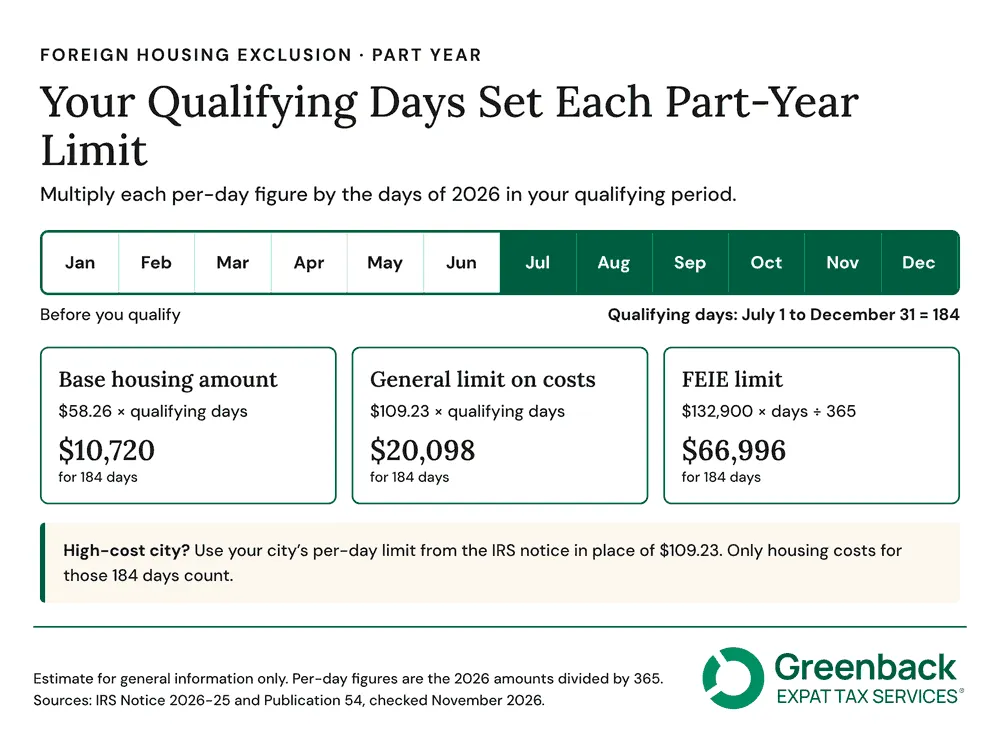
For 2026, the base housing amount is $58.26 per day, the general limit on housing costs is $109.23 per day, and the FEIE limit is $364.11 per day. Multiply each one by your qualifying days.
City limits have their own per-day rates in the IRS notice, such as $161.64 a day in Bangkok. Because these are estimates rounded to the dollar, the figures on your return may differ slightly.
What Does the Calculation Look Like in Practice?
These two examples run the six steps for a full year at the general limit and for a mid-year move. Each one continues to the FEIE, so you can see how much income is left taxable. They’re estimates for illustration, using the 2026 figures.
Example 1: A Full Year in Porto, Portugal
Maria works in Porto all year on a salary of $155,000. Portugal’s only listed locations are Lisbon and Alverca, so Porto uses the general limit.
| Step | Amount |
|---|---|
| Qualifying days | 365 |
| Housing costs | $45,000 |
| Limit (general) | $39,870 |
| Smaller of the two | $39,870 |
| Minus the base housing amount | −$21,264 |
| Housing exclusion | $18,606 |
| FEIE: smaller of $132,900 or $155,000 − $18,606 | $132,900 |
| Left taxable | $3,494 |
Without the housing exclusion, $22,100 would stay taxable. Income you don’t exclude is taxed at the bracket it would reach if the excluded income were counted, as our FAQ on the FEIE stacking rule explains.
Example 2: Moving to Bangkok Mid-Year
James moves to Bangkok and has 184 qualifying days in 2026. In those days, he earns a $95,000 salary and spends $32,000 on housing.
| Step | Amount |
|---|---|
| Qualifying days | 184 |
| Housing costs for those days | $32,000 |
| Bangkok limit: $161.64 × 184 | $29,742 |
| Smaller of the two | $29,742 |
| Minus the base: $58.26 × 184 | −$10,720 |
| Housing exclusion | $19,022 |
| FEIE: prorated limit, $132,900 × 184 ÷ 365 | about $67,000 |
| Left taxable | about $9,000 |
James won’t meet the Physical Presence Test until he has 330 full days abroad in 2027. He can extend his deadline with Form 2350 until he qualifies, or file without the exclusion and amend later. Our Form 2555 guide covers first-year timing, and our FAQ on changing countries mid-year covers moves between countries.
What Happens After You Have Your Housing Exclusion Estimate?
Your housing exclusion is calculated before the FEIE, and it lowers the FEIE room: the FEIE is the smaller of your FEIE limit or your foreign earned income minus the housing exclusion. Together, the two can exclude all or most of your foreign-earned income, and anything left may be offset by the Foreign Tax Credit.
A Few Things This Estimate Leaves Out
- Currency: convert foreign rent and bills with the IRS foreign exchange rates.
- Unreasonable costs: costs the IRS considers lavish or extravagant don’t count.
- U.S. Government allowances: a nontaxable housing allowance reduces your housing amount.
- Second households and spouses: special rules apply and are covered in our guide’s married couples section.
Frequently Asked Questions about the Foreign Housing Exclusion Calculator
No, the IRS does not offer an online foreign housing exclusion calculator. The Instructions for Form 2555 include a Limit on Housing Expenses Worksheet for your location’s limit and a Housing Deduction Carryover Worksheet for self-employed filers. Part VI of Form 2555 then calculates the foreign housing exclusion based on your housing costs, qualifying days, and base housing amount.
Multiply the daily base housing amount by your qualifying days. For 2026, the full-year base housing amount is $21,264, or $58.26 a day, which is 16% of the $132,900 FEIE limit divided by 365. For example, a qualifying period with 184 days in 2026 has an estimated base housing amount of $10,720.
Yes. The foreign housing exclusion is calculated first, then the FEIE. The FEIE is limited to the smaller of the FEIE limit, $132,900 for a full year in 2026, or your foreign earned income minus your foreign housing exclusion. The foreign housing exclusion adds to the total you exclude only if your foreign earned income exceeds your FEIE limit.
Your Days, Your City, and Your Income Shape the Estimate
Your qualifying days set the limit, your city determines how much housing costs count, and your income decides whether the housing exclusion adds anything beyond the FEIE. Greenback’s accountants calculate each of these on Form 2555 alongside your FEIE. If you’re a U.S. citizen living abroad paying high rent, we help you claim it correctly. Learn more about how we help U.S. citizens living abroad and corporate expats. If you’re self-employed, learn more about how we help self-employed expats.

Let an Expert Run Your Housing Numbers
This calculator guide gives estimates for general information. Housing limits change each year, and every situation is different, so please consult a qualified tax professional before you file.



Featured In


