IRS Tax Compliance Report Now Downloads on Demand


The IRS began issuing the Tax Compliance Report on demand on August 20, 2026, a download from your IRS Individual Online Account that carries an IRS digital certificate the recipient can verify. It covers your income tax filing and payment record and nothing else. The report returns one of three verdicts: Compliant, Noncompliant, or Compliance issue, and it withholds your income, your dependents, and your filing status. The IRS names three situations for it: applying for a job, a loan, or a government benefit. The report itself is not new. Federal agencies have obtained it for years through a signed consent form.
The Report Grades Filing and Payment Only
The details behind the verdict are short. According to the IRS, the report lists your tax filing history and either the federal taxes you owe or a statement that none are due. Three lookback windows decide the verdict:
- Late payments: federal income, employment, or excise taxes paid late in the past 4 tax years.
- Missing or late returns: returns you did not file, or filed late, in the past 6 years.
- Fraud penalties: fraudulent failure to file, or civil tax fraud penalties, assessed within 5 years.
The sample below shows the layout: the verdict sits in a box near the top, the filing table lists one row per tax period, and the sections beneath it cover what you owe and the two penalty windows.
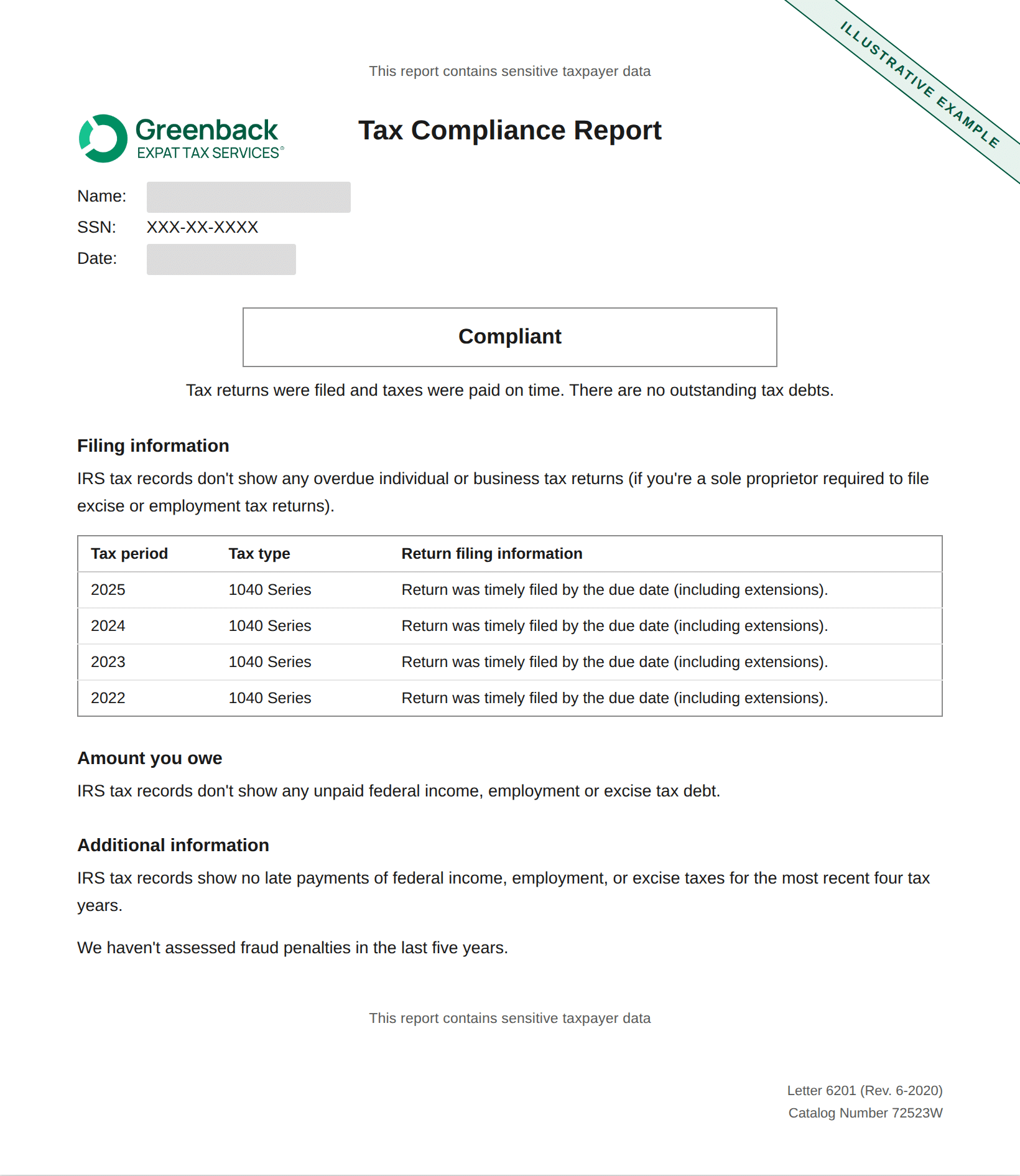
In the IRS’s own words, “the report doesn’t show your income, dependents, or filing status.” The IRS describes the result as broader coverage than a transcript. A transcript shows what you reported; this shows whether you are square.
FBAR and Form 8938 Are Not Covered
Everything the report measures is a federal tax return or a federal tax payment. The FBAR goes to FinCEN, not the IRS, so it was never going to show up here. Form 8938 goes to the IRS, is attached to your return, and still does not appear on the IRS’s list of what the report contains.
An American abroad should know that before handing the document to anyone. A Compliant verdict means your returns are filed, and your tax is paid. It does not mean your foreign account reporting is current, and it is silent on the filings that FATCA exists to collect. If you have unfiled foreign asset reports, a Compliant verdict on this report does not resolve them, and nobody reading it will learn that they exist.
Three Situations Now Have a Document
The IRS names three uses: applying for a job, a loan, or a government benefit, plus a catch-all for any other service that requires tax compliance information. The release goes further in specifying who is on the receiving end, naming “financial institutions, government agencies, and other organizations that receive the report” as the parties who can verify the certificate. Each one means something different if you live outside the U.S.
1. A Loan Abroad Now Has a Faster Answer
Lenders ask for evidence that your U.S. tax affairs are in order, and until now, the answer was an IRS transcript, which shows your return data without saying whether you are compliant. A refinance or a property purchase can now be supported with a document you download the same afternoon. Whether a particular lender accepts it is the lender’s decision, so ask before you rely on it.
2. A Job Application Can Ask for Proof
Federal employment and federal contract work already involved a tax check, and the mechanics ran through the agency rather than the applicant. The IRS describes a Tax Compliance Report in its Internal Revenue Manual as IRS Letter 6201, produced through the Federal Tax Check Service, and processed “only upon receipt of a valid Form 14767, Consent to Disclose Tax Compliance Check.” That consent needs a handwritten signature, since electronic signatures are not accepted, and the agency requested it rather than the applicant. That manual dates the letter to a 2020 revision, so the document long predates the announcement. What changed in August is that you can produce it without an agency asking you to.
3. A Government Benefit Claim May Need It
Benefit applications that test tax compliance are the third use. The advantage here is what the report withholds: an agency confirming you are current does not also receive your income figures, your filing status, or who you claim as a dependent.
A Noncompliant Verdict Is Worth Finding First
The verdict can read Noncompliant, and the triggers above are dated and specific. A return you filed two years late still sits inside the six-year window, whether or not you have since caught up. The third verdict, Compliance issue, reads “IRS tax records show a possible compliance issue” and sits between the other two. Late returns are reported as a day count rather than a flag, so a return filed well after its due date shows the exact number of days.
That is a reason to pull your own report now rather than the week an employer or a lender asks for it. Nobody sees your copy unless you send it, though a federal agency can still obtain one with your signed consent, and it is better to know which of the three verdicts you would be handing over. If it comes back Noncompliant, streamlined procedures exist for exactly this situation, and late-filing help is a routine request.
Transcripts and Residency Letters Differ
Three IRS documents get confused with each other.
| Tax Compliance Report | IRS transcript | Form 6166 | |
|---|---|---|---|
| What it proves | Your filing and payment status | Line-by-line return data | U.S. tax residency for treaty relief |
| What it omits | Income, dependents, filing status, foreign account filings | A compliance verdict | Your filing and payment record |
| Who typically asks | Employers, lenders, benefit agencies | Lenders, tax preparers | Foreign tax authorities |
| Where you get it | IRS Online Account | IRS Online Account or by mail | Apply on Form 8802 |
No IRS page says the Tax Compliance Report satisfies a treaty claim, so treat Form 8802 as the only route to Form 6166 until the IRS says otherwise.
Company Filings Go Through a Separate Download
The individual report stops at your own return. It shows a sole proprietor’s delinquent excise or employment tax returns because those are reported on a personal return, and it shows nothing about a corporation or a partnership.
Those sit in a separate document. The Business tax compliance report is available from the Business Tax Account under its own Tax records tab and uses the same digital certificate. A business owner asked to evidence compliance for the company as well as themselves needs both, and late company returns have their own catch-up path.
Getting Yours Starts in Your Online Account
- Sign in and download it: In your IRS Individual Online Account, open the Records and status tab, select Tax records, and get the Tax compliance report.
- Keep the original PDF: Open it in Adobe Reader on a desktop, where the authentication details display at the top of the report.
- Read the verdict before you send it: Check which of the three statuses you would send.
- Confirm the recipient will take it: The IRS has not published a list of institutions that accept it, so ask first.
- Deal with a Noncompliant verdict early: Bringing filings current is a conversation worth having with a preparer who has deep expertise in cross-border returns.

All figures and requirements in this article reflect IRS guidance in effect as of publication. The information in this article is for general informational purposes only and does not constitute tax, legal, or financial advice. Tax rules are complex and change frequently. Consult a qualified tax professional regarding your specific situation before taking any action.



Featured In





