UK Budget Tax Changes for Americans: Savings and Rental Income

- What the UK Budget Changes for Savings, Property and ISAs
- What to Do Before the New Rates Start
- How Higher UK Savings Tax Affects Your Foreign Tax Credit
- Cash ISA or Taxable Savings After the Budget
- New Property Income Tax Rates for UK Landlords
- Side Income, Business Sales and U.S. LLC Owners
- When Your U.S. Return Picks Up the Higher UK Tax
- Frequently Asked Questions about the UK Budget for Americans
- Your Savings Allowance and U.S. Bracket Decide Whether Your Total Tax Rises


The UK Budget of October 28, 2026, plans to raise UK income tax on savings interest and rental income to 24%, 44% and 49% from April 6, 2027, subject to the Finance Bill 2026-27, and keeps the Cash ISA limit at £20,000. For your 2026 tax return, filed in 2027, UK tax on savings and rent remains at today’s rates of 20%, 40%, and 45%. From April 2027, the higher UK tax lands on your UK bill first, then reaches your U.S. tax return from the UK through the Foreign Tax Credit. For everything else about life and tax in Britain, start with our guide to living in the UK.
The UK Budget’s 2027 tax changes don’t alter any U.S. tax rule. The extra UK tax can count toward your Foreign Tax Credit, up to the U.S. tax on the same income, and unused credit can be carried back for 1 year and forward for up to 10 years. Whether your total tax goes up depends on your Personal Savings Allowance and your U.S. tax bracket. This guide covers what changes, what to review before April 2027, and when the new rates will be reflected on your U.S. return.
What the UK Budget Changes for Savings, Property and ISAs
Budget 2026 raises the planned UK rates on savings and property income by 2 percentage points and leaves the income tax bands, the Personal Savings Allowance and capital gains tax rates unchanged. The Finance Act 2026 already sets 22%, 42%, and 47% for 2027-28, and the Finance Bill 2026-27 is due to raise them, as the GOV.UK Budget overview sets out.
| Change | Now (2026-27) | From April 6, 2027 (status) | Effect on your U.S. return |
|---|---|---|---|
| Savings interest rates | 20% / 40% / 45% | 24% / 44% / 49%, UK-wide (announced) | More UK tax that can count toward the credit |
| Property income rates | 20% / 40% / 45% in England, Wales and Northern Ireland | 24% / 44% / 49% in England, Wales and Northern Ireland (announced) | More UK tax that can count toward the credit |
| Landlords’ mortgage interest credit | 20% | Property basic rate: 22% in law, 24% announced | None; the U.S. deducts mortgage interest on Schedule E |
| Cash ISA limit | £20,000 | £20,000 for savers over 18 (secondary legislation due November 2026) | ISA interest stays taxable in the U.S. |
| Lifetime ISA withdrawal charge | 20% for home purchases above the price cap, from October 29, 2026 (was 25%) | No further change | No U.S. rule change |
| Trading allowance | £1,000 | £3,000 | Side income stays reportable in the U.S. |
| Business Asset Disposal Relief | £1 million lifetime limit, 18% | £500,000 lifetime limit, 18% | The U.S. taxes the gain under its own rules |
| Founders’ Relief | Not available | Proposed: 10% on up to £10 million of lifetime gains (consultation) | The U.S. taxes the gain under its own rules |
| Relief for U.S. LLC owners | Not available | Planned; claims intended from early 2028 (consultation) | No change to your U.S. return |
| Unchanged | Personal Allowance £12,570, bands, Personal Savings Allowance £1,000 / £500, £5,000 starting rate for savings, dividend and capital gains tax rates | Unchanged | No change |
If all your interest sits inside your Personal Savings Allowance or the £5,000 starting rate for savings, your UK tax on it doesn’t change, though it stays taxable on your U.S. return. The bands and allowances behind these figures are set out in our UK tax system guide.

See How the New UK Rates Reach Your U.S. Return
What to Do Before the New Rates Start
You have until April 6, 2027, to review how the new rates apply to your savings, rental income and any business sale. Each check uses your latest UK tax calculation and U.S. return, and each one matches a section of this guide:
- Collection: Check whether HMRC collects your tax through your tax code or Self Assessment.
- Savings: Compare Cash ISA and taxable savings at your U.S. tax bracket.
- Rentals: Review your mortgage interest credit at the new property basic rate.
- Incorporation: Check the U.S. side before moving property into a UK company.
- Business sales: Disposals before April 6, 2027, generally keep the £1 million limit.
- U.S. credit timing: Consider the accrual method on your next timely-filed U.S. return.
How Higher UK Savings Tax Affects Your Foreign Tax Credit
Higher UK tax on savings interest can count toward your Foreign Tax Credit, up to the U.S. tax on that interest. If your UK tax on the interest is already higher than the U.S. tax, the Budget adds unused credit. If most of your interest sits inside your Personal Savings Allowance, more of the same total simply shifts to the UK.
You claim credit for UK tax on Form 1116, limited to the U.S. tax on that income, as the IRS explains in Publication 514. Your Personal Savings Allowance shelters interest from UK tax but leaves it fully taxable in the U.S., which is why it matters so much here.
Three Savers Before and After the New Rates
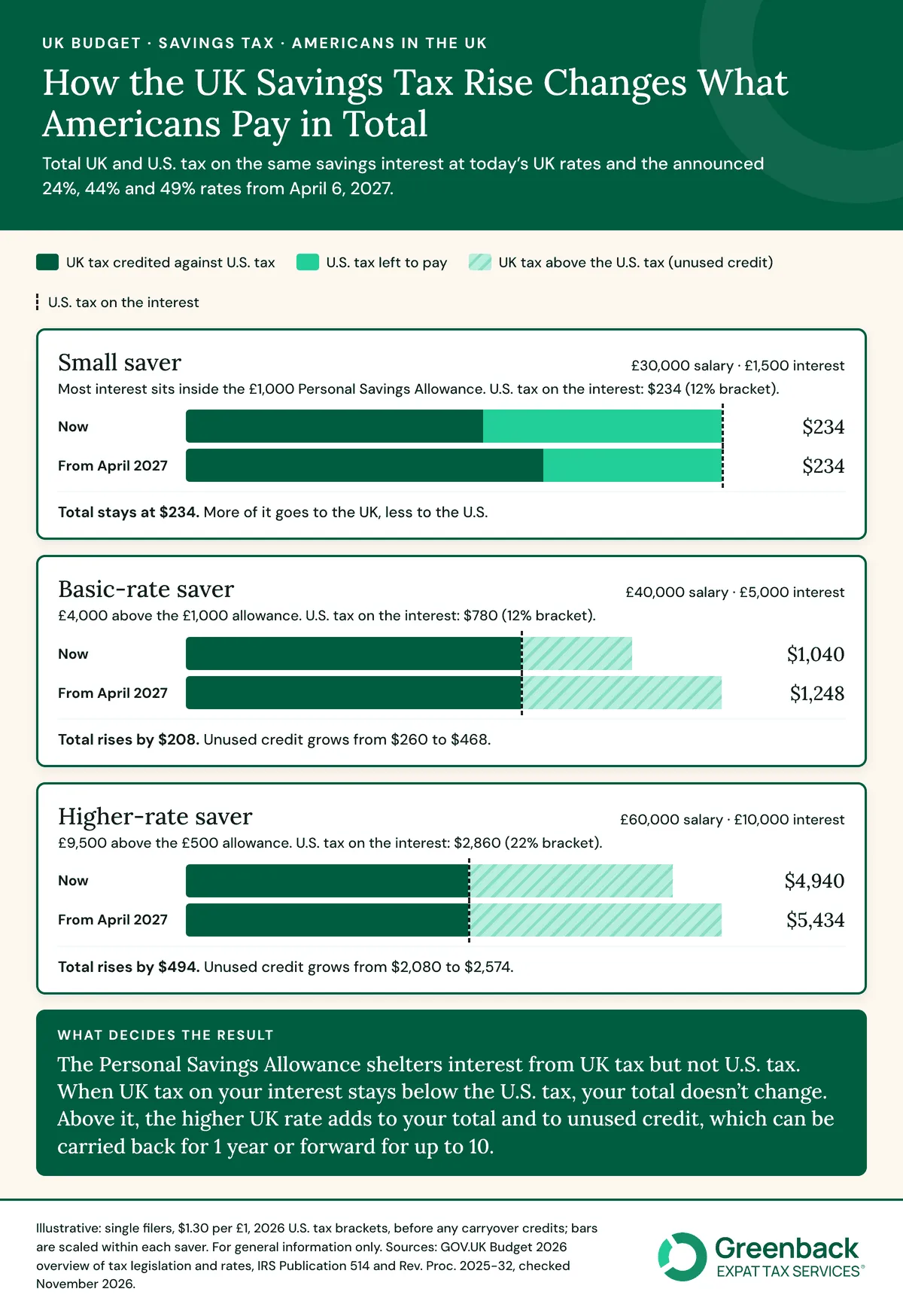
These simplified examples use single filers, $1.30 per £1, and 2026 U.S. tax brackets. Most single Americans in the UK basic-rate band fall in the 10% or 12% U.S. bracket, because the top of the band (£50,270) is about $65,000 before the U.S. standard deduction. Our comparison of UK vs. U.S. tax rates shows how the two sets of brackets align.
- Small saver (£30,000 salary, £1,500 interest): UK tax on the interest rises from $130 to $156, still below the U.S. tax of $234. Total tax remains at $234, with more of it going to the UK.
- Basic-rate saver (£40,000 salary, £5,000 interest): UK tax rises from $1,040 to $1,248, already above the U.S. tax of $780. Total tax rises by $208, and unused credit grows from $260 to $468.
- Higher-rate saver (£60,000 salary, £10,000 interest): UK tax rises from $4,940 to $5,434 against U.S. tax of $2,860. Total tax rises by $494, and unused credit grows from $2,080 to $2,574.
Unused credit only helps when another year, or other passive income, has U.S. tax to offset; our guide to Foreign Tax Credit carryovers explains how.
Other Situations That Change the Result
Excluding your salary doesn’t lower the U.S. rate on your interest. If you claim the Foreign Earned Income Exclusion, the IRS taxes your other income as if the excluded salary were included; our FAQ on the FEIE stacking rule shows the calculation. UK tax residents also pay UK tax on U.S. bank interest, and the U.S.-UK tax treaty sets out how relief applies to that income. Recent arrivals under the 4-year foreign income and gains regime may keep foreign interest out of UK tax altogether.
Cash ISA or Taxable Savings After the Budget
A Cash ISA lowers your total tax on interest only when UK tax on that interest would be higher than the U.S. tax. ISA interest is free of UK tax but still taxable in the U.S., with no UK tax to credit. That holds for many basic-rate savers in the 12% U.S. bracket and most higher-rate savers.
When a Cash ISA Lowers Your Total Tax
For the same three savers, before any carryover credits, the Cash ISA lowers the total only where UK tax is higher than the U.S. tax. The Cash ISA limit stays at £20,000 for savers over 18, reversing the earlier plan to cut it to £12,000, through secondary legislation due in November 2026.
| Saver | Total tax, taxable savings from April 2027 | Total tax, Cash ISA |
|---|---|---|
| Small saver | $234 | $234 |
| Basic-rate saver | $1,248 | $780 |
| Higher-rate saver | $5,434 | $2,860 |
ISA interest goes on Schedule B like any other interest, which is why a UK ISA isn’t tax-exempt in the U.S., and the account counts toward your FBAR and Form 8938 thresholds alongside your other UK bank accounts. Each ISA type is reported a little differently, as our UK ISA reporting guide shows.
Stocks and Shares ISAs and Lifetime ISAs
UK Budget coverage often suggests a stocks and shares ISA. For Americans, UK funds held in one are usually PFICs, which bring Form 8621 reporting; our FAQ on ISAs and PFIC rules explains why. For first-time buyers, the Lifetime ISA charge drops to 20% for above-cap purchases, and a new First Time Buyer ISA with a 25% bonus on up to £20,000 replaces it for new savers from April 2029; see our guide to buying property in the UK.
New Property Income Tax Rates for UK Landlords
From April 6, 2027, rental profits in England, Wales and Northern Ireland are planned to be taxed at 24%, 44% and 49%. Scotland and Wales can set their own property income rates under their income tax powers. Many landlords already pay more UK tax on rent than U.S. tax, so for them the rise mostly adds unused credit.
The Mortgage Interest Credit Moves With the New Rate
Your tax credit for mortgage interest on residential property is given at the property basic rate. The Finance Act 2026 sets that rate at 22% for 2027-28, and it would rise to 24% if the Finance Bill 2026-27 passes as announced, which would soften part of the rise for landlords with a mortgage.
Your UK Rent on Your U.S. Return
On your U.S. return, mortgage interest is deducted directly, and U.S. depreciation lowers your net rent, so U.S. tax on UK rent is often below the UK tax, and the extra UK tax mostly adds unused credit. Our FAQ on foreign rental property depreciation and our UK rental income guide walk through both returns. If you rent out a U.S. home while living in the UK, the U.S. taxes that rent first, so the higher UK rate adds UK tax with no extra U.S. credit.
Holding Property Through a UK Company
Property held in a UK company pays corporation tax, so the new property rates don’t apply to it. For U.S. purposes, a UK company you own is a foreign corporation, which brings Form 5471 and its own rules, so read up on UK limited companies for Americans before you transfer anything.
Side Income, Business Sales and U.S. LLC Owners
The Budget triples the trading allowance to £3,000, halves the Business Asset Disposal Relief lifetime limit to £500,000, and plans new relief for UK residents with U.S. LLC income. None of these change U.S. rules, so this income stays on your U.S. return under U.S. law.
Trading Allowance Rises to £3,000
From April 6, 2027, you won’t need to declare trading income to HMRC when the £3,000 allowance covers all of it, but your U.S. return still includes it. Net self-employment earnings of $400 or more bring U.S. self-employment tax unless the U.S.-UK totalization agreement assigns your coverage to the UK, as our guide to self-employment in the UK explains.
Business Asset Disposal Relief and the Proposed Founders’ Relief
Business Asset Disposal Relief keeps its 18% rate, but the lifetime limit falls to £500,000 for disposals on or after April 6, 2027, subject to a transitional rule. The government also proposes a Founders’ Relief at 10% on up to £10 million of lifetime gains from the same date, subject to consultation. The U.S. taxes your gain under its own rules and does not apply UK relief; the U.S. side of selling UK assets is explained in our guide to UK capital gains on property.
Planned Relief for U.S. LLC Owners
The government plans to introduce new double-taxation relief for UK residents with income from U.S. LLCs and similar entities, for which relief is currently unavailable. Consultation and draft legislation come first, and claims are intended to begin in early 2028. It doesn’t change how you report the LLC on your U.S. return.
When Your U.S. Return Picks Up the Higher UK Tax
The return you file in 2027 for 2026 isn’t affected; the higher UK tax reaches your U.S. return in the year you pay it, or the year it accrues under the accrual method. Tax collected through your tax code can start showing up on your 2027 return, and most Self Assessment and accrual-method filers see it on their 2028 return or later.
How HMRC Collects the Higher Tax
- Tax code: If you’re employed or get a pension and earn £10,000 or less in interest, HMRC usually sends a tax calculation between June and the following March and collects the tax through your tax code, often in a later tax year, as GOV.UK explains. Your tax code can also include an estimate of tax on interest for the current tax year, so collection at the new rates can start from April 2027. Without a tax code, HMRC may send a Simple Assessment letter.
- Self Assessment: If you file a UK Self Assessment return, which anyone with more than £10,000 of interest must do, your January 31 and July 31 payments on account are based on the previous year. Most of the higher tax for 2027-28 falls in the balancing payment due January 31, 2029. Sole traders and landlords registered for Self Assessment with qualifying income over £30,000 for 2025-26 must also use Making Tax Digital for Income Tax from April 6, 2027.
- From April 2029: The government plans to make Self Assessment payments more regular for people who pay on account, with an option to pay through PAYE.
When the U.S. Credit Lands
Under the cash method, you claim the credit in the U.S. tax year in which you pay UK tax. Under the accrual method, UK tax for 2027-28 accrues on April 5, 2028, so it will be reported on your 2028 U.S. return. You choose the accrual method on Form 1116 for a timely-filed original return, and it applies to later years as well. When payment and income fall in different years, the 1-year carryback can help bridge part of the gap.
Frequently Asked Questions about the UK Budget for Americans
No, the UK Budget doesn’t change U.S. tax rules, and the 2026 tax return filed in 2027 uses today’s UK rates of 20%, 40%, and 45% on savings and rent. Americans in the UK still report worldwide interest and rent, and higher UK tax on that income can count toward the Foreign Tax Credit, up to the U.S. tax on it, with unused credit carried back for 1 year or forward for up to 10 years.
The 24%, 44%, and 49% UK savings and property rates have been announced but are not yet law. Finance Act 2026 sets rates of 22%, 42% and 47% for 2027-28, and the Finance Bill 2026-27 is due to raise them. The £20,000 Cash ISA limit depends on secondary legislation due in November 2026, and Founders’ Relief and the relief for U.S. LLC owners are still under consultation.
For a UK tax resident, the new UK property rates generally apply to overseas rental profits, including rent from a U.S. home. The U.S. taxes U.S. rent first, and the UK gives credit for that U.S. tax, so the higher UK rate adds UK tax with no extra U.S. credit. Recent arrivals using the 4-year foreign income and gains regime may keep foreign rent out of UK tax.
Yes, if Finance Bill 2026-27 passes as announced. Finance Act 2026 already applies the UK property income rates to individuals who are not UK tax residents, so an American who moves away but still rents out a home in England, Wales or Northern Ireland would pay the new rates on that rent. The rent stays on the U.S. return, where UK tax paid on it can count toward the Foreign Tax Credit.
Your Savings Allowance and U.S. Bracket Decide Whether Your Total Tax Rises
If most of your interest falls within your Personal Savings Allowance, the Budget mostly shifts tax from your U.S. return to the UK. Above the allowance, UK tax on interest is usually already higher than the U.S. tax, so the new rates generally add to your total and build unused credit. A Cash ISA can lower that total for many savers.
If you’re an American living in the UK, preparing both returns together helps ensure each credit is claimed in the correct year. Learn more about how we help Americans living in the UK, owners of foreign property and owners of foreign businesses. Our U.S. accountants can prepare your U.S. tax return and our UK chartered accountants your UK Self Assessment return, or you can book an expat tax consultation to plan before April 2027.

Ready for the Changes From April 2027?
This article is for general information only. The UK savings and property rates for 2027-28, the Cash ISA limit, Founders’ Relief and the relief for U.S. LLC owners were announced in the UK Budget and may change before they become law. The examples are simplified and use an illustrative exchange rate, so speak with a qualified tax professional about your own situation. Greenback Expat Tax Services is a U.S. expat tax preparation firm with expertise in U.S. and UK income tax returns for Americans abroad.



Featured In


