IRS Form 4868 for Expats Explained: How to Extend Your Tax Deadline
- Do Expats Already Get an Extension Before Filing Form 4868?
- How Do I File Form 4868 as an Expat?
- Can I Extend Beyond October 15 After Filing Form 4868?
- Should I File Form 4868 or Form 2350 for the FEIE?
- Does Form 4868 Affect My Estimated Tax Payments?
- Does Form 4868 Cover My FBAR Filing?
- Does Filing Form 4868 Extend My State Tax Deadline?
- What Happens If I Don't File Form 4868 and Miss My Deadline?
- Frequently Asked Questions
- Your Next Steps


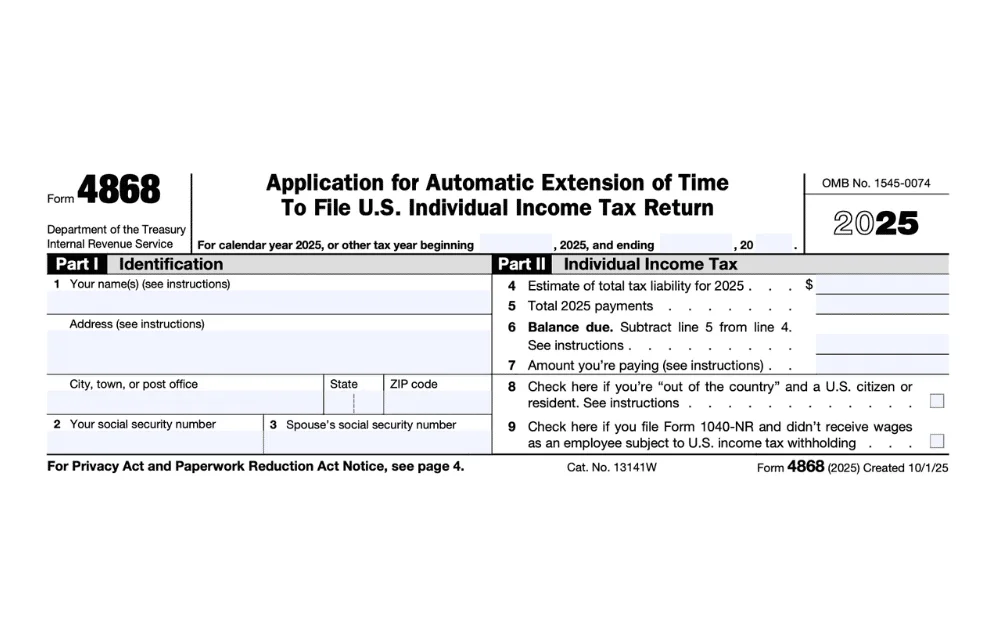
Form 4868 (Application for Automatic Extension of Time to File U.S. Individual Income Tax Return) gives you an additional four months to file your federal return, extending your deadline to October 15. For Americans living abroad who already get an automatic two-month extension to June 15, filing Form 4868 before that date buys you another four months of breathing room to gather foreign documents, finalize FEIE calculations, or coordinate with a tax professional. You can download the form directly from the IRS website.
Here are the key expat filing deadlines for the 2025 tax year (filed in 2026):
- April 15, 2026: Regular filing deadline for domestic taxpayers and payment deadline for all taxpayers, including expats
- June 15, 2026: Automatic expat filing extension (no form required)
- October 15, 2026: Extended deadline (requires Form 4868 filed by June 15)
- December 15, 2026: Final extension (requires a written request mailed to the IRS by October 15)
The most important thing to know: Form 4868 extends your time to file, not your time to pay. If you owe taxes, the IRS expects payment by April 15, regardless of when you file. Interest accrues from April 15 on any unpaid balance at the current rate of 6% annually (Q2 2026), compounded daily.

Need More Time to File? Extend Your Deadline Correctly
Here’s how Form 4868 works for expats, when to file it, and how it interacts with other extensions and deadlines.
Do Expats Already Get an Extension Before Filing Form 4868?
Yes. If you live outside the United States and Puerto Rico on April 15 and your tax home is in a foreign country, you automatically get a two-month filing extension to June 15 with no paperwork required. When you file your return, attach a brief statement explaining that your tax home and abode were outside the U.S. on the regular due date.
This automatic extension is separate from Form 4868 and applies to U.S. citizens, green card holders, and resident aliens living abroad. It does not apply to Americans who are temporarily overseas on vacation or business travel, or to military personnel (who have separate extension provisions).
For many expats, the June 15 deadline is enough. But if you need more time to gather foreign income documents, finalize FEIE or FTC calculations, or coordinate with local and U.S. tax professionals, Form 4868 extends your deadline by 4 months to October 15.
How Do I File Form 4868 as an Expat?
Filing Form 4868 before June 15 extends your filing deadline to October 15, 2026. The extension is automatic. The IRS doesn’t approve or deny it. Simply filing the form by the deadline gives you the extension. You won’t receive confirmation unless your request is denied (which is rare).
Expat deadline: You must file Form 4868 by June 15, 2026 (your automatic expat deadline). Domestic taxpayers must file by April 15.
Three ways to file Form 4868
You can file Form 4868 in three ways:
| Method | Details |
|---|---|
| Electronically through IRS e-file | Use tax preparation software or the IRS Free File system. This is the fastest and most reliable option. |
| By making an electronic payment | Paying through IRS Direct Pay or EFTPS and designating the payment as an extension automatically counts as filing Form 4868. No separate form needed. |
| By mail | Send the paper form to the address listed in the Form 4868 instructions. Allow extra time for international mail delivery. |
What to include on Form 4868
You’ll need to estimate your total tax liability for the year and report any payments you’ve already made (withholding, estimated tax payments, etc.). The IRS uses this to calculate whether you owe a balance. If you can, include a payment with your extension to minimize interest charges.

Even if you think you’ll owe $0 after applying the Foreign Earned Income Exclusion or Foreign Tax Credit, filing Form 4868 is still good practice. It protects you from failure-to-file penalties if your calculations end up being slightly off.
Can I Extend Beyond October 15 After Filing Form 4868?
Yes, but only in limited circumstances. If you still can’t file by October 15, you can request a 2-month extension to December 15, 2026. This is the final extension available.
To request it, you must:
- Have already received the October 15 extension
- Write a letter to the IRS explaining why you need the additional time
- Mail the letter to the IRS by October 15
Include your full name, Social Security number, the tax year, and a detailed explanation of why you need the extra time. The IRS grants this extension on a case-by-case basis. If your request is approved, you won’t hear back. You’ll only receive a response if the request is denied.
December 15 is the absolute final deadline. No further extensions are available after this date.
Should I File Form 4868 or Form 2350 for the FEIE?
If you moved abroad during the tax year and haven’t yet met the physical presence test (330 days) or the bona fide residence test (full tax year of residence) by your filing deadline, you have two options:
Option 1: File Form 2350
Form 2350 (Application for Extension of Time to File U.S. Income Tax Return) is specifically designed for expats who expect to qualify for the FEIE but haven’t yet met the requirements. The extension runs until 30 days after the date you expect to qualify.
Example: You moved to Germany on August 1, 2025. Your 330-day physical presence period won’t be complete until late June 2026. By filing Form 2350 before June 15, 2026, you can extend your filing deadline until approximately late July 2026, giving you time to meet the test and claim the full FEIE on your original return.
Form 2350 must be filed by June 15, 2026, and it does not extend your payment deadline. Interest still accrues from April 15 on any unpaid balance.
Option 2: File on time without the FEIE, then amend
File your return by the applicable deadline (June 15 or October 15) without claiming the FEIE, pay any taxes owed, and then file an amended return (Form 1040-X) after you meet the qualification test. You’ll receive a refund for the taxes that the FEIE would have eliminated.
This approach is more conservative but avoids any risk of missing a deadline.
Does Form 4868 Affect My Estimated Tax Payments?
No. Form 4868 and the automatic expat extension only extend the deadline for filing your annual return. They have no effect on estimated tax payment deadlines, which follow the standard quarterly schedule (April 15, June 16, September 15, and January 15). If you’re required to make estimated payments, those deadlines are unchanged by any filing extension.

Extension Doesn’t Mean You Can Delay Payment
Does Form 4868 Cover My FBAR Filing?
No. The FBAR (FinCEN Form 114) has its own extension rules completely separate from Form 4868 and your income tax return:
- Due date: April 15
- Automatic extension: October 15 (no form required)
- How to file: Electronically through the BSA E-Filing System at FinCEN, not with the IRS
You do not need to file Form 4868 to get the FBAR extension. It happens automatically. However, the FBAR is a completely separate filing from your tax return and must be submitted through FinCEN’s system, not attached to your Form 1040.
Does Filing Form 4868 Extend My State Tax Deadline?
Not always. State extension rules vary, and many states don’t offer the same automatic two-month extension for Americans living abroad.
Some states automatically extend your state deadline when you file a federal extension (Form 4868). Others require a separate state extension form. A few key examples:
- California: Automatically extends to October 15 when you file a federal extension, but interest and penalties may still apply from the original due date
- New York: Requires a separate state extension (Form IT-370) if you need extra time
- Virginia: Grants an automatic six-month extension to file, but payment is still due by the original deadline
If you still have state tax obligations from your last state of residence, check that state’s extension rules separately. Don’t assume a federal extension covers your state filing.
What Happens If I Don’t File Form 4868 and Miss My Deadline?
The key benefit of Form 4868 is that it eliminates the failure-to-file penalty, which is the more expensive of the two late penalties (5% of unpaid taxes per month, up to 25%). Without an extension, filing even one day late triggers this penalty if you owe taxes.
Form 4868 does not eliminate the failure-to-pay penalty (0.5% per month) or interest on unpaid balances. Those accrue from April 15 regardless of any extension. But the math is clear: the filing penalty is ten times larger than the payment penalty, so filing Form 4868 is always worth it, even if you can’t pay.
If you owe $0 after applying the FEIE and FTC, there are no penalties or interest for filing late. However, filing on time is still important to maintain your compliance record and claim available refunds (which expire after three years).
For a full breakdown of late filing penalties and how to minimize them, see our guide on what happens if you file your expat taxes late.
Frequently Asked Questions
No. The automatic extension to June 15 requires no advance paperwork. When you file your return, attach a statement explaining that your tax home and abode were outside the U.S. and Puerto Rico on the regular due date. That’s all the IRS needs.
No. Form 4868 must be filed by your applicable due date to be valid. For expats, that means June 15. If you miss this deadline, you lose the October 15 extension, and your return is considered late. File as soon as possible to minimize failure-to-file penalties.
No. The IRS has stated that filing an extension does not affect audit selection. Millions of taxpayers file extensions every year, and it’s a routine part of the tax system. Filing a rushed, inaccurate return is riskier than filing a correct return on extension.
This is one of the most common reasons expats file extensions. Many countries issue tax documents on different schedules than the U.S. Filing Form 4868 gives you until October 15 to gather all your foreign income statements, tax certificates, and other documents needed for an accurate return.
Traditional and Roth IRA contributions for the 2025 tax year must be made by April 15, 2026, regardless of any extension. However, SEP-IRA contributions can be made up to the extended filing deadline (October 15 if you filed Form 4868), which makes extensions especially valuable for self-employed expats looking to maximize retirement contributions.
Your Next Steps
If you’re approaching a filing deadline and aren’t ready, file Form 4868 before June 15 to protect yourself from failure-to-file penalties. Estimate any taxes you owe and make a payment by April 15 to stop interest from accruing. Gather your foreign income documents and file your return as soon as you’re ready, well before your extended deadline.
Contact us, and one of our Customer Champions will be happy to help. If you’re ready to be matched with a Greenback accountant, get started here.

File Your Extension With Confidence
The information provided in this article is for general guidance only and should not be construed as legal or tax advice. Extension deadlines, interest rates, and penalty amounts are subject to change. Consult with a qualified tax professional regarding your unique situation.