Form 1099 for Foreign Contractors: When It Applies and What to Send Instead

- When Do You Have to Send a 1099 to a Foreign Contractor?
- What Do You Collect Instead of a 1099?
- What If a Foreign Contractor Does Some of the Work Inside the U.S.?
- What Are the Deadlines, and What Happens If You Miss Them?
- Which Form Applies to Your Contractor
- Frequently Asked Questions
- Two Questions Decide Almost Every Foreign Contractor Payment


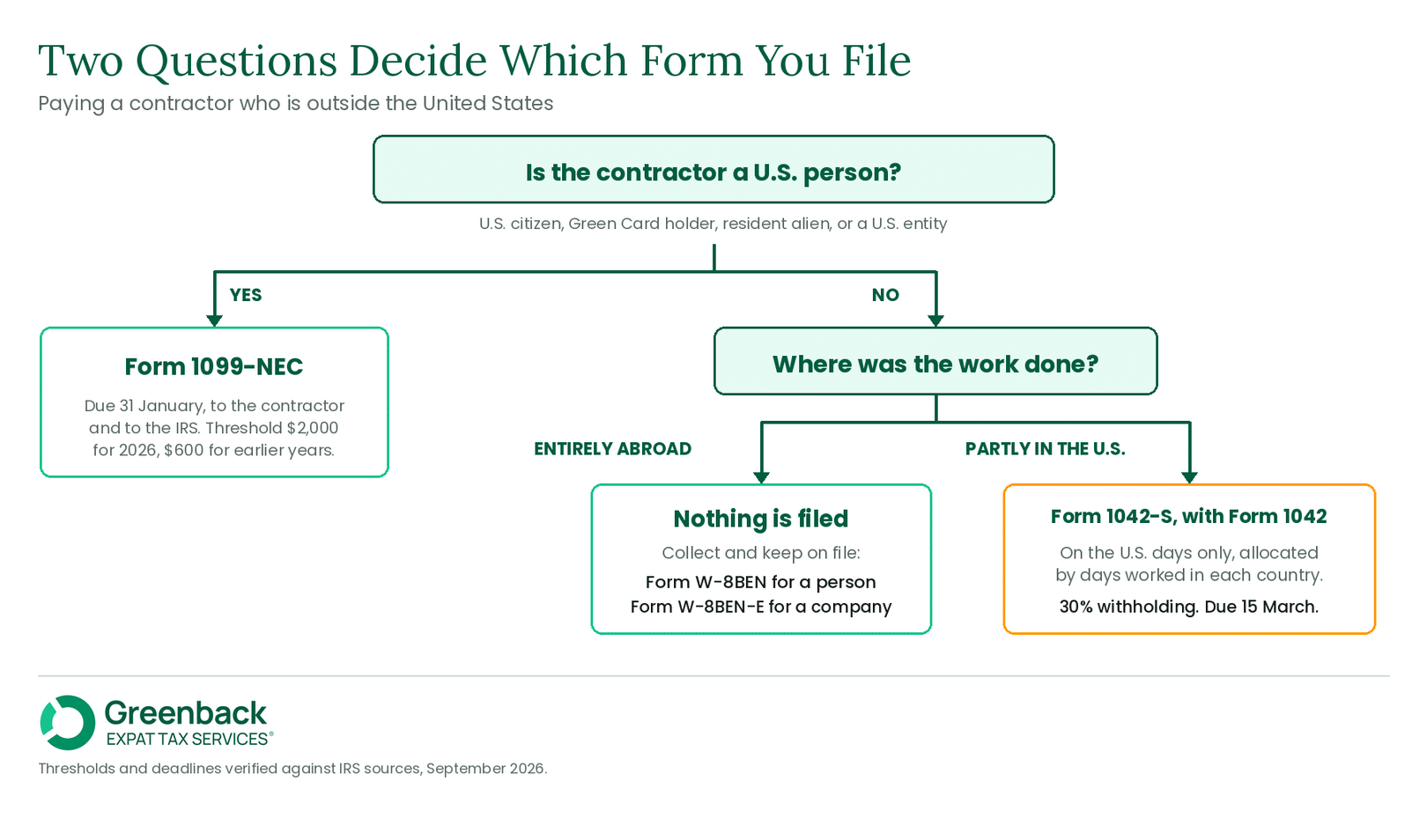
A U.S. business does not file Form 1099-NEC for a foreign contractor who performs the work outside the United States. Form 1099-NEC reports payments to U.S. persons, so for a foreign contractor, you collect Form W-8BEN, or Form W-8BEN-E if you are paying a company, keep it on file, and file nothing with the IRS for that payment. Where the contractor is a U.S. person, the form is due once you pay them $2,000 or more during 2026, up from $600 for payments made in earlier years.
Living abroad does not make someone a foreign contractor. This is where businesses most often go wrong. The IRS defines a United States person as a citizen or resident of the United States, and citizenship does not lapse with an address change. An American who has lived in Berlin for fifteen years, invoices you through a German company and has never set foot in your office, is still a U.S. person, and still gets a 1099-NEC. For this purpose, a foreign contractor is a contractor who is not a U.S. person.
Two questions decide which of those applies, and only two. Is the contractor a U.S. person? And where was the work physically performed? Everything else, the contractor’s nationality on paper, the currency you paid in, and where your company is registered, changes nothing.
The other case worth settling before you file, and the one most published guidance gets wrong, is the foreign contractor who spends part of the engagement inside the United States. That payment goes on Form 1042-S instead, with 30% withholding, and only the days worked inside the U.S. count toward the reportable amount.
When Do You Have to Send a 1099 to a Foreign Contractor?
You issue Form 1099-NEC when the contractor is a U.S. person, and you paid them at or above the reporting threshold for that year.
U.S. persons, for this purpose, are U.S. citizens, Green Card holders, resident aliens, and entities formed under U.S. law, including partnerships, corporations, estates, and domestic trusts.
| Payments made | Reporting threshold |
|---|---|
| Before 2026 | $600 or more |
| In 2026 | $2,000 or more |
| After 2026 | Indexed for inflation |
If your contractor is a foreign person and did the work abroad, no 1099-NEC is due at any amount. There is no threshold to watch, because the form does not apply.
A U.S. Citizen Abroad Is Still a U.S. Person
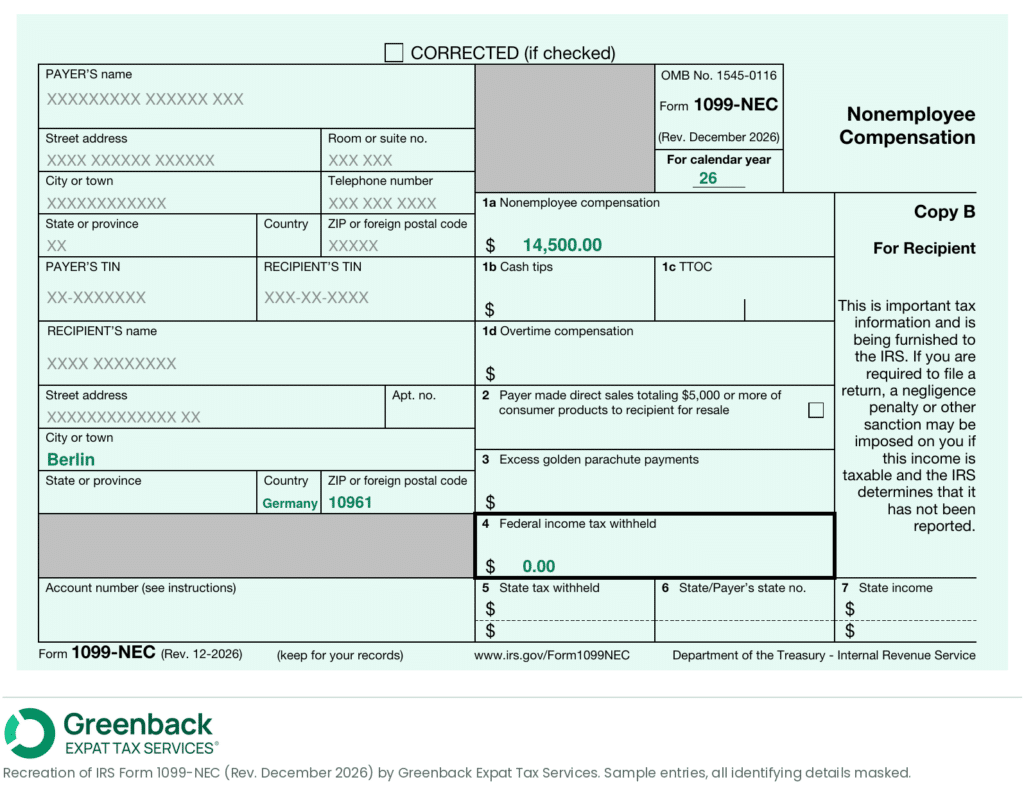
That freelancer in Berlin, invoicing you in euros from a German bank account, is a U.S. person, so a 1099-NEC is due once you cross the threshold. Being registered as a business in Germany does not change that, and their own U.S. filing obligations continue for as long as they hold the passport.
The form itself barely changes. The contractor’s foreign street address, city, and postal code go in the recipient block, exactly where a U.S. address would, with the country named in its own field. Box 1a shows the full amount paid for the year, and Box 4 shows nothing withheld when the contractor has returned a Form W-9 with a valid taxpayer identification number.
The contractor on the other side of that payment has their own set of obligations. Our guide to contracting from abroad covers what they file when your 1099 arrives and when it does not.
What Do You Collect Instead of a 1099?
For a foreign contractor, the document you need is a Form W-8BEN, which you keep on file rather than sending to the IRS. It is the contractor’s certification that they are not a U.S. person, and it is what justifies your decision not to report the payment or withhold from it.
W-8BEN for a Person, W-8BEN-E for a Company
The individual version is Form W-8BEN. If you are paying a foreign company instead of an individual, you collect Form W-8BEN-E, the entity version. Payments to a foreign corporation are not reported on 1099-NEC either.
The U.S. equivalent, Form W-9, is what you collect from a U.S. person. If you are unsure which applies to a given contractor, our guide to W-9 and W-8 forms sets them side by side.
A W-8BEN Expires at the End of the Third Year
A signed W-8BEN stays valid from the date it is signed through the last day of the third succeeding calendar year. A form signed in March 2026 covers you through 31 December 2029. It also stops being valid the moment anything on it becomes untrue, which most often means the contractor moves to the United States or takes a Green Card.
Set a renewal reminder against the expiry date. A long-running engagement will outlast the paperwork that covers it, and the form is easier to refresh while the contractor is still invoicing you.
What If the Contractor Will Not Provide One?
Which rate applies depends on what your records say the contractor is. When everything points to a foreign payee, and you simply have no W-8BEN, 30% withholding is the default for U.S.-source payments. Where the facts point to a U.S. person, and what is missing is a valid Form W-9, backup withholding applies at 24%, and a 1099-NEC is due.
The practical move is the same in both cases. Collect the form before the first payment goes out, because withholding is either done at the time or not.
What If a Foreign Contractor Does Some of the Work Inside the U.S.?
A few days of work on U.S. soil changes both the form you file and the amount you report on it. The two are separate mistakes, and a payer can make either one on its own.
Form 1042-S Replaces the 1099-NEC
The IRS instructions for Form 1099-NEC direct payers to use Form 1042-S for payments to nonresident aliens. A foreign contractor that performs services on U.S. soil has earned U.S.-source income, which is reported on Form 1042-S, with Form 1042 filed alongside it. Withholding is 30% unless a treaty provision reduces it.
A 1099-NEC here is the wrong form, filed with the wrong part of the IRS, on a payment that also carried a withholding obligation the payer never met.
Only the U.S. Days Are U.S.-Source Income
The amount is where the second mistake happens. The IRS sources personal service income by where the services were physically performed, regardless of where the contract was signed, where the payment was sent, or where the payer is resident. Work split between countries is allocated on a time basis: days worked in the U.S. divided by total days worked.
Take a contractor in Toronto on a $60,000 engagement who spends five days of a 120-day project in your New York office. The U.S.-source portion is five divided by 120, multiplied by $60,000, which is $2,500. That $2,500 is what the 1042-S reporting and withholding attach to. The remaining $57,500 was earned in Canada and is foreign-source.
What Are the Deadlines, and What Happens If You Miss Them?
Form 1099-NEC is due 31 January, both to the contractor and to the IRS, and that single date applies whether you file on paper or electronically. Form 1042-S is due 15 March, again for both copies, and an automatic 30-day extension is available on Form 8809.
Penalties are charged per return, so a business that misses ten forms is charged ten times.
For returns due in 2026:
| How late | Penalty per return |
|---|---|
| Up to 30 days | $60 |
| 31 days through 1 August | $130 |
| After 1 August, or never filed | $340 |
| Intentional disregard | $680 |
The step from $130 to $340 is the one worth acting on. If you find the error in June, filing before 1 August more than halves the charge.
Ten or More Returns Must Be E-Filed
The paper option closes at volume. A business that files 10 or more information returns in a year must e-file all of them, and the count includes 1099s, W-2s, and other returns together rather than counting each type separately. Businesses that send their own files to the IRS, rather than going through a payroll or 1099 service, need an IRS-issued Transmitter Control Code to do so, and the IRS can take up to 45 calendar days to issue one.
The route itself changes in 2027. The IRS FIRE system stops accepting information returns on November 19, 2026, and from January 1, 2027, the IRIS Taxpayer Portal is the only electronic route. Our guide covers the application, the identity check, and how long each step takes.
How to Fix a 1099 You Already Filed
File a corrected/amended return marked as a correction, and send the corrected copy to the contractor as well. A wrong dollar amount, a wrong taxpayer identification number, a wrong name, and a form issued to the wrong person all need correcting. A 1099-NEC issued to a foreign contractor who should never have received one is also worth correcting, because the contractor now has a U.S. information return in their name reporting income they did not earn in the United States.
What a CP2100 Notice Means
A CP2100 or CP2100A notice tells you that the name and taxpayer identification number you reported do not match IRS records. Nothing is charged at that stage. Contact the contractor for corrected details, and begin backup withholding on future payments if they cannot produce them.
Which Form Applies to Your Contractor
| Who the contractor is, and where they worked | What you file |
|---|---|
| Foreign person, worked entirely abroad | Nothing. Hold the W-8BEN or W-8BEN-E |
| Foreign person, some work inside the U.S. | Form 1042-S and Form 1042, on the U.S. portion |
| U.S. person, anywhere in the world | Form 1099-NEC |
Form 1099-NEC is the contractor version, and our guide to the other 1099 forms covers what each of the rest reports, from 1099-MISC to 1099-K.
Frequently Asked Questions
Generally, no. Form 1099-NEC applies to U.S. persons, so a foreign contractor performing services outside the United States receives no 1099 at any payment amount. You collect Form W-8BEN from them instead and keep it on file. The exception is a contractor who performs part of the work inside the United States, which is reported on Form 1042-S instead.
Yes. A U.S. citizen or Green Card holder is a U.S. person wherever they live, so a 1099-NEC is due once payments reach the threshold, $2,000 for payments made in 2026 and $600 for payments made before 2026. Collect Form W-9 from them, and keep W-8BEN for contractors who are not U.S. persons.
Form W-8BEN for a foreign individual, and Form W-8BEN-E for a foreign company. Neither is filed with the IRS. You collect the form, keep it with your records, and rely on it to support treating the payment as exempt from reporting and withholding. It stays valid through the end of the third calendar year after it was signed.
Without valid documentation, you cannot treat the payment as exempt, and 30% withholding applies to U.S.-source payments to an undocumented foreign payee. Ask for the form before you make the first payment. Once the year has closed, the choice between withholding and not withholding has already been made for you.
No. Payments to foreign corporations are not reported on Form 1099-NEC. Collect Form W-8BEN-E (the entity version) and keep it on file. Payments to U.S. corporations are generally exempt from 1099-NEC reporting as well, though payments to U.S. partnerships and LLCs taxed as partnerships usually are reportable.
Two Questions Decide Almost Every Foreign Contractor Payment
Almost every one of these payments comes down to whether the contractor is a U.S. person and where the work was physically done. Get both answers in writing before the first payment, and the reporting follows on its own. Greenback’s accountants sort out which form each arrangement calls for, correct filings that went out on the wrong one, and keep the documentation in a shape that still holds up if the IRS asks about it three years from now.

Get Foreign Contractor Payments Filed on the Right Form
This article is for informational purposes only. The content does not constitute tax, legal, or financial advice. Tax rules and regulations change frequently, and your individual circumstances may affect how they apply to you. For personalized guidance, consult a qualified tax professional with expertise in U.S. expat taxes.



Featured In





