Contracting From Abroad: How to Report Income With or Without a 1099



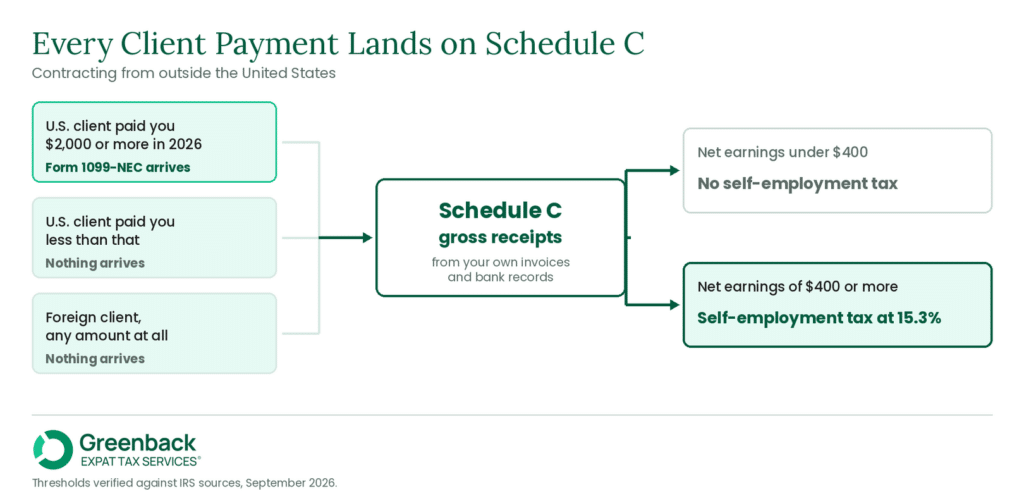
If you work as an independent contractor or freelancer from outside the United States, you report every dollar you earn, whether or not a form arrives to document it. Most contractors abroad receive no 1099 at all because foreign clients have no U.S. reporting obligation, and U.S. clients file only above a threshold. Your invoices and bank records are what the return is built from.
That means a U.S. return every year, self-employment tax at 15.3% once net earnings reach $400, and a reported total that matches what every client paid you across the year.
If you are the business making the payment, the rules run the other way. Our guide to 1099s for foreign contractors covers when a 1099-NEC is due, what to collect instead, and what changes if the contractor does part of the work inside the United States. Everything here is written for the contractor receiving the money.
Will Your Clients Send You a 1099?
A U.S. Client Files Only Above the Threshold
A U.S. business sends Form 1099-NEC if you are a U.S. person and it paid you at or above the reporting threshold for that year: $2,000 or more for payments made during 2026, and $600 or more for payments made in earlier years.
A U.S. citizen or Green Card holder is a U.S. person, no matter how long they have lived abroad, so a foreign address does not exempt your client from filing. The same applies whether you invoice as a freelancer, a sole proprietor, or a single-member LLC.
Below the threshold, that same client sends nothing, and the income is just as reportable. The threshold governs your client’s filing duty and has no bearing on yours.
A Foreign Client Never Files One
A German agency or a Singaporean startup has no U.S. information reporting obligation, so no 1099 exists, and none is coming.
Nothing about that makes the income invisible. U.S. citizens and Green Card holders report worldwide income, and a payment with no U.S. paperwork behind it is reported exactly like one that came with a form attached.
What Do You Report When No 1099 Arrives?
You report all of it on Schedule C as gross receipts, sourced from your own records. The Schedule C total is the sum of what every client paid you across the year, documented or not.
Your Invoices and Bank Records Are the Record
Invoices and deposits are sufficient on their own, and they are what an examiner asks for. Keep them in a shape you could hand to someone else: invoice number, client, date paid, currency, amount received, and the exchange rate you converted at.
Reconcile the invoices against the deposits once a quarter. A missing invoice is findable in March and considerably harder to reconstruct in the following January.
The account for those deposits is handled separately. If your foreign accounts together exceed $10,000 at any point in the year, you have an FBAR to file, and a contractor paid into a local account can cross that threshold faster than most people expect.
Where a client pays through a platform, the platform statement is also a record, though it usually reports the gross amount. Fees the platform deducts are deductible business expenses you claim on Schedule C, and the gross figure is still what you report as receipts.
What to Do When a 1099 Shows the Wrong Amount
Check every 1099 against your own figure before you file, because the two can disagree for two different reasons.
- A timing difference is no one’s fault: A client who pays on 30 December reports it in that year, and you received it in January. Report what reached you, keep the deposit record that dates it, and expect the figures not to match.
- If the figure is wrong, it’s the client’s to correct: ask them to file a corrected form and keep the invoices and deposits that support your number. Report the amount you were paid either way, because tax on money that never reached you is real money.
If you have been abroad for years without filing because nothing was ever documented, you have a defined route back. Our guide to the Streamlined Filing Procedures covers who qualifies and what it involves.
Are You a Contractor or an Employee?
Worth working out, because the label on your invoice does not decide it, and the answer can change what you owe by thousands. The IRS looks at how much control the client has over your work.
IRS Rules on Contractor vs. Employee
The IRS weighs the whole picture, and a real contractor arrangement matches the contractor column on most of them.
| Criteria | Employee | Contractor |
|---|---|---|
| Hours | Set by the client | Set by you |
| Method | The client directs each step | You decide how the work gets done |
| Tools | The client’s, provided to you | Yours, bought at your own cost |
| Clients | One, open-ended | Several, or free to take more |
| Payment | A set amount on a set date | Per project or per deliverable |
| Risk | None, you are paid either way | Yours, you can lose money on a job |
If you are paid through a U.S. payroll with tax already withheld, you are an employee working abroad, and our guide to working remotely abroad for a U.S. company covers that situation instead.
A U.S. Client Who Misclassified You Owes Half
A contractor pays the full 15.3% self-employment tax. An employee pays 7.65%, and the employer pays the other 7.65%.
If a U.S. client treated you as a contractor when the facts made you an employee, Form 8919 reports the uncollected Social Security and Medicare tax on those wages and leaves you paying the employee share instead of both.
A Foreign Employer Changes the Answer Completely
This is where the classification question stops being about paperwork. U.S. Social Security and Medicare taxes reach wages earned outside the United States only in a short list of cases: you work for an American employer, you work on an American vessel or aircraft, you work in a country with a totalization agreement that assigns coverage to the United States, or your foreign employer has a voluntary agreement covering its American staff.
A foreign company that is none of those things is outside the U.S. system. Wages it pays you for work done abroad carry no U.S. Social Security or Medicare tax at all. Contract with the same company as a self-employed contractor, and the identical work carries a 15.3% rate.
Totalization agreements are what decide most real cases, and they can assign coverage either way, so this is worth advice rather than assumption.
Which Taxes Apply to Contractor Income Abroad?
- Self-employment tax applies to foreign earnings: Once net earnings reach $400, you owe 15.3%, split 12.4% for Social Security and 2.9% for Medicare. Our guide to self-employment tax for U.S. expats covers who owes it, and what a totalization agreement with the country you live in can do about it.
- No client withholds anything for you, which is why contractors pay in four times a year rather than once. Our guide to quarterly estimated payments covers the amounts and the dates.
- The Foreign Earned Income Exclusion does not apply to it: the FEIE can exclude your contractor income from U.S. income tax, leaving the self-employment tax on that same income fully payable. An income tax bill of zero sitting next to a self-employment tax bill of several thousand dollars is a normal outcome, not a mistake.
For the filing mechanics, Schedule C through Schedule SE and on to Form 1040, see our step-by-step guide to filing self-employment tax as an expat.
Frequently Asked Questions
Do you have to report income if you never received a 1099?
Yes. A missing form does not make income unreportable. U.S. citizens and Green Card holders report worldwide income, and contractor earnings go on Schedule C, whether a 1099 documents them or only your own invoices and bank records do. Foreign clients never issue 1099s, so most contractors abroad report most of their income without a form.
Will a foreign company send you a 1099?
No. Form 1099 is a U.S. information return, and a company with no U.S. filing obligation has no reason to issue one. Your records are the documentation. Keep invoices and matching bank deposits with the exchange rate you used, and report the total as gross receipts on Schedule C.
Do you pay self-employment tax on foreign contractor income?
Usually yes, at 15.3% on net earnings of $400 or more. The Foreign Earned Income Exclusion exempts income from income tax while leaving self-employment tax in place. The main relief is a totalization agreement between the United States and the country where you live and pay into the social security system, which can exempt you from the U.S. side.
What if a client sends a 1099 with the wrong amount?
Report the amount you were paid and keep the invoices and deposits that support it. Most disagreements are about timing: a client counts a payment in the year they sent it, even if you received it in January. Where the figure is genuinely wrong, ask the client to file a corrected form.
Does working for a foreign employer change your self-employment tax?
It can change it completely. U.S. Social Security and Medicare taxes reach wages earned abroad only in a few defined cases, and a foreign employer with no American affiliation is usually outside all of them. The same work done as a self-employed contractor is subject to 15.3%. Totalization agreements decide most real cases, so the answer depends on the country.
How Contractors Abroad File Without the Paperwork
Independent contractors, freelancers, and digital nomads abroad earn most of their income without a form attached, and the file built throughout the year is what the return is based on. Greenback’s accountants rebuild income from invoices and bank records, determine which earnings the exclusion covers and which still carry self-employment tax, and file returns for contractors who have been abroad for years without a return.

Get Contractor Income Reported Right, Form or No Form
This article is for informational purposes only. The content does not constitute tax, legal, or financial advice. Tax rules and regulations change frequently, and your individual circumstances may affect how they apply to you. For personalized guidance, consult a qualified tax professional with expertise in U.S. expat taxes.



Featured In