Alternative Minimum Tax (AMT): What American Expats Need to Know
- What Is the Alternative Minimum Tax?
- Who Has to Pay the Alternative Minimum Tax?
- How Do I Calculate the Alternative Minimum Tax?
- Why Do Expats Need to Worry About AMT?
- How Does the Foreign Tax Credit Work with AMT?
- Can I Get Credit for AMT Paid in Previous Years?
- What Changes Are Coming to AMT in 2026?
- Common Expat AMT Scenarios
- Do I Need Professional Help with AMT?
- Related Resources


Despite claiming the Foreign Earned Income Exclusion or other expat tax benefits, some Americans living abroad discover they still owe taxes through an alternative calculation called the Alternative Minimum Tax. According to the IRS, the AMT ensures that taxpayers with high economic income pay at least a minimum amount of tax, even when deductions and exclusions significantly reduce their regular tax bill.
Here’s what you need to know about how the AMT affects your expat taxes and what you can do about it.
Key Takeaways
- The AMT ensures high-income taxpayers pay a minimum tax, even with deductions that would otherwise eliminate their tax bill
- For the 2025 tax year, AMT exemptions are $88,100 (single) and $137,000 (married filing jointly)
- Expats cannot use the Foreign Earned Income Exclusion to offset AMT, but the Foreign Tax Credit still applies
- Many expats in high-tax countries avoid AMT entirely through the Foreign Tax Credit
What Is the Alternative Minimum Tax?
The Alternative Minimum Tax is a parallel tax system Congress created in 1969 to ensure wealthy taxpayers couldn’t use deductions and tax preferences to reduce their tax bill to zero. Think of it as a tax floor – it’s the minimum you should expect to pay if your regular tax calculation drops too low.
Here’s how it works: You calculate your taxes twice – once under the regular system and once under the AMT system. You pay whichever amount is higher.
Check If AMT Applies to You
How the AMT Calculation Differs from Regular Taxes
The AMT starts with your regular taxable income, then adds back certain deductions and adjustments that are allowed under the regular tax system. This creates a higher income amount (called Alternative Minimum Taxable Income, or AMTI) that gets taxed at flat rates of either 26% or 28%.
Typical deductions added back for AMT calculations include:
- State and local tax deductions (capped at $10,000)
- Certain business deductions
- Incentive stock option (ISO) exercises
- Some itemized deductions
For most expats, the AMT becomes relevant when you have: High income combined with significant deductions that reduce your regular tax to very low levels, significant capital gains, or income from exercising stock options.
Who Has to Pay the Alternative Minimum Tax?
Technically, every U.S. taxpayer must calculate AMT if their tax bill falls below the minimum threshold. In practice, most Americans, including most expats, never pay the AMT because their income falls below the exemption amounts or their regular tax already exceeds the AMT calculation.
AMT Exemptions for the 2025 Tax Year
The IRS provides exemption amounts that shelter a significant portion of income from AMT. For the 2025 tax year (filed in 2026), the exemptions are:
| Filing Status | AMT Exemption Amount |
|---|---|
| Single or Head of Household | $88,100 |
| Married Filing Jointly or Qualifying Surviving Spouse | $137,000 |
| Married Filing Separately | $68,500 |
Example: You’re a single taxpayer living in Germany with an annual salary of $75,000. After applying expat tax benefits, you don’t owe any U.S. taxes under the regular system. Typically, the AMT might apply, but because your income is less than $88,100, you’re exempt from the AMT entirely.
When Does the AMT Exemption Phase Out?
For high earners, the AMT exemption gradually reduces and eventually disappears. The exemption phases out at 25 cents for every dollar of AMTI above these thresholds:
| Filing Status | Phase-Out Begins | Exemption Fully Eliminated |
|---|---|---|
| Single or Head of Household | $626,350 | $978,750 |
| Married Filing Jointly or Qualifying Surviving Spouse | $1,252,700 | $1,800,700 |
| Married Filing Separately | $626,350 | $900,350 |
Once your income exceeds these thresholds, more of your income becomes subject to AMT rates, significantly increasing your potential AMT liability.
How Do I Calculate the Alternative Minimum Tax?
The AMT is calculated on IRS Form 6251. Here’s the basic process:
- Step 1: Start with your regular taxable income
- Step 2: Add back certain deductions and adjustments (preference items)
- Step 3: Subtract the AMT exemption for your filing status (if you qualify)
- Step 4: Apply the AMT tax rates
- Step 5: Compare your regular tax and pay the higher amount
AMT Tax Rates for the 2025 Tax Year
The AMT uses a two-tier rate structure that’s simpler than the regular seven-bracket system:
| Filing Status | Income Level | AMT Rate |
|---|---|---|
| Single or Head of Household | $0 to $239,100 | 26% |
| Over $239,100 | 28% | |
| Married Filing Jointly or Qualifying Surviving Spouse | $0 to $239,100 | 26% |
| Over $239,100 | 28% | |
| Married Filing Separately | $0 to $119,550 | 26% |
| Over $119,550 | 28% |
Long-term capital gains and qualified dividends are taxed at the same preferential rates under both the regular tax system and AMT – they don’t get hit with the 26% or 28% AMT rates.
Example Calculation
Let’s say you’re married, filing jointly with AMTI of $250,000:
- Subtract exemption: $250,000 – $137,000 = $113,000 subject to AMT
- Apply 26% rate: $113,000 x 26% = $29,380 AMT
- Compare to your regular tax calculation
- Pay whichever is higher

The AMT calculation can become complex, especially when multiple income sources, stock options, or foreign tax considerations are involved. Consulting with a qualified expat tax professional ensures that you’re calculating correctly and utilizing all available strategies to minimize your tax bill.
Why Do Expats Need to Worry About AMT?
Due to the credits and exclusions available to prevent double taxation, many U.S. expats can eliminate their U.S. tax bill through the regular tax system. Historically, the AMT only affected the very wealthy. However, more expats are finding themselves subject to AMT as income levels rise and expat populations grow in high-income professions like technology, finance, and consulting.
When Expats Trigger AMT
You’re more likely to face AMT as an expat if you:
- Have high income (well above the exemption thresholds)
- Claim the Foreign Earned Income Exclusion and still have significant taxable income
- Have significant capital gains from investments or property sales
- Exercise incentive stock options (ISOs) from a U.S. employer
- Receive significant bonuses or equity compensation
- Have substantial state and local tax deductions (for those maintaining U.S. state ties)
Which Expat Tax Benefits Work with AMT?
Here’s the critical limitation for expats: You cannot use the Foreign Earned Income Exclusion or Foreign Housing Exclusion to reduce your AMT liability. These exclusions only apply to the regular tax calculation.
However, the good news: The Foreign Tax Credit DOES work with AMT. If you pay taxes to your host country, you can use the Foreign Tax Credit to offset your AMT bill.
This is why many expats in high-tax countries (like the UK, France, Germany, or Scandinavia) never pay AMT. The foreign taxes they’ve already paid generate enough Foreign Tax Credits to cover both their regular U.S. tax and any potential AMT.
How Does the Foreign Tax Credit Work with AMT?
When you’re subject to AMT, the Foreign Tax Credit operates differently than in the regular tax system. Instead of the usual dollar-for-dollar offset, you must calculate a modified Foreign Tax Credit using Form 1116 with AMT rules.
Foreign Tax Credit Strategies for AMT
Strategy 1: High-Tax Country Advantage
If you live in a country with higher tax rates than the U.S., you’ve likely paid enough foreign tax to eliminate both your regular tax and AMT. The Foreign Tax Credit “stacks” to cover whichever is higher.
Example: You’re in France earning $200,000. After French taxes, you have significant Foreign Tax Credits available. Even if AMT applies to your U.S. return, the French taxes you paid likely exceed both calculations, reducing your U.S. tax to zero.
Strategy 2: Low-Tax Country Considerations
If you live in a low-tax or no-tax country (like the UAE, Monaco, or parts of the Caribbean), you have fewer foreign taxes to use as credits. In these situations:
- The Foreign Earned Income Exclusion helps with regular tax, but not AMT
- Any AMT liability must be paid, though it may be partially offset by the limited foreign taxes you did pay
- Careful timing of income and deductions becomes critical
Can I Get Credit for AMT Paid in Previous Years?
Yes. If you pay AMT in one year but wouldn’t owe it in a future year, you may be able to claim a Minimum Tax Credit (MTC) to offset your regular tax in those future years.
This is particularly valuable for expats who:
- Exercised stock options in one year (triggering AMT) but sold the shares in a later year
- Had a temporary high income that pushed them into AMT for a single year
- Experienced one-time capital gains events
To claim the Minimum Tax Credit, complete and attach Form 8801 to your tax return. The credit carries forward indefinitely until used, though it can only offset regular tax, not AMT, in future years.
The Minimum Tax Credit applies only to certain types of AMT triggered by “deferral” preference items (like ISO exercises), not all AMT situations. Consult a tax professional to determine your eligibility.
What Changes Are Coming to AMT in 2026?
For the 2025 tax year, the AMT rules remain consistent with recent years, with annual inflation adjustments to exemption amounts and phase-out thresholds.
However, starting in 2026, the One Big Beautiful Bill Act (OBBBA) makes significant changes:
- AMT exemption amounts become permanent (previously set to expire)
- Phase-out thresholds reset lower (starting at $500,000 for singles and $1 million for joint filers)
- Phase-out percentage increases from 25% to 50%
What this means for expats: More taxpayers may face AMT starting in 2026, particularly those with income between $500,000 and $1 million. If you expect to be in this range, consider consulting with an expat tax professional about income timing strategies for 2025.
Common Expat AMT Scenarios
Scenario 1: Tech Worker in Low-Tax Country with Stock Options
Situation: You work for a U.S. tech company from Dubai, earning $180,000 in salary plus exercising $100,000 worth of incentive stock options.
AMT Impact: Dubai has no income tax, so you have minimal Foreign Tax Credits. The ISO exercise creates a large AMT preference item. You’ll likely owe AMT on the ISO spread even though you used FEIE on your salary.
Strategy: Consider exercising ISOs across multiple years to stay under AMT thresholds, or time exercises to coincide with years when you’re in higher-tax jurisdictions.
Scenario 2: Finance Professional in High-Tax Country
Situation: You work in London earning $250,000, paying UK taxes of approximately 40% on your income.
AMT Impact: Even if AMT applies to your U.S. calculation, your UK taxes generate sufficient Foreign Tax Credits to eliminate all U.S. tax liability, including any AMT.
Strategy: Maintain proper documentation of UK taxes paid and file Form 1116 correctly to ensure full credit utilization.
Scenario 3: Retired Expat with Rental Income
Situation: You’re retired in Portugal with $90,000 in U.S. rental income and Social Security, paying minimal Portuguese taxes.
AMT Impact: Rental depreciation and certain deductions that reduce your regular tax may be added back for AMT, potentially creating AMT liability.
Strategy: Consider whether rental property strategies (like cost segregation studies) make sense given AMT implications, or explore restructuring rental activities.
Do I Need Professional Help with AMT?
The AMT calculation can become quite complex, especially when combined with:
- Foreign Tax Credit calculations
- Stock option exercises
- Multiple income sources across different countries
- Capital gains from foreign property or investments
- Business income is subject to different tax treatment
Given the complexity, we recommend consulting an expat tax professional if you:
- Have an income above $200,000
- Exercise stock options or receive equity compensation
- Have significant capital gains
- Live in a low-tax country but have complex income sources
- Paid AMT in previous years and want to claim the Minimum Tax Credit
If you’re ready to be matched with a Greenback accountant who can help you minimize your AMT exposure and maximize your available tax benefits, click the get started button below. For general questions about AMT or working with Greenback, contact our Customer Champions.
Avoid an AMT Surprise.
This article is provided for general informational purposes and is not intended as legal or tax advice. AMT rules are complex and change frequently. For specific advice on your unique situation, consult with a qualified tax professional.
Related Resources
For AMT and Tax Planning
- Foreign Tax Credit: Everything You Need to Know
- Form 1116: How to Claim the Foreign Tax Credit
- Foreign Earned Income Exclusion: Your Complete Guide
For Stock Options and Equity Compensation
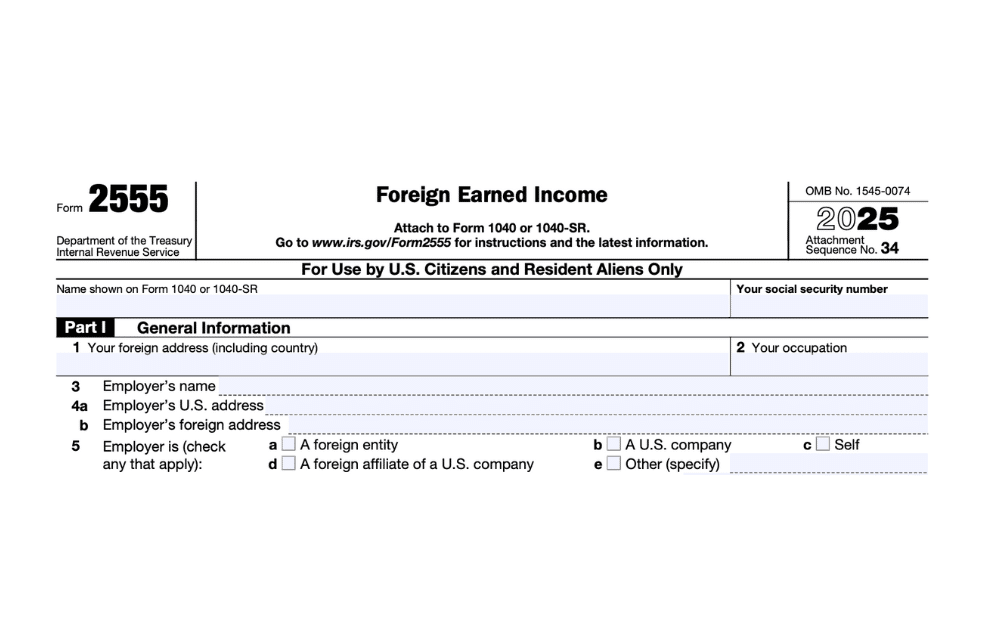
- Form 2555: Filing for the Foreign Earned Income Exclusion
- U.S. Tax Forms for Expats: What You Need to File
For General Expat Tax Guidance