Form 1040-ES: U.S. Estimated Tax for Individuals
- What Is Form 1040-ES?
- Who Must File Form 1040-ES?
- When Are Form 1040-ES Payments Due?
- How Do I Calculate My Estimated Tax?
- How Do I Pay Estimated Taxes?
- What Happens If I Don't Pay Enough?
- Form 1040-ES vs. Form 1040-ES (NR)
- How Does This Connect to My Annual Return?
- Special Considerations for Expats
- What If I Need to Adjust My Payments?
- Next Steps for Filing Form 1040-ES
- Related Resources


If you’re self-employed or earning income abroad without U.S. tax withholding, quarterly estimated taxes matter. The good news? According to the IRS, 62% of expats owe $0 in U.S. taxes after applying tax protections like the Foreign Earned Income Exclusion and Foreign Tax Credit.
However, if you expect to owe $1,000 or more after subtracting withholding and credits, you’ll need to make estimated tax payments throughout the year using Form 1040-ES. This form helps you calculate the amount to pay and when, thereby avoiding underpayment penalties.
What Is Form 1040-ES?
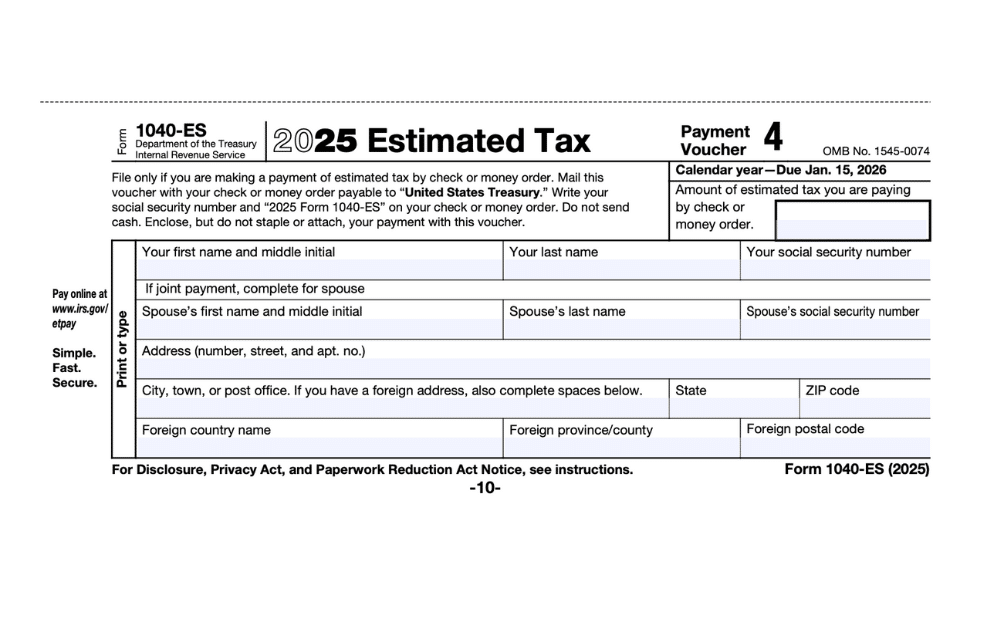
Form 1040-ES (Estimated Tax for Individuals) helps you figure out and pay estimated taxes on income not subject to withholding. Unlike your annual Form 1040 (which reports last year’s income), Form 1040-ES is forward-looking. You’re estimating your annual earnings and prepaying taxes in quarterly installments.
The form includes a worksheet to calculate your estimated tax liability, payment vouchers for each quarter, and instructions for determining if payments are required.
Who Must File Form 1040-ES?
You must make estimated tax payments if you expect to owe at least $1,000 in tax after subtracting withholding and credits, AND your withholding will be less than the smaller of 90% of this year’s tax or 100% of last year’s tax (110% if your AGI exceeded $150,000 or $75,000 if married filing separately).
Typical situations requiring estimated payments Include Self-Employed expats, those working for foreign employers who don’t withhold U.S. taxes, investment income, rental income, and other types of untaxed income.
You don’t need estimated payments if you had no tax liability last year, expect to owe less than $1,000, or your withholding covers at least 90% of this year’s tax.
Even if you use the Foreign Earned Income Exclusion to eliminate federal income tax, you still owe self-employment tax (15.3%) on net business income. You may need estimated payments for self-employment tax alone.
Get Clarity on Form 1040-ES as an Expat
When Are Form 1040-ES Payments Due?
For the 2025 tax year, quarterly estimated tax payments are due on these dates:
| Payment Period | Income Earned | Due Date |
|---|---|---|
| 1st Quarter | January 1 – March 31 | April 15, 2025 |
| 2nd Quarter | April 1 – May 31 | June 16, 2025 |
| 3rd Quarter | June 1 – August 31 | September 15, 2025 |
| 4th Quarter | September 1 – December 31 | January 15, 2026 |
Special Exception for the 4th Payment: You don’t have to make the January 15, 2026, payment if you file your 2025 tax return by January 31, 2026, and pay the entire balance due with your return.
For the 2026 tax year, quarterly estimated tax payments are due on these dates:
| Payment Period | Income Earned | Due Date |
|---|---|---|
| 1st Quarter | January 1 – March 31 | April 15, 2026 |
| 2nd Quarter | April 1 – May 31 | June 15, 2026 |
| 3rd Quarter | June 1 – August 31 | September 15, 2026 |
| 4th Quarter | September 1 – December 31 | January 15, 2027 |
If a due date falls on a weekend or legal holiday, the payment is due the next business day.
How Do I Calculate My Estimated Tax?
Form 1040-ES includes a worksheet. Here’s the process:
- Estimate Adjusted Gross Income: Project total income (self-employment, foreign earned income, investment, rental, other)
- Calculate Deductions and Credits: Subtract standard/itemized deductions, FEIE (up to $130,000 for 2025), and apply credits like Foreign Tax Credit
- Figure Expected Tax: Use tax rate schedules, add self-employment tax (15.3% unless totalization agreement applies), Additional Medicare Tax, Net Investment Income Tax if applicable
- Determine Quarterly Payment: Divide the total estimated tax by four
Safe Harbor Shortcut: Pay 100% of last year’s total tax divided by four (110% if AGI exceeded $150,000). This guarantees no penalties.
Example: Sarah, a freelancer in Spain, expects a gross income of $80,000, $20,000 in expenses, and a net income of $60,000. After $15,000 standard deduction, her taxable income is $45,000. Federal tax: ~$5,200, plus self-employment tax of ~$8,500 = $13,700 total. Quarterly payment: $3,425.
With FEIE excluding her $60,000 income, Sarah owes $0 federal income tax but still owes $8,500 self-employment tax. Her quarterly payments: $2,125 each.
How Do I Pay Estimated Taxes?
Online (Recommended): IRS Direct Pay (free), EFTPS (Electronic Federal Tax Payment System), credit/debit card (fees apply), or IRS2Go mobile app.
By Mail: Complete the payment voucher and mail it with a check or money order to the “United States Treasury.” Write your SSN and “2025 Form 1040-ES” on your check. Don’t send cash or staple payment to the voucher.
What Happens If I Don’t Pay Enough?
The IRS may charge an underpayment penalty based on the amount of underpayment, when it occurred, and the IRS’s quarterly interest rates (approximately 8% annually as of 2025).
Penalty exceptions: Total tax minus withholding under $1,000, paid 90% of the current year’s tax or 100% of last year’s (110% for high earners), retired after age 62 or disabled with reasonable cause, or casualty/disaster/unusual circumstance.
Form 2210: The IRS usually calculates penalties automatically. Use Form 2210 to calculate penalties yourself, request a waiver, or use the annualized income method for uneven income.
Form 1040-ES vs. Form 1040-ES (NR)
Form 1040-ES: Used by U.S. citizens and resident aliens to calculate and pay quarterly estimated taxes. This is the form most expats use when they expect to owe tax for the year.
Form 1040-ES (NR): Used by nonresident aliens who have U.S. source income that is not entirely withheld. As a U.S. citizen abroad, you are still treated as a U.S. person for tax purposes, so you should use the regular Form 1040-ES.
How Does This Connect to My Annual Return?
When you file Form 1040, report all estimated payments on line 26. These payments are credited toward your tax liability. Overpayments become refunds; underpayments are owed (plus potential penalties). You can apply overpayments to next year’s estimated taxes.
Special Considerations for Expats
- Automatic Extension: You get until June 15 to file, but taxes owed are due April 15 with interest accruing from that date.
- Currency Conversion: Convert foreign income to U.S. dollars using average exchange rates. Keep documentation.
- Totalization Agreements: If paying into a foreign social security system in a totalization agreement country, you may be exempt from U.S. self-employment tax with a Certificate of Coverage.
- State Taxes: Most states don’t recognize FEIE. You may owe state taxes even with no federal tax liability.
What If I Need to Adjust My Payments?
Complete a new Form 1040-ES worksheet if your income changes. Overestimated? Reduce remaining payments. Underestimated? Increase them. The sooner you adjust, the less penalty you’ll owe.
Next Steps for Filing Form 1040-ES
If you’re self-employed, freelancing abroad, or have other income without withholding, here’s what to do:
- Download Form 1040-ES from the IRS website at irs.gov/forms-pubs
- Complete the worksheet to estimate your tax liability
- Set up electronic payments through IRS Direct Pay or EFTPS
- Mark your calendar for the quarterly due dates
- Keep records of all payments and calculations
- Report payments on your annual Form 1040 when you file
Making estimated tax payments may feel like an extra burden, but it helps you avoid a large tax bill and penalties at the end of the year. By staying current with your payments, you can focus on your work abroad with confidence that your U.S. tax obligations are handled.
Stay Ahead of Your Quarterly Payments
This article is for informational purposes only and does not constitute tax, legal, or financial advice. Tax laws and regulations change frequently. For advice on your specific situation, consult with a qualified tax professional.
Related Resources
- Estimated Tax Payments for US Expats: Rules, Deadlines & More
- Form 1040 for US Expats: File Correctly & Owe $0 (2025 Guide)
- Schedule SE: Self-Employment Tax Guide for Expats
- Schedule C: How to Report Foreign Business Income
- Foreign Earned Income Exclusion (FEIE): Complete Guide
- Foreign Tax Credit: How to Avoid Double Taxation
- Self-Employment Tax for US Expats (Step-by-Step Guide)
- Form 2210: Underpayment of Estimated Tax Penalties
- Totalization Agreements: Avoid Double Social Security Tax
- Schedule 1 Form 1040: Additional Income and Adjustments