Forms 8804 and 8805 Explained: Partnership Withholding on Foreign Partners
- What Is Form 8804?
- What Is Form 8805?
- What Is the Difference Between ECI and ECTI?
- Are There Exceptions to Partnership Withholding?
- When Are Forms 8804 and 8805 Due?
- How Do Quarterly Installment Payments Work?
- What Penalties Apply for Late Filing or Non-Compliance?
- How Do Forms 8804 and 8805 Relate to Other Partnership Forms?
- Who Needs to Pay Attention to Forms 8804 and 8805?
- Let Greenback Handle Partnership Withholding for You
- Related Resources


If your partnership (or LLC taxed as a partnership) has any effectively connected taxable income (ECTI) allocated to a foreign partner, you are required to file Form 8804 and Form 8805 with the IRS. This applies even if no distributions were made and even if no withholding tax is owed.
According to the IRS, partnerships must pay withholding tax under IRC Section 1446 regardless of the foreign partner’s ultimate U.S. tax liability.
The standard withholding rates on ECTI are:
- 37% for non-corporate foreign partners (individuals, trusts, estates)
- 21% for corporate foreign partners
- Reduced rates may apply under an applicable U.S. tax treaty

Not Sure If Your Partnership Must Withhold?
Here’s how the two forms work together and what you need to know to stay compliant.
What Is Form 8804?
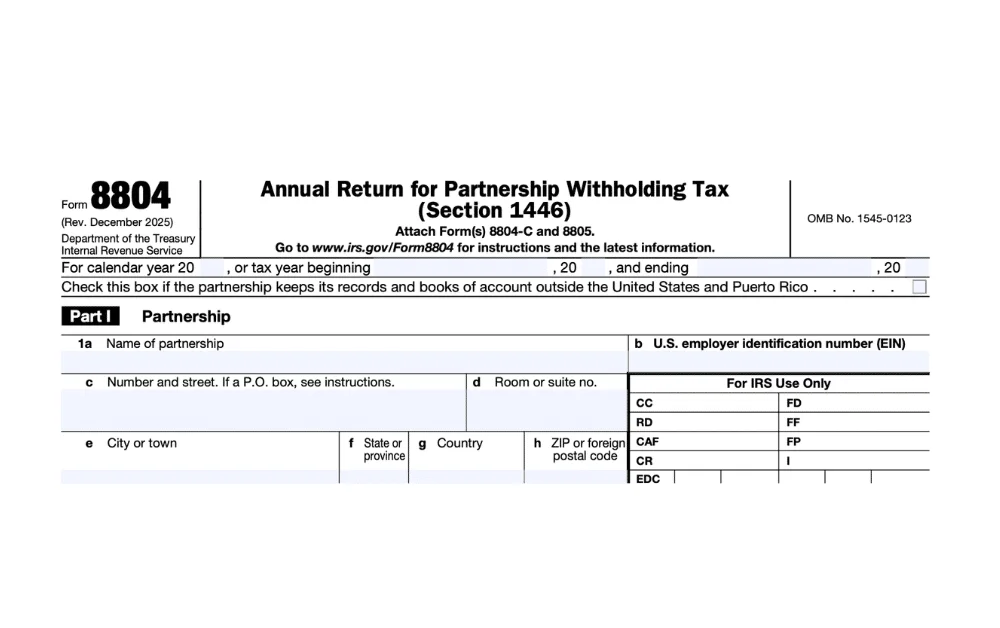
IRS Form 8804 (Annual Return for Partnership Withholding Tax) is the partnership’s annual return that reports its total Section 1446 withholding tax liability for the tax year. Think of it as the summary form, similar to how Form W-3 summarizes all W-2s.
| Form 8804 Essentials | Details |
|---|---|
| Who files | Any U.S. or foreign partnership with ECTI allocated to foreign partners |
| Purpose | Reports total withholding tax liability and serves as the transmittal form for all Forms 8805 |
| Attachments required | A copy of Form 8805 for every foreign partner, even if no tax was withheld |
| Payment | Any remaining balance of withholding tax owed for the year is paid with Form 8804 |
Form 8804 also reconciles quarterly installment payments made during the year (via Form 8813) against the total annual liability. If the partnership overpaid during the year, the overpayment can be allocated to partners or claimed as a credit.
What Is Form 8805?
IRS Form 8805 (Foreign Partner’s Information Statement of Section 1446 Withholding Tax) is the individual statement issued to each foreign partner. Think of it as the partnership’s equivalent of a W-2 or 1099 for a foreign partner.
| Form 8805 Essentials | Details |
|---|---|
| Who files | The partnership prepares a separate Form 8805 for each foreign partner |
| Purpose | Reports the foreign partner’s share of ECTI and any withholding tax paid on their behalf |
| Partner copy | The partnership must deliver a copy of Form 8805 to each foreign partner by the filing deadline |
| IRS copy | A copy of each Form 8805 must be attached to Form 8804 |
| Required even if no tax withheld | Yes. A Form 8805 is required for each foreign partner regardless of whether withholding tax was paid |
The foreign partner attaches their copy of Form 8805 to their U.S. income tax return (Form 1040-NR for individuals, Form 1120-F for corporations) to claim a credit for the Section 1446 tax withheld on their behalf. Without Form 8805, the foreign partner cannot claim the withholding credit.
What Is the Difference Between ECI and ECTI?
You will see two related terms in partnership withholding: ECI and ECTI. They are not the same thing, and the distinction directly affects how much tax the partnership withholds.
Effectively connected income (ECI) is the broader concept. It refers to all gross income that a foreign person earns in connection with a U.S. trade or business. Common types of ECI include:
- Business profits earned through U.S. operations
- Rental income from U.S. real property (when the partnership is engaged in a real estate trade or business)
- Gains from the sale of U.S. business assets
- Service income earned in the U.S.
Effectively connected taxable income (ECTI) is the narrower figure used for Section 1446 withholding. ECTI is ECI minus the deductions allocable to that income, such as business expenses, depreciation, and state and local taxes. In other words, ECTI is the net amount after deductions, and it is the number the partnership uses to calculate how much withholding tax to pay for each foreign partner.
| Term | What It Means | Role in Partnership Withholding |
|---|---|---|
| ECI | Gross income connected to a U.S. trade or business | The starting point; determines whether income is subject to U.S. taxation on a net basis |
| ECTI | ECI minus allocable deductions | The actual figure used to calculate Section 1446 withholding tax on Forms 8804 and 8805 |
This distinction matters. A partnership with $500,000 in ECI but $300,000 in allocable deductions would calculate withholding on only $200,000 of ECTI. If a foreign partner submits a Form 8804-C certifying partner-level deductions or losses, those can further reduce the ECTI used for withholding purposes.
Income that is not effectively connected to a U.S. trade or business (such as passive portfolio income) is generally not subject to Section 1446 withholding. However, it may be subject to different withholding rules under Sections 1441 and 1442.

The partnership must withhold on ECTI even if no cash distributions are made to the foreign partner during the year. The obligation is based on the partner’s allocated share of income, not on actual distributions.
For a deeper explanation of how the IRS classifies and taxes effectively connected income, see our full guide: What Is Effectively Connected Income (ECI) and How Is It Taxed?
Are There Exceptions to Partnership Withholding?
The IRS does provide some exceptions that can reduce or eliminate the withholding requirement:
- Form 8804-C certification: A foreign partner can use Form 8804-C to certify partner-level deductions and losses that reduce their allocable share of ECTI. If the foreign partner certifies that their partnership investment is their only activity producing effectively connected income and the estimated annualized tax due is less than $1,000, no withholding is required.
- Tax treaty reductions: If the foreign partner is a resident of a country with a U.S. tax treaty, the withholding rate on certain types of income may be reduced below the standard 37% or 21%.
- Net losses: If a foreign partner’s allocable share of ECTI is a loss, no withholding is required for that partner.
Even when no withholding tax is owed, the partnership must still file Forms 8804 and 8805 to report the foreign partner’s ECTI.
When Are Forms 8804 and 8805 Due?
| Situation | Filing Deadline | Extension Available |
|---|---|---|
| Calendar-year partnership with U.S. partners | March 15 following the close of the tax year | Yes, via Form 7004 (6-month extension) |
| Partnership composed entirely of foreign partners | June 15 following the close of the tax year | Yes, via Form 7004 |
| Delivering Form 8805 to foreign partners | Same as the partnership return deadline (including extensions) | Extends with partnership extension |
Form 7004 extends the filing deadline only. It does not extend the deadline for paying the withholding tax. Any balance of withholding tax owed must be paid by the original filing deadline to avoid late payment penalties and interest.
How Do Quarterly Installment Payments Work?
Partnerships do not wait until the annual filing to pay the withholding tax. Instead, they must make quarterly installment payments during the tax year using Form 8813 (Partnership Withholding Tax Payment Voucher).
For calendar-year partnerships, the quarterly due dates are:
| Installment | Due Date |
|---|---|
| 1st quarter | April 15 |
| 2nd quarter | June 15 |
| 3rd quarter | September 15 |
| 4th quarter | December 15 |
The partnership can use Form 8804-W to calculate the required installment amounts. Payments can be made electronically through EFTPS or by mailing a check with Form 8813 to Internal Revenue Service Center, P.O. Box 409101, Ogden, UT 84409.
Calculating the correct installment amounts requires careful coordination between partner allocations, treaty provisions, and any Form 8804-C certifications. Underpaying can trigger penalties; overpaying ties up cash unnecessarily. This is an area where working with an experienced accountant pays for itself.
What Penalties Apply for Late Filing or Non-Compliance?
The IRS imposes significant penalties for partnerships that fail to file Forms 8804 and 8805 or fail to withhold and pay Section 1446 tax.
Form 8804 Penalties
| Violation | Penalty |
|---|---|
| Late filing | 5% of unpaid tax per month (or part of a month), up to 25% |
| Filed more than 60 days late | Minimum penalty of the lesser of the tax due or the inflation-adjusted minimum (approximately $510 for 2025 returns) |
| Late payment | 0.5% of unpaid tax per month, up to 25% |
| Underpayment of estimated tax | Calculated using Schedule A (Form 8804) based on IRS underpayment interest rates |
Form 8805 Penalties
| Violation | Penalty |
|---|---|
| Failure to file correct Form 8805 with the IRS | Approximately $310-$340 per form (inflation-adjusted for 2025), up to an annual maximum |
| Failure to furnish correct Form 8805 to the foreign partner | Approximately $310-$340 per form, with a separate annual maximum |
| Intentional disregard | Higher penalty per form with no annual maximum cap |
Trust Fund Recovery Penalty
Under IRC Section 6672, any individual who is responsible for withholding and remitting Section 1446 tax can be held personally liable for the unpaid tax and penalties. This is known as the Trust Fund Recovery Penalty and can apply to general partners, managing members, or anyone else with authority over the partnership’s finances.
Reasonable cause relief: The IRS may waive penalties if the partnership can demonstrate reasonable cause for the failure to file or pay on time. This requires a written explanation and supporting documentation. A Greenback accountant can help you prepare a reasonable cause argument and work toward penalty abatement.
How Do Forms 8804 and 8805 Relate to Other Partnership Forms?
If your partnership has foreign partners, you likely have overlapping filing requirements:
| Form | Purpose | Relationship to 8804/8805 |
|---|---|---|
| Form 1065 | U.S. Return of Partnership Income | Reports partnership income; separate filing from Form 8804 |
| Schedule K-1 (Form 1065) | Partner’s share of income, deductions, credits | Foreign partners receive both a K-1 and a Form 8805 |
| Form 8865 | Return of U.S. Persons with Respect to Certain Foreign Partnerships | Filed by U.S. persons with interests in foreign partnerships |
| Form 8813 | Quarterly payment voucher for Section 1446 tax | Used to make installment payments throughout the year |
| Form 8833 | Treaty-based return position disclosure | Filed when claiming treaty-reduced withholding rates |
The filing requirements can stack quickly. A single partnership with foreign partners may need to file Form 1065, Form 8804, individual Forms 8805, quarterly Forms 8813, and potentially Form 8833, all with different deadlines and requirements. Missing any one of these forms can trigger separate penalties.
Who Needs to Pay Attention to Forms 8804 and 8805?
Partnership withholding under Section 1446 affects several types of taxpayers:
- U.S. partnerships with foreign investors. If your domestic partnership or LLC has even one nonresident alien partner, you must withhold and file.
- Foreign partnerships with U.S. business income. A foreign partnership that earns ECTI from a U.S. trade or business must also comply with Section 1446 for its foreign partners.
- Foreign partners receiving Form 8805. If you are a foreign partner who received a Form 8805, you should attach it to your U.S. income tax return (Form 1040-NR or Form 1120-F) to claim a credit for the tax withheld.
- U.S. expats in cross-border partnerships. If you are an American living abroad and you are a partner in a partnership with foreign co-investors, you may need to ensure the partnership is meeting its withholding obligations. If you own a business abroad, Greenback’s CPAs handle Form 8804, Form 8805, and all complex business tax requirements so you can focus on running your business.
Let Greenback Handle Partnership Withholding for You
Partnership withholding on foreign partners is one of the more complex areas of U.S. tax compliance. Between quarterly installment calculations, annual reporting, tax treaty provisions, partner-level certifications, and the risk of personal liability, this is not an area where guesswork pays off.
If you realize you’re in over your head and worried that you’ll mess it up, let us help. You’ll have peace of mind, knowing that your taxes were done right. Have questions about the process or next steps? Contact us, and one of our Customer Champions will happily address all your concerns. If you’re ready to be matched with a Greenback accountant, click the get started button below.

Get Your Partnership Withholding Filed Correctly
This article is for informational purposes only and does not constitute legal or tax advice. Partnership withholding obligations involve complex rules with significant penalties for non-compliance. For guidance on your specific situation, contact Greenback to speak with an expat tax specialist.
Related Resources
- What Is Effectively Connected Income (ECI) and How Is It Taxed?
- Form 1065: Partnership Tax Guide for American Expats
- Form 8865: What U.S. Persons with Foreign Partnerships Need to Know
- Form 8833: Tax Treaty Disclosure for Expats
- How U.S. Tax Treaties Reduce Your Foreign Tax Burden
- Resident vs. Nonresident Alien Tax Differences
- U.S. Citizen with a Foreign Business: Tax Reporting Requirements
- Foreign Tax Credit Guide
- FEIE vs. FTC: Which Strategy Is Best?
- U.S. Expat Taxes: The Complete Guide