Do I Need to File Form 8833 to Claim Tax Treaty Benefits?
- When Do I NOT Need to File Form 8833?
- What Is the Savings Clause and Why Does It Matter?
- How to File Form 8833
- What Are the Penalties for Not Filing Form 8833?
- Do Tax Treaties Help with State Taxes?
- How Do Tax Treaties Work with the FEIE and Foreign Tax Credit?
- Who Benefits Most from Tax Treaty Provisions?
- Get Help with Form 8833 and Treaty Benefits
- Related Resources


You need to file Form 8833 if you are claiming a tax treaty benefit that overrides or modifies any provision of the Internal Revenue Code and reduces (or could reduce) the tax on your U.S. return. However, most common treaty benefits that U.S. expats use, such as reduced withholding on dividends and interest or exemptions for pensions and Social Security, are specifically exempt from the Form 8833 filing requirement.
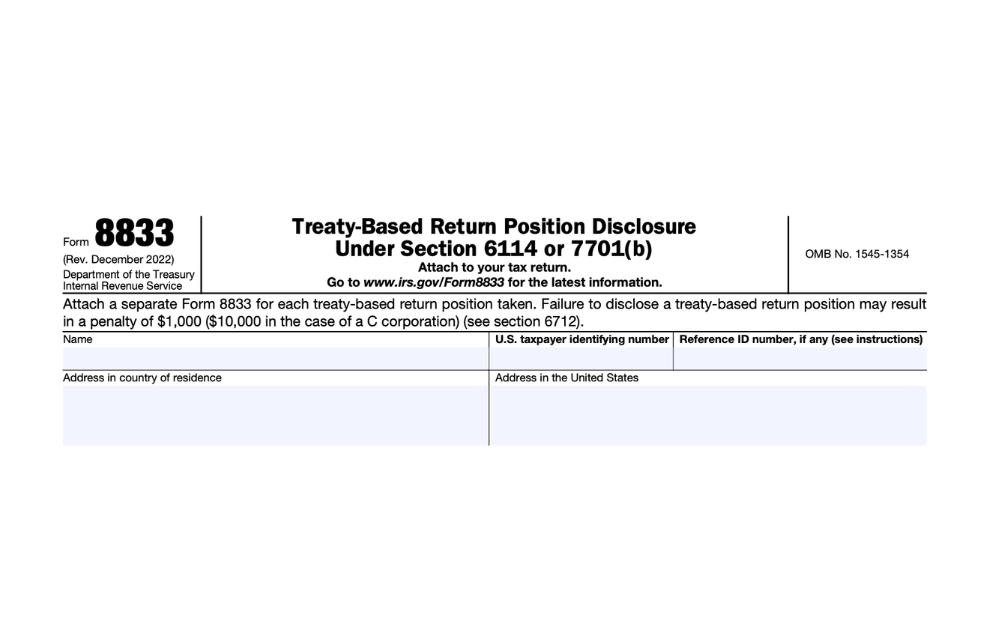
According to the IRS, Form 8833 (“Treaty-Based Return Position Disclosure Under Section 6114 or 7701(b)”) must be attached to your tax return when you take a treaty-based position. The penalty for failing to file is $1,000 per occurrence ($10,000 for C corporations), even if the treaty benefit itself is valid. The U.S. currently has income tax treaties with more than 60 countries.
Common situations that do require Form 8833:
- Changing the source of an income item or deduction based on a treaty
- Claiming a credit for a specific foreign tax not otherwise allowed under the IRC
- Reducing or modifying the taxation of gain or loss from a U.S. real property interest
- Dual-resident taxpayers determining their country of residence under a treaty tie-breaker with income items totaling more than $100,000
Unsure If You Need to File Form 8833?
Here’s when you need it, when you don’t, and why the savings clause matters for U.S. citizens.
When Do I NOT Need to File Form 8833?
The IRS provides specific exemptions from the Form 8833 filing requirement. You do not need to file if you are claiming any of the following treaty benefits:
| Treaty Benefit | Why Form 8833 Is Not Required |
|---|---|
| Reduced withholding rate on interest, dividends, rent, or royalties otherwise subject to 30% tax | Claimed through Form W-8BEN, not Form 8833 |
| Exemption or reduced tax on income from personal services, pensions, annuities, Social Security, or other public pensions | These are explicitly exempted by IRS regulations |
| Exemption for income of artists, athletes, students, trainees, or teachers | Covered by the personal services exemption |
| Taxable scholarship and fellowship grants with treaty exemptions | Included in the personal services exemption |
| Reduction under an International Social Security Agreement (totalization agreement) or Diplomatic/Consular Agreement | Governed by separate agreements, not Form 8833 |
| Partnership or estate/trust treaty positions where the entity reports the information on its own return | The reporting obligation shifts to the entity |
These exemptions cover the majority of treaty benefits that individual U.S. expats claim. If your treaty benefit falls into one of these categories, you simply claim it on your return without Form 8833.
What Is the Savings Clause and Why Does It Matter?
The savings clause is the single most important concept for U.S. citizens trying to use tax treaties. Nearly every U.S. tax treaty contains one, and it preserves the United States’ right to tax its own citizens and residents as if the treaty did not exist.
In practical terms, this means most treaty provisions that reduce or eliminate tax on specific types of income do not apply to U.S. citizens or green card holders. The treaty benefits are designed primarily for foreign nationals earning income in the U.S. or for U.S. nonresidents.
Example: The U.S.-UK tax treaty may reduce UK withholding tax on dividends paid to a U.S. resident. But the savings clause means the U.S. can still tax a U.S. citizen living in the UK on that same dividend income at normal U.S. rates.
Exceptions to the Savings Clause
Despite the savings clause, most treaties list specific exceptions where U.S. citizens can still claim benefits. Common exceptions include:
- Social Security benefits — many treaties specify which country can tax these payments, even for U.S. citizens
- Certain pension provisions — some treaties allow one-time lump-sum pension withdrawals without U.S. tax (the U.S.-UK treaty is a notable example)
- Student and trainee provisions — some treaties exempt education-related income for a limited period
- Certain alimony and child support provisions
Because the savings clause and its exceptions vary treaty by treaty, determining whether a specific benefit applies to you requires reviewing the actual treaty text for your country of residence. This is where professional guidance makes a significant difference.
How to File Form 8833
File a separate Form 8833 for each treaty-based position you take on your return. The form is attached to your Form 1040 (or 1040-NR for dual-resident taxpayers claiming treaty nonresidency).
What the Form Requires
| Section | What You Provide |
|---|---|
| Treaty country | The country whose treaty you are invoking |
| Treaty article | The specific article number containing the benefit |
| IRC section | The Internal Revenue Code provision being overridden or modified |
| Limitations on benefits | Whether the treaty’s limitation on benefits (LOB) article applies |
| Explanation statement | A narrative describing the treaty position, the facts supporting it, and the nature and amount of income, deduction, or credit involved |
The explanation statement (Lines 5-6) is the most critical part. The IRS expects a clear, factual summary of why the treaty provision applies to your situation, including specific dollar amounts or reasonable estimates of the income affected.

If you are a dual-resident taxpayer claiming residency in the foreign country under a treaty tie-breaker, you generally file Form 1040-NR (not Form 1040) with Form 8833 attached. This is a significant filing change that requires careful planning because it affects your worldwide income reporting obligations.
What Are the Penalties for Not Filing Form 8833?
The penalty for failing to disclose a treaty-based return position on Form 8833 is $1,000 per failure for individuals ($10,000 for C corporations), under IRC Section 6712. This penalty applies even if:
- The treaty benefit is valid and you were entitled to claim it
- The failure did not result in any underpayment of tax
- You claimed the benefit correctly on your return but simply forgot Form 8833
The IRS may waive the penalty if you can demonstrate reasonable cause for the failure, such as first-time filing as an expat, reliance on professional advice, or lack of awareness of the requirement. If you missed filing Form 8833 in a prior year, correcting it promptly and providing a reasonable cause explanation gives you the best chance of penalty abatement.
Do Tax Treaties Help with State Taxes?
Federal tax treaties do not automatically apply to state taxes. Some states honor federal treaty provisions, but many do not. States like California, New Jersey, and Pennsylvania, among others, generally do not recognize international tax treaty benefits.
This means you could eliminate your federal tax liability through a treaty provision but still owe state income tax on the same income. Check with your state’s department of revenue or work with your tax preparer to determine whether your state recognizes the treaty you are claiming.
How Do Tax Treaties Work with the FEIE and Foreign Tax Credit?
Even if the savings clause prevents you from claiming a specific treaty benefit, you still have two powerful tools to avoid double taxation:
- Foreign Earned Income Exclusion (FEIE): Exclude up to $130,000 of foreign earned income for the 2025 tax year. This works independently of any tax treaty and does not require Form 8833.
- Foreign Tax Credit (FTC): Claim a dollar-for-dollar credit for income taxes paid to foreign governments. Tax treaties actually support FTC claims by clarifying which country has primary taxing rights over specific income types.
In most cases, the FEIE and FTC provide equal or greater tax relief than treaty provisions for U.S. citizens. According to IRS data from 2016-2021, 62% of Americans who file from abroad owe $0 in federal taxes after applying these benefits.
That said, for certain income types, such as foreign pensions, Social Security benefits, or royalties, treaty provisions may offer protections that the FEIE and FTC do not. The right strategy often combines treaty benefits (where available) with the FEIE or FTC for comprehensive tax protection.
For a detailed comparison, see our guide on choosing between the FEIE and FTC.
Who Benefits Most from Tax Treaty Provisions?
While the savings clause limits treaty benefits for most U.S. citizens, certain groups benefit significantly:
- Dual citizens and dual status filers can use treaty tie-breaker rules to establish residency in one country for tax purposes, potentially reducing their overall tax burden.
- Retirees abroad receiving Social Security or foreign pensions often find treaty provisions that clarify or reduce taxation on retirement income. If you’re a retiree living abroad, treaty benefits for pension income are worth exploring.
- H-1B and work visa holders who are nonresident aliens may benefit from treaty provisions on wages, scholarships, and training income. Many of these benefits are exempt from the Form 8833 filing requirement.
- Corporate expats working under employer relocation may benefit from treaty provisions on housing allowances, tax equalization, and employer-provided benefits. If you’re on a corporate assignment abroad, your tax preparer should evaluate available treaty benefits alongside the FEIE and FTC.
- Foreign business owners may find that treaty provisions affect how their business profits, dividends, and royalties are taxed across borders. If you own a business abroad, treaty analysis is an essential part of your tax planning. Learn more about foreign business tax reporting.
Get Help with Form 8833 and Treaty Benefits
Tax treaties are some of the most complex documents in international tax law. Each treaty is different, savings clause exceptions vary by country, and claiming the wrong position can result in penalties or unexpected tax liability. Your tax preparer needs to review the specific treaty for your country, identify which provisions apply despite the savings clause, and draft a defensible explanation statement.
No matter how late, messy, or complex your return may be, we can help. You’ll have peace of mind, knowing that your taxes were done right. If you’re ready to be matched with a Greenback accountant, click the get started button below. For general questions on expat taxes or working with Greenback, contact our Customer Champions.
Claim Your Treaty Benefits the Right Way
This article is for informational purposes only and does not constitute tax or legal advice. Tax treaty provisions are complex and vary by country. For guidance specific to your situation, contact Greenback to speak with an expat tax specialist.
Related Resources
- How U.S. Tax Treaties Reduce Foreign Tax
- Totalization Agreements and Tax Treaties
- Foreign Earned Income Exclusion
- Foreign Tax Credit Guide
- FEIE vs. FTC: Which Strategy Is Best?
- Form 1116: Claiming the Foreign Tax Credit
- Do Expats Pay State Taxes?
- Form 1040 for U.S. Expats
- U.S. Expat Taxes: The Complete Guide
- Why Do U.S. Citizens Living Abroad Pay Taxes?