Form 8865 for Expats Explained: Reporting Your Foreign Partnership
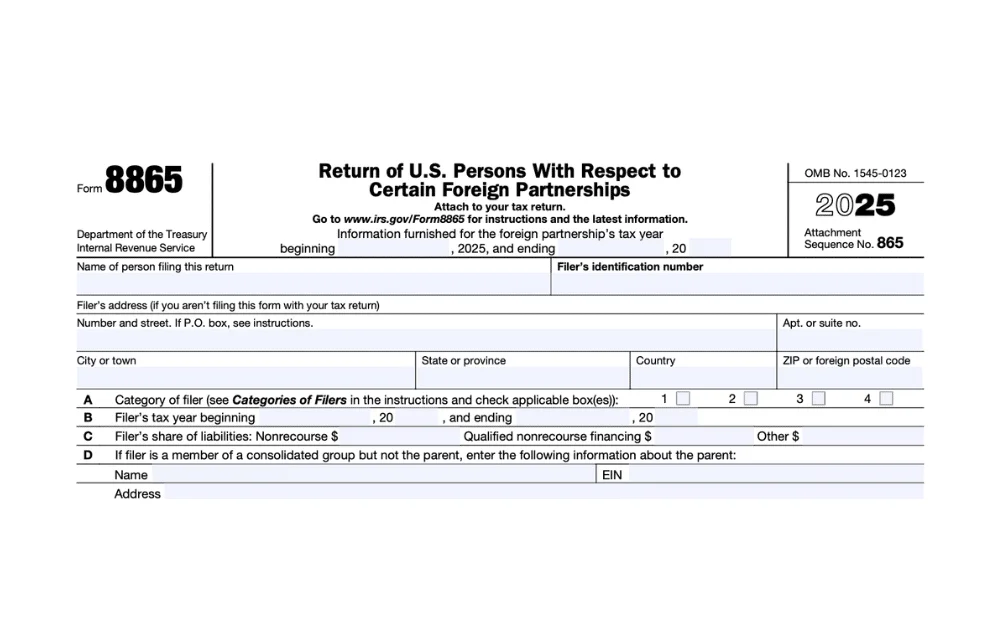


If you’re a U.S. person with a controlling or significant interest in a foreign partnership, you likely need to file Form 8865. The form is required if you control more than 50% of the partnership, own at least 10% of a controlled foreign partnership, contributed property worth $100,000 or more, or had a reportable ownership change during the year.
According to the IRS, Form 8865 is an informational return, meaning it does not create any additional tax liability on its own. However, penalties for not filing start at $10,000 per partnership, per year, and can escalate to $60,000 or more. The most common filing triggers are:
- Majority ownership (more than 50% of the partnership’s capital, profits, or losses)
- 10% or greater interest in a partnership where U.S. persons collectively own more than 50%
- Property contributions of $100,000 or more to a foreign partnership
- Ownership changes (acquisitions, dispositions, or shifts of 10% or more)

Not Sure If You’re Required to File Form 8865?
Here’s how to determine your filing category, what the penalties look like, and why this form is one of the most complex in international tax reporting.
What Is Form 8865?
Form 8865, officially titled “Return of U.S. Persons With Respect to Certain Foreign Partnerships,” is an informational tax return that reports your ownership of, transactions with, and activities related to a foreign partnership. A partnership qualifies as “foreign” when it was not created or organized in the United States or under U.S. law.
The IRS uses Form 8865 to enforce three sections of the Internal Revenue Code:
- Section 6038: Reporting on controlled foreign partnerships
- Section 6038B: Reporting transfers of property to foreign partnerships
- Section 6046A: Reporting acquisitions, dispositions, and changes in foreign partnership interests
Form 8865 is similar in structure to Form 1065 (the domestic partnership return) and shares some conceptual overlap with Form 5471 (for foreign corporations) and Form 8858 (for foreign disregarded entities). If you’re unsure which form applies to your foreign business, our guide on tax forms for foreign businesses breaks down the differences by entity type.
Who Needs to File Form 8865?
The IRS divides filers into four categories based on the nature of their interest in the foreign partnership. You may fall into more than one category, which means completing additional schedules.
| Category | Who It Applies To | What Triggers It |
|---|---|---|
| Category 1 | U.S. person who controls a foreign partnership | More than 50% ownership of capital, profits, or losses |
| Category 2 | U.S. person with 10%+ interest in a controlled foreign partnership | At least 10% ownership where U.S. persons collectively own more than 50% |
| Category 3 | U.S. person who contributed property to a foreign partnership | Contributions of $100,000+ in a 12-month period, or resulting in 10%+ ownership |
| Category 4 | U.S. person with a reportable ownership event | Acquisitions, dispositions, or changes in proportional interest of 10%+ |
How “Control” Works
A foreign partnership is “controlled” when U.S. persons own more than 50% of its capital, profits, or losses. This includes constructive ownership, meaning that interests held by your spouse, family members, or related entities may be attributed to you.
Example: You own 30% of a German partnership. Your spouse owns 25%. Under constructive ownership rules, you’re treated as owning 55%, making this a controlled foreign partnership and triggering Category 1 filing.
Example: You and two American business partners each own 20% of a partnership in Portugal. Together, U.S. persons hold 60%, making it a controlled foreign partnership. Each partner with 10% or more ownership files as at least a Category 2 filer.
Important: Multi-Member Foreign LLCs Count Too
The filing requirement is not limited to traditional partnerships. Foreign business entities that elect partnership taxation, such as a multi-member LLC organized outside the U.S., also trigger Form 8865 reporting. If you instead own a single-member foreign LLC treated as a disregarded entity, you would file Form 8858 rather than Form 8865.
What Schedules Are Required for Each Category?
Each filer category requires different schedules to be completed. Category 1 filers have the most extensive requirements, essentially reporting the full financial picture of the partnership.
| Schedule | What It Reports | Cat. 1 | Cat. 2 | Cat. 3 | Cat. 4 |
|---|---|---|---|---|---|
| A | Constructive ownership of partnership interest | Yes | Yes | Yes | Yes |
| A-1 | Certain partners of foreign partnership | Yes | — | Yes | — |
| A-2 | Affiliation schedule | Yes | Yes | Yes | Yes |
| B | Income statement (trade or business income) | Yes | — | — | — |
| G | Gain deferral method (Section 721(c)) | Yes | — | Yes | Yes |
| H | Acceleration events for gain deferral | Yes | — | Yes | Yes |
| K | Partners’ distributive share items | Yes | — | — | — |
| K-1 | Partner’s share of income, deductions, credits | Yes | Yes | — | — |
| K-2 | International items (foreign taxes, income sources) | Yes | Yes | — | — |
| K-3 | Partner’s share of K-2 items | Yes | Yes | — | — |
| L | Balance sheets per books | Yes | — | — | — |
| M | Balance sheets for interest allocation | Yes | — | — | — |
| M-1 | Reconciliation of book vs. return income | Yes | — | — | — |
| M-2 | Analysis of partners’ capital accounts | Yes | — | — | — |
| N | Related-party transactions | Yes | Yes | — | — |
| O | Transfer of property to foreign partnership | — | — | Yes | — |
| P | Acquisitions, dispositions, and changes of interest | — | — | — | Yes |

Every Form 8865 filed for a foreign partnership must include Schedules K-2 and K-3. The IRS considers all partnerships reported on Form 8865 to have foreign income by default, so these international schedules are always required for Category 1 and 2 filers.
Multiple Category 1 Filers Exception
If more than one U.S. person qualifies as a Category 1 filer for the same foreign partnership in a given tax year, only one of them is required to file Form 8865. The others must attach a statement titled “Controlled Foreign Partnership Reporting” to their income tax return identifying who filed the form. However, if you also qualify as a Category 3 or 4 filer, you must still file a separate Form 8865 for those requirements.
When Is Form 8865 Due?
Form 8865 is attached to your income tax return and follows the same deadline.
| Your Situation | Filing Deadline | Extended Deadline |
|---|---|---|
| U.S.-based filers | April 15, 2026 | October 15, 2026 (with Form 4868) |
| Americans living abroad | June 15, 2026 (automatic extension) | October 15, 2026 (with Form 4868) |
If you extend your income tax return, the Form 8865 deadline extends with it. Even if you are not otherwise required to file a U.S. income tax return, you must still file Form 8865 by the date your return would have been due.
What Are the Penalties for Not Filing Form 8865?
The penalty structure varies by filer category, but all are severe. The IRS also keeps the statute of limitations open indefinitely on your entire tax return until you file required international information returns.
| Category | Initial Penalty | Continuation Penalty | Maximum Total | Additional Consequences |
|---|---|---|---|---|
| 1, 2, and 4 | $10,000 per partnership, per year | $10,000 for each 30-day period after 90-day IRS notice | $60,000 per return ($10K initial + $50K continuation) | 10% reduction in foreign tax credits; criminal penalties possible |
| 3 | 10% of fair market value of contributed property | Same structure as above | $100,000 per contribution (no limit if intentional disregard) | Criminal penalties under IRC Sections 7203, 7206, 7207 |

These penalties apply per foreign partnership, per year. If you have interests in multiple foreign partnerships and miss multiple years, exposure multiplies rapidly.
Behind on Filing? Relief Is Available
If you’ve missed filing Form 8865 in prior years and your failure was not willful, the IRS offers paths to come into compliance, often with penalties waived entirely:
- Streamlined Filing Compliance Procedures: Available to individual taxpayers who can certify their non-compliance was not willful. Learn more about Streamlined Filing.
- Delinquent International Information Return Submission Procedures: For taxpayers who can demonstrate reasonable cause for the late filing.
The key in both cases is addressing the issue before the IRS contacts you.
Why Is Form 8865 So Complex for Expat Business Owners?
Form 8865 is one of the most time-intensive international tax forms. The IRS estimates it takes over 40 hours to prepare. Several factors make it particularly challenging for Americans abroad:
- Currency conversion requirements: All financial information on Form 8865 must be reported in U.S. dollars. You’ll need to convert your partnership’s financial statements using IRS-approved exchange rates, and the method you use (yearly average vs. transaction-date rates) can meaningfully affect your reported figures.
- Schedule N audit risk: Schedule N requires detailed reporting of all transactions between the foreign partnership and its partners or related entities. The IRS uses this schedule to flag transfer pricing issues and related-party transactions that may shift income outside U.S. taxing jurisdiction. Even routine management fees, loans, or service charges between you and your partnership must be reported.
- Coordination with other international forms: Form 8865 rarely exists in isolation. Depending on your situation, you may also need to file Form 5471 (if the partnership holds foreign corporations), Form 8858 (for disregarded entities owned by the partnership), FBAR (if your partnership interest gives you signature authority over foreign accounts), or Form 8938 (for FATCA reporting of the partnership interest itself).
- Section 721(c) gain deferral rules: If you contribute appreciated property to a foreign partnership, Schedules G and H require complex tracking of gain deferral and potential acceleration events. These rules were designed to prevent U.S. taxpayers from avoiding gain recognition by transferring assets to foreign partnerships.
- Constructive ownership traps: Attribution rules can unexpectedly push you into a higher filing category. Interests owned by family members, related corporations, partnerships, or trusts may be attributed to you, potentially triggering Category 1 filing obligations you did not expect.
Get Expert Help with Form 8865
Form 8865 is not a form most taxpayers can handle on their own. Between the four filer categories, 16+ potential schedules, mandatory K-2/K-3 reporting, and penalties that start at $10,000 per partnership, professional help is not just recommended but essential for getting this right.
If you own a business abroad, our CPAs and Enrolled Agents specialize in foreign partnership reporting, gain deferral calculations, and full international tax compliance. We’ll make sure every required schedule is filed correctly so you can focus on running your business with confidence.
If you’re ready to be matched with a Greenback accountant, click the get started button below. For general questions about expat taxes or working with Greenback, contact our Customer Champions.

Own a Foreign Partnership? File It Correctly.
This article is for informational purposes only and does not constitute legal or tax advice. Tax rules for foreign partnerships are complex and change frequently. For guidance on your specific situation, contact Greenback to speak with an expat tax specialist.
Related Resources
- What Are the U.S. Tax Requirements for Foreign Partnerships?
- What Tax Forms Do I Need to File for My Foreign Business?
- Form 5471: Filing Requirements for Foreign Corporations
- Form 5471 vs. Form 5472: Which One Do I Need?
- Form 8858: Foreign Disregarded Entity Reporting
- What Is a Controlled Foreign Corporation (CFC)?
- Starting a Business Overseas: Tax Guide for U.S. Citizens
- Streamlined Filing: How to Catch Up on Taxes
- FBAR Filing Requirements
- U.S. Expat Tax Forms: What You Need to File