Form I-407: Record of Abandonment of Lawful Permanent Resident Status
- What Is Form I-407?
- Why Do I Need to File Form I-407 Instead of Just Letting My Green Card Expire?
- When Should I File Form I-407?
- What Information Does Form I-407 Require?
- How Do I File Form I-407?
- What Happens After I File Form I-407?
- What Are My Tax Filing Requirements After Filing Form I-407?
- Can I Change My Mind After Filing Form I-407?
- What Mistakes Should I Avoid When Filing Form I-407?
- How Does Form I-407 Differ from Renouncing U.S. Citizenship?
- Where Can I Get Help with Form I-407 and My Final Tax Filings?
- Related Resources


Form I-407 is the official USCIS document that green card holders file to voluntarily relinquish their lawful permanent resident status. According to USCIS, simply letting your green card expire or living abroad for extended periods does NOT automatically end your status—you must formally file Form I-407, or the IRS continues to treat you as a U.S. tax resident subject to worldwide income reporting.
The decision to file Form I-407 has significant tax implications beyond just immigration status. For green card holders who have held their status for 8 or more of the last 15 years, filing this form may trigger exit tax obligations and require filing Form 8854. For those with fewer years, Form I-407 simply marks the end of U.S. tax residency—but only after completing proper final tax filings.
Whether you’re below the 8-year mark and avoiding exit tax entirely, or you’re a long-term resident preparing Form 8854, getting the sequence right prevents years of complications with both USCIS and the IRS.
What Is Form I-407?
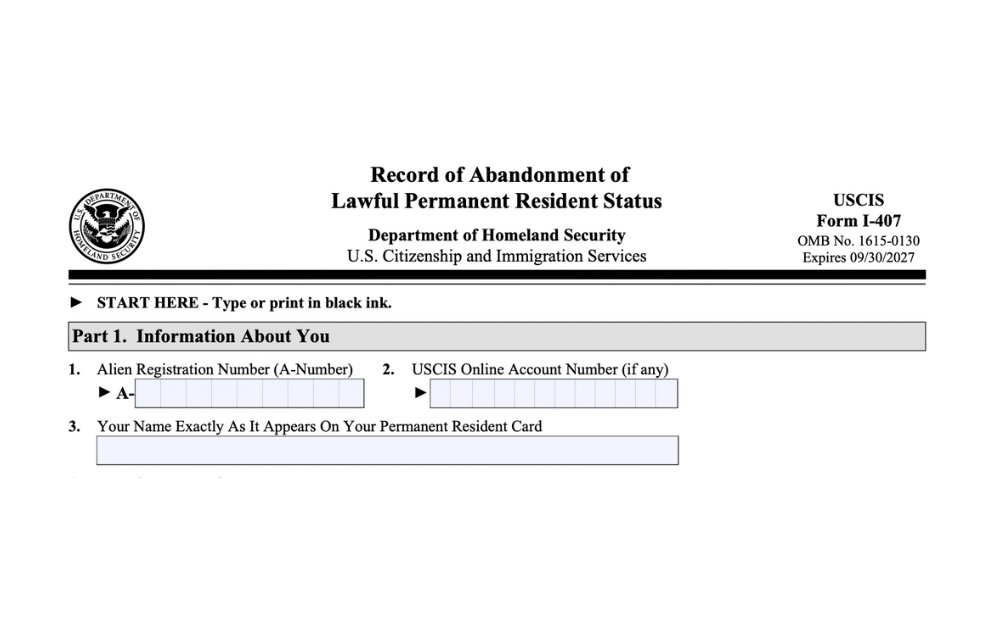
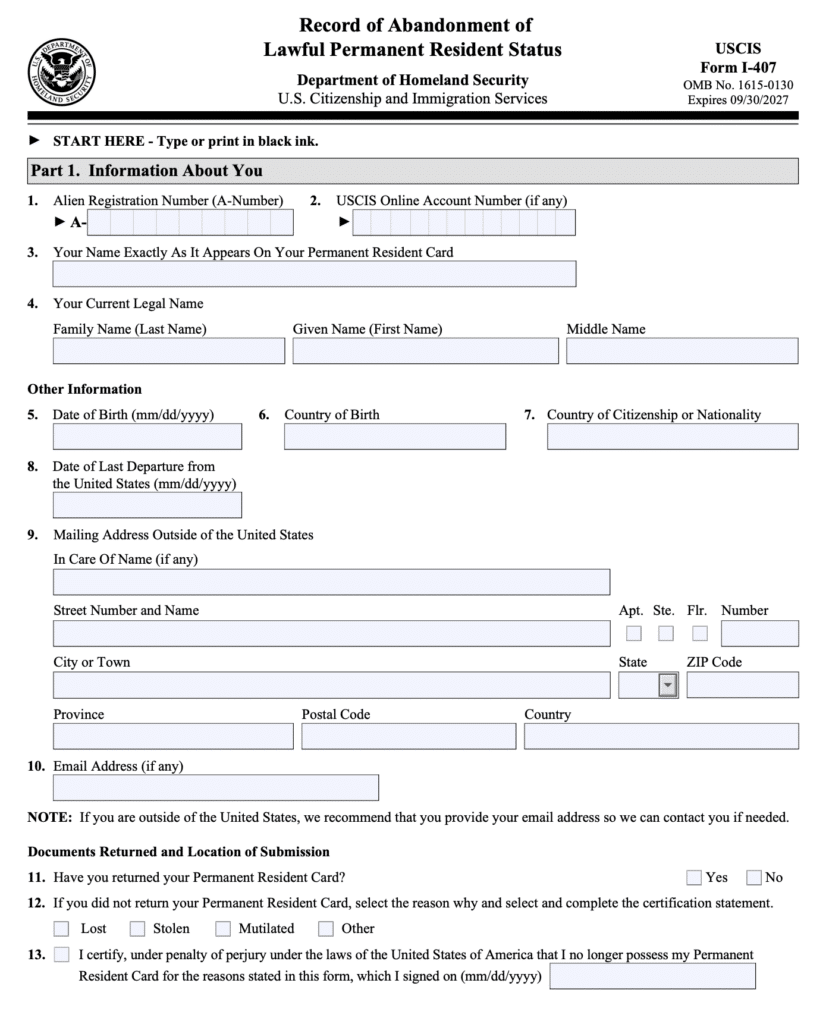
Form I-407 (Record of Abandonment of Lawful Permanent Resident Status) is the Department of Homeland Security form that officially terminates your lawful permanent resident status. When you file this one-page form with USCIS, you’re formally notifying the U.S. government that you no longer intend to maintain permanent residency in the United States.
The form itself is straightforward and requires:
- Your name, date of birth, and alien registration number (A-number)
- Your green card number and issue/expiration dates
- The reason you’re abandoning your status
- Your intended country of future residence
- Your signature and the date
However, the form’s simplicity belies its significance. Filing Form I-407 is a permanent, irrevocable action. Once USCIS processes your abandonment, you cannot “reactivate” your green card. If you later want to live in the U.S., you must apply for an entirely new immigrant visa.
See What Filing Form I-407 Means for Your Taxes
Why Do I Need to File Form I-407 Instead of Just Letting My Green Card Expire?
This is one of the most common—and costly—misconceptions among green card holders living abroad. Your physical green card has an expiration date (typically 10 years from issuance), but that expiration date has nothing to do with your tax residency status.
The IRS considers you a U.S. tax resident as long as you hold lawful permanent resident status, even if:
- Your physical green card has expired
- You haven’t been to the U.S. in years
- You’re living and working permanently in another country
- You filed taxes as a non-resident in your current country
Until you formally abandon your status through one of these methods, you remain a U.S. person for tax purposes:
- Filing Form I-407 with USCIS
- Having your status administratively or judicially terminated
- Filing Form 8833 to claim treaty benefits as a non-resident (which itself can trigger exit tax for long-term residents)
Without formal abandonment, you must:
- File Form 1040 annually, reporting worldwide income
- File FBAR if foreign accounts exceed $10,000
- Pay U.S. tax on foreign income (though most expats owe $0 after credits)
- Face penalties for non-filing, even if you believed you were “done.”
Form I-407 is the clean, official way to end this status and your associated tax obligations (after completing final filings).
When Should I File Form I-407?
You should consider filing Form I-407 when:
You’re Moving Abroad Permanently
If you’ve relocated to another country for work, family, or retirement and don’t intend to return to live in the U.S., filing Form I-407 proactively:
- Ends ongoing U.S. tax filing requirements (after your final return)
- Prevents CBP from questioning your intent when you visit the U.S.
- Stops the clock toward becoming a long-term resident (if under 8 years)
- Gives you control over the timing of expatriation for tax purposes
You Can’t Meet Residency Requirements
If you’ve been outside the U.S. for more than one year without a reentry permit, or you’re spending most of your time abroad, you risk having U.S. Customs and Border Protection determine you’ve “abandoned” your status inadvertently at a port of entry. Filing Form I-407 yourself:
- Let you choose the abandonment date (important for tax calculations)
- Avoids surprise determinations at airports
- Allows you to prepare your tax filings in advance
You’re Approaching 8 Years and Want to Avoid Exit Tax
If you received your green card fewer than 8 years ago and don’t plan to use it long-term, filing Form I-407 before you hit the 8-year mark means you’ll never be subject to potential exit tax liability, regardless of your net worth.
You Received a Green Card You Don’t Need
Some people obtain green cards through family sponsorship or employment, but never intend to use them permanently. If you’re not using your status and don’t plan to, file Form I-407:
- Ends compliance requirements you’re not maintaining anyway
- Prevents penalties from accumulating for unfiled returns
- Creates a clean record with immigration authorities
What Information Does Form I-407 Require?
Form I-407 is a single-page document available on the USCIS website. Here’s what you need to provide:
Part 1: Information About You
- Full legal name (as it appears on your green card)
- Other names used
- Date of birth
- Country of birth
- Alien registration number (A-number)
Part 2: Information About Your Permanent Resident Card
- Receipt number (begins with letters)
- Card number (on back of card)
- Date card was issued
- Card expiration date
Part 3: Reason for Filing Form I-407
You must select one or more reasons:
- I wish to abandon my permanent resident status
- My permanent resident card was erroneously issued
- I was ordered to be removed or deported
- I was admitted as a refugee or granted asylum and now wish to return to my home country
Most green card holders select the first option.
Part 4: Additional Information
- Your intended country of future residence
- Whether you intend to apply for a non-immigrant visa (for future visits)
Part 5: Applicant’s Statement, Contact Information, Certification, and Signature
- Your current physical address
- Daytime and mobile phone numbers
- Email address
- Your signature and date
The form must be signed in the presence of either:
- A USCIS officer
- A U.S. Consular officer abroad
- A U.S. Customs and Border Protection officer at a port of entry
How Do I File Form I-407?
Filing Form I-407 requires submitting the completed form along with surrendering your physical green card. You have three options:
Option 1: Mail to USCIS
Complete Form I-407 and mail it to:
USCIS
Attn: I-407
31 Rochester Avenue
Portsmouth, NH 03801
Include your physical green card (and any reentry permits or refugee travel documents issued by USCIS). Use certified mail with tracking to confirm delivery.
Processing time: Typically 4-8 weeks for confirmation
Option 2: Submit at a U.S. Embassy or Consulate Abroad
Make an appointment at a U.S. embassy or consulate in your current country of residence. Bring:
- Completed Form I-407
- Your physical green card
- Valid identification (passport)
The consular officer will witness your signature, take possession of your green card, and provide confirmation of abandonment.
Processing time: Immediate confirmation at the appointment
Option 3: Submit at a U.S. Port of Entry
If you’re traveling to the U.S., you can submit Form I-407 to a U.S. Customs and Border Protection officer when you enter. Bring:
- Completed Form I-407
- Your physical green card
- Valid passport from your country of citizenship
If you submit at a port of entry, you may be allowed to enter the U.S. on a temporary admission or waiver, but you’ll need proper visa authorization (ESTA or visa) for future visits.
Processing time: Immediate confirmation
What Happens After I File Form I-407?
Once USCIS processes your Form I-407:
- You’ll receive confirmation that your lawful permanent resident status has been terminated. Save this documentation—you’ll need it for your final tax filings.
- Your green card is void. You cannot use it for any purpose, including returning to the U.S. If you visit the U.S. in the future, you’ll need tourist visa authorization (ESTA or B-1/B-2 visa depending on your citizenship).
- USCIS notifies the IRS of your abandonment date. This triggers your final tax filing requirements.
Your expatriation date for tax purposes is the date you filed Form I-407 (or the date USCIS received it by mail). This date determines:
- What income do you report on your final U.S. tax return
- Whether you need to file Form 8854 (if you’re a long-term resident)
- When your exit tax liability is calculated (if applicable)
What Are My Tax Filing Requirements After Filing Form I-407?
Your tax filing requirements depend on whether you’re a “long-term resident” (i.e., you’ve held your green card for 8 or more of the last 15 years).
For All Green Card Holders (Regardless of Length of Residency):
File a final U.S. tax return for the year you file Form I-407. You have two options:
Option 1: Dual-Status Return
File Form 1040 for January 1 through the day before your I-407 filing date (reporting worldwide income). File Form 1040-NR for the remainder of the year (reporting only U.S.-source income). Learn more about dual-status filing.
Option 2: Full-Year Resident Return
File Form 1040 for the entire year as a U.S. resident, reporting worldwide income. This allows you to use the standard deduction and file jointly with a U.S. citizen spouse, thereby reducing your tax liability.
File FBAR and Form 8938 if applicable for the portion of the year you were a resident. Even in your final year, if foreign accounts exceeded $10,000 at any point, you must file FBAR. If you meet FATCA thresholds, file Form 8938 with your return.
For Long-Term Residents Only (8+ Years):
File Form 8854 with your final tax return to certify 5 years of tax compliance and determine if you’re a “covered expatriate” subject to exit tax.
You’re a covered expatriate if you meet any one of these tests:
- Net worth of $2 million or more on your abandonment date
- Average annual net income tax exceeds $206,000 (2025 threshold) for the prior 5 years
- Cannot certify 5 years of full U.S. tax compliance
If you’re a covered expatriate, you’ll owe exit tax on unrealized gains above $890,000 (2025 exclusion amount). Special rules apply to retirement accounts and deferred compensation.
If you’re behind on filing, use Streamlined Filing Procedures to catch up before filing Form I-407. This allows you to certify compliance on Form 8854 and potentially avoid covered expatriate status.
Can I Change My Mind After Filing Form I-407?
No. Filing Form I-407 is permanent and irrevocable. Once USCIS processes your abandonment, you cannot:
- Withdraw the form
- Reactivate your green card
- Claim permanent resident status
If you later decide you want to live in the U.S. permanently, you must:
- Apply for a new immigrant visa from scratch
- Meet all eligibility requirements again
- Go through the full green card application process
This is why the decision to file Form I-407 should be made carefully, ideally after consulting both immigration and tax professionals.
You may want to consider filing Form I-313, which could give you an extension of up to 2 years to be outside the U.S. without losing your immigration status.
What Mistakes Should I Avoid When Filing Form I-407?
- Filing without getting tax compliant first. If you can’t certify 5 years of compliance on Form 8854 (for long-term residents), you automatically become a covered expatriate. Catch up on any missing returns through Streamlined Filing before filing Form I-407.
- Not calculating potential exit tax exposure. If you’re a long-term resident with substantial assets, calculate your potential exit tax before abandoning your residency. In some cases, timing your abandonment or making gifts to family members can significantly reduce your tax liability.
- Forgetting about state tax obligations. Even after filing Form I-407, you may have state tax filing requirements if you maintained ties to a U.S. state (property, driver’s license, voter registration).
- Filing Form 1040-NR while still holding a green card. This can signal to USCIS that you’ve inadvertently abandoned your status, which can trigger unintended tax consequences. Only file as a non-resident after formally filing Form I-407.
- Not understanding that mailing the form starts the clock. Your expatriation date for tax purposes is when you file Form I-407 or when USCIS receives it by mail. This date determines your final tax filing requirements and when assets are valued for exit tax purposes.
- Assuming you can visit the U.S. freely afterwards. After abandoning your green card, you’ll need visa authorization to enter the U.S. Apply for ESTA (if you’re from a Visa Waiver Program country) or a B-1/B-2 tourist visa well before any planned trips.
How Does Form I-407 Differ from Renouncing U.S. Citizenship?
Form I-407 and citizenship renunciation are both expatriating acts, but they’re fundamentally different:
Form I-407:
- Ends green card status (lawful permanent residency)
- You retain your foreign citizenship
- Only triggers exit tax if you’re a long-term resident (8+ years)
- Can still visit the U.S. with proper visa authorization
- Cannot live or work in the U.S. without a new visa or green card
Citizenship Renunciation:
- Ends U.S. citizenship permanently
- Always triggers potential exit tax (if you meet covered expatriate tests)
- Requires taking an oath of renunciation at a U.S. embassy
- Can still visit the U.S. with proper visa authorization
- Cannot claim U.S. citizenship benefits ever again
- Costs $450 processing fee (reduced from $2,350 effective April 13, 2026) vs. no fee for Form I-407
For green card holders who aren’t U.S. citizens, Form I-407 is the only relevant form—you cannot renounce citizenship you don’t have.
Where Can I Get Help with Form I-407 and My Final Tax Filings?
Filing Form I-407 requires coordinating both immigration and tax requirements. The sequence matters: catch up on any missing returns, determine if you’re a long-term resident, calculate potential exit tax exposure, file Form I-407, and complete final tax returns.
Whether you need help determining if you’re a long-term resident, catching up on unfiled returns through Streamlined Filing, calculating your exit tax exposure, or preparing your final tax returns and Form 8854, we can guide you through every step.
If you’re ready to be matched with a Greenback accountant, click the Get Started button below. For general questions on US expat taxes or working with Greenback, contact our Customer Champions.
Get Help Filing Form I-407 the Right Way
This article is for informational purposes only and does not constitute tax, legal, or immigration advice. Form I-407 filing and expatriation tax rules are complex and subject to change. Please consult with qualified tax and immigration professionals regarding your specific situation before filing Form I-407.
Related Resources
- How to Abandon Your Green Card: Step-by-Step Guide
- U.S. Exit Tax (Expatriation Tax): What It Is and How It Works
- What Is IRS Form 8854? A Guide for Expats
- Do Green Card Holders Pay Taxes on Foreign Income?
- How Do I File My Taxes as a Dual-Status Alien?
- Form 1040 for U.S. Expats: File Correctly & Owe $0
- FBAR: Foreign Bank Account Report Filing Requirements
- Streamlined Filing for U.S. Expats: Your Penalty-Free Path to Tax Compliance
- Do Expats Pay State Taxes? Guide for Americans Living Abroad
- Form 8833 & Tax Treaties: How to Claim Treaty Benefits