IRS Voluntary Disclosure Program: When Willful Non-Compliance Requires Serious Action
- What Is the Voluntary Disclosure Program?
- When Should I Consider the Voluntary Disclosure Program?
- How Does the Voluntary Disclosure Program Work?
- What Are the Penalties Under the Voluntary Disclosure Program?
- How Long Does the Voluntary Disclosure Program Cover?
- Can I Request Reduced Penalties?
- What About Payment Requirements?
- How Does the Voluntary Disclosure Program Compare to Other Programs?
- What Happens If I Don't Come Forward?
- Why Don't Most Expats Need the Voluntary Disclosure Program?
- What Are My Next Steps?
- How Greenback Can Help With Voluntary Disclosure Program
- Related Resources
- Frequently Asked Questions


According to the IRS Criminal Investigation Division, if your failure to file was willful and you’re concerned about criminal exposure, the Voluntary Disclosure Practice provides a structured pathway to resolve your tax obligations and potentially avoid criminal prosecution. While the program involves significant penalties, it offers protection for taxpayers facing the most serious compliance issues.
The VDP is designed for taxpayers whose noncompliance was intentional, reckless, or involved fraud. This article explains when the Voluntary Disclosure Program (VDP) is necessary, how it works, and why most expats qualify for less severe compliance programs instead.
What Is the Voluntary Disclosure Program?
The IRS Criminal Investigation Voluntary Disclosure Practice lets you resolve income tax liabilities and tax information reporting obligations through a compliance pathway. The program provides a framework for you to come forward before the IRS discovers your noncompliance.
The program is designed for taxpayers who have willfully failed to comply with tax or tax-related obligations. “Willful” means you knew about your filing requirements and chose not to comply, or you were recklessly indifferent to your obligations.

Most expats who simply didn’t know about their U.S. tax filing obligations qualify for the much more favorable Streamlined Filing Compliance Procedures instead.
When Should I Consider the Voluntary Disclosure Program?
You Might Need VDP If:
- You deliberately chose not to file U.S. tax returns despite knowing the requirement
- You intentionally hid foreign accounts or income from the IRS
- You falsified documents or created fraudulent structures to evade taxes
- You’re uncomfortable certifying “non-willful” conduct under penalty of perjury
You Probably Don’t Need VDP If:
- You genuinely didn’t know U.S. citizens had to file from abroad
- You thought living abroad exempted you from U.S. taxes
- You misunderstood the FBAR requirements
For non-willful situations, the Streamlined Filing Compliance Procedures offer penalty-free or reduced-penalty pathways to compliance.
Unsure if your situation requires Voluntary Disclosure?
How Does the Voluntary Disclosure Program Work?
There is a two-part electronic application process.
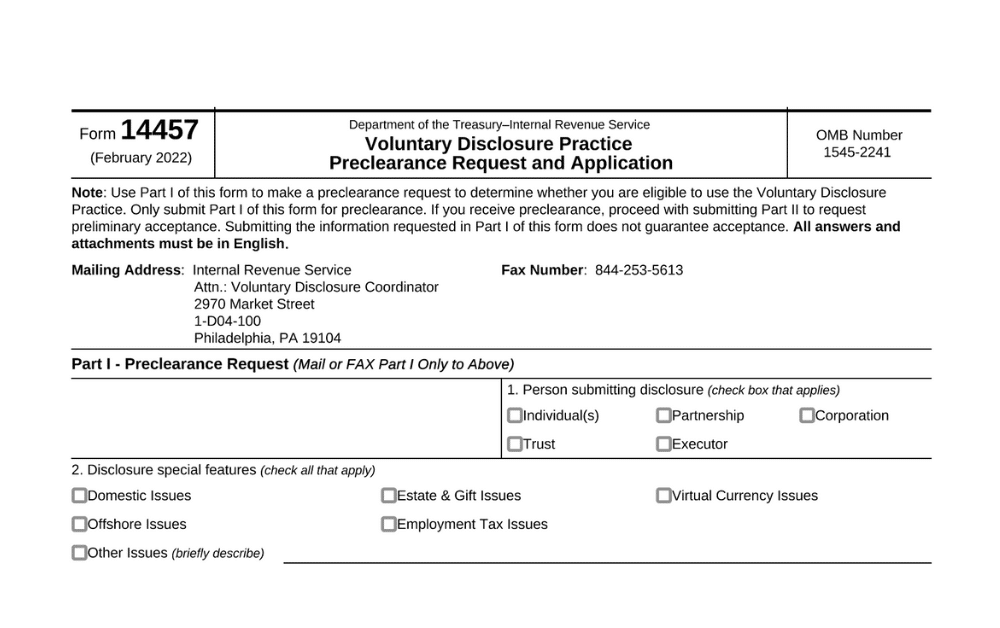
Step 1: Preclearance (Form 14457, Part I)
Fill out Part I of Form 14457 and fax it to 844-253-5613. This determines your eligibility.
Timeliness: You must come forward before the IRS contacts you or learns about your situation from another source.
Step 2: Complete Disclosure (Form 14457, Part II)
Once you receive a preclearance letter, you must electronically submit Part II within 45 days. You can request one 45-day extension.
You’ll provide a statement acknowledging your willful failure to comply. This narrative must be truthful, complete, and detailed.
Step 3: Civil Examination
If approved, CI provides a Preliminary Acceptance Letter and forwards your case to a civil examiner. You must cooperate fully with providing requested documents.
What Are the Penalties Under the Voluntary Disclosure Program?
The VDP involves substantial penalties in exchange for resolving issues civilly rather than criminally.
Tax Penalties
The IRS typically requires a civil fraud penalty of 75% on the tax year with the highest tax correction. If your highest underpayment year involved $50,000 in unpaid taxes, you’d face a $37,500 fraud penalty for that year alone, plus the $50,000 in taxes owed and interest.
FBAR Penalties
For FBAR noncompliance, the IRS asserts a willful FBAR penalty of typically 50% for the year with the maximum aggregate account balance. If your highest foreign account balance were $200,000, you’d face a $100,000 FBAR penalty for that year.
These penalties are severe, which is why the VDP should only be used when willful conduct prevents you from qualifying for more favorable programs.
How Long Does the Voluntary Disclosure Program Cover?
The disclosure period covers the most recent six tax years. The six-year lookback provides relief compared to unlimited exposure, but the IRS can extend beyond six years if you fail to cooperate fully.
Can I Request Reduced Penalties?
While you can request reduced penalties instead of the 75% fraud penalty, approval is exceptional. You would need clear and convincing evidence. Most VDP participants pay the standard penalty structure.
What About Payment Requirements?
You must pay all tax, interest, and penalties in full. If you’re unable to make full payment, you may request other payment arrangements by disclosing this upfront and submitting a proposed payment plan with a completed Collection Information Statement (Form 433-A).
How Does the Voluntary Disclosure Program Compare to Other Programs?
- Streamlined Filing (Non-Willful): File three years of tax returns and six years of FBARs. Zero penalties for expats living abroad. Learn more
- Delinquent FBAR Procedures: For taxpayers who are current on tax returns and have only missed FBARs. Learn more
- VDP (Willful): Six years of returns. 75% fraud penalty. 50% FBAR penalty. Protection from criminal prosecution (typically).
What Happens If I Don’t Come Forward?
Civil Penalties: 75% fraud penalty, willful FBAR penalties up to 50% of account balances, unlimited assessment period.
Criminal Exposure: Tax evasion charges carry a fine of up to $100,000 and a potential prison sentence of five years. Filing false returns up to $100,000 fine and three years in prison. Willful FBAR violations up to $250,000 fine and five years in prison.
The IRS can also levy bank accounts, seize assets, and place liens on property.
Why Don’t Most Expats Need the Voluntary Disclosure Program?
The vast majority of Americans abroad qualify for Streamlined Filing instead.
You genuinely believed you no longer had U.S. filing obligations, thought your employer withholding meant compliance, didn’t know about FBAR requirements, or received incorrect advice.
If your situation involved confusion or lack of knowledge rather than intentional evasion, you qualify for Streamlined Filing with zero penalties for expats living abroad.
What Are My Next Steps?
1. Assess Your Situation Honestly: Did you know about your filing obligations? Did you deliberately avoid filing? Would you feel comfortable certifying “non-willful” conduct under penalty of perjury?
2. Act Quickly: Once the IRS contacts you first or receives information about your situation from third parties, you no longer qualify for voluntary disclosure.
3. Get Professional Guidance: The distinction between willful and non-willful conduct has enormous financial consequences. Professional evaluation helps ensure you choose the right compliance program.
4. Don’t Panic: Thousands of taxpayers have successfully completed the program and resolved their tax issues civilly. While the penalties are substantial, the program provides protection from criminal prosecution.
How Greenback Can Help With Voluntary Disclosure Program
We’ve helped over 23,000 expats file over 71,000 returns while maintaining a 4.9-star average across 1,200+ TrustPilot reviews.
For most expats, we guide you through Streamlined Filing, which typically results in zero penalties. Our flat-fee package costs $1,600.
For complex willful situations requiring VDP, we work with experienced tax attorneys who specialize in voluntary disclosure matters.
Whether your situation requires the Voluntary Disclosure Program or qualifies for more favorable compliance options, the most important step is taking action now. The relief and confidence that come from getting right with the IRS are worth the effort.
If you’re ready to be matched with a Greenback accountant, click the get started button below. For general questions on expat taxes or working with Greenback, contact our Customer Champions.
Ready to evaluate whether VDP or Streamlined is right for you?
This article is for informational purposes only and does not constitute legal or tax advice. The Voluntary Disclosure Program involves complex legal considerations and potential criminal exposure. Individual situations vary, and you should consult with qualified tax and legal professionals before making any decisions about voluntary disclosure. Greenback Expat Tax Services can help evaluate your situation and connect you with appropriate legal resources when necessary.
Related Resources
- Streamlined Filing for U.S. Expats: Your Penalty-Free Path to Tax Compliance
- FBAR Penalties: What Expats Need to Know
- Delinquent FBAR Submission Procedures
- Tax Fraud vs. Tax Evasion (Explained)
- Never Filed Taxes? Here’s How to Catch Up Without Penalties
- FBAR: What It Is, Who Must File & How To Report Foreign Accounts
- Back Taxes for American Expats: What You Need to Know
- Accidental American Taxes: Compliance & IRS Rules
- Your Chances of Being Audited by the IRS as a US Expat
- How US Expats Can Avoid Tax Penalties
Frequently Asked Questions
Does the Voluntary Disclosure Program guarantee immunity from prosecution?
The IRS does not guarantee immunity, but practically does not refer taxpayers for prosecution if you fully cooperate, sign the closing agreement, and pay the resulting liability.
How long does the Voluntary Disclosure Program process take?
Typically 12-24 months from initial preclearance through final closing agreement.
Can I withdraw from the Voluntary Disclosure Program after starting?
Yes, but withdrawal means losing VDP protection and facing potential prosecution or audit.
Is the Voluntary Disclosure Program available to people living abroad?
Yes. All U.S. citizens, green card holders, expatriates, and non-resident aliens can utilize the program.