
You’re in the U.S. on a Visa or Green Card. Your Tax Filing Doesn’t Have to Be Confusing.
You’re in the right place if…
-
You arrived in the U.S. this year and need to file a dual status return
Your first year requires both Form 1040 and Form 1040-NR. We handle the complex split-year filing so you don’t overpay on your nonresident period.
-
You just received your Green Card and need to report worldwide income
Green Card holders are U.S. residents for tax purposes from day one, meaning all worldwide income becomes taxable. We help you understand FBAR requirements, foreign asset reporting, and how to claim foreign tax credits to avoid double taxation.
-
You’re on an H-1B, L-1, or other work visa with stock compensation
RSUs, stock options, and equity grants have complex tax treatment. We report all compensation correctly and help you understand tax timing on vesting and sale.
-
You’re an F-1 or J-1 student confused about scholarship taxation and filing requirements
Scholarships, OPT income, FICA exemptions, and the five-year nonresident rule create confusion. We file Form 1040-NR correctly and claim all applicable exclusions.
-
You don’t know if you’re a resident alien or nonresident alien for tax purposes
The substantial presence test determines your filing status. We calculate your days, determine your correct status, and file the right form (1040 vs 1040-NR).
-
You want to claim tax treaty benefits from your home country
The U.S. has treaties with 60+ countries that can reduce your U.S. tax burden. We identify which treaty articles apply and complete Form 8833 correctly.
-
You’re transitioning from student visa (F-1) to work visa (H-1B)
Your filing status changes when you transition from nonresident to resident. We navigate this shift and ensure you’re positioned correctly for FBAR and new reporting requirements
-
You have foreign bank accounts, investments, or property in your home country
As a U.S. resident (including Green Card holders), foreign accounts over $10,000 trigger FBAR requirements. Foreign investments may require PFIC reporting. We determine which forms you need and file everything correctly to avoid penalties.
Start your U.S. expat tax return today.
"*" indicates required fields
You Need Certainty. We Provide the Blueprint. Our knowledge center is designed to answer your questions, so you understand the rules before you file.

How Do I Know If I’m a Resident Alien or Nonresident Alien?
It depends on the substantial presence test, which counts your days in the U.S. over a three-year period weighted by specific fractions. Generally, if you’ve been in the U.S. for 183 days or more this year (or meet the three-year calculation), you’re a resident alien for tax purposes. Students and certain visa holders have special exemption rules that can extend the nonresident period. Learn more about determining your tax status
What’s a Dual Status Return and When Do I Need One?
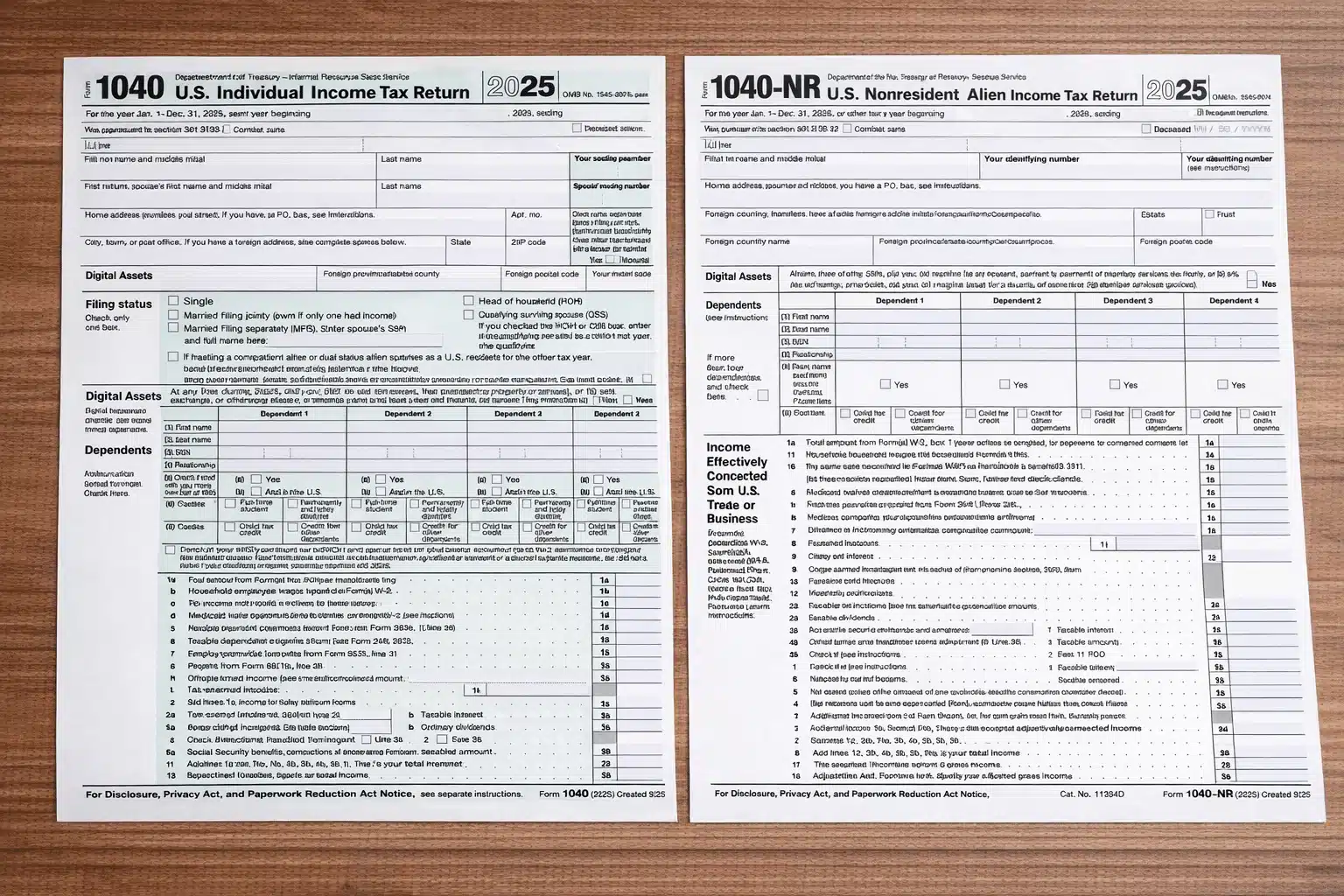
A dual status return is required in your first year in the U.S. when you arrive mid-year and become a resident. Part of the year you’re taxed as a nonresident (generally before arrival or before meeting substantial presence), and part you’re taxed as a resident. This requires filing both Form 1040 for the resident portion and Form 1040-NR for the nonresident portion, with a dual status statement attached. Read the complete dual status filing guide
Can I Claim Tax Treaty Benefits From My Home Country?
Probably yes, if your home country has an income tax treaty with the U.S. Common treaty benefits include reduced withholding on certain income types, student and researcher exclusions, and income exemptions for specific professions. We determine which treaty articles apply to your situation and complete Form 8833 to claim the benefits correctly. Learn more about U.S. tax treaties
How Are RSUs and Stock Options Taxed?
Restricted Stock Units (RSUs) are typically taxed as ordinary income when they vest, not when you receive or exercise them. Stock options have different treatment depending on whether they’re Incentive Stock Options (ISOs) or Non-Qualified Stock Options (NSOs). Capital gains tax applies when you eventually sell the shares. Proper basis tracking from vesting through sale is critical to avoid double taxation. Learn more about H-1B taxes and stock compensation
Do I Need to File FBAR as a Visa Holder?
Once you’re a U.S. resident for tax purposes, you must file FBAR (FinCEN Form 114) if your foreign financial accounts exceeded $10,000 at any point during the year. This includes bank accounts, investment accounts, and certain other financial accounts in your home country. Students in their first five years are generally nonresidents and don’t have FBAR obligations unless they have U.S.-source income above filing thresholds. Learn more about FBAR filing requirements
What Are My Tax Obligations as a New Green Card Holder?
Green Card holders are treated as U.S. residents for tax purposes from the date you receive your Green Card, meaning you must report worldwide income to the IRS. This includes foreign employment income, rental properties, investment income, pensions, and business ownership in your home country. You’ll file Form 1040 (not 1040-NR) and may need to file FBAR for foreign accounts over $10,000, Form 8938 for foreign financial assets, and other international forms depending on your situation. Learn more about Green Card holder tax requirementsFeatured In






Visa Holders Just Like You Trust Greenback
 4.84/5
 4.9/5
4.9/5
 4.8/5
4.8/5
Tax Help For Foreign Nationals Living in the U.S.
Filing U.S. taxes as a visa holder or Green Card holder requires determining your correct resident or nonresident status, understanding which forms apply, maximizing treaty benefits from your home country, reporting worldwide income correctly, and handling foreign account and asset reporting. Our services are designed to handle every aspect of your tax compliance, from first-year dual status complexity to ongoing filing with stock compensation, foreign income reporting, and FBAR/FATCA requirements.
Dual Status Tax Return Preparation (Form 1040 & Form 1040-NR)
We handle complete dual status return preparation for your first year in the U.S., determining which form serves as your primary return based on your December 31 status, correctly splitting income between resident and nonresident periods, and attaching the proper dual status statement. We ensure your return is paper-filed correctly since dual status returns cannot be e-filed. Our CPAs understand the complex allocation rules and help you minimize tax liability during your transition year. Our Dual Status Return package is $875.
$875
USD
FBAR & FATCA Reporting for Resident Aliens
Once you become a U.S. resident for tax purposes, you must report foreign financial accounts exceeding $10,000 on FBAR (FinCEN Form 114). Additionally, Form 8938 (FATCA) may be required for foreign financial assets above certain thresholds. We determine which forms you need, file FBAR by the April 15 deadline (automatically extended to October 15), and complete Form 8938 with your tax return. Penalties for non-filing can be severe, making proper compliance critical.
$125+
USD
Amended Returns for Incorrect Status or Form Filing
Filed as a full-year resident when you should have filed dual status? Used Form 1040 when you should have filed 1040-NR? We prepare amended returns (Form 1040-X or Form 1040-X NR) to correct filing errors, recalculate tax liability with proper resident versus nonresident treatment, and claim refunds for overpayment. Many foreign nationals discover their dual status requirement late or misunderstand their resident/nonresident status. Correcting these errors often results in significant refunds.
$565
USD
First-Year Green Card Holder Filing & Worldwide Income Reporting
Receiving your Green Card triggers immediate U.S. resident tax status, meaning you must report worldwide income from the date you receive it. We handle first-year complexity including determining your exact residency start date, reporting all foreign income correctly (employment, rental properties, investments, pensions), claiming foreign tax credits to prevent double taxation, and filing required forms like FBAR and Form 8938 for foreign accounts and assets. Many new Green Card holders don’t realize the scope of their worldwide reporting requirements, which can create serious compliance gaps and penalties.
$565
USD
Catch Up on Late Filings Without Penalties
Just discovered you should have been filing U.S. taxes? Many visa holders don’t realize their filing requirements until years later. We help you catch up through the Streamlined Filing Procedures, which often eliminates penalties entirely for non-willful failures to file. Whether you didn’t know about your obligations, were confused about your resident vs. nonresident status, or received incorrect advice, we’ll get you compliant and give you peace of mind.
$1,750
USD
Strategic Tax Consultation for Complex Situations
Need personalized advice about your specific visa tax situation? Our CPAs and Enrolled Agents provide one-on-one consultations covering status determination, treaty benefit optimization, dual status planning, stock compensation strategies, FBAR obligations, and transition planning when your visa status changes. A consultation helps you understand your obligations before filing and can identify planning opportunities to minimize your U.S. tax liability legally. Our 30 minute consultations start at $250.
$250+
USD
Your Questions, Answered: US Tax Guides & Resources
Visit the Knowledge Center






Foreign National in the U.S. Tax FAQs
Can Greenback help me determine if I need to file a dual status return and prepare it correctly?
Yes, Greenback has deep expertise in dual status tax return preparation for foreign nationals in their first year in the U.S. We determine if you need a dual status return by calculating the substantial presence test (which counts your days in the U.S. over a three-year period using a weighted formula), identifying your residency start date (the first day you meet substantial presence or your Green Card receipt date), and determining which form is your primary return based on your December 31 status.
We then prepare the complete dual status return including Form 1040 for your resident portion, Form 1040-NR for your nonresident portion, proper income allocation between the two periods, and a dual status statement explaining the split. Since dual status returns cannot be e-filed, we ensure paper filing is done correctly. Our dual status return preparation is $875. Learn more about our dual status filing services.
I just received my Green Card. Can Greenback help me report worldwide income and set up foreign account reporting?
Yes, Green Card holders become U.S. residents for tax purposes from the date you receive your card, triggering worldwide income reporting requirements. We prepare your Form 1040 including all foreign employment income, rental properties in your home country, foreign investment income, foreign pensions, and foreign business ownership.
We also help you understand and file FBAR (FinCEN Form 114) if your foreign accounts exceeded $10,000 at any point during the year, prepare Form 8938 (FATCA) for foreign financial assets if you exceed the thresholds ($400,000/$600,000 for taxpayers abroad, $50,000/$75,000 for U.S. residents), and claim Foreign Tax Credits to prevent double taxation on income already taxed in your home country.
Most Green Card holders owe little or nothing after Foreign Tax Credits are properly applied. Our federal return preparation starts at $565, and FBAR filing starts at $125 for up to 5 accounts. Learn more about our federal tax return preparation and FBAR filing services.
Can Greenback help me claim tax treaty benefits from my home country?
Yes, the U.S. has income tax treaties with over 60 countries that can significantly reduce your U.S. tax burden. Common treaty benefits include student and researcher income exclusions (often up to $5,000 or more depending on the treaty), reduced withholding rates on dividends, interest, and royalties (often 15% instead of 30%), income exemptions for teachers, professors, and specific professions, and tie-breaker provisions if you’re considered a resident of both countries.
We identify which treaty articles apply to your specific situation, prepare Form 8833 (Treaty-Based Return Position Disclosure) to claim the benefits correctly, calculate the treaty benefit amount and ensure proper documentation, and coordinate treaty benefits with your other tax positions to maximize savings.
Treaty benefits can save thousands in U.S. taxes when properly claimed. This is included in our federal tax return preparation.
I’m on an H-1B with RSUs and stock options. Can Greenback handle the complex reporting?
Yes, Greenback has deep expertise in stock compensation reporting for H-1B and other work visa holders. Restricted Stock Units (RSUs) are taxed as ordinary income when they vest (not when granted), with the fair market value on vesting date included in your W-2. Stock options have different treatment: Incentive Stock Options (ISOs) have no ordinary income at exercise but may trigger Alternative Minimum Tax (AMT), while Non-Qualified Stock Options (NSOs) are taxed as ordinary income on the spread at exercise. When you sell shares, capital gains tax applies on the difference between sale price and your cost basis.
We handle complete stock compensation reporting including vesting date fair market value calculations, proper basis tracking from vesting through sale, AMT calculations for ISO exercises, coordination with your W-2 to avoid double taxation, and capital gains reporting when shares are sold. Proper reporting prevents overpayment and IRS notices. This is included in our federal tax return preparation.
I filed the wrong form or didn’t know I was dual status. Can Greenback fix it with an amended return?
Yes, we prepare amended tax returns to correct filing errors common among foreign nationals. If you filed as a full-year resident (Form 1040) when you should have filed dual status, used Form 1040-NR when you should have filed Form 1040 (or vice versa), missed claiming treaty benefits worth thousands, or didn’t report stock compensation correctly, we file Form 1040-X (or Form 1040-X NR for nonresidents) to recalculate your tax liability with proper status and form, claim refunds for overpayment, and correct your filing position with the IRS.
Many foreign nationals discover their dual status requirement late or receive incorrect advice from tax software. Correcting these errors often results in significant refunds. Our amended return preparation is $565. Learn more about our amended return services.
What happens when I transition from F-1 student visa to H-1B work visa? Will Greenback help me with the status change?
Your filing status likely changes from nonresident alien to resident alien, either in the year you receive the H-1B or soon after depending on the substantial presence test. F-1 students are exempt from substantial presence for their first five calendar years, but H-1B holders count toward substantial presence from day one.
This transition triggers major reporting changes including FBAR filing requirements if your foreign accounts exceed $10,000, Form 8938 (FATCA) for foreign financial assets above applicable thresholds, worldwide income reporting (not just U.S.-source income), access to standard deduction ($14,600 for single filers in 2025, $29,200 for married filing jointly), loss of treaty benefits that only apply to nonresidents, and different tax rates and brackets.
Greenback guides you through this transition, determines your exact residency start date, files the correct forms for your status, and ensures you’re positioned correctly for ongoing compliance. This is included in our federal tax return preparation.
How much does Greenback charge for foreign national tax preparation?
Our pricing is transparent and flat-fee based. Dual status tax return preparation (Form 1040 + Form 1040-NR with dual status statement) is $875. Standard federal tax return preparation for resident aliens (Form 1040) starts at $565, which includes stock compensation reporting (RSUs, options), treaty benefit claims (Form 8833), and standard schedules. FBAR filing for foreign bank accounts starts at $125 for up to 5 accounts.
Amended returns to correct filing errors are $565. If you’ve missed filing requirements entirely, our Streamlined Filing Package (3 years of returns + 6 years of FBARs) is $1,750. Strategic tax consultations for complex situations start at $250 for 30 minutes.
Most clients find our expertise saves far more than our fees cost through proper status determination, treaty optimization, and avoiding IRS penalties for incorrect filing. Use our pricing calculator to get an estimate.
I didn’t know I needed to file U.S. taxes as a visa holder. Can Greenback help me catch up without penalties?
Yes, many visa holders don’t realize their U.S. filing requirements until years later. Greenback helps you catch up through IRS Streamlined Filing Procedures, which often eliminate penalties entirely for non-willful failures to file. Common reasons foreign nationals fall behind include confusion about resident vs. nonresident status (many assume nonresidents don’t need to file, which is incorrect), receiving incorrect advice from friends or non-expert tax preparers, not realizing Green Card holders must report worldwide income, or not understanding dual status filing requirements in their first year. We prepare the required 3 years of delinquent tax returns, file 6 years of FBARs for foreign accounts, complete Form 14653 certifying non-willful failure to file, apply all available treaty benefits and deductions retroactively, and help you become compliant with peace of mind.
Most clients using Streamlined Procedures face no penalties and many owe $0 after proper status determination and treaty benefits are applied. Our flat-fee Streamlined Filing Package is $1,750. The sooner you catch up, the better—waiting increases risk of IRS discovery and potential penalties. Learn more about our Streamlined Filing services.
You’re in the U.S. on a visa or you’ve received your Green Card. Your tax filing doesn’t have to be confusing.