Foreign Tax Credit: How Expats Can Reduce U.S. Taxes

- What Is the Foreign Tax Credit?
- Who Qualifies for the Foreign Tax Credit?
- What Foreign Taxes Qualify for the Foreign Tax Credit?
- Foreign Tax Credit Limit: How Much You Can Claim
- What the Foreign Tax Credit Does Not Cover
- Foreign Tax Credit Carryover Rules
- How to Claim the Foreign Tax Credit
- Foreign Tax Credit vs. Foreign Earned Income Exclusion
- How the Foreign Tax Credit Works with Tax Treaties
- Common Mistakes Expats Make with the FTC
- How Greenback Helps With the Foreign Tax Credit
- Frequently Asked Questions


The Foreign Tax Credit (FTC) is a U.S. international tax credit that offsets qualifying foreign income taxes against your U.S. tax liability, dollar for dollar, reducing or even eliminating double taxation. Double taxation is one of the biggest tax challenges for U.S. expats: paying income tax to both the U.S. and another country on the same income. The credit is capped each year at the U.S. tax you owe on your foreign income, so it can offset that tax but never result in a refund. Anything you cannot use in the current year can be carried back one year or carried forward for up to 10 years, and the credit is claimed on Form 1116.
You can generally claim the credit when all of the following are true:
- You paid or accrued a foreign tax: to a foreign country or a U.S. possession.
- The U.S. taxes the same income: the credit only relieves tax charged twice on the same dollar.
- The foreign tax is an income tax: taxes on wages, interest, dividends, rent, and business profits qualify. Consumption taxes and most social taxes do not.
- You are not excluding that same income: income you exclude under the Foreign Earned Income Exclusion cannot also generate a credit.
What Is the Foreign Tax Credit?
The Foreign Tax Credit is a U.S. international tax credit that lets you subtract income tax paid to a foreign government from the U.S. tax you owe on that same income. It reduces your U.S. tax dollar for dollar rather than reducing your taxable income. There is no fixed dollar cap, but the amount you can claim each year is limited to the U.S. tax attributable to your foreign-source taxable income.
The IRS puts the rule this way: if you paid or accrued foreign taxes to a foreign country or U.S. possession and are subject to U.S. tax on the same income, you may be able to take either a credit or an itemized deduction for those taxes (IRS page updated July 9, 2026).
Because U.S. citizens and Green Card holders file a U.S. return on worldwide income, no matter where they live, the same salary, rental income, or dividend can fall inside two tax systems at once. The credit is the primary mechanism that prevents that overlap from resulting in a second full tax bill. For most Americans abroad, it is the primary relief from double taxation.
The credit is worth most if you live in a country whose income tax rate is higher than the U.S. rate, because the foreign tax you have already paid then covers the U.S. tax on that income in full.
Example of How the Foreign Tax Credit Works
Mark is a single U.S. citizen working in Germany. His only income is a salary of $120,000, on which he pays $35,000 in German income tax. After the $15,750 standard deduction, the IRS confirmed for the 2025 tax year, his taxable income is $104,250, and his U.S. tax before credits is $17,867 under the 2025 rate schedule.
All of Mark’s income is foreign, so his credit limit is that whole $17,867. He applies the Foreign Tax Credit against it, and the U.S. tax on his salary is fully offset. The remaining $17,133 in German tax he paid goes to the carryover, which applies to the prior year first, then forward.
Who Benefits Most from the FTC?
- Expats in higher-tax countries: France, Canada, Germany, and the U.K. are common examples, where foreign tax paid often exceeds the U.S. tax on the same income.
- Expats with income the exclusion does not reach: the credit applies to rental income, dividends, interest, capital gains, and business profits, not only wages.
- Expats who want to keep contributing to U.S. retirement accounts: excluded income does not count as compensation for IRA purposes, so taking the credit instead of the exclusion can preserve your ability to contribute.

Start with a clear picture of your credit
Who Qualifies for the Foreign Tax Credit?
You qualify for the Foreign Tax Credit if you paid or accrued foreign income tax to a foreign country or a U.S. possession and are subject to U.S. tax on the same income. There is no minimum income, no minimum time abroad, and no residency test to pass. What matters is that a qualifying foreign tax was charged on income that the U.S. also taxes.
In practice, that means:
- You paid or accrued the tax: paid means you handed it over, whether by withholding or by payment; accrued means the liability became fixed, even if payment came later.
- The tax was imposed on you: a tax billed to your employer or another person does not become yours to credit.
- The income is on your U.S. return: if the income is not taxable in the U.S., there is no U.S. tax for the credit to offset.
Most U.S. citizens and Green Card holders abroad meet these conditions without difficulty. Nonresident aliens generally cannot claim the credit, with narrow exceptions for those who were residents of Puerto Rico for the entire tax year and for foreign tax on foreign-source income that is effectively connected with a U.S. trade or business, per the IRS instructions for Form 1116 (2025 revision).
Who Cannot Claim the FTC?
- Anyone who paid no foreign income tax: there is no foreign tax for the credit to apply to, so the exclusion or a treaty position is the route to look at instead.
- Anyone excluding the same income: income excluded under the Foreign Earned Income Exclusion or the foreign housing exclusion cannot also support a credit.
- Anyone whose foreign taxes do not qualify: VAT, sales tax, and most social taxes fall outside the credit.
- Anyone electing the deduction instead: if you deduct foreign taxes on Schedule A for the year, you cannot also credit any of them.
What Foreign Taxes Qualify for the Foreign Tax Credit?
Only foreign income taxes qualify for the credit. The IRS applies four tests: the tax must be imposed on you, you must have paid or accrued it, it must be a legal and actual foreign tax liability, and it must be an income tax or a tax charged in place of an income tax (IRS page updated July 9, 2026). A levy that fails any one of the four is not creditable, however large the bill was.
Requirements for a Foreign Tax to Qualify
To qualify, a foreign tax must:
- Be imposed on you: the tax must be charged to you by a foreign country or U.S. possession. The taxes your employer pays may count if they are included in your gross income and not reimbursed.
- Be paid or accrued by you: amounts withheld from your pay count as paid. A liability that has become fixed counts as accrued.
- Be a legal and actual liability: you can credit only the amount you owe under foreign law, reduced by any refund or rebate you are entitled to. Voluntary overpayments do not count.
- Be an income tax or a tax in lieu of one: taxes on wages, salaries, interest, dividends, rent, and business profits qualify. Taxes on goods, services, or payroll do not.
Keep the documentation that supports each figure. Foreign tax must be reported in U.S. dollars, so a foreign assessment notice, a payslip series, or a final foreign tax return is what backs up the number on your Form 1116.
Foreign Taxes That Do Not Qualify
Several common foreign charges fall outside the credit:
| Foreign charge | Why it does not qualify |
|---|---|
| Value-added tax and sales tax | VAT, GST, and excise taxes are consumption taxes, not income taxes |
| Social security contributions covered by a totalization agreement | Covered contributions sit outside the credit, even though they come out of your pay like income tax |
| Foreign property taxes | Real estate taxes are not income taxes, though they may be deductible against rental income |
| Foreign tax on income you excluded | Tax allocable to income excluded under the FEIE or the housing exclusion is not creditable |
| Tax paid to a sanctioned government | Tax paid to a country designated under section 901(j) does not qualify |
| Soak-up taxes | A foreign tax charged only because a U.S. credit is available is not creditable |
If you live in France, for example, French income tax is creditable, and French VAT is not.
Foreign Tax Credit Limit: How Much You Can Claim
Your Foreign Tax Credit for a year cannot exceed the U.S. tax attributable to your foreign-source taxable income. IRS Publication 514 (2025) states the calculation as U.S. tax before credit multiplied by foreign-source taxable income divided by worldwide taxable income. There is no fixed dollar ceiling on the credit, so the figure moves with your own mix of U.S. and foreign income.
(Foreign-source taxable income / Worldwide taxable income) x U.S. tax before credit = your maximum credit
This limitation applies separately to each category of income, which is why a large credit in one category cannot rescue a U.S. balance due in another. It is also why the credit can reduce your U.S. tax on foreign income to nothing and still never produce a refund. Foreign tax above the limit is not wasted; it moves into the carryover rules covered next.
Example of the Limit in Practice
John is a single U.S. citizen living in Canada. He earns $100,000 of Canadian salary, on which he pays $22,000 in Canadian income tax, plus $20,000 of U.S. interest income.
One step catches people out. Form 1116 apportions deductions that are not tied to a particular source, including the standard deduction, in proportion to gross income. Five-sixths of John’s income is foreign, so five-sixths of his standard deduction is applied against it, and his foreign-source taxable income is below his Canadian salary.
| Figure | Amount |
|---|---|
| Canadian salary | $100,000 |
| U.S. interest income | $20,000 |
| Standard deduction | $15,750 |
| Worldwide taxable income | $104,250 |
| Foreign-source taxable income, after apportioning the deduction | $86,875 |
| U.S. tax before credit | $17,867 |
| Credit limit ($86,875 / $104,250 x $17,867) | $14,889 |
| Canadian tax paid | $22,000 |
| Credit claimed this year | $14,889 |
| Carried back or forward | $7,111 |
John paid more Canadian tax than his limit allows, so he claims $14,889 this year, with $7,111 carried over. The $2,978 of U.S. tax still due is the tax on his U.S. interest income, which the credit was never able to reach.
What the Foreign Tax Credit Does Not Cover
The credit offsets regular U.S. income tax. It does not offset the 3.8% Net Investment Income Tax, which applies to investment income once modified adjusted gross income exceeds $200,000 if filing single or $250,000 if filing jointly. The credits under Sections 27(a) and 901(a) are allowed only against tax imposed by Chapter 1 of the tax code, and that surtax sits in Chapter 2A, so the IRS states plainly that those credits may not be used to reduce it.
This surprises people who have foreign investment income and a full credit. Your Form 1116 credit can reduce your regular income tax on a foreign dividend or a foreign property gain to nothing, and the 3.8% can still apply on top of it.
Taxpayers argued for years that a tax treaty promised broader relief, and two won at the Court of Federal Claims. In August 2026, the Federal Circuit reversed both decisions, holding that a treaty credit is subject to the same limitations as the credit in the tax code. Rehearing and Supreme Court review were still open when this page was updated, so treat that as the current position rather than a closed question.
One route remains. Foreign income taxes taken as a deduction rather than a credit can reduce net investment income itself, because foreign income taxes properly allocable to investment income are a deduction on Form 8960. The catch is that the credit or deduction choice is annual and all or nothing, so giving up the credit for a year usually costs more than the surtax it saves. Our guide to the Net Investment Income Tax covers the thresholds, the foreign earned income add-back and the calculation.
Foreign Tax Credit Carryover Rules
Foreign tax you cannot use this year is generally not lost. Under IRS Publication 514 (2025), unused foreign taxes carry back for 1 year and forward for up to 10 years, applied to the same category of income. The order is fixed: the excess goes first to the immediately preceding year, and only the remainder moves forward.
How the Carryover Works
- Carry back one year: if you had U.S. tax on foreign income last year, you can amend that return to apply this year’s excess credit and claim a refund.
- Carry forward 10 years: the unused amount stays available for a decade and applies against future U.S. tax on foreign income in the same category.
- Track it by category: excess general category credit cannot offset U.S. tax on passive category income, so the carryover has to be recorded category by category.
Example of a Carryover in Practice
In 2025, Adam paid $50,000 in foreign tax and could use only $30,000 against his U.S. liability. The remaining $20,000 goes first to 2024, and whatever 2024 cannot absorb carries forward for up to 10 years. Our guide to the foreign tax credit carryover covers the ordering rules and the recordkeeping in detail.
If your foreign income varies or you move between countries, keeping a running carryover schedule is what turns a one-year excess into a real saving later.
How to Claim the Foreign Tax Credit
Claiming the credit takes four steps: check whether you can skip Form 1116, complete the form for each category of income, apply the credit limit, and carry the result to your Form 1040. Most expats need Form 1116, and the credit is claimed on the return for the year the foreign tax was paid or accrued.
Step 1: Determine If You Need to File Form 1116
You can elect to claim the credit without filing Form 1116 only if all three of the following apply, per the Form 1116 instructions:
- All of your foreign-source gross income is passive category income, such as most interest and dividends.
- All of that income and the foreign tax on it were reported to you on a qualified payee statement, such as a Form 1099-DIV, Form 1099-INT, or Schedule K-1.
- Your total creditable foreign taxes are no more than $300, or $600 if you file a joint return.
The election is simple, but it costs you the carryover: if you elect out of Form 1116, unused foreign tax for that year cannot be carried back or forward. Anyone with wages, self-employment income, or rental income abroad files the form.
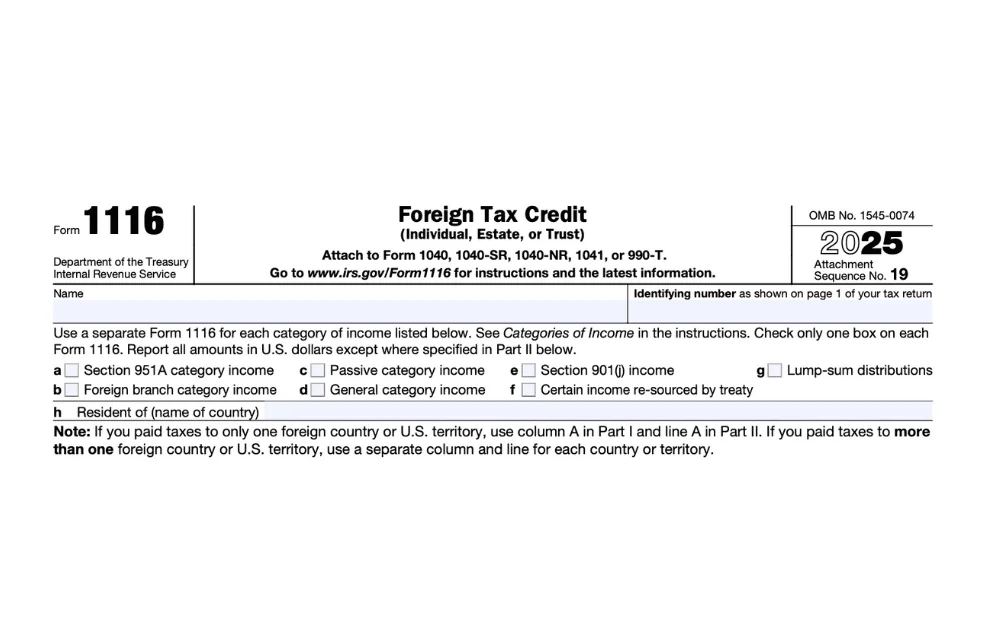
Step 2: Complete IRS Form 1116
Form 1116 asks for the country you paid, the type of income, the amount of foreign tax in U.S. dollars, and any deductions or exclusions allocated against that income.
The form is completed separately for each income category. The Form 1116 instructions list seven:
- Passive category income
- General category income
- Foreign branch category income
- Section 951A category income
- Section 901(j) income from sanctioned countries
- Certain income re-sourced by treaty
- Lump-sum distributions
Wages fall under the general category and rental income under the passive category, so an expat with both files two copies of the form. Credits in one category cannot offset U.S. tax in another, and mixing them is a frequent cause of an unexpected balance due. A Form 1116 explanation statement is also required in some situations, including certain accrual and treaty positions. If you choose to claim the credit in the year foreign tax accrues rather than the year you pay it, Publication 514 requires you to follow that method in all later years, so treat it as a long-term decision rather than a one-year convenience.
Step 3: Calculate Your Credit Limit
Part III of Form 1116 calculates the limit for that category using the formula covered above. If the foreign tax you paid comes in below the limit, you claim all of it. If it comes in above, you claim the limit and record the difference on your carryover schedule for next year’s return.
Step 4: Apply the Credit to Your Tax Return
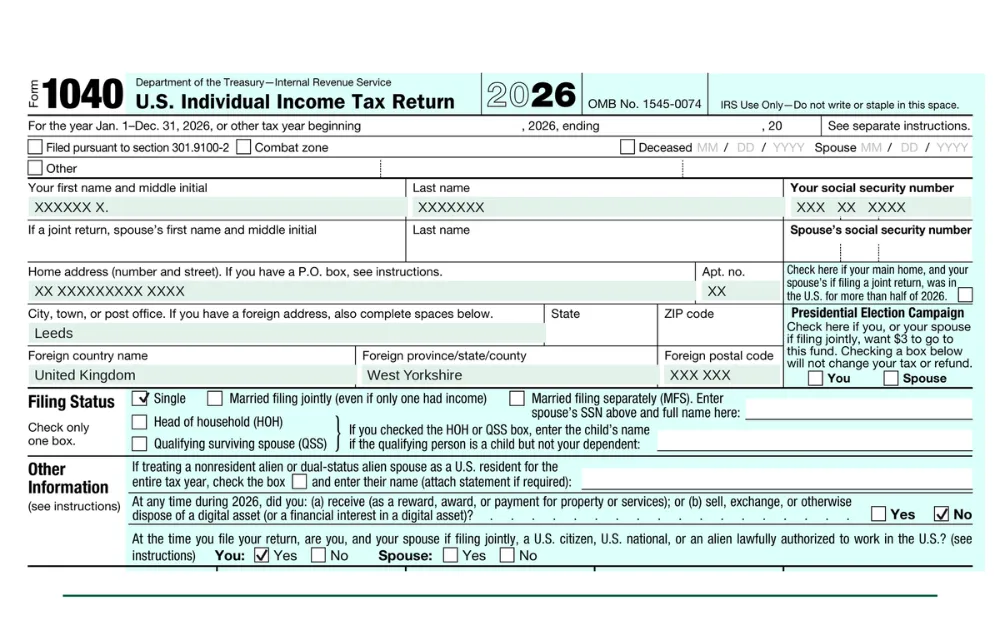
The allowable credit carries from Form 1116 to Schedule 3 of your Form 1040 and reduces your total tax. If your foreign tax exceeds the limit, the excess is generally not lost. It moves into the carryback and carry-forward rules covered above, so a high-tax year can still help you in another year.
Foreign Tax Credit vs. Foreign Earned Income Exclusion
The Foreign Tax Credit and the Foreign Earned Income Exclusion both reduce U.S. tax on income earned abroad, and you can use both in the same year as long as you do not apply them to the same dollar of income. The credit generally wins in higher-tax countries; the exclusion generally wins where local income tax is low or absent.
Where Each One Wins
The credit is generally limited to the U.S. tax attributable to your foreign-source taxable income, and unused amounts carry back one year and forward 10 years. The exclusion is capped at a fixed figure instead, $130,000 for the 2025 tax year and $132,900 for 2026, applies only to earned income, and nothing carries over.
The exclusion also requires you to pass either the physical presence test or the bona fide residence test, while the credit has no such requirement. If you are weighing the two for the first time, our FEIE and FTC comparison walks through the trade-offs, including what happens when you revoke the exclusion. Talk through any plan to move countries with your accountant before you choose, because the better option often changes with the local tax rate.
How the Foreign Tax Credit Works with Tax Treaties
A tax treaty does not replace the Foreign Tax Credit. A treaty works alongside the credit, determining which country has the right to tax a particular source of income and sometimes re-sourcing income so that the credit can apply. Treaty positions are reported on Form 8833, and income re-sourced by treaty is a separate category on Form 1116.
Totalization agreements cover a different problem. They keep you out of two social security systems at once, and contributions covered by an agreement are never creditable, whatever they cost you.
Common Mistakes Expats Make with the FTC
Five mistakes account for most of the trouble with the credit, and each one has a clear fix.
1. Claiming the FTC on Excluded Income
Foreign tax that relates to income you excluded under the Foreign Earned Income Exclusion is not creditable.
Solution: allocate deliberately. Use the exclusion or the credit for each portion of income, and never both on the same earnings.
2. Mixing Income Categories on One Form
Filing a single Form 1116 for wages and passive income overstates the credit in one category and understates it in another.
Solution: Complete a separate Form 1116 for each category and keep the limits separate.
3. Not Keeping Track of Carry-forwards
A carry-forward you do not record expires after 10 years, and by then the supporting paperwork is usually gone.
Solution: keep a carryover schedule by year and by category, and carry it forward with your tax records each year so the balance is never reconstructed from memory.
4. Failing to Convert Foreign Taxes to U.S. Dollars
Foreign tax must be reported in U.S. dollars, and switching conversion methods between years is a common reason for an adjustment to a credit.
Solution: use published IRS rates or a single reasonable, consistent method, and keep the workings with your records.
5. Overlooking FBAR and FATCA
The credit can cover your entire U.S. tax bill and leave your reporting obligations exactly where they were. If your foreign accounts together top $10,000 at any point in the year, an FBAR applies, and larger foreign financial assets bring FATCA reporting on Form 8938.
Solution: Treat the credit and the information reports as two separate jobs on the same return.
How Greenback Helps With the Foreign Tax Credit
The Foreign Tax Credit is claimed on your U.S. return, so it is worked out as part of federal tax return preparation rather than as a filing of its own. If you are choosing between the credit and the exclusion, or want a carryover position reviewed before you commit to a method, an expat tax consultation covers that in one session. For returns that are still outstanding, Greenback’s streamlined filing service handles the back years and the credit together.

Let us handle your Foreign Tax Credit this year
Frequently Asked Questions
Yes, but not on the same income. You can exclude foreign earned income up to the annual exclusion limit and then apply the credit to income above that limit, or to income the exclusion does not cover, such as rent, dividends, and interest. Foreign tax allocable to the excluded portion is not creditable.
There is no set dollar figure. Your limit is your own U.S. tax on your own foreign income, worked out from the fraction in Publication 514 and applied to each income category on its own. Two people paying identical foreign tax can therefore have very different limits, which is why the calculation has to be done on your figures rather than looked up.
In everyday use, yes. An international tax credit is a general term for relief against taxes paid to another country. For U.S. individual filers, the credit that provides that relief is the Foreign Tax Credit, claimed on Form 1116. If you see the phrase in a bank statement, an employer briefing, or an accountant’s letter, it is almost always this credit being described.
You may still owe some U.S. tax. The credit offsets what you paid abroad, so a lower foreign rate leaves a gap that the U.S. still taxes. In that situation, it is worth checking whether the Foreign Earned Income Exclusion, or a combination of the two, produces a better result.
The credit applies to the income tax portion, not to U.S. self-employment tax. Self-employment tax of 15.3% funds Social Security and Medicare, and the Foreign Tax Credit cannot reduce it. A totalization agreement with your country of residence generally relieves you of self-employment tax.
You can claim it on an amended return. Most amended claims run on a three-year clock, but a claim for refund relating to foreign taxes has a 10-year window under Publication 514, so a missed credit from several years back is often still recoverable.
This article provides general information about the Foreign Tax Credit for U.S. taxpayers, including Americans living abroad. Tax laws are complex and change frequently, and the right choice between the credit, the exclusion, and a treaty position depends on your own figures. For advice tailored to your situation, consult a qualified tax professional with expertise in expat taxation.

Featured In





