How to Move to Canada from the U.S.: Immigration, Costs, and Taxes



Canada feels familiar, but moving across the border is a full international relocation. While Americans can visit for up to six months at a time without a visa, settling long-term requires formal legal status. You cannot simply cross the border, sign a lease, and start looking for local work.
All Canadian immigration programs are managed by Immigration, Refugees and Citizenship Canada (IRCC), the federal government department responsible for visas, work permits, permanent residence, and citizenship.
Most Americans make the move through a few immigration pathways:
- Temporary work permits, including streamlined professional permits under the Canada-United States-Mexico Agreement (CUSMA)
- Express Entry, Canada’s online points-based selection system for skilled professionals seeking permanent residence
- Family sponsorship by a Canadian citizen or permanent resident spouse or partner
- Study permits at designated Canadian colleges and universities
Recent policy changes have also reshaped how Americans approach these options. On November 3, 2026, IRCC updated the Express Entry scoring system to award more bonus points for Canadian work experience and qualifying job offers in high-wage occupations. For Americans applying solely on U.S. credentials, getting invited directly from the States has become a lot more competitive. As a result, securing a temporary work permit first is now the most practical stepping stone toward staying permanently.
At the same time, relocating also reshapes your finances. Because the United States uses a citizenship-based tax system, you have to continue filing an annual U.S. tax return while Canada taxes your worldwide income from the day you establish residential ties.
Key Takeaways
- No Automatic Right to Settle: Americans can visit Canada for up to six months visa-free for tourism, but living or working in Canada requires an approved work permit, study permit, or permanent resident visa from IRCC.
- CUSMA Work Permits: Qualified American professionals (such as software engineers, accountants, and management consultants) with a Canadian job offer can get employer-specific work permits quickly without a lengthy Labour Market Impact Assessment (LMIA).
- November 2026 Express Entry Rule Changes: Canada now awards up to 150 points for eligible Canadian work experience in high-wage occupations and no longer requires an LMIA for qualifying high-wage job offers.
- Proof of Settlement Funds: Federal Skilled Worker candidates without an authorized job offer must show at least CAD 15,263 in personal liquid funds for a single applicant, rising to CAD 28,362 for a family of four.
- Remote Work Triggers Tax Residency: Working remotely from Canada for an American employer on an extended stay makes your salary taxable in Canada and can create corporate tax risks for your employer.
- Dual Tax Filing Obligations: You must file both a Canadian personal tax return (reporting worldwide income as a tax resident) and an annual U.S. return (Form 1040). The Foreign Tax Credit (FTC) or Foreign Earned Income Exclusion (FEIE) prevents double taxation.
- Canadian Accounts for Americans: Registered Retirement Savings Plans (RRSPs) enjoy tax-deferred treatment under the U.S.-Canada tax treaty, but Tax-Free Savings Accounts (TFSAs) are not recognized as tax-free by the IRS and can trigger complex foreign trust reporting.
Immigration Options for Americans Moving to Canada
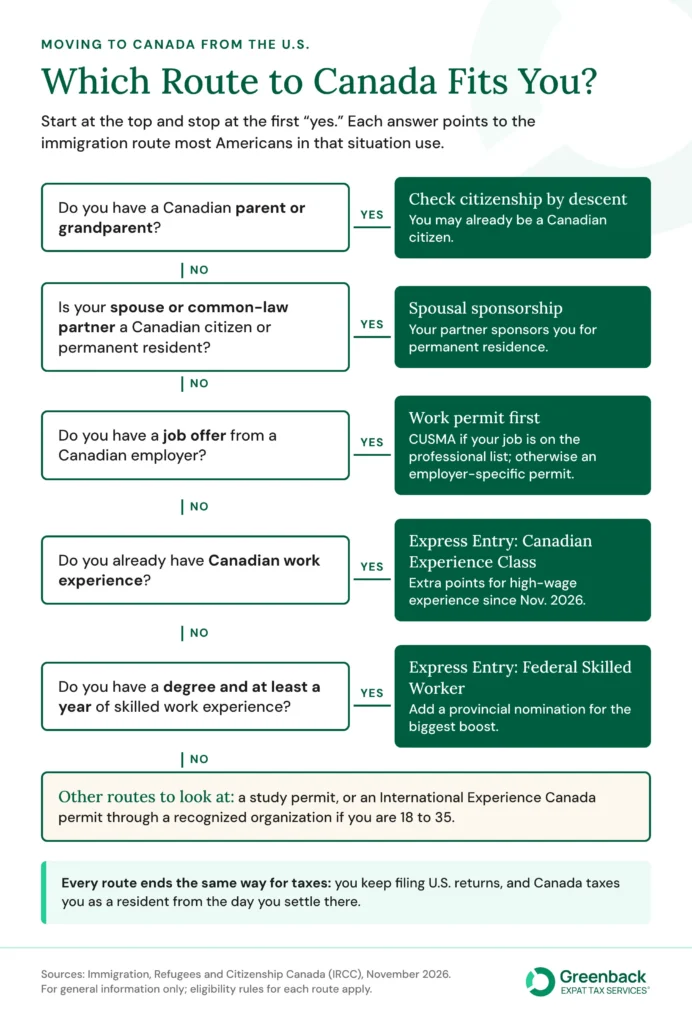
Can Americans move to Canada? Yes, through several established pathways. The right option depends on whether you have a Canadian job offer, immediate Canadian family, or prior Canadian work or study experience.
Match your current situation to the immigration path designed for it:
If you have a qualifying Canadian job offer:
- Your Best Path: A temporary work permit, such as a CUSMA Professional Work Permit or an LMIA-supported employer work permit.
- What to Expect: This is the fastest way to physically move to Canada. Once you complete one year of full-time Canadian work experience, you become eligible for the Canadian Experience Class (CEC) under Express Entry and earn valuable bonus Comprehensive Ranking System (CRS) points toward permanent residence.
If you have a Canadian spouse or common-law partner:
- Your Best Path: Family Class Spousal Sponsorship.
- What to Expect: If you are legally married to, or have lived together continuously for at least 12 months with, a Canadian citizen or permanent resident, your partner can sponsor you directly. This provides a direct route to permanent residency without needing job offers, points tests, or minimum educational assessments.
If you don’t have a Canadian job offer or Canadian family:
- Your Best Path: Express Entry (via the Federal Skilled Worker Program) or a Provincial Nominee Program (PNP).
- What to Expect: You will compete in an online pool based on your age, degrees, language test scores, and foreign career experience. If your score falls short of federal draw cutoffs, targeted provincial streams can nominate you based on regional labor shortages, adding 600 bonus points to guarantee an invitation to apply for permanent residence.
Work Permits for U.S. Citizens: CUSMA and Other Options
Because obtaining permanent residence directly from the U.S. has become more competitive, securing a temporary work permit first is now the most practical first step for many Americans. After one year of full-time skilled work in Canada, your profile qualifies for the Canadian Experience Class and earns bonus points for future Express Entry draws.
What Is CUSMA?
CUSMA stands for the Canada-United States-Mexico Agreement, the free trade treaty that replaced NAFTA (known as USMCA in the United States). The treaty includes special rules that make it much easier for business people and skilled professionals from all three countries to cross borders for work.
Under CUSMA, eligible American workers are exempt from the standard Labour Market Impact Assessment (LMIA). That means Canadian employers don’t have to spend months advertising the position to prove no Canadian worker was available before hiring you.
CUSMA Professional Work Permits
If you have heard of the NAFTA or TN visa that Canadians use to work in the United States, a CUSMA Professional Work Permit is the exact Canadian counterpart for Americans moving north. Both options are part of the same trade treaty and share the exact same list of about 60 eligible professions.
- Who Qualifies: Common roles include software engineers, computer systems analysts, management consultants, accountants, graphic designers, technical writers, and scientific researchers.
- Requirements: You must have a pre-arranged job offer from a Canadian business in a listed profession, along with the degree or professional credentials that the list specifies.
- Border Issuance: Because American citizens are visa-exempt visitors, you do not have to wait months for an online consular visa application. You can bring your employment contract, proof of educational credentials, and employer compliance receipt directly to a Canada Border Services Agency (CBSA) officer at a major land border crossing or international airport and receive your physical work permit on the spot.

Planning to Work Remotely from Canada for a U.S. Company?
CUSMA Intra-Company Transferees
If you work for an American corporation that has a Canadian parent company, branch, subsidiary, or affiliate, your employer can transfer you to the Canadian location under CUSMA:
- Eligible positions include executives, senior managers, and workers with specialized proprietary knowledge.
- You must have worked for the U.S. company for at least one continuous year within the three years immediately preceding the transfer.
International Experience Canada (SWAP)
Americans aged 18 to 35 can also get an open work permit through the International Experience Canada working holiday category. Because the U.S. does not have a formal reciprocal youth mobility treaty with Canada, Americans have to apply through an IRCC-designated Recognized Organization, such as SWAP Working Holidays.
Express Entry and How Canada’s Points System Works
Express Entry is not an immigration visa or an application you submit for automatic approval. Instead, it is an online candidate matching pool managed by IRCC to select candidates for permanent residence under three economic programs:
- Federal Skilled Worker Program (FSWP): For skilled workers with foreign (including U.S.) work experience.
- Canadian Experience Class (CEC): For professionals with at least one year of skilled Canadian in-country work experience.
- Federal Skilled Trades Program (FSTP): For qualified commercial and technical tradespersons.
Instead of processing applications on a first-come, first-served basis, Canada ranks everyone in the Express Entry pool against each other using a mathematical score called the Comprehensive Ranking System (CRS).
How Points Are Scored
You do not gain points simply by waiting in the pool over time. Points are based entirely on merit, credentials, and demographic profile across a 1,200-point scale:
- Age (Peaks Early): You earn the maximum points when you’re between 20 and 29 years old. Starting on your 30th birthday, your score drops each year. By age 40, you receive significantly fewer age points, which is why older applicants need other strengths (like high language scores or Canadian work experience) to stay competitive.
- Education: A bachelor’s degree earns baseline points, a master’s earns more, and a doctorate earns the maximum. An approved agency must verify foreign degrees to confirm they match Canadian standards.
- Language Proficiency: You must complete an approved test, such as the CELPIP-General (Canadian English Language Proficiency Index Program) or IELTS General Training (International English Language Testing System). High test scores (Canadian Language Benchmark 9 or higher) provide one of the largest point gains available.
- Provincial Nominee Boost: If an individual province nominates you through a Provincial Nominee Program (PNP), your profile automatically receives 600 bonus points, which guarantees you will be selected in the next invitation round.
Every few weeks, IRCC conducts an invitation round. The department sets a minimum cutoff score (for example, 510 points) and issues an Invitation to Apply (ITA) for permanent residence to everyone whose score is at or above that line.
What Changed on November 3, 2026?
Canada introduced major structural changes to CRS scoring to prioritize candidates who are already working inside the country or who hold verified high-wage employment:
- High-Wage Job Offer Bonus: Candidates with a qualifying job offer in a high-wage occupation now earn significant additional CRS points without requiring an LMIA.
- Canadian Experience Points: Candidates with Canadian skilled work experience in a high-wage occupation can now earn up to 150 points (140 points if accompanied by a spouse or common-law partner).
- The Takeaway for Americans: In the past, an American professional in their late twenties with a master’s degree, top English test scores, and three years of U.S. work experience could often score high enough to receive an ITA directly from the States. Under the updated scoring model, U.S. credentials alone face steeper competition from applicants already working inside Canada.
You can see the current programs and draw results on IRCC’s Express Entry page.
Moving to Canada Without a Job Offer
If you don’t have a Canadian job offer, you can still immigrate, but you have to qualify through a pathway that does not depend on an employer:
- Federal Skilled Worker Program: Candidates with multiple degrees, bilingual language skills (English and French), and substantial personal savings can enter the Express Entry pool without a job offer and wait for category-based draws targeting healthcare, STEM, or trade professions.
- Provincial Nominee Streams: Several provinces operate streams that search the federal pool for specific occupational backgrounds and issue nominations without requiring a local job offer.
- Family Sponsorship: If you are legally married to, or in a documented common-law partnership with (living together continuously for at least 12 months), a Canadian citizen or permanent resident, your partner can sponsor you directly for permanent residence.
- Study Permits: Enrolling in a degree or diploma program at a Designated Learning Institution provides legal entry and part-time student work authorization. While Canada planned roughly 155,000 new study permits for 2026, graduating from an eligible university program can lead to a Post-Graduation Work Permit.
- Citizenship by Descent: If you have a Canadian parent or grandparent, check your eligibility for Canadian citizenship by descent before applying for visas, as you may already be a Canadian citizen.
Immigration Programs That Are Currently Closed
Canada occasionally pauses or ends immigration programs based on policy priorities:
- The Start-up Visa Program stopped accepting new applications on December 31, 2025. IRCC plans to introduce a replacement entrepreneur pilot in the future.
- The Self-Employed Persons Program is paused and not accepting new applicants through late 2026. Entrepreneurs looking to establish a business in Canada should evaluate province-specific business immigration streams.
Minimum Settlement Funds Required by IRCC
If you apply for permanent residence under the Federal Skilled Worker Program without an authorized Canadian job offer, IRCC requires you to prove you have enough liquid savings to support your family while you settle.
These minimum amounts are updated periodically by IRCC and reflect current proof-of-funds requirements:
| Family Size | Required Settlement Funds (CAD) | Approximate Equivalent (USD) |
| 1 (Single Applicant) | $15,263 | ~$11,200 |
| 2 | $19,001 | ~$13,900 |
| 3 | $23,360 | ~$17,100 |
| 4 | $28,362 | ~$20,800 |
| 5 | $32,168 | ~$23,600 |
| 6 | $36,280 | ~$26,600 |
| 7 | $40,392 | ~$29,600 |
| Each Additional Member | +$4,112 | +$3,000 |
Rules for Settlement Funds: The money must be your own, liquid, and immediately accessible. You can’t use real estate equity, borrowed funds, personal loans, or business accounts to satisfy this requirement. You must provide official bank letters covering the six months leading up to your application.
Exemption Note: If you are applying under the Canadian Experience Class, or if you hold an authorized job offer and work permit in Canada, you are exempt from having to show these settlement funds.
For rent, groceries, and other living costs compared with U.S. cities, see whether it’s expensive to live in Canada.
Application Fees and Relocation Costs
An economic-class permanent residence application costs CAD 1,590 per adult applicant, which includes the permanent residence processing fee and the right of permanent residence fee. Official language tests and educational credential evaluations cost roughly $500 USD to $700 USD combined, plus physical moving costs and early rental deposits.
Where to Live: Major Canadian Cities Compared
Where you settle influences your housing costs, your local tax rate, and your professional opportunities:
- Toronto, Ontario: Canada’s largest city and economic center. Toronto offers the deepest job market for corporate, finance, marketing, and tech professionals, but features some of the highest housing and rental costs in the country.
- Vancouver, British Columbia: Offers mild coastal weather with immediate access to mountains and the Pacific Ocean. Vancouver hosts a growing tech sector, though real estate prices remain among the highest in North America.
- Calgary, Alberta: Pairs a strong corporate and energy job market with significantly more affordable housing. Alberta has no provincial sales tax (only the 5% federal Goods and Services Tax applies) and maintains lower, flat provincial income tax brackets.
- Montreal, Quebec: Known for vibrant culture, walkable neighborhoods, and comparatively lower rents. However, Quebec operates its own independent immigration selection system, and professional life heavily requires French fluency under provincial language laws.
- Ottawa, Ontario: A stable, high-income city centered around federal government administration and technology research. Many local jobs require bilingualism.
- Halifax, Nova Scotia: A growing coastal city with a strong quality of life and lower housing costs, though provincial income tax rates are higher.
Working Remotely from Canada for a U.S. Employer
Many Americans wonder if they can relocate to Canada and simply keep their current U.S. remote job.
While visitors can perform limited remote work during a short holiday, living in Canada long-term requires formal immigration status. In addition, physical presence creates legal and tax considerations:
- Canadian Corporate Tax Exposure: A U.S. company with an employee working permanently from Canada can inadvertently create a Permanent Establishment (PE) under Canadian tax law, exposing company profits to Canadian corporate taxation. Many U.S. employers require workers to transition to a Canadian Employer of Record (EOR) service or an independent contractor model.
- Taxing the Salary: Canada taxes residents on worldwide income. Income earned while physically sitting at a desk in Canada is considered Canadian-source income, even if paid in U.S. dollars directly into an American bank account.
- No Automatic Canadian Withholding: Because American employers rarely run Canadian payroll, they don’t deduct Canadian income taxes or Canada Pension Plan (CPP) contributions from your pay. You must set aside money and make quarterly tax installment payments directly to the Canada Revenue Agency (CRA) to avoid interest charges.
Cross-Border Taxes: Your Transition Year in the U.S. and Canada
Moving across the border doesn’t mean you stop filing U.S. taxes. The United States is one of only two countries that tax its citizens on worldwide income, regardless of where they live. That means you will manage two tax systems at once:
How Dual Tax Filing Works
- With the Canada Revenue Agency (CRA): You become a Canadian tax resident on the day you establish significant residential ties (such as signing an apartment lease, purchasing a home, or moving your family and household belongings). You file a part-year Canadian return (the T1 General) for your move year, reporting only the worldwide income you earned after your arrival date.
- With the Internal Revenue Service (IRS): You continue filing your standard annual Form 1040, reporting all income earned across the entire year.
- Avoiding Double Taxation: You generally will not pay full tax twice on the same dollar. Because Canadian income taxes are generally higher than U.S. federal rates, most Americans use the Foreign Tax Credit (Form 1116). This lets you apply the income taxes you pay in Canada directly against your U.S. tax bill, typically reducing your U.S. tax owed to zero and generating credit carryovers for future years. Alternately, the Foreign Earned Income Exclusion (Form 2555) allows qualifying expats who pass the physical presence test to exclude up to $132,900 of foreign earned wages for 2026.
To see what you would pay in each country at different incomes, compare Canada vs. U.S. taxes; to file in both countries each year, read the tax guide for Americans living in Canada.

Protect Your Investments Before You Cross the Border
Canadian Financial Accounts to Know Before You Move
Once you settle in Canada, your day-to-day banking changes, and how the IRS treats Canadian investment accounts catches many newcomers off guard:
- RRSPs Are Safe: A Registered Retirement Savings Plan (RRSP) is Canada’s primary retirement savings account, similar to a traditional 401(k) or IRA. Under the U.S.-Canada Tax Treaty, earnings inside an RRSP grow tax-deferred for both Canadian and U.S. tax purposes. You don’t owe annual U.S. tax on growth inside the account.
- TFSAs Can Create Expat Tax Issues: A Tax-Free Savings Account (TFSA) allows Canadians to invest after-tax dollars and withdraw growth completely tax-free. However, the IRS doesn’t recognize a TFSA’s tax-free status. The U.S. treats a TFSA like an ordinary taxable foreign brokerage account or foreign grantor trust. You have to report all interest, dividends, and capital gains on your U.S. return each year, and holding one can trigger complex foreign trust reporting forms (Form 3520 and Form 3520-A) with penalties for errors. Most cross-border advisors recommend that Americans avoid opening a TFSA.
- Reporting Your Canadian Bank Accounts (FBAR): Once the combined total of all your Canadian financial accounts (checking, savings, RRSPs, and investments) exceeds $10,000 USD at any point during the calendar year, you have to file an annual Foreign Bank and Financial Accounts Report, known as the FBAR (FinCEN Form 114).
- State Tax Exit Planning: Leaving the United States doesn’t automatically get rid of your tax ties with your home state. States like California, New York, and Virginia may continue to tax your income unless you take deliberate administrative steps to abandon your state residency, such as surrendering your state driver’s license, closing local bank accounts, and updating voter registrations.
Moving to Canada Checklist for Americans
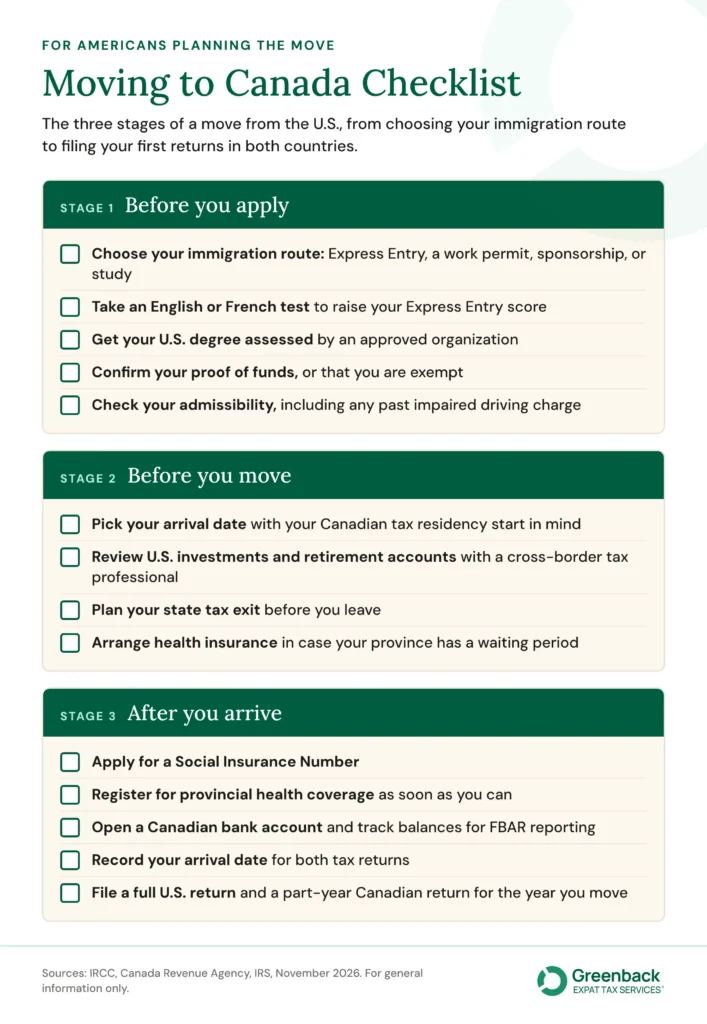
Most of the critical decisions happen before you apply or pack. Use this chronological checklist to organize your relocation.
Before You Apply
- Choose your primary immigration pathway (CUSMA work permit, Express Entry, or spousal sponsorship).
- Register for and complete an official language exam (CELPIP-General or IELTS General Training).
- Order an Educational Credential Assessment (ECA) through an approved agency like World Education Services (WES).
- Request police clearance certificates, including an FBI Identity History Summary.
- Gather six months of official bank statements that meet the unencumbered settlement funds threshold.
- Check for any past legal issues (such as a past driving under the influence conviction) that could cause inadmissibility.
Before You Move
- Consult with a cross-border CPA to plan your U.S. state tax exit and review your retirement accounts.
- Rebalance your investment portfolio to eliminate non-U.S. foreign mutual funds, which trigger heavy passive foreign investment company (PFIC) taxes in the U.S.
- Request health and vaccination records for your family and import certificates for household pets.
- Notify your U.S. banks and brokerages of your move, and confirm they allow expats to keep accounts with a foreign address.
- Set your intended Canadian tax residency start date.
After You Arrive
- Apply in person at a Service Canada office for your Social Insurance Number (SIN), which is required to work.
- Register for provincial health coverage (such as OHIP in Ontario or MSP in British Columbia) and review any waiting periods.
- Open a Canadian bank account that supports cross-border transfers.
- Obtain Canadian auto insurance and make an appointment to exchange your U.S. driver’s license for a provincial license.
- Keep a permanent record of your exact arrival date for both your U.S. and Canadian tax returns.
Frequently Asked Questions
No. A U.S. citizen can visit Canada without a visa, but living there long term requires an immigration status such as permanent residence, a work permit, or a study permit.
No. Moving to Canada or becoming a Canadian permanent resident or citizen does not take away U.S. citizenship, because both countries allow dual citizenship. You must still file U.S. taxes while you live in Canada.
No. U.S. Social Security benefits generally continue to be paid to U.S. citizens living in Canada. The U.S.-Canada totalization agreement also coordinates the two countries’ social security systems, so work in both countries can count toward benefits.
A past impaired driving conviction can make an American inadmissible to Canada. Impaired driving committed on or after December 18, 2018 is treated as serious criminality under Canadian immigration law, so an affected applicant usually needs criminal rehabilitation or a temporary resident permit before entering or immigrating.
New permanent residents qualify for their province’s public health insurance, which covers medically necessary hospital and physician care without out-of-pocket charges. Some provinces start coverage right away and others apply a waiting period, and prescriptions, dental care, and vision care usually need separate coverage.
No matter how complex your cross-border tax situation is, Greenback can help. We’ve helped thousands of Americans in Canada file both their U.S. and Canadian returns correctly and avoid double taxation. Our CPAs and Enrolled Agents live in 14 time zones, and many are expats themselves.
If you’re ready to be matched with a Greenback accountant, click the get started button below. For general questions on expat taxes or working with Greenback, contact our Customer Champions.

Make Your Move to Canada Tax-Ready
This article is for informational purposes only and should not be considered immigration or tax advice. Canadian immigration policies and requirements are subject to change. For the latest program details, visit Immigration, Refugees and Citizenship Canada (IRCC) and the IRS. Always consult with qualified immigration and tax professionals regarding your specific situation.
Related Resources
- U.S. Expat Tax Guide for Living in Canada
- Canada vs. U.S. Taxes: Complete Comparison
- Is It Expensive to Live in Canada? Costs Compared to the U.S.
- How to Retire in Canada as a U.S. Citizen
- TFSA for U.S. Citizens: The Tax Trap You Need to Know
- Canadian Retirement Programs for U.S. Citizens: Complete Tax Guide
- Canada Capital Gains and Attribution Rules vs. U.S.
- What Documents Do I Need to File My Canada Tax Return?
- Countries That Allow Dual Citizenship
- Canada Tax Return Services
- How Are Canadian Pensions Taxed in the US?


Featured In


