Canadian Citizenship by Descent: Who Qualifies Under Canada’s New Law?
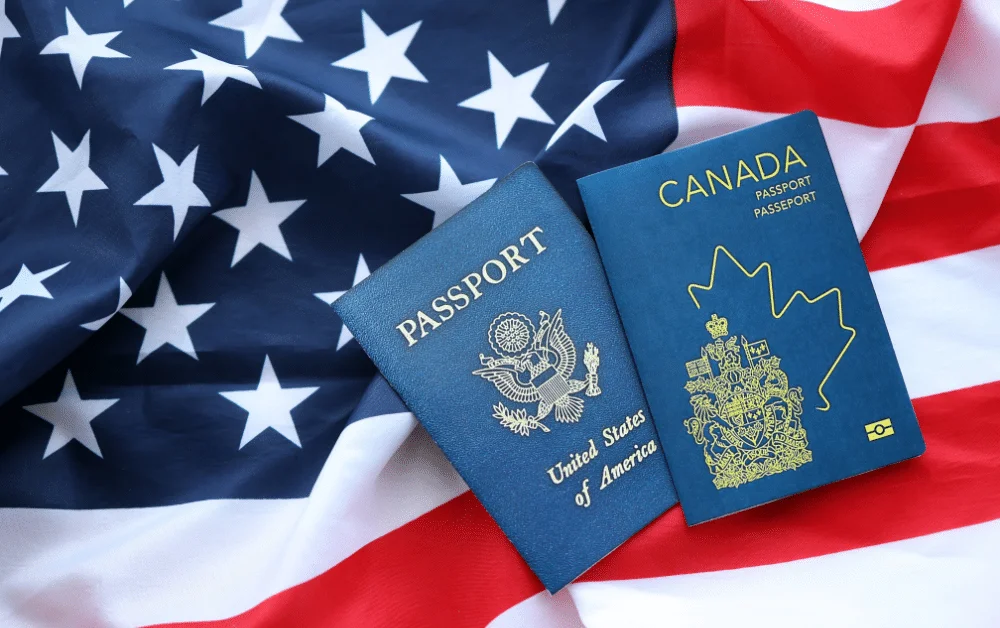

If you have a Canadian parent, grandparent, or even a great-grandparent, you may already be a Canadian citizen and not even know it. Canada’s Bill C-3, which took effect on December 15, 2025, permanently removed the first-generation limit on citizenship by descent, retroactively granting citizenship to people who were previously excluded.
The key facts you need to know right now:
- Retroactive recognition: If you were born before December 15, 2025, and have a Canadian ancestor in your direct line, you may already be a citizen automatically
- No generational cap (for those born before the law): The old rule that stopped citizenship after one generation born abroad is gone
- You must apply for proof: You are not issued a certificate automatically; you must apply through IRCC
Thinking About Dual Citizenship?
Here’s what the law actually says, who qualifies, how to apply, and what new Canadian-American dual citizens need to know about U.S. taxes.
What Is Canadian Citizenship by Descent?
Canadian citizenship by descent is citizenship acquired by a child born outside Canada to a Canadian parent. If your mother or father was a Canadian citizen when you were born, you may have acquired Canadian citizenship at birth, even if you were born in the United States or another country.
Before Bill C-3, this transfer of citizenship was subject to what Canada called the “first-generation limit.” Under that rule, only the first generation born outside Canada could inherit citizenship. If your parent was born in Canada and you were born in the U.S., you were a citizen. But if both your parent and you were born outside Canada, you were not, even if your grandparent was born in Montreal or Vancouver.
That restriction no longer exists for anyone born before December 15, 2025.
What Changed Under Canada’s New Law (Bill C-3)?
Bill C-3, formally titled An Act to Amend the Citizenship Act (2025), received Royal Assent on November 20, 2025, and came into force on December 15, 2025. The law made three critical changes:
- Removed the first-generation limit retroactively: If you were born before December 15, 2025, and would have been a Canadian citizen but for the first-generation limit, the law now automatically recognizes you as a citizen. You do not need to apply for citizenship; you apply for proof of citizenship you already have.
- Restored citizenship for “Lost Canadians.” The term “Lost Canadians” refers to people who lost or never obtained citizenship because of outdated rules in earlier versions of Canada’s citizenship laws. Most cases were addressed through legislative changes in 2009 and 2015, but some people remained excluded. Bill C-3 extends citizenship to these remaining Lost Canadians, their descendants, and those born abroad to a Canadian parent in the second or later generation.
- Introduced a new rule for future births: For anyone born on or after December 15, 2025, to a Canadian parent who was also born outside Canada, there is a new requirement: the Canadian parent must have spent at least 1,095 days (three years) physically present in Canada before the child’s birth. This “substantial connection” requirement does not apply to people born before that date.
| When You Were Born | What You Need to Qualify |
|---|---|
| Before December 15, 2025 | A Canadian citizen in your direct line of descent (parent, grandparent, great-grandparent, etc.). No physical presence requirement. |
| On or after December 15, 2025 | A Canadian parent who spent at least 1,095 days (3 years) in Canada before your birth. |
The law change was prompted by a December 2023 Ontario Superior Court of Justice ruling that found the first-generation limit unconstitutional. The Canadian government chose not to appeal the decision, and Bill C-3 was the legislative response.
How Many Generations Can Claim Canadian Citizenship?
This is the question driving the most search activity and the most confusion. The answer depends on your birth date.
- Born before December 15, 2025: There is no generational limit. If your great-great-grandparent was born in Canada and Canadian citizenship descends unbrokenly to you, you may be a citizen. The law retroactively recognizes the entire chain, provided there is an original “anchor” who was a Canadian citizen (born in Canada or naturalized).
- Born on or after December 15, 2025: The generational chain can still extend beyond the first generation, but your Canadian parent must prove 1,095 days of physical presence in Canada before your birth. This is what Canada calls the “substantial connection” requirement.

“Unbroken chain of descent” means each person in the chain must have been born to a Canadian citizen. If any link in the chain was not a Canadian citizen at the time their child was born, the chain breaks. Bill C-3 retroactively fixes many of those broken links by restoring citizenship to people who were previously excluded, but the specific circumstances of each family’s history matter.
Can You Get Citizenship Through a Grandparent or Great-Grandparent?
Through a grandparent: Yes. This is the most common scenario for Americans applying right now. Here is how it works:
- Your grandparent was born in Canada (or was a naturalized Canadian citizen)
- Your parent was born outside Canada to that grandparent
- Under the old law, your parent was a first-generation citizen, and you were blocked by the first-generation limit
- Under Bill C-3, your parents’ citizenship is confirmed, and your citizenship as their child is retroactively recognized
You are already a citizen. You just need to prove it.
Through a great-grandparent: Yes, the same logic applies, but the documentation chain is longer. You will need to establish:
- Your great-grandparent’s Canadian birth or citizenship
- Your grandparents’ birth to that great-grandparent (even if born outside Canada)
- Your parent’s birth to that grandparent
- Your own birth to that parent
Each link in the chain requires documentary proof.
Through even earlier ancestors: Theoretically possible for those born before December 15, 2025, but the further back the connection goes, the harder it becomes to document. Immigration lawyers note that the biggest barrier for most American applicants is not eligibility but documentation: proving an unbroken chain of descent to a Canadian-born ancestor can require birth certificates, marriage certificates, and, sometimes, immigration records spanning generations.
How to Apply for Canadian Citizenship by Descent
You do not “apply for citizenship” in the traditional sense. If you qualify under Bill C-3, you are already a citizen. What you apply for is a citizenship certificate, which is official proof that you are a Canadian citizen.
Documents Needed
The exact documents depend on how many generations separate you from your Canadian-born ancestor. At minimum, expect to gather:
- Your birth certificate (long form, showing parents’ names)
- Your parents’ birth certificate (showing their parents’ names)
- Your Canadian ancestor’s birth certificate or naturalization records
- Marriage certificates for each generation (to establish name changes and connections)
- Any available immigration or travel records that support the chain
For families with roots in Quebec, the demand for archival records has surged. Archives across Canada have reported significant increases in requests from Americans since the law took effect.
Application Process
- Step 1: Gather all supporting documents. Allow two to three months for this step. Start with the Canadian ancestor’s birth certificate and work forward through each generation. Contact Canadian provincial archives and vital statistics offices early, as processing times have increased due to demand.
- Step 2: Complete the application. Use IRCC Form CIT 0001 (Application for a Citizenship Certificate for Adults). The form is available on the IRCC website.
- Step 3: Pay the application fee. The fee for a citizenship certificate is $75 CAD, paid online when you submit your application.
- Step 4: Submit your application. Applications can be submitted online through the IRCC portal.
- Step 5: Wait for processing. As of early 2026, processing times from the U.S. are approximately 10 to 11 months. Nearly 50,000 people are currently waiting for decisions on citizenship certificate applications, a backlog directly attributable to the surge in applications following Bill C-3.
- Step 6: Receive your citizenship certificate. If approved, you will receive a certificate that serves as official proof of Canadian citizenship. You can then use it to apply for a Canadian passport.
Do You Automatically Become a Canadian Citizen?
If you were born before December 15, 2025, and qualify under Bill C-3, then yes, you are automatically a citizen. The law retroactively recognizes your citizenship. You do not need to take a test, attend a ceremony, or swear an oath.
However, “automatic” does not mean “documented.” Without a citizenship certificate, you have no official proof. You cannot use your Canadian citizenship to enter Canada, get a passport, or access any benefits until you have applied for and received your certificate.
If you were born on or after December 15, 2025, you are a citizen at birth only if your Canadian parent meets the 1,095-day physical presence requirement. Your parent does not need to have applied for their own citizenship certificate for you to be eligible. The law retroactively recognizes their status, which in turn establishes yours.
A note on renunciation: If you discover you are now a Canadian citizen under Bill C-3 and do not want to be, the law includes a simplified renunciation process for people who became citizens automatically and were not previously granted citizenship.
What This Means for U.S. Taxes
Here is the part that many new dual citizens overlook: becoming a Canadian citizen does not change your U.S. tax obligations.
You Still File U.S. Taxes
The United States is one of only two countries in the world that taxes based on citizenship, not residence. If you are a U.S. citizen, you must file a U.S. federal tax return and report your worldwide income to the IRS every year, regardless of where you live or how many other passports you hold.
Acquiring Canadian citizenship does not reduce, eliminate, or change this obligation. Whether you remain in the U.S., move to Canada, or live in a third country, the IRS expects you to file your annual return.
Dual Citizenship Does Not Equal Tax Relief
A common misconception is that dual citizenship provides tax advantages or relief. It does not. Your U.S. tax filing requirements are determined entirely by your U.S. citizenship (or green card status). Having a Canadian passport alongside your American one is irrelevant to the IRS.
That said, if you do move to Canada, powerful protections exist to prevent double taxation:
- Foreign Earned Income Exclusion (FEIE): Exclude up to $130,000 of foreign earned income from U.S. taxation for the 2025 tax year (filed in 2026), or $132,900 for the 2026 tax year.
- Foreign Tax Credit (FTC): Claim a dollar-for-dollar credit for Canadian income taxes paid. Because Canada’s tax rates are generally higher than U.S. rates, this credit typically eliminates your entire U.S. tax liability.
- U.S.-Canada Tax Treaty: The treaty determines which country has primary taxing rights on specific income types and provides additional protections for pensions, dividends, and other income.
| Your Situation | U.S. Tax Impact |
|---|---|
| Stay in the U.S. with Canadian citizenship | No change. File U.S. taxes as usual. |
| Move to Canada | File U.S. and Canadian returns. FEIE or FTC typically eliminates U.S. tax. |
| Open Canadian bank accounts | May trigger FBAR (if accounts exceed $10,000) and FATCA reporting. |
| Receive Canadian pension income later | Reported on U.S. return. Treaty prevents double taxation. |
Canada-U.S. Tax Treaty Basics
The U.S.-Canada tax treaty is one of the most comprehensive bilateral tax agreements in the world. For dual citizens, the key provisions include:
- Employment income: Generally taxed in the country where the work is performed. If you live and work in Canada, Canada has primary taxing rights, and you use the FTC to offset U.S. tax.
- Pensions and Social Security: Canadian Pension Plan (CPP) and Old Age Security (OAS) benefits paid to U.S. residents are treated as U.S. Social Security benefits. Only 85% is potentially taxable, and the Foreign Tax Credit can offset the remaining liability.
- Investment income: Dividends, interest, and capital gains are subject to specific treaty provisions that reduce withholding rates and assign taxing rights.
- RRSPs: The treaty allows U.S. citizens to defer U.S. tax on RRSP growth, as with a traditional IRA. This is a significant benefit for Americans living in Canada.
- TFSAs: Unlike RRSPs, Tax-Free Savings Accounts are not recognized as tax-free by the IRS. All TFSA investment income must be reported and taxed on your U.S. return. This is one of the most common tax traps for Americans in Canada.
If You Are Behind on U.S. Tax Filing
If you have not been filing U.S. tax returns, obtaining Canadian citizenship does not fix that problem. It may, however, bring your U.S. obligations into sharper focus, especially if you plan to open Canadian bank accounts or eventually move to Canada.
The IRS offers the Streamlined Filing Compliance Procedures for taxpayers who missed filing deadlines due to non-willful reasons. The program requires filing three years of tax returns and six years of FBARs, and most people who come forward voluntarily face zero penalties.
Frequently Asked Questions
Not unless you live in Canada. Canada taxes based on residency, not citizenship. If you remain in the United States, your Canadian citizenship creates zero Canadian tax obligations. You only begin filing Canadian returns if you establish tax residency in Canada (generally by living there).
Yes. Once you receive your citizenship certificate, you can apply for a Canadian passport from anywhere in the world. You do not need to live in Canada or have ever lived there.
The IRS does not track your citizenship. However, if you open a Canadian or other financial account, the institution may report your information to the IRS under FATCA (the Foreign Account Tax Compliance Act). And if those accounts exceed $10,000 in aggregate at any point during the year, you must file an FBAR.
Possibly. What matters is whether your ancestor was a Canadian citizen, not whether they ever applied for a passport or certificate. Many Canadians who emigrated to the United States in the 19th and early 20th centuries never obtained formal documentation but were citizens by virtue of being born in Canada. A Canadian birth certificate is typically the strongest proof of citizenship.
From start to finish, expect 12 to 14 months: two to three months to gather documents and three to four weeks to prepare and submit the application, followed by approximately 10 to 11 months of IRCC processing time. The processing backlog is expected to grow as awareness of Bill C-3 continues to spread.
No matter how late, messy, or complex your return may be, we can help. You’ll have peace of mind, knowing that your taxes were done right.
If you’re a dual citizen or are becoming one through Canadian citizenship by descent, Greenback’s CPAs and Enrolled Agents specialize in helping Americans with cross-border tax situations stay compliant while minimizing their tax burden.
If you’re ready to be matched with a Greenback accountant, get started here. For general questions about dual citizenship and taxes, contact our Customer Champions.
Plan Ahead for Cross-Border Taxes
This article provides general information about Canadian citizenship by descent and U.S. tax obligations. Tax laws and immigration rules are complex and change frequently. For specific advice on your citizenship eligibility, consult with a qualified Canadian immigration lawyer. For advice on your U.S. tax situation, consult with a qualified expat tax professional.
Related Resources
- Dual Citizen Taxes Explained: U.S. Filing Rules and How to Avoid Double Tax
- U.S. Expat Tax Guide for Living in Canada
- Canada vs. U.S. Taxes for Expats: Rates, Key Differences, and How to Avoid Double Tax
- FEIE vs. FTC for Expats Explained: How to Choose the Right Tax Strategy
- FBAR Explained: Filing Requirements, Deadlines, and Penalties
- TFSA for U.S. Citizens in Canada: What You Need to Know About the Tax Trap
- How to Move to Canada as an American: Immigration, Costs, and U.S. Tax Planning
- Canadian Retirement Programs for U.S. Citizens: Complete Tax Guide
- Which Countries Allow Dual Citizenship with the U.S.?
- U.S. Tax Help for Americans with Dual Citizenship