IRS Finalizes Schedule 1-A: What the New OBBBA Deductions Mean for U.S. Expats



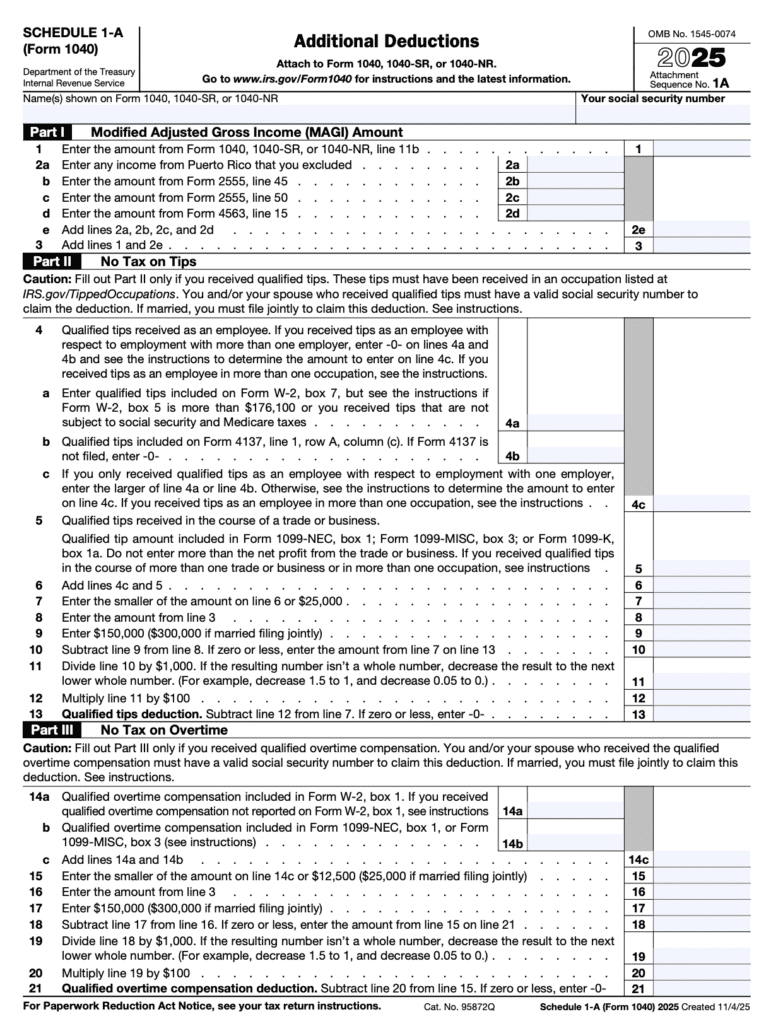
The IRS has finalized Schedule 1-A (Form 1040), a brand-new form for the 2025 tax year to be filed in 2026. This development follows Congress’s passage of the One Big Beautiful Bill Act (OBBBA) in July 2025, which temporarily added four new deductions: tips, overtime pay, car loan interest, and an enhanced senior deduction.
For Americans living abroad, the real story isn’t the deductions themselves (most expats won’t qualify) but rather how Schedule 1-A interacts with the Foreign Earned Income Exclusion (FEIE) when calculating Modified Adjusted Gross Income (MAGI). This matters because MAGI determines eligibility for many tax benefits, and the new form explicitly requires adding back excluded foreign income.
The bottom line: Schedule 1-A represents a significant structural change to the 1040 filing system, but most expats will find limited practical benefit from the actual deductions. Here’s why.

New Schedule 1-A Deductions Could Lower Your Tax Bill
Why Did the IRS Create Schedule 1-A?
When Congress passed OBBBA in July 2025, it temporarily added four new deductions effective for tax years 2025 through 2028. Rather than overcrowding existing forms, the IRS created a new schedule specifically for these OBBBA provisions.
Schedule 1-A will be filed alongside Form 1040, 1040-SR, or 1040-NR starting with the 2025 tax year (filed in 2026).

This is a completely separate form from the existing Schedule 1 (Additional Income and Adjustments), which continues to be used for reporting additional income and above-the-line deductions like student loan interest and the foreign housing deduction.
Related Article: Trump’s 2025 Tax Policies: What U.S. Expats Need to Know
The Four OBBBA Deductions: What They Are
Schedule 1-A covers four temporary deductions:
1. Tips Deduction
Taxpayers can deduct qualified tips reported on W-2s or 1099s. For self-employed individuals, the deduction cannot exceed net business profit.
Why expats can’t use it: Foreign employers don’t have U.S.-compliant tip reporting systems, can’t withhold U.S. payroll taxes, and often operate under labor laws that don’t recognize U.S. tip reporting requirements.
2. Overtime Deduction
Covers overtime pay reported on W-2 forms. The deduction rarely applies to contractors since “overtime” is a legal concept tied to U.S. labor law.
Why expats can’t use it: Foreign employers don’t follow U.S. overtime laws or payroll systems, making qualification nearly impossible.
3. Car Loan Interest Deduction
Allows up to $10,000 in interest on a loan used to buy a passenger vehicle for personal use. The vehicle must have completed final assembly in the United States, the loan must have been originated after December 31, 2024, and the loan must be secured by a first lien on the vehicle. Lease payments don’t qualify. This is the only OBBBA deduction available if you’re married filing separately.
The vehicle decides this, not the lender: the IRS tests where the car was assembled, not where your bank sits. You can establish final assembly in the United States from the plant of manufacture reported in the vehicle identification number (VIN), or from the final assembly point printed on the label affixed to the vehicle. A foreign-built car financed by a U.S. bank doesn’t qualify. A U.S.-built car financed abroad can.
Where many expats do run out of room: the $10,000 cap falls by $200 for every $1,000 of modified adjusted gross income above $100,000, or $200,000 on a joint return. Your excluded foreign income is added back before that test runs, so a single filer reaches $150,000 of MAGI and the cap is gone. A nonresident alien filing Form 1040-NR generally can’t claim the deduction at all, because Section 873 limits deductions to those connected with a U.S. trade or business.
No statement arrives from a foreign lender, and you don’t need one. U.S. lenders report this interest to the IRS; a foreign bank has no such obligation, and the deduction doesn’t depend on receiving a statement. What you do need is the VIN, which goes on Schedule 1-A itself, plus your own loan records showing the interest you paid.
The final regulations take effect on November 9, 2026, and cover tax years 2025 through 2028.
4. Enhanced Senior Deduction
Adds up to $6,000 per taxpayer born before January 2, 1961, so age 65 by the end of 2025, and up to $12,000 on a joint return where both spouses qualify. The deduction starts phasing out once MAGI passes $75,000, or $150,000 on a joint return, falling by 6 cents for every dollar above that. A single filer is out entirely at $175,000 of MAGI, a joint filer at $250,000.
Why some expats may lose out: Even if you exclude income with FEIE, those amounts are added back into MAGI for this deduction, pushing many retirees abroad above the threshold.
Learn more about U.S. Expat Deductions and Credits.
The Expat Angle: Why MAGI Calculations Matter Most
Here’s what makes Schedule 1-A significant for expats, even if you can’t claim the deductions:
Excluded Income Still Counts Toward MAGI
Schedule 1-A explicitly requires adding back amounts excluded under:
- The Foreign Earned Income Exclusion (Form 2555)
- The Puerto Rico exclusion
- The American Samoa exclusion
This means even if your foreign earned income isn’t taxed thanks to the FEIE, it still raises your Modified Adjusted Gross Income, which can phase you out of these new deductions.
Real-World Example:
Sarah, age 67, teaching part-time in Portugal:
- Foreign salary: $95,000
- Excludes the full $95,000 under the FEIE, so none of it is taxed
- MAGI for Schedule 1-A: $95,000, because the excluded amount is added back
- That’s $20,000 above the $75,000 threshold, so the $6,000 deduction falls by $1,200
- Claims a $4,800 senior deduction
John, age 68, retired in France:
- Foreign pension income: $160,000
- A pension is not foreign earned income, so the FEIE never applied to it, and there is nothing to add back
- MAGI for Schedule 1-A: $160,000
- That’s $85,000 above the $75,000 threshold, so the $6,000 deduction falls by $5,100
- Claims a $900 senior deduction
The difference between these two is worth sitting with. Sarah’s income is excluded from tax and still counts for this test. John’s was never excludable in the first place. Either way the number that decides the deduction is the same one.
Most Working Expats Won’t Benefit
The tips and overtime deductions require U.S. employer reporting systems that simply don’t exist abroad. Foreign employers:
- Don’t classify compensation as “tips” or “overtime” under U.S. law
- Don’t issue W-2s with proper U.S. payroll codes
- Aren’t subject to Fair Labor Standards Act overtime rules
- Can’t withhold U.S. Social Security and Medicare taxes
Even if you receive tips or work overtime abroad, without U.S.-compliant documentation, you can’t claim these deductions.
Related: 3 Tax Deductions for Tips, Overtime, and More That Expats Can’t Use
Using Schedule 1-A for Your 2025 Tax Return
Now that Schedule 1-A is finalized, here’s what expats need to know about filing:
Who Must File Schedule 1-A:
You’ll need to file Schedule 1-A if you’re claiming any of the four OBBBA deductions. Most expats will skip this form entirely because:
- Tips and overtime deductions require U.S. employer W-2 reporting
- Car loan interest requires a vehicle that completed final assembly in the United States
- Senior deduction may be phased out due to MAGI calculations
When to File:
Schedule 1-A is filed with your Form 1040 by these deadlines:
- April 15, 2026: Standard filing deadline
- June 15, 2026: Automatic extension for Americans living abroad (no forms required)
- October 15, 2026: Final deadline with Form 4868 extension
How It Works with Other Forms:
Schedule 1-A totals flow to line 13b of Form 1040 or Form 1040-SR, or to line 13c of Form 1040-NR.
If you’re also filing:
- Schedule 1 for additional income and adjustments
- Form 2555 for the Foreign Earned Income Exclusion
- Form 1116 for Foreign Tax Credit
All of these forms work together, and excluded income from Form 2555 gets added back when calculating MAGI for Schedule 1-A eligibility.
What’s the Difference Between Schedule A, Schedule 1, and Schedule 1-A?
With three similarly named schedules, it’s easy to get confused. Here’s what each form does:
1. Schedule A (Form 1040)
- Purpose: Itemized deductions
- Covers: Mortgage interest, state/local taxes, charitable contributions, medical expenses
- Who Uses It: Taxpayers who itemize instead of taking the standard deduction
- Status: Permanent form, updated annually
2. Schedule 1 (Form 1040)
- Purpose: Additional income and adjustments to income
- Covers: Business income, rental income, unemployment, student loan interest, IRA contributions, foreign housing deduction
- Who Uses It: Taxpayers with income sources beyond W-2s or valuable above-the-line deductions
- Status: Permanent form, updated annually
3. Schedule 1-A (Form 1040)
- Purpose: OBBBA deductions only
- Covers: Tips, overtime, car loan interest, and senior deduction
- Who Uses It: Taxpayers qualifying for one or more of the four OBBBA deductions
- Status: NEW in 2025, temporary (expires after 2028)
Schedule 1-A is not an update or replacement for Schedule 1 or Schedule A. It’s a completely separate form that works alongside them.
For comprehensive guidance on Schedule 1 (the main form for additional income and adjustments), see our complete Schedule 1 filing guide.

Don’t Miss Newly Created Adjustments
Strategic Implications for Expats
Who Might Actually Benefit:
Retirees abroad with moderate income:
- Born before January 2, 1961
- Total income, with any excluded foreign income added back, under $75,000 (single) or $150,000 (joint) for the full amount
- Could claim the enhanced $6,000/$12,000 senior deduction
Expats still paying off a U.S.-assembled vehicle:
- The car completed final assembly in the United States, which you can check against the VIN or the label on the vehicle
- The loan was originated after December 31, 2024, and is secured by a first lien on the car
- MAGI, with any excluded foreign income added back, sits under $100,000, or $200,000 on a joint return
- Could deduct up to $10,000 in interest, whether the lender is U.S. or foreign
Who Won’t Benefit:
Working expats with foreign employers:
- Cannot claim tips or overtime deductions without a U.S. employer reporting
- Foreign payroll systems don’t generate the required documentation
High-earning expats:
- FEIE exclusions added back to MAGI
- Likely to exceed the $75,000 and $150,000 MAGI thresholds
- Senior deduction phases out or disappears entirely
Expats driving a foreign-assembled car:
- A vehicle assembled outside the United States doesn’t qualify, whoever financed it
- Most cars bought new overseas fall here, so check the plant of manufacture in the VIN before ruling yourself in or out
- Nonresident aliens filing Form 1040-NR are outside this deduction under Section 873
What Should Expats Do Now?
1. Determine If Schedule 1-A Applies to You
Most expats can skip this form. You only need Schedule 1-A if you:
- Were born before January 2, 1961, so age 65 by the end of 2025, with total income, excluded amounts added back, under the MAGI thresholds
- Are still paying interest on a vehicle that completed final assembly in the United States
- Have U.S. employer-reported tips or overtime (rare for expats)
2. Focus on Proven Expat Tax Strategies
Rather than counting on limited OBBBA deductions, expats should maximize existing, reliable tax benefits:
- Foreign Earned Income Exclusion (FEIE): Exclude up to $130,000 of foreign earned income (2025 tax year)
- Foreign Tax Credit (FTC): Dollar-for-dollar credit for foreign taxes paid
- Foreign Housing Deduction: Available for self-employed expats on Schedule 1
- Totalization Agreements: Avoid double Social Security taxation
3. Understand Your Complete Filing Picture
Schedule 1-A is just one small piece of expat tax filing. For comprehensive guidance on Schedule 1 (which most expats actually need) and Schedule 1-A, see our Schedule 1 complete filing guide.
4. Calculate Your True MAGI
If you’re a senior expat potentially eligible for the enhanced deduction, remember that your MAGI includes excluded foreign income added back. Run the numbers before assuming eligibility.
5. Get Professional Help
The interaction between Schedule 1-A, FEIE, and MAGI calculations can be complex. Greenback’s expat tax specialists can review your specific situation and determine whether any OBBBA deductions apply to you.
Ready to make sure you’re covered? Get started with Greenback today and let our expat tax experts handle the details for you.
Frequently Asked Questions About Schedule 1-A
Yes. The IRS has finalized Schedule 1-A, and it’s available for use starting with the 2025 tax year (for tax returns filed in 2026).
No, the FEIE functions the same way. However, excluded income is counted toward MAGI when determining eligibility for the four OBBBA deductions on Schedule 1-A.
No. Under OBBBA, these deductions are temporary and currently set to expire after the 2028 tax year. Congress would need to pass new legislation to extend them.
Yes. Schedule 1 continues to be required for reporting additional income (such as business or rental income or unemployment income) and for claiming adjustments to income (such as student loan interest, IRA contributions, or the foreign housing deduction). Schedule 1-A is a separate, additional form.
Only the car loan interest deduction is available when married filing separately. The tips, overtime, and senior deductions are not allowed for MFS filers.
Possibly. The test is the vehicle, not the lender. If the car completed final assembly in the United States, the loan was originated after December 31, 2024, and the loan is secured by a first lien on the car, a foreign lender doesn’t disqualify you. You won’t receive a U.S. information statement from that bank, so keep your own loan records showing interest paid and enter the vehicle’s VIN on Schedule 1-A.
The Bottom Line: Policy Over Practice for Most Expats
Schedule 1-A represents a significant structural addition to the U.S. tax system, but for most American expats, it’s more about understanding policy implications than claiming actual deductions.
The form is finalized and ready for the 2026 filing season, and it’s temporary: the four deductions it carries run from 2025 through 2028. Most working expats will skip it because the tips and overtime deductions require U.S. employer reporting that foreign payroll systems don’t provide.
Two of the four are worth a second look before you decide. The senior deduction can reach retirees abroad with moderate total income, but excluded foreign income is added back into MAGI first, which is what phases most people out. The car loan interest deduction depends on where the vehicle was assembled, not on who lent you the money, which puts it within reach of more expats than the early coverage suggested.
For comprehensive guidance on the forms you’ll actually need (like Schedule 1 for additional income and adjustments), see our complete Schedule 1 filing guide.
Get Expert Help with Your Expat Taxes
Greenback is an American company founded in 2009 by U.S. expats. We’ve been helping Americans get their taxes done right for over 15 years, and many of our CPAs and Enrolled Agents are expats themselves, living in 14 time zones and experiencing firsthand the challenges of filing from abroad.
Whether Schedule 1-A applies to you or not, our team can handle your complete expat tax filing, from the FEIE to Foreign Tax Credits to business income reporting.
If you’re ready to be matched with a Greenback accountant, click the Get Started button below. For general questions on U.S. expat taxes or working with Greenback, contact our Customer Champions.

Schedule 1-A changes may apply to your foreign income.
This article is for informational purposes only and should not be considered tax advice. Tax laws change frequently, and individual circumstances vary. Please consult with a qualified tax professional for advice specific to your situation.


Featured In





