Bona Fide Residence vs. Physical Presence Test: Which to Use



You qualify for the Foreign Earned Income Exclusion (FEIE) under the bona fide residence test if you have lived in a foreign country for an uninterrupted period covering a full calendar year with no date set for your return, and under the physical presence test if you spent 330 full days in foreign countries during any 12 consecutive months. You only need to pass one of them to qualify for the FEIE.
Here is what decides it for most people:
- Bona fide residence suits a settled move with no end date, and it lets you travel back to the U.S. without counting days.
- Physical presence suits a first partial year abroad, a fixed-term posting, or a life spread across several countries.
- You choose per tax year, so the test you use this year does not commit you to it next year.
- Either test unlocks the same exclusion: up to $130,000 on a 2025 return and $132,900 on a 2026 return.
Below: the two questions that settle it, where the tests differ in practice, how to switch between them, and what to do if neither one fits this year.
How Does Each Test Work?
- The Bona fide residence test qualifies you if you have lived in a foreign country for an uninterrupted period covering a full tax year, 1 January to 31 December. There is no day count. The IRS decides it based on the facts of your situation: how long you stayed, what work you did there, what ties you built, and whether you paid tax to that country.
- The Physical presence test qualifies you if you have spent 330 full days in foreign countries within any 12 consecutive months. A full day runs from midnight to midnight. Your intentions and your ties make no difference, and the 12 months can start on any date.
Both routes require a tax home in a foreign country for the whole qualifying period, and both are claimed on Form 2555: Part II for bona fide residence, Part III for physical presence.
What Is the Difference Between the Bona Fide Residence Test and the Physical Presence Test?
| What decides it | Bona Fide Residence Test | Physical Presence Test |
|---|---|---|
| Time abroad | An uninterrupted period covering a full tax year, 1 January to 31 December | 330 full days within any 12 consecutive months |
| When it can start | Must cover a whole calendar year | Any date in any month |
| Trips to the U.S. | Brief trips are fine if you return without unreasonable delay | Roughly 35 days in total across the 12-month period |
| Does intent matter | Yes. The facts decide, and a posting with a set end date usually fails | No. Only where you physically were |
| Countries | One foreign country where you are resident | Any number of foreign countries |
| Requalifying | Covers your whole residence period once you qualify | Requalify for each period you claim |
| What proves it | Lease, local tax filings, local ties, your Form 2555 answers | Passport stamps, flight records, accommodation receipts |
The intent row is the one people underestimate. The IRS says that if you go abroad to work for a specified period of time, you ordinarily will not be regarded as a bona fide resident even if you stay for a tax year or longer. “Ordinarily” is doing real work there. It is not an automatic bar, because the determination turns on the length of your stay, the nature of your work, your activities in the country, and whether you paid tax there. What it does mean is that a three-year contract with a return flight already booked is a weak bona fide claim, and the day count is the safer route.
Which Test Should You Choose?
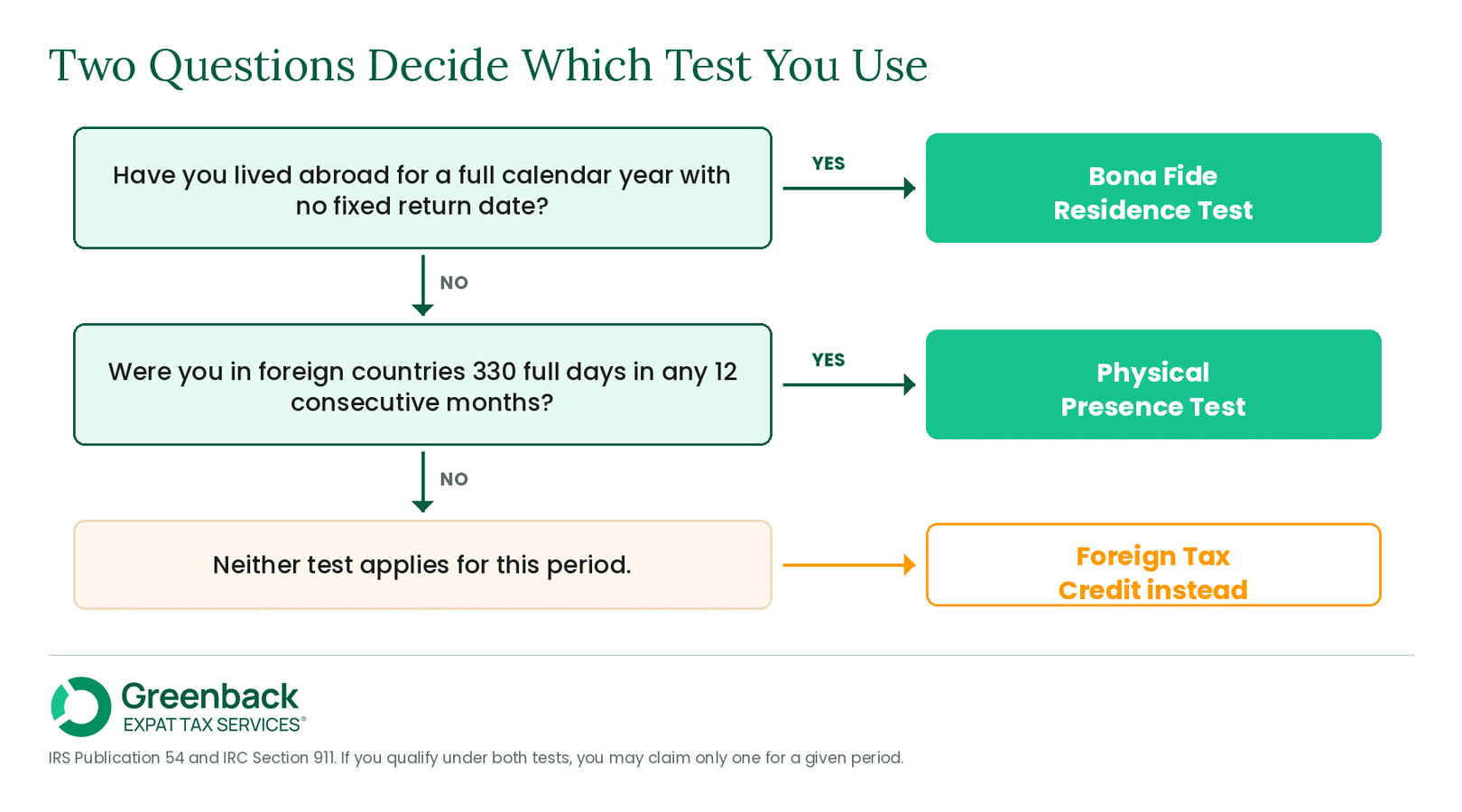
Two questions settle whether you claim the bona fide residence test or the physical presence test. First, have you lived in a foreign country for an uninterrupted period covering a full calendar year, with no date set for your return? If yes, the bona fide residence test is open to you. If no, ask the second question: Were you in foreign countries for 330 full days in any 12 consecutive months? If yes, the physical presence test is open. If neither, the Foreign Tax Credit is the route for that period.
- Bona fide residence usually applies if you have made a permanent move, want to visit the U.S. without tracking days, or are retiring abroad with no return date.
- Physical presence usually applies if you are on a posting with a fixed end date, move between countries, or have not yet completed a full calendar year abroad.
For a full year abroad, either test gives you the full exclusion, so the choice only starts to matter for a part-year.
Can You Switch Between the Tests?
Yes. You choose a test for each tax year, and a year claimed under one does not commit you to it the next. The common pattern is physical presence for a first partial year abroad, then bona fide residence once a full calendar year is behind you. You report which test you used on Form 2555, Part II or Part III.
What If You Qualify for Neither?
There is no partial credit for falling short. If no 12-month window contains 330 full days, and no uninterrupted period covers a full calendar year, you cannot claim the FEIE for that year at all.
Proration is different, and the two are easy to confuse. It applies when you do qualify, but your qualifying period covers only part of a tax year, and the limit scales down: the maximum exclusion is multiplied by your qualifying days in that year and then divided by 365.
If neither test works for a year, the Foreign Tax Credit still does. It gives you a dollar-for-dollar credit against your U.S. tax for income tax you paid abroad, it has no residence or day-count test, and in a high-tax country, it often produces a better result than the exclusion anyway.
Frequently Asked Questions
The bona fide residence test is harder to meet than the physical presence test, because it turns on judgment rather than a day count. You need an uninterrupted period of residence covering a full tax year, 1 January to 31 December, before you can claim it at all. The IRS then weighs your ties to the country, the nature of your work, and whether you paid tax there. Someone who has moved with no return date, signed a lease, and pays local tax has a strong claim.
No, you only need one, and you claim under one for a given period. If you satisfy both, you pick whichever gives you the longer qualifying period, since that determines how much of the exclusion you get in a partial year.
A stopover of under 24 hours while you are in transit between two foreign countries does not count as time present in the U.S., so it does not disturb the rest of your count. It does not add a qualifying day either, because you were not in a foreign country for the full 24 hours. You lose that one day and nothing more.
The IRS can waive the minimum time requirement when adverse conditions force you out of a country, and it publishes the qualifying countries and dates each year. Our guide to the FEIE time requirement waiver covers who it covers and how to claim it.
Get the Residency Test Right the First Time
Choosing the wrong test, or missing a qualifying period by a few days, changes what you owe. Whether you need help deciding which test fits your year, documenting a bona fide claim, or counting days for physical presence, our team has deep expertise in both routes to the exclusion.

Claim the Right Test on This Year’s Return
This article is for informational purposes only. The content does not constitute tax, legal, or financial advice. Tax rules and regulations change frequently, and your individual circumstances may affect how they apply to you. For personalized guidance, consult a qualified tax professional with expertise in U.S. expat taxes.



Featured In





