Form 8867 Explained: The Due Diligence Checklist That Protects Your Tax Return
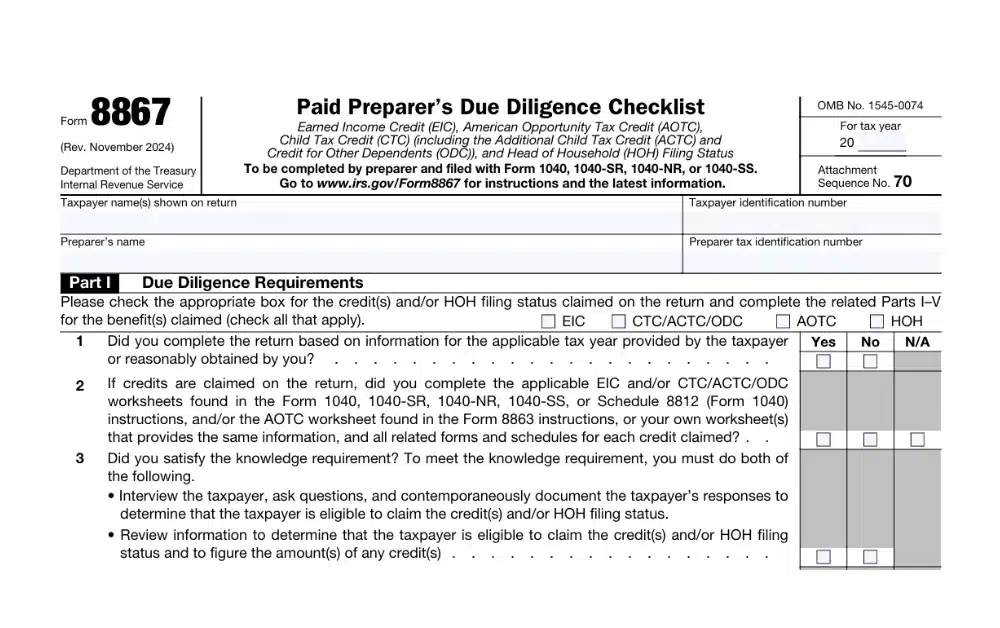


Form 8867 is a due diligence checklist that your paid tax preparer must complete when your return claims any of the following: the Child Tax Credit (CTC) or Additional Child Tax Credit (ACTC), the Earned Income Tax Credit (EITC), the American Opportunity Tax Credit (AOTC), or Head of Household filing status. You don’t fill out Form 8867 yourself. Your preparer files it with the IRS to confirm they verified your eligibility for these credits before claiming them on your return.
According to the IRS, tax preparers who fail to meet due diligence requirements face a penalty of $600 per credit or filing status claimed without proper verification. For taxpayers, this matters because it means your preparer should be asking detailed questions about your children’s residency, ages, SSNs, income, and education expenses before filing. If they’re not, your return may be at risk.
For expats, Form 8867 has a critical implication: if you use the Foreign Earned Income Exclusion (FEIE) to exclude your income, you lose access to the refundable Additional Child Tax Credit. The choice between the FEIE and the Foreign Tax Credit directly affects whether your preparer can claim these credits on your behalf. Here’s what Form 8867 covers, why it matters for expat families, and how to tell if your preparer is meeting their obligations.

Your Return Deserves More Than Just Filing
Here’s why this form matters for your return and what to look for when choosing a tax preparer.
Why Should I Care About a Form My Preparer Fills Out?
Form 8867 exists because the IRS found that many preparers were claiming credits their clients didn’t actually qualify for. The consequences fell on both sides: preparers faced penalties, and taxpayers had to repay credits plus interest when the IRS caught the errors.
For the 2025 tax year (returns filed in 2026), the IRS penalty for each due diligence failure is $650 per credit or status. A preparer who fails to verify all four credits and HOH status on a single return faces up to $2,600 in penalties. But the preparer penalty is only half the story. If the IRS later disallows a credit on your return, you’re the one who has to:
- Repay the full credit amount plus interest
- File Form 8862 to recertify eligibility before claiming the credit again
- Potentially face a two-year ban from claiming that credit (or ten years if the IRS determines fraud)
A properly completed Form 8867 means your preparer has done the work to verify you truly qualify, reducing the risk that any of this happens to you.
What Does My Preparer Have to Do?
Under IRC Section 6695(g) and Treasury Regulation 1.6695-2, paid preparers must meet four specific requirements for each covered credit or filing status:
| Requirement | What It Means for You |
|---|---|
| Complete Form 8867 | Your preparer answers specific eligibility questions for each credit you’re claiming, based on information you provide |
| Complete the credit worksheets | Your preparer calculates the correct credit amounts using IRS worksheets (EIC worksheet, Schedule 8812, Form 8863) |
| Apply the knowledge requirement | Your preparer cannot ignore information that seems inconsistent or incorrect; they must ask follow-up questions |
| Retain records for three years | Your preparer keeps copies of Form 8867, supporting documents, and notes from your interview |
The knowledge requirement is particularly important. If something on your return looks unusual, for example, claiming three qualifying children when you’re 25 years old, or reporting $20,000 in self-employment income with zero business expenses, your preparer is required to ask additional questions. A preparer who doesn’t ask follow-up questions in those situations is not meeting due diligence requirements.
Which Credits Matter Most for Expats?
Not all Form 8867 credits apply equally to Americans living abroad. Here’s how each one typically affects expats:
| Credit | 2025 Amount | Expat Eligibility | Key Restriction |
|---|---|---|---|
| Child Tax Credit | Up to $2,200/child | Available to most expat parents | Child must have SSN; taxpayer (or spouse if MFJ) must also have SSN (new OBBBA rule) |
| Additional Child Tax Credit (refundable) | Up to $1,700/child | Not available if you file Form 2555 (FEIE) | Must use Foreign Tax Credit instead of FEIE to claim this |
| Credit for Other Dependents | $500/dependent | Available for dependents who don’t qualify for CTC | Non-refundable; reduces tax owed but won’t generate a refund |
| EITC | Up to $8,046 | Rarely available to full-time expats | Must live in the U.S. for more than half the year; cannot file Form 2555 |
| AOTC | Up to $2,500/student | Available if paying U.S. qualified education expenses | Student must be enrolled at least half-time at eligible institution |
The FEIE-ACTC conflict is the most important thing expats need to know here. If you use the Foreign Earned Income Exclusion (Form 2555) to exclude your foreign income, you cannot claim the refundable Additional Child Tax Credit. For families with children, this means the choice between FEIE and the Foreign Tax Credit is not just about which saves more on income tax. It’s about whether you can access up to $1,700 per child in refundable credits.
For a detailed comparison, see our guide on choosing between the FEIE and FTC.
How Do I Know If My Preparer Is Doing This Right?
You’ll never see Form 8867 in your tax documents (it’s filed with the IRS, not given to you). But you can spot whether your preparer is meeting due diligence requirements based on their process.
Signs your preparer is doing it right:
- Asks detailed questions about your children’s residency, ages, and Social Security numbers
- Requests supporting documents (birth certificates, school records, proof of residency)
- Explains which credits you qualify for and why
- Discusses whether FEIE or FTC is better for your family’s situation
- Takes time to verify your circumstances rather than rushing through
Warning signs your preparer is cutting corners:
- Promises a specific refund amount before reviewing your situation
- Doesn’t ask about your children’s living arrangements or SSN status
- Claims credits without requesting supporting documents
- Can’t explain why you qualify (or don’t qualify) for a specific credit
- Doesn’t discuss the FEIE/ACTC trade-off if you have children
What Changed for the 2025 Tax Year?
The One Big Beautiful Bill Act (OBBBA), signed into law in July 2025, made several changes that affect Form 8867 due diligence:
| Change | Impact on Your Return |
|---|---|
| CTC increased to $2,200 per child (from $2,000) | Higher potential credit; now indexed for inflation going forward |
| Taxpayer SSN requirement | You (or your spouse if filing jointly) must now have a valid SSN to claim CTC/ACTC, not just the child |
| TCJA provisions made permanent | $200,000/$400,000 phase-out thresholds, $500 ODC, and $2,500 earned income floor for ACTC are now permanent |
| Due diligence penalty: $650/failure | Up from $635 (returns filed in 2025); reflects inflation adjustment for returns filed in 2026 |
The new SSN requirement is especially relevant for expat families with non-citizen spouses. If you’re married filing jointly, at least one spouse must have a valid Social Security number (not an ITIN) to claim the CTC or ACTC. Your preparer should verify this as part of their Form 8867 due diligence.
Why Professional Preparation Matters for Expats
Expat tax situations add layers of complexity to the credits covered by Form 8867. Your preparer needs to coordinate these credits with expat-specific forms and strategies:
- Form 2555 (FEIE) vs. Form 1116 (FTC): The choice between these directly determines whether you can claim the refundable ACTC
- Physical presence and bona fide residence tests: These affect both your FEIE eligibility and potentially your HOH filing status
- Foreign-issued documents: Birth certificates, school records, and residency proofs from other countries may need additional verification
- Multi-country situations: Digital nomads and families who moved during the year may have split residency that affects credit eligibility
At Greenback, our CPAs and Enrolled Agents handle these interactions every day. When we complete Form 8867 for your return, we’ve already analyzed whether the FEIE or FTC produces the better result for your family, verified that your children meet all qualifying tests, and confirmed that every credit is properly coordinated with your expat tax strategy.
No matter how late, messy, or complex your return may be, we can help. Contact us, and one of our Customer Champions will gladly help. If you need specific advice on your tax situation, you can also get a consultation with one of our expat tax experts.

Let an Expert CPA Handle the Compliance Checklist
This article is for informational purposes only and does not constitute tax advice. Credit eligibility rules are complex and subject to change. For guidance on your specific situation, contact Greenback to speak with an expat tax specialist.
Related Resources
- Child Tax Credit for Expats
- Credit for Other Dependents
- Can Expats Claim the Earned Income Tax Credit?
- Foreign Earned Income Exclusion
- Foreign Tax Credit Guide for U.S. Expats
- Choosing Between the FEIE and FTC
- Form 2555: Filing for the FEIE
- Form 1116: Foreign Tax Credit Form
- U.S. Expat Tax Deductions and Credits
- U.S. Expat Taxes: The Complete Guide