IRS Form 8993: Who It’s For, How It Works & Filing Instructions

- What Is Form 8993 Used For?
- Who Has to File Form 8993?
- How Do You Fill Out Form 8993, Part by Part?
- How Does the Taxable Income Limit Work on Form 8993?
- Where Does the Form 8993 Total Go?
- When Is Form 8993 Due?
- Where Can You Get the Form 8993 PDF and Instructions?
- Frequently Asked Questions about Form 8993
- The Taxable Income Limit Decides How Much of the Deduction You Keep


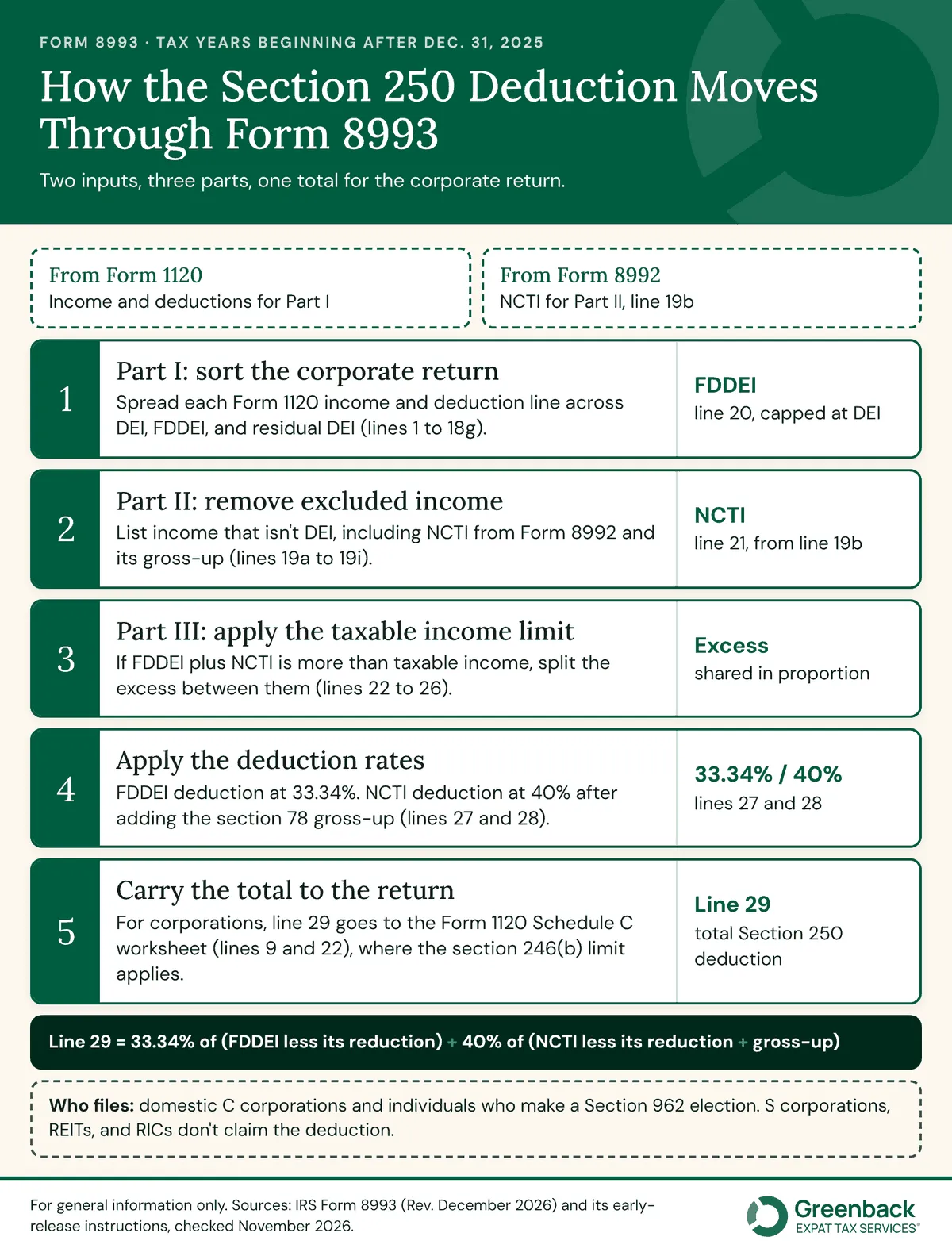
IRS Form 8993 is the tax form used to calculate the Section 250 deduction, which lowers U.S. tax on certain foreign-related income. Form 8993 covers foreign-derived deduction eligible income (FDDEI) and net CFC tested income (NCTI) for tax years beginning after December 31, 2025. FDDEI replaced foreign-derived intangible income (FDII), and NCTI replaced global intangible low-taxed income (GILTI). The deduction is generally 33.34% of FDDEI and 40% of NCTI plus its Section 78 gross-up. The Section 250 deduction on Form 8993 is limited by taxable income.
Domestic C corporations file Form 8993 to claim the Section 250 deduction. Individuals file Form 8993 only if they make a Section 962 election. S corporations, REITs, and RICs can’t claim the Section 250 deduction. The Rev. December 2026 Form 8993 has three parts: Part I sorts income, Part II removes income that doesn’t qualify, and Part III calculates the deduction. Form 8993, line 29, shows the total Section 250 deduction, which a corporation carries to Form 1120.
What Is Form 8993 Used For?
Form 8993 is used to work out a single Section 250 deduction amount, on line 29, from the income and deductions on your return. Its full title is “Section 250 Deduction for Foreign-Derived Deduction Eligible Income (FDDEI) and Net CFC Tested Income (NCTI).”
The Rev. December 2026 Form Uses FDDEI and NCTI
The Rev. December 2026 Form 8993 drops the deemed intangible income calculation. Under Public Law 119-21, FDDEI is calculated without deemed intangible income, the deemed tangible income return, or qualified business asset investment, and interest expense and research or experimental expenditures are no longer allocated to qualifying income. Part II also adds two exclusions for income and gain from the sale of intangible property and certain depreciable, amortizable, or depletable property, for sales after June 16, 2025.
The form is final for tax years beginning after December 31, 2025. The IRS has posted the matching instructions as an early release.
Earlier Returns Use the FDII and GILTI Version
Returns for tax years that began before 2026 use the earlier Form 8993, which calculated the deduction for foreign-derived intangible income (FDII) and global intangible low-taxed income (GILTI). That is the version people still search for as the “FDII form” or the “GILTI form.” For those years, our guide to GILTI explains the old calculation and rates.

Own a Company With Foreign Sales or a CFC?
Who Has to File Form 8993?
Form 8993 is filed by domestic corporations and by individuals who make a Section 962 election, when either one claims the Section 250 deduction. The IRS instructions require everyone who claims the deduction to use the form.
1. Domestic C Corporations
A U.S. C corporation files Form 8993 when it has FDDEI from selling goods or services to foreign customers, or an NCTI inclusion from a controlled foreign corporation (CFC) it owns. The form is attached to Form 1120.
2. Individuals Who Make a Section 962 Election
An individual U.S. shareholder can use Form 8993 only after making a Section 962 election, which taxes the NCTI inclusion as if the individual were a corporation. Without the election, an individual doesn’t claim the Section 250 deduction. Whether the election helps depends on your rates and the foreign tax your company paid, which our Section 962 election guide walks through.
S Corporations, REITs, and RICs Don’t File
S corporations, real estate investment trusts, and regulated investment companies can’t claim the Section 250 deduction. Partnerships don’t claim it either. A partnership reports the information on Schedule K-3, and a corporate partner uses those figures on its own Form 8993. If you are weighing entity types, our FAQ on S corps, C corps, and LLCs for expat business owners compares them.
How Do You Fill Out Form 8993, Part by Part?
The Form 8993 instructions build the deduction in three parts: Part I sorts the income on your corporate return, Part II lists income that doesn’t count, and Part III applies the percentages and the taxable income limit.
1. Part I Sorts Your Income Into DEI and FDDEI
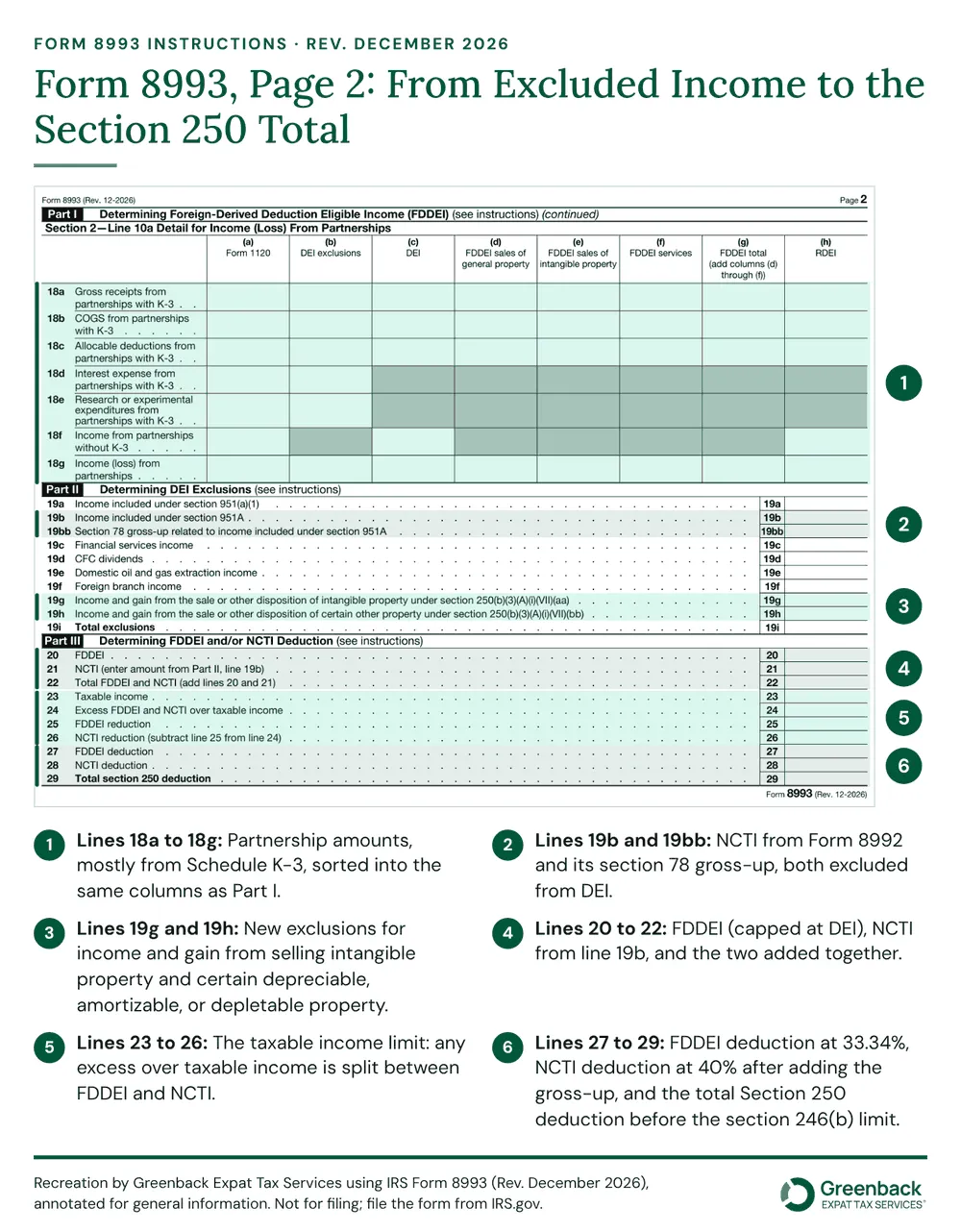
Part I, Section 1 (lines 1 to 17) takes each income and deduction line from Form 1120 and spreads it across columns (a) to (h): the amount on Form 1120, amounts excluded from deduction eligible income (DEI), DEI, the foreign-derived portion (FDDEI), and the rest (RDEI). Line 17 shows taxable income before the net operating loss and Section 250 deductions.
Interest expense (line 12) and research or experimental expenditures (line 13) are entered only in columns (a) and (b), because they are no longer allocated to DEI or FDDEI. Section 2 (lines 18a to 18g) includes the corporation’s share of partnership amounts, primarily from Schedule K-3. Our FDDEI guide explains which sales count as foreign-derived.
2. Part II Lists Income That Doesn’t Count as DEI
Part II (lines 19a to 19i) lists the income excluded from DEI. The lines are:
- 19a: Subpart F and other section 951(a)(1) inclusions
- 19b: NCTI, taken from Form 8992
- 19bb: the section 78 gross-up on NCTI
- 19c to 19f: financial services income, CFC dividends, domestic oil and gas extraction income, and foreign branch income
- 19g and 19h: income and gain from selling intangible property and certain depreciable, amortizable, or depletable property after June 16, 2025
- 19i: total exclusions
3. Part III Calculates the Deduction
Part III (lines 20 to 29) turns FDDEI and NCTI into the deduction. Line 20 is FDDEI, capped so it can’t exceed DEI. Line 21 is NCTI from line 19b, and line 22 adds the two. Lines 23 to 26 apply the taxable income limit. Line 27 is the FDDEI deduction at 33.34%, line 28 is the NCTI deduction at 40% after adding the gross-up, and line 29 is the total.
How Does the Taxable Income Limit Work on Form 8993?
If FDDEI plus NCTI is more than your taxable income, Form 8993 reduces the deduction. Line 23 is taxable income figured without the Section 250 deduction. Line 24 is the amount by which line 22 exceeds it, and lines 25 and 26 split that excess between FDDEI and NCTI in proportion to each.
Example: A Corporation With FDDEI and NCTI
A U.S. C corporation has $200,000 of FDDEI on line 20, $100,000 of NCTI on line 21, and a $10,000 section 78 gross-up on line 19bb. Line 22 is $300,000.
With $500,000 of taxable income on line 23, the limit doesn’t apply, and line 24 is -0-. The FDDEI deduction on line 27 is $66,680 (33.34% of $200,000), and the NCTI deduction on line 28 is $44,000 (40% of $110,000). Line 29 is $110,680.
With $250,000 of taxable income on line 23, the corporation has $50,000 of excess on line 24. Because FDDEI is two-thirds of the $300,000 total, $33,333 of that excess reduces FDDEI on line 25, and the remaining $16,667 reduces NCTI on line 26. The FDDEI deduction on line 27 drops to $55,567 (33.34% of $166,667), and the NCTI deduction on line 28 drops to $37,333 (40% of $93,333). The total on line 29 is $92,900, which is $17,780 less than the first case.
Where Does the Form 8993 Total Go?
A corporation carries Form 8993, line 29, to Form 1120 through the Worksheet for Schedule C, lines 9 and 22, in the Form 1120 instructions. That worksheet applies the Section 246(b) limit, so the deduction you claim can be lower than line 29. An individual who made the Section 962 election follows the steps in our Section 962 election guide.
When Is Form 8993 Due?
Form 8993 is due with your income tax return by the return’s due date, including extensions. You attach it to the return that claims the deduction. If you find a mistake later, you file a corrected Form 8993 with an amended return and write “Corrected” at the top.
Where Can You Get the Form 8993 PDF and Instructions?
The Form 8993 PDF and its instructions are on the IRS website at IRS.gov/Form8993. The Rev. December 2026 form is final, and the matching instructions are an early release, so check IRS.gov/Form8993 for the final instructions before you file. For earlier years, the earlier instructions on IRS.gov cover the FDII and GILTI version.
Frequently Asked Questions about Form 8993
Usually, no. Form 8993 is filed by domestic C corporations and by individuals who make a Section 962 election. An individual who owns a controlled foreign corporation directly and doesn’t make the election doesn’t claim the Section 250 deduction, so there is no Form 8993 to file.
Yes. Form 8993 was known as the FDII form and the GILTI form because it calculated the Section 250 deduction for foreign-derived intangible income and global intangible low-taxed income. For tax years beginning after December 31, 2025, Form 8993 covers FDDEI and NCTI instead.
Not for FDDEI. If taxable income on Form 8993, line 23, is zero or less, the full amount of FDDEI and NCTI is treated as excess on line 24, so the FDDEI deduction on line 27 is zero. Line 28 can still show 40% of any Section 78 gross-up related to NCTI, because the form adds the gross-up after the reduction. Line 29 is figured before the Section 246(b) limit, which can lower the deduction claimed on Form 1120.
Yes, if you have NCTI. Form 8992 calculates the NCTI inclusion; that amount goes on Form 8993, line 19b, and then on line 21. A corporation with FDDEI and no NCTI completes Form 8993 without Form 8992.
The Taxable Income Limit Decides How Much of the Deduction You Keep
Form 8993 turns FDDEI and NCTI into one deduction, and the taxable income limit on lines 23 to 26 decides how much of it survives. A year with lower profits can shrink the deduction even when foreign sales and NCTI stay the same, so it is worth running the limit with your expected taxable income before you file.
Greenback’s accountants prepare Form 8993 alongside Form 8992, Form 5471, and the corporate return, as part of our additional expat tax services. If you’re an American who owns a business abroad, we can help with the U.S. forms your company adds to your return. Learn more about how we help foreign business owners.

File Form 8993 With Confidence.
This article is for general information only and is based on Form 8993 (Rev. December 2026) and the early-release instructions for that revision. The Section 250 deduction depends on your entity type, income, and elections, so speak with a tax professional about your situation. Greenback’s expat tax accountants can review your business filings.



Featured In




