NCTI Tax: How Net CFC Tested Income Works for U.S. Shareholders



- What Is Net CFC Tested Income (NCTI)?
- Who Has to Include NCTI in Income?
- When Did NCTI Replace GILTI?
- How Is NCTI Different From GILTI?
- How Is NCTI Calculated?
- What Is the NCTI Tax Rate?
- How Do You Report NCTI on Your Return?
- Frequently Asked Questions about NCTI
- Individual Owners Pay NCTI at Their Own Rates Unless They Elect
Net CFC tested income (NCTI) is the share of a foreign company’s profits that a U.S. shareholder must include in U.S. income each year. Any U.S. person who owns 10% or more of a controlled foreign corporation (CFC) includes their share of its tested income, even if the profits stay in the company. GILTI (global intangible low-taxed income) became NCTI for a U.S. shareholder’s tax years beginning after December 31, 2025. Form 8992 is where NCTI is calculated and filed with Form 5471.
The NCTI tax rate depends on who owns the company. U.S. corporations pay an effective 12.6% on NCTI: the 21% corporate rate after a 40% deduction, before foreign tax credits. Corporations also get a credit for 90% of the foreign taxes tied to the company’s profits. Individuals who make the Section 962 election get the same 40% deduction and 90% credit. Individuals without the election pay their regular income tax rates on NCTI, up to 37% for 2026, with neither benefit. This article explains who includes NCTI, how it is calculated, which rate applies, and how to report it.
What Is Net CFC Tested Income (NCTI)?
NCTI stands for net CFC tested income, and CFC stands for controlled foreign corporation. It is the amount a U.S. shareholder includes in income under Section 951A of the tax code: their share of a CFC’s tested income, minus their share of any tested losses. The One Big Beautiful Bill Act (OBBBA, sometimes called OB3) gave it this name in 2025.
NCTI Taxes Profits That Stay in the Company
The rule exists so that profits held inside a foreign company don’t sit outside the U.S. tax system indefinitely. You include your share of NCTI in the year the company earns it, whether or not the company pays you a dividend.

Own a Foreign Company? Get NCTI Right From the Start
Who Has to Include NCTI in Income?
You include NCTI if you are a U.S. shareholder of a controlled foreign corporation. That takes two tests: your own ownership and the U.S. ownership of the company as a whole. Individual owners are covered the same way as corporations, and Americans abroad include NCTI the same way as owners living in the U.S.
1. You Own 10% or More of the Company
You are a U.S. shareholder if you are a U.S. person who owns at least 10% of a foreign company’s voting power or value. That includes owning shares personally, so an individual owner reports NCTI on their own return. Americans who start a business overseas and own 10% or more of the local company are U.S. shareholders of it. Our FAQ on whether owning a foreign corporation automatically means GILTI or NCTI applies walks through the ownership tests.
2. U.S. Shareholders Together Own More Than 50%
The company is a CFC if its U.S. shareholders, each owning 10% or more, together own more than 50% of its voting power or value. The controlled foreign corporation guide explains how both tests are applied.
Family Members’ Shares Can Count Toward 10%
Ownership is measured with attribution rules, so shares held by your spouse, children, grandchildren, and parents can count as yours. Siblings’ shares don’t count under these family rules.
When Did NCTI Replace GILTI?
GILTI is now called net CFC tested income (NCTI) for a U.S. shareholder’s tax years beginning after December 31, 2025. For an individual filing on a calendar year, your 2026 tax return, filed in 2027, is the first NCTI year. Your 2025 and earlier returns, including any late or amended ones, still use the GILTI rules.
Treasury Reads the Date by the Shareholder’s Tax Year
The law says the new rules apply to “taxable years beginning after December 31, 2025.” In proposed regulations published in the Federal Register in August 2026, Treasury and the IRS read this as the U.S. shareholder’s tax year. Under those proposed rules, a shareholder whose tax year begins before 2026 continues to use GILTI for a foreign company year that begins after 2025 and ends within that shareholder’s tax year. This mostly affects shareholders that don’t file on a calendar year, such as some corporations.
How Is NCTI Different From GILTI?
NCTI is calculated in the same basic way as GILTI, but several of the numbers have changed. The 10% return on a company’s tangible assets no longer comes off the inclusion; the Section 250 deduction drops from 50% to 40%; and the foreign tax credit rises from 80% to 90% of the foreign taxes attributable to tested income. The deduction and the credit still reach only corporations and Section 962 electors.
The Changes Side by Side
| Feature | GILTI (2025 and earlier) | NCTI (2026 and later) |
|---|---|---|
| Return on tangible assets (QBAI) | A 10% return on qualified assets, less certain interest, came off the inclusion | Eliminated |
| Section 250 deduction* | 50% of the inclusion | 40% of the inclusion |
| Effective federal rate, before foreign tax credits* | 10.5% | 12.6% |
| Foreign tax credit (deemed paid)* | 80% of foreign taxes on tested income | 90% of foreign taxes on tested income |
| Rough foreign tax rate where U.S. tax is fully offset* | About 13.125% | About 14% |
| Expenses allocated to this income for the credit limit | Including interest and research costs | Only directly allocable expenses; no interest or research costs |
| High-tax exclusion | Available by election | Kept in the law; no NCTI-specific IRS guidance yet |
*Applies to corporations and individuals who make the Section 962 election. The full-offset rate assumes the foreign tax credit limit doesn’t reduce the credit.
How Is NCTI Calculated?
NCTI is calculated by adding your share of tested income from each CFC, then subtracting your share of tested losses from any CFC that lost money. Tested income is broadly the company’s net profit after allowable deductions, with certain kinds of income carved out because other rules already tax them or exclude them.
1. Find Each Company’s Tested Income or Loss
Start with the company’s gross income, then remove the items the law excludes from tested income:
- Income effectively connected with a U.S. business: Taxed separately in the U.S.
- Subpart F income: Taxed under its own rules. Our FAQ on how GILTI and Subpart F income differ explains the split.
- High-taxed income: Income excluded because it was taxed at a high rate abroad, under Section 954(b)(4). The NCTI tax rate section covers the election.
- Dividends from related companies: Dividends received from a related person.
- Foreign oil and gas extraction income: Covered by separate rules.
Subtract the deductions that belong to the remaining income. A positive result is tested income; a negative result is a tested loss.
2. Apply Your Ownership Share
You take your pro rata share of each company’s tested income or loss, which generally follows your share of the company’s stock. The 2025 law also changed how that share is calculated when ownership changes during the year, and proposed regulations set out the details, effective as of August 2026. The Form 5471 guide covers how the share is reported.
3. Net the Totals
Add up your shares of tested income, subtract your shares of tested losses, and the result, if positive, is your NCTI for the year.
An Example With a Profitable Company and a Loss
You own 100% of Company A, which has $300,000 of tested income, and 100% of Company B, which has a $100,000 tested loss.
| Step | Amount |
|---|---|
| Company A tested income | $300,000 |
| Company B tested loss | ($100,000) |
| NCTI | $200,000 |
The loss from Company B reduces what you include from Company A in the same year. Now suppose Company A holds equipment with an average adjusted basis of $500,000. For a 2025 return, a 10% return on that equipment ($50,000), less certain interest expense, would have come off the inclusion, leaving at least $150,000. For 2026, the equipment doesn’t change the result, and all $200,000 is included.
What Is the NCTI Tax Rate?
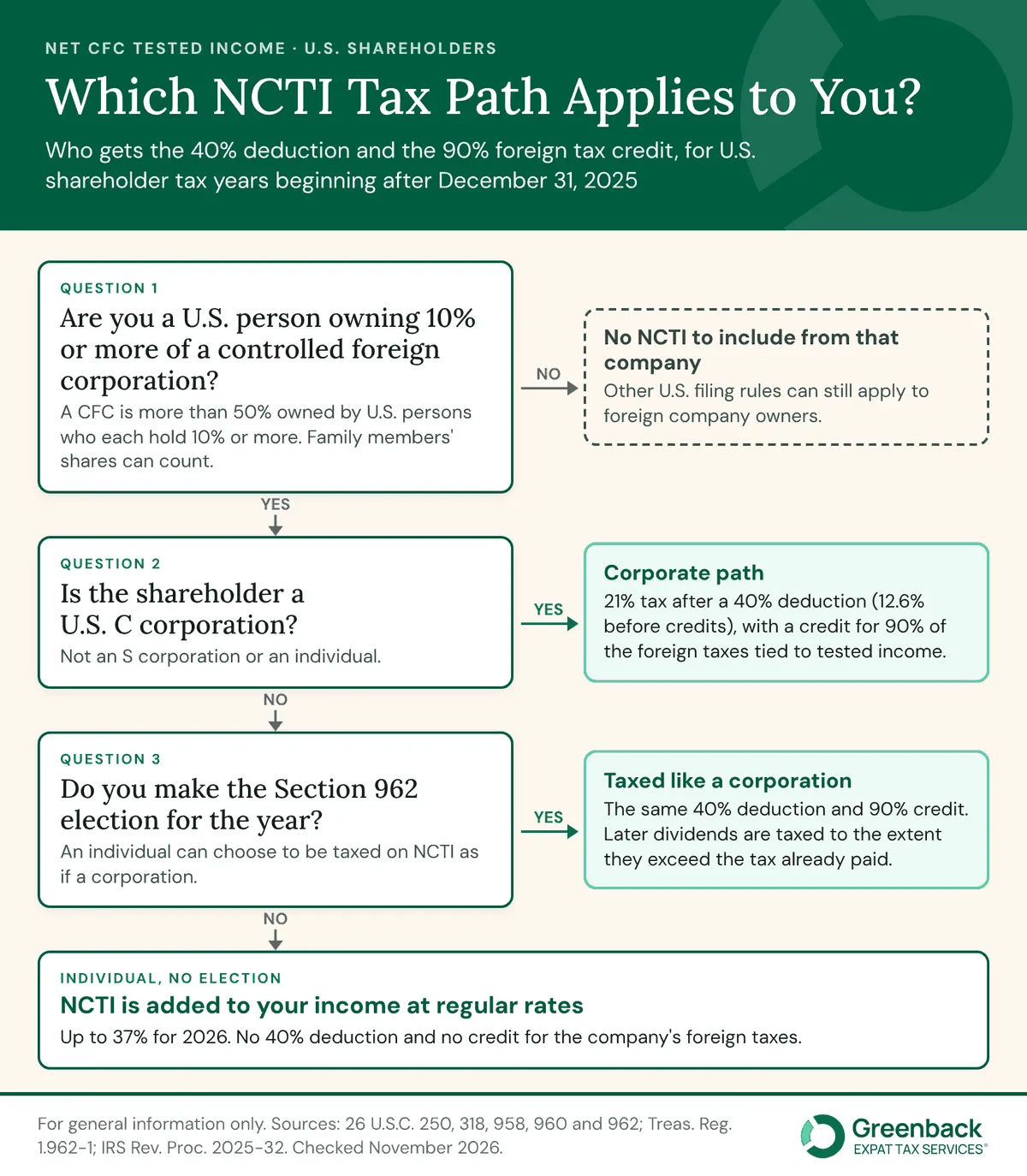
The widely quoted 12.6% NCTI rate is a corporate figure. It comes from the 40% deduction in Section 250 of the tax code, as amended by OB3, and the 21% corporate rate. Which rate you pay depends on whether a corporation owns the shares and, for individuals, whether you make the Section 962 election. The decision chart shows which path applies to you.
1. U.S. Corporations Pay 12.6% Before Credits
A U.S. C corporation that owns 10% or more of a CFC takes a 40% deduction on its NCTI and pays the 21% corporate rate on the remainder, for an effective rate of 12.6%. It can also claim a 90% foreign tax credit for the foreign taxes tied to the company’s tested income. A U.S. corporation can also take a separate 33.34% deduction for foreign-derived deduction eligible income (FDDEI), its income from sales and services to customers abroad.
2. Section 962 Electors Get the Corporate Treatment
A Section 962 election allows an individual to be taxed on NCTI as if they were a domestic corporation, which applies the 40% deduction and the 90% foreign tax credit. The Section 962 election guide compares the two paths using an example.
3. Individuals Without the Election Pay Regular Rates
If you hold the shares personally and don’t elect, NCTI is taxed at your regular rates, up to 37% for 2026, under the brackets in IRS Revenue Procedure 2025-32. The 40% deduction and the 90% foreign tax credit don’t apply, so foreign corporate tax the company pays doesn’t reduce your U.S. tax on NCTI.
The High-Tax Exclusion Under NCTI
Income taxed abroad at a high enough rate can be left out of tested income by election. The law still contains this exclusion for NCTI, but the IRS hasn’t yet issued guidance on how the election applies under NCTI. The GILTI high-tax exception guide covers how the election applies under GILTI and what remains open.
How Do You Report NCTI on Your Return?
You report NCTI on Form 8992 and attach it to your tax return, along with Form 5471 for each CFC. Individuals without the election carry the result to Schedule 1 of Form 1040, and owners making the Section 962 election add the forms that claim the deduction and the credit. The IRS instructions for the 2026 Form 8992 are still in draft.
1. File Form 5471 for Each CFC
Form 5471 reports each company’s income, ownership, and tested income or loss. It is the starting point for the NCTI figures. The foreign business tax reporting guide lists the other returns a foreign company owner may need to file.
2. Calculate NCTI on Form 8992
Form 8992 brings together your shares of tested income and tested loss from every CFC you own and arrives at your NCTI for the year.
3. Carry the Result to Your Return
Where the result goes depends on who owns the company and whether you make the election:
| Owner | Forms |
|---|---|
| Individual, no election | The Form 8992 result on Schedule 1, line 8o, according to the draft instructions |
| Individual making the Section 962 election | Form 8993 for the deduction; Form 1118 for the foreign tax credit |
| U.S. corporation | Form 8993 and Form 1118, filed with Form 1120 |
Due Dates for Americans Abroad
If you live and work outside the U.S. on April 15, you get an automatic extension to June 15 to file, but interest runs from April 15 on any tax not paid by then. Form 4868 extends the filing date to October 15.
If Earlier Years Were Missed
Owners who weren’t aware of Form 5471 or GILTI often have catch-up options. Greenback’s Streamlined Filing Compliance Procedures guide explains how they work.
Frequently Asked Questions about NCTI
No. The Foreign Earned Income Exclusion covers pay for personal services, such as wages and self-employment income, and NCTI is a share of a company’s profits. A salary the company pays its owner for work performed is wages, which may qualify for the exclusion on its own terms.
In most cases, yes. Attribution rules treat stock owned by one spouse as owned by the other spouse when determining U.S. shareholder status, unless the spouses are legally separated under a divorce or separate maintenance decree. One exception matters for Americans abroad: stock owned by a spouse who is a nonresident alien is not counted as owned by a U.S. citizen or resident for these tests.
Generally no. Earnings included as NCTI become previously taxed earnings, and a later dividend paid from them is generally not included again. For an individual who made the Section 962 election, the dividend is taxable to the extent it exceeds the U.S. tax already paid on that NCTI.
Individual Owners Pay NCTI at Their Own Rates Unless They Elect
For most people who personally own a foreign company, the NCTI bill is based on their own income tax rate. The 12.6% rate, the 40% deduction, and the 90% credit are corporate benefits that an individual reaches only through the Section 962 election, so the election is the first thing to review with your preparer each year.
If you’re a business owner abroad with a foreign company, Greenback’s accountants can handle NCTI, Form 5471, and the Section 962 analysis with you. Learn more about how we help foreign business owners.

Your NCTI, Prepared by Expat Tax Accountants
This article is for general information about U.S. tax rules for owners of foreign corporations and is not tax advice. The proposed regulations and draft IRS instructions mentioned here may change before they become final. Your situation may differ, so speak with a tax professional with expertise in international tax before acting.



Featured In


