IRS Form 8992: Who It’s For, How It Works & Filing Instructions

- What Is Form 8992?
- Who Has to File Form 8992?
- How Do You Fill Out Form 8992, Line by Line?
- How Do You Complete Form 8992 Schedule A?
- What Is Form 8992 Schedule B?
- Where Does the Form 8992 Total Go on Your Return?
- When Is Form 8992 Due?
- Where Can You Get the Form 8992 PDF and Instructions?
- Frequently Asked Questions about Form 8992
- Line 3 Is the Number That Reaches Your Return


IRS Form 8992 is the form U.S. shareholders of a controlled foreign corporation (CFC) use to calculate the foreign company income they report on their U.S. tax return each year. The Rev. December 2026 version calculates net CFC tested income (NCTI) for tax years beginning after December 31, 2025. Form 8992 was known as the GILTI form until NCTI replaced global intangible low-taxed income (GILTI). NCTI is your share of your CFCs’ tested income, minus your share of their tested losses. You report NCTI whether or not the companies pay anything out.
You file Form 8992 if you are a U.S. shareholder of a CFC, meaning you own 10% or more of its vote or value, and you hold its stock directly or through foreign entities. Most filers attach Schedule A (Form 8992), which lists each company, while consolidated groups attach Schedule B. The Rev. December 2026 Form 8992 has just three lines because the old tangible-asset return is gone. Line 3 is your NCTI inclusion, and individuals report it on Schedule 1 (Form 1040).
What Is Form 8992?
Form 8992 is the IRS form that calculates a U.S. shareholder’s NCTI inclusion, the net tested income from the shareholder’s CFCs, after tested losses, that is added to gross income for the year. The current version, titled “Calculation of Net Controlled Foreign Corporation Tested Income (NCTI),” applies to tax years beginning after December 31, 2025.
The Rev. December 2026 Form Calculates NCTI
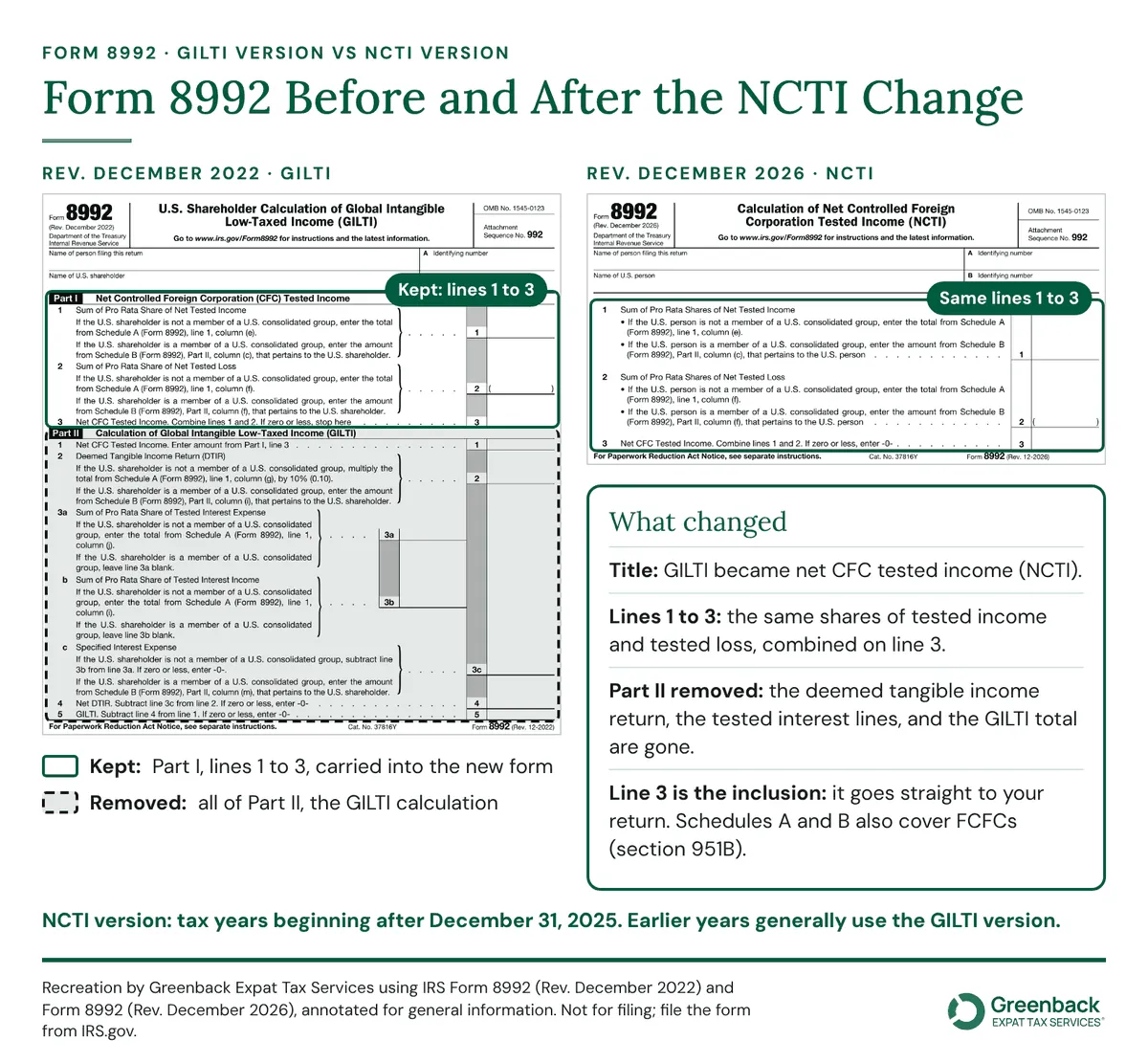
The Rev. December 2026 Form 8992 drops the tangible-asset return the GILTI version subtracted. That deemed 10% return on a company’s tangible assets made up most of Part II of the old form. The Rev. December 2026 form keeps only the first step: add up your shares of tested income and tested loss, and line 3 is the inclusion.
The form was retitled to match, and Schedules A and B now also cover foreign-controlled foreign corporations (FCFCs) under new section 951B. The NCTI guide explains the law change behind it.
Earlier Returns Use the GILTI Version of the Form
Returns for tax years that began before 2026 generally use Form 8992 (Rev. December 2022), titled “U.S. Shareholder Calculation of Global Intangible Low-Taxed Income (GILTI).”
Fiscal-year companies need a closer look: a company year that began in 2025 still follows the GILTI rules, even if it ends during your 2026 tax year. For an earlier year, our guide to the GILTI calculation covers the old form’s Part II.

Own a Foreign Company? Start With Form 8992
Who Has to File Form 8992?
You have to file Form 8992 if you were a U.S. shareholder of at least one CFC during the company’s tax year and owned its stock directly or through foreign entities at any time that year. A U.S. shareholder owns 10% or more of the company’s vote or value. Which schedule is attached depends on the type of filer.
1. U.S. Shareholders Who Own CFC Stock Directly or Indirectly
A CFC is a foreign corporation more than 50% owned, by vote or value, by U.S. shareholders. You count as a U.S. shareholder if you own 10% or more of its voting power or value, including shares attributed to you from family members and related entities. Filing depends on owning the stock directly or through foreign entities (section 958(a)), so ownership attributed to you only under the constructive ownership rules of section 958(b) doesn’t by itself trigger Form 8992. Our FAQ on whether owning a foreign corporation automatically means you owe GILTI or NCTI walks through common cases, and our FAQ on owning less than 10% of a foreign corporation covers smaller stakes.
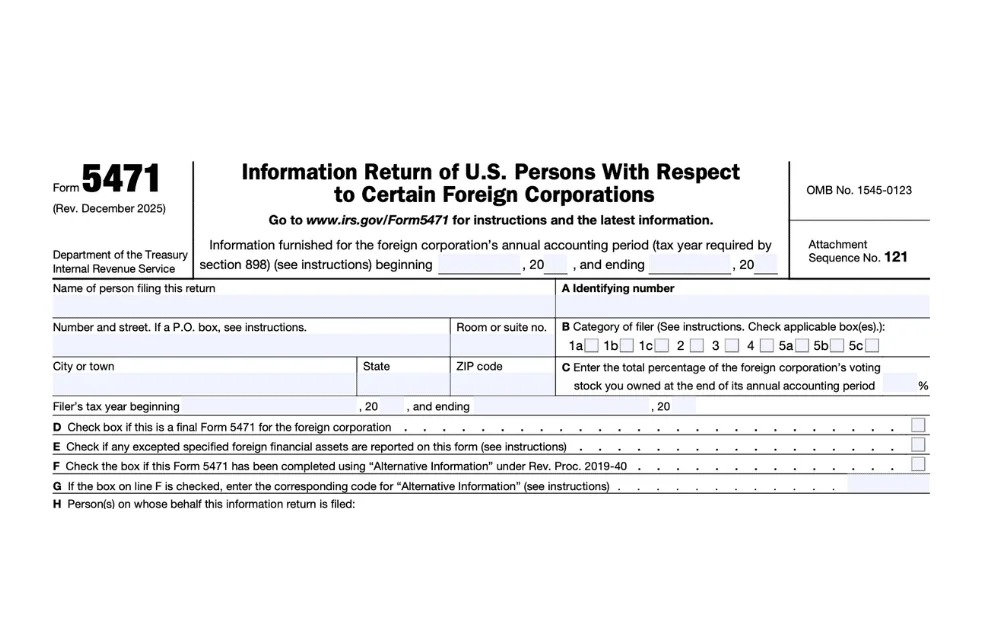
The figures on Form 8992 come from Form 5471, and both forms are part of foreign business tax reporting for Americans who own companies abroad.
2. Shareholders Outside a Consolidated Group Attach Schedule A
If you are a U.S. shareholder that isn’t part of a U.S. consolidated group, including an individual or a stand-alone corporation, you complete Form 8992 and attach Schedule A (Form 8992).
3. Consolidated Groups File One Form With Schedule B
A U.S. consolidated group files a single consolidated Form 8992 with Schedule B (Form 8992) attached to the group’s return. Each member that is a U.S. shareholder still completes its own Form 8992, but those forms aren’t filed.
4. S Corporations With the Entity Election File Form 8992
An S corporation files Form 8992 if it elected under Proposed Regulations section 1.958-1(e) to be treated as owning the CFC stock itself and is a U.S. shareholder of the CFC. It completes Form 8992 and Schedule A and attaches them to Form 1120-S.
5. Partners in a Domestic Partnership Use Schedule K-3 Figures
A U.S. partnership no longer completes Form 8992 or Schedule A. It reports the information on Schedules K-2 and K-3 (Form 1065), Part VI. If you are a partner who is a U.S. shareholder of the partnership’s CFC, you use your Schedule K-3 figures to complete your own Form 8992. If you own a CFC through a foreign partnership, you are treated as owning the stock indirectly and, if you are a U.S. shareholder, file your own Form 8992.
How Do You Fill Out Form 8992, Line by Line?
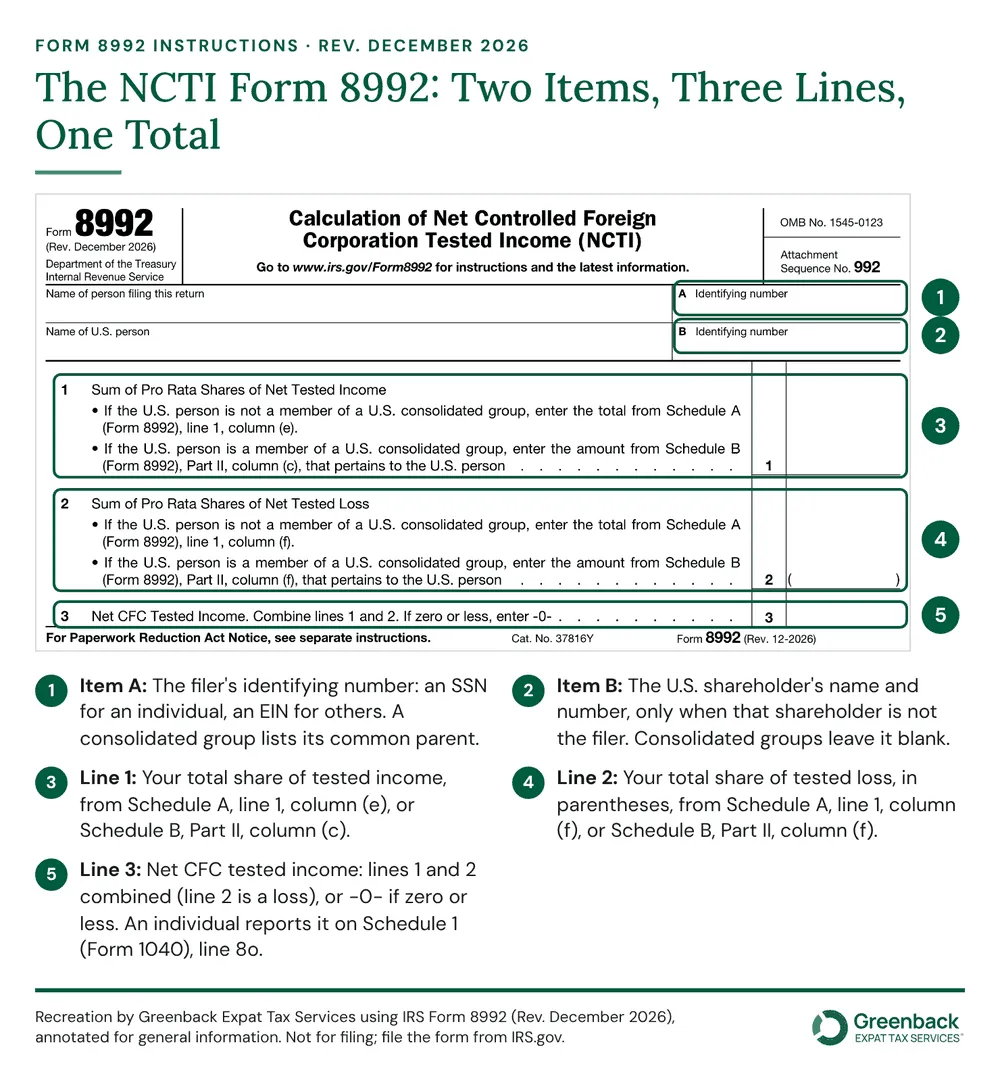
The Form 8992 instructions set an order: complete Schedule A columns (a) through (f) first, then lines 1 through 3, and then Schedule A columns (g) and (h) only if line 3 is more than zero. The form itself has two identifying items and three lines.
1. Items A and B Identify the Filer and the U.S. Shareholder
Item A is the identifying number of the person filing the return: a Social Security number for an individual and an EIN for everyone else. A consolidated group lists its common parent here.
Item B is used only when the U.S. shareholder differs from the filer. Enter that shareholder’s name and identifying number. A consolidated group leaves item B and the shareholder’s name blank.
2. Line 1 Totals Your Shares of Net Tested Income
Line 1 is the total of Schedule A, line 1, column (e), your pro rata shares of tested income from every CFC that had tested income. A member of a consolidated group enters its amount from Schedule B, Part II, column (c).
3. Line 2 Totals Your Shares of Net Tested Loss
Line 2 is the total of Schedule A, line 1, column (f), your shares of tested loss, entered in parentheses. A consolidated group member uses Schedule B, Part II, column (f). Our FAQ on reporting a foreign business that runs at a loss covers the rest of the return.
4. Line 3 Is Your Net CFC Tested Income
Line 3 combines lines 1 and 2. If the result is zero or less, you enter -0-. A positive line 3 is your NCTI inclusion, the amount that moves to your income tax return.
Example: Two CFCs Show How a Tested Loss Lowers Form 8992, Line 3
Say you own 60% of a consulting company in Singapore with $250,000 of tested income, and 100% of a startup in Portugal with a $50,000 tested loss.
- Schedule A, columns (c) and (d): $250,000 of tested income for the Singapore company and a $50,000 tested loss for the Portugal company.
- Schedule A, column (e): your share of the Singapore company’s tested income is $150,000 (60% of $250,000).
- Schedule A, column (f): your share of the Portugal company’s tested loss is $50,000.
- Line 1: $150,000.
- Line 2: ($50,000).
- Line 3: $100,000, your NCTI inclusion.
- Columns (g) and (h): the Singapore company is the only one with tested income, so its allocation ratio is 1.0000 and all $100,000 is allocated to it. The Portugal company gets no allocation.
Without the Portugal company, line 3 would have been $150,000, so the tested loss cut the inclusion by $50,000.
How Do You Complete Form 8992 Schedule A?
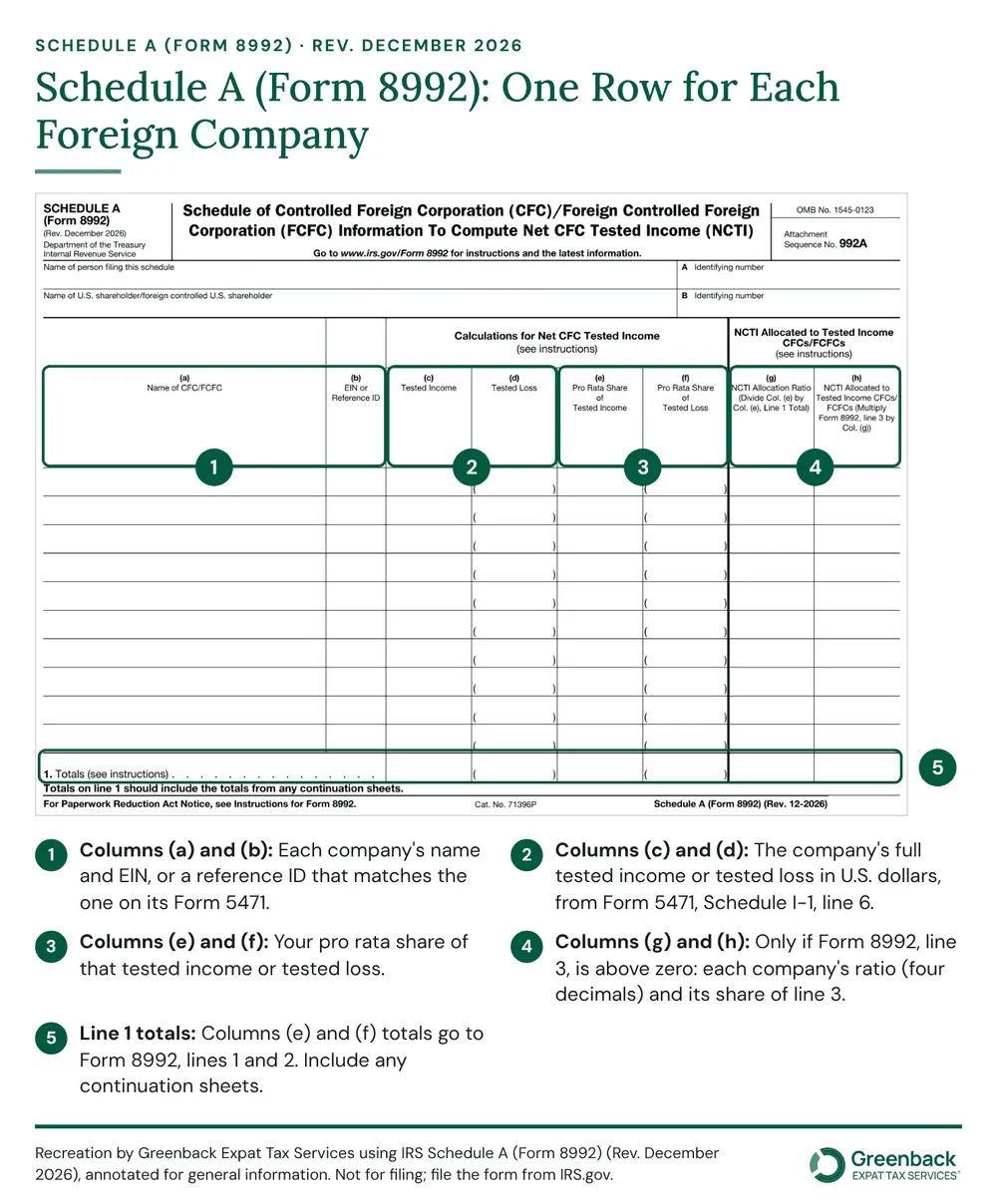
Schedule A (Form 8992) lists each CFC on its own row, with its tested income or loss and your pro rata share, and its totals feed lines 1 and 2 of Form 8992. Columns (a) and (b) identify each CFC, columns (c) through (f) calculate tested income and loss, and columns (g) and (h) allocate line 3 back to each CFC.
Columns (a) and (b) Identify Each CFC
Column (a) is the company’s name, with any prior names from the past three years in parentheses. Column (b) is its EIN, or a reference ID if it has none. The reference ID must match the one used for the same company on Form 5471, item 1b(2).
Columns (c) and (d) Come From Form 5471
Columns (c) and (d) are the company’s full tested income or tested loss in U.S. dollars, taken from line 6 of Schedule I-1 of Form 5471. If you don’t file Schedule I-1 for a company, for example because another owner files it under the multiple-filer exception, you still enter the amounts as if you had.
Columns (e) and (f) Are Your Pro Rata Shares
Column (e) is your pro rata share of the tested income in column (c), and column (f) is your share of the tested loss in column (d). Your share generally follows the stock you own in the company.
Columns (g) and (h) Allocate Line 3 Back to Each CFC
Complete columns (g) and (h) only if Form 8992, line 3, is more than zero. For each company with an amount in column (e), divide that amount by the line 1 total of column (e) and enter the ratio to four decimal places. Column (h) multiplies line 3 by that ratio, in whole dollars. These allocations are used on Form 5471, Schedules J and P, which track each company’s earnings and previously taxed earnings.
If you own more companies than fit on one page, use the continuation sheet and include its totals on line 1 of the first page.
The Pro Rata Share Rules Are Changing
Public Law 119-21 amended section 951(a)(2), which changes how your pro rata share is figured when ownership of a company changes during its tax year. Treasury’s proposed regulations (REG-115646-25), published in the Federal Register, would apply to CFC tax years beginning after 2025, and you may rely on them if you apply them consistently.
What Is Form 8992 Schedule B?
Schedule B (Form 8992) is used only by U.S. consolidated groups. Part I reports each CFC owned by any member, along with the tested income and loss from Form 5471, Schedule I-1, and each member’s pro rata share. Part II calculates each member’s amounts, which become lines 1 and 2 on that member’s Form 8992. Some Part I amounts also go to Form 1118, Schedule D. If you file as an individual, you won’t use Schedule B.
Where Does the Form 8992 Total Go on Your Return?
The Form 8992, line 3 amount is your NCTI inclusion, reported on Schedule 1 (Form 1040), line 8o, for individuals and on Form 1120, Schedule C, line 17, for C corporations. Other filers use the comparable line of their return.
| Filer | Where line 3 goes |
|---|---|
| Individual | Schedule 1 (Form 1040), line 8o |
| C corporation | Form 1120, Schedule C, line 17 |
| S corporation with the entity election | Form 1120-S, Schedule K, line 10, code E |
| Other filers | The comparable line of their return |
Related Forms Can Lower the Tax on the Inclusion
Corporations may claim the Section 250 deduction for their NCTI inclusion on Form 8993. Individuals get the deduction only if they make a Section 962 election, which taxes the inclusion at corporate rates. Individuals who make the election also claim credit for the foreign company’s taxes on Form 1118.
Some Income Never Reaches Form 8992
Tested income excludes Subpart F income, and income taxed at a high enough foreign rate is also left out if the high-tax exception election is made.
When Is Form 8992 Due?
Form 8992 is due with your income tax return, by the return’s due date, including extensions. Attach it, with Schedule A or Schedule B, to the return that reports the line 3 amount.
Americans Abroad Get Until June 15, With Interest From April 15
If, on the regular due date, you are a U.S. citizen or resident living outside the U.S. and Puerto Rico and your main place of business is also outside them, you get an automatic two-month extension to June 15 to file and pay. Interest runs from April 15 on any tax not paid by then, which our FAQ on interest after the June 15 extension explains. You can request more time to October 15 with Form 4868, and the extensions for Americans abroad guide compares the options.
Corrections Go With an Amended Return
If you find a mistake after filing, you file a corrected Form 8992 with an amended return. Write “Corrected” at the top of the form and attach a statement identifying the changes. The instructions note that penalties under sections 6038(b) and (c) may apply when required information isn’t reported. Business owners who have fallen behind on several years of returns can start with our guide to filing late business tax returns.
Where Can You Get the Form 8992 PDF and Instructions?
The Form 8992 PDF, Schedules A and B, and the instructions are on the IRS website at IRS.gov/Form8992. The About Form 8992 page lists the PDF versions used for earlier years. The IRS has posted the Rev. December 2026 version ahead of the final release, so check IRS.gov/Form8992 for the final version before you file.
Frequently Asked Questions about Form 8992
Yes. Form 8992 is required because you are a U.S. shareholder of a CFC, whether or not the company made money. If your shares of tested loss equal or exceed your shares of tested income, line 3 of Form 8992 is -0-, and you skip Schedule A columns (g) and (h).
No. A U.S. shareholder files one Form 8992 for the year. Each CFC goes on its own row of Schedule A (Form 8992), and the Schedule A totals flow to lines 1 and 2 of the single Form 8992. A U.S. consolidated group also files one consolidated Form 8992, with Schedule B.
Yes. The NCTI inclusion on Form 8992 is based on your share of the CFC’s tested income for the year, whether or not the company paid you a dividend, salary, or any other distribution. A U.S. shareholder reports it on Form 8992, even when the company retained all of its profits.
Usually, yes. A U.S. shareholder of a CFC generally files Form 5471 for that company, and the tested income and tested loss on Schedule A (Form 8992) come from Schedule I-1 of Form 5471. A shareholder excused from Schedule I-1 under the multiple-filer exception still enters each company’s amounts on Schedule A (Form 8992).
Line 3 Is the Number That Reaches Your Return
Schedule A lists each company’s Form 5471 figures; lines 1 and 2 of Form 8992 add up your shares, and line 3 is the NCTI inclusion that lands on your return. Most of the work is getting the Form 5471 figures and the pro rata shares right.
Greenback’s accountants prepare Form 5471 and Form 8992 together for Americans who own companies abroad, as part of our additional expat tax services. If you’re an American who owns a business abroad, we can help with the U.S. forms your foreign company adds to your return. Learn more about how we help foreign business owners.

File Form 8992 With Confidence
This article is for general information only and is based on the Rev. December 2026 version of Form 8992 and its instructions. Rules for controlled foreign corporations depend on ownership, entity type, and elections, so speak with a tax professional about your situation. Greenback’s expat tax accountants can review your foreign business filings.

Featured In


