IRIS Taxpayer Portal: How to E-File 1099s With the IRS

- Who Needs to Use the IRIS Taxpayer Portal?
- What Is IRIS, and Which Forms Does It Take?
- Who Can Use IRIS, and What ID Does the IRS Require?
- How Long Does a Transmitter Control Code Take?
- What If No One at Your Business Has an SSN or ITIN?
- How Do You File 1099s Once Your Code Arrives?
- When Are 1099s Due to the IRS and to Recipients?
- Can You Get an Extension on a 1099 Deadline?
- How Do You Fix a Rejected or Incorrect 1099?
- Do You Need IRIS A2A Instead of the Portal?
- Frequently Asked Questions
- The Code Takes 45 Days and the Deadlines Do Not Move

The IRIS Taxpayer Portal is the IRS system for e-filing 1099s and other information returns, and it is provided free of charge by the IRS. Filing through IRIS requires a Transmitter Control Code, a five-character identifier that the IRS takes up to 45 calendar days to issue. The IRS launched IRIS on January 25, 2023, alongside the existing FIRE system. The FIRE system stops accepting information returns at 3 p.m. ET on November 19, 2026, and from January 1, 2027, IRIS is the only electronic route for the returns FIRE carried.
A business needs its own Transmitter Control Code if it files 10 or more information returns per year and sends them directly to the IRS, rather than through a payroll or 1099 service. The 10-return count adds every information return type together. Sole proprietors abroad paying U.S. contractors, owners reporting from a U.S. entity, and employers of household staff all file returns that count toward that total. Tax year 2026 returns are due January 31, 2027, for Form 1099-NEC and March 31, 2027, for most other 1099s. Counting back 45 days puts the application at mid-December for a U.S. address, and early November if the approval letter has to reach a foreign one.
Who Needs to Use the IRIS Taxpayer Portal?
| If this is you | What it means |
|---|---|
| Fewer than 10 information returns a year | The e-file threshold does not reach you. Paper filing is still allowed. |
| A payroll or 1099 service files for you | The service transmits under its own code. You never touch the portal. |
| 10 or more, and you upload the files yourself | You need your own code. This page is for you. |
| You e-file through FIRE today, at any volume | You need an IRIS code as of January 1, 2027 |
| You are filing your own tax return | Does not apply. Start with Form 1040 and Schedule C. |
The Threshold Counts Every Form Type Together
Ten 1099-NECs on their own hit it. So do six 1099-NECs and four W-2s, even though the W-2s themselves go to the Social Security Administration rather than to IRIS. Corrected returns do not count toward the aggregate, but if the original had to be e-filed, the correction does too.
Filing From Abroad Changes Nothing About the Obligation
A U.S. entity owned from overseas has the same duty as one run from Ohio. Your individual tax return is separate and is subject to self-employment tax abroad and taxes for digital nomads.
Four Dates Set the Runway
If you are in that group, four dates decide how much time you have. FIRE stops accepting returns in November 2026, IRIS becomes the only route in January 2027, and the two 1099 filing deadlines fall in January and March 2027.
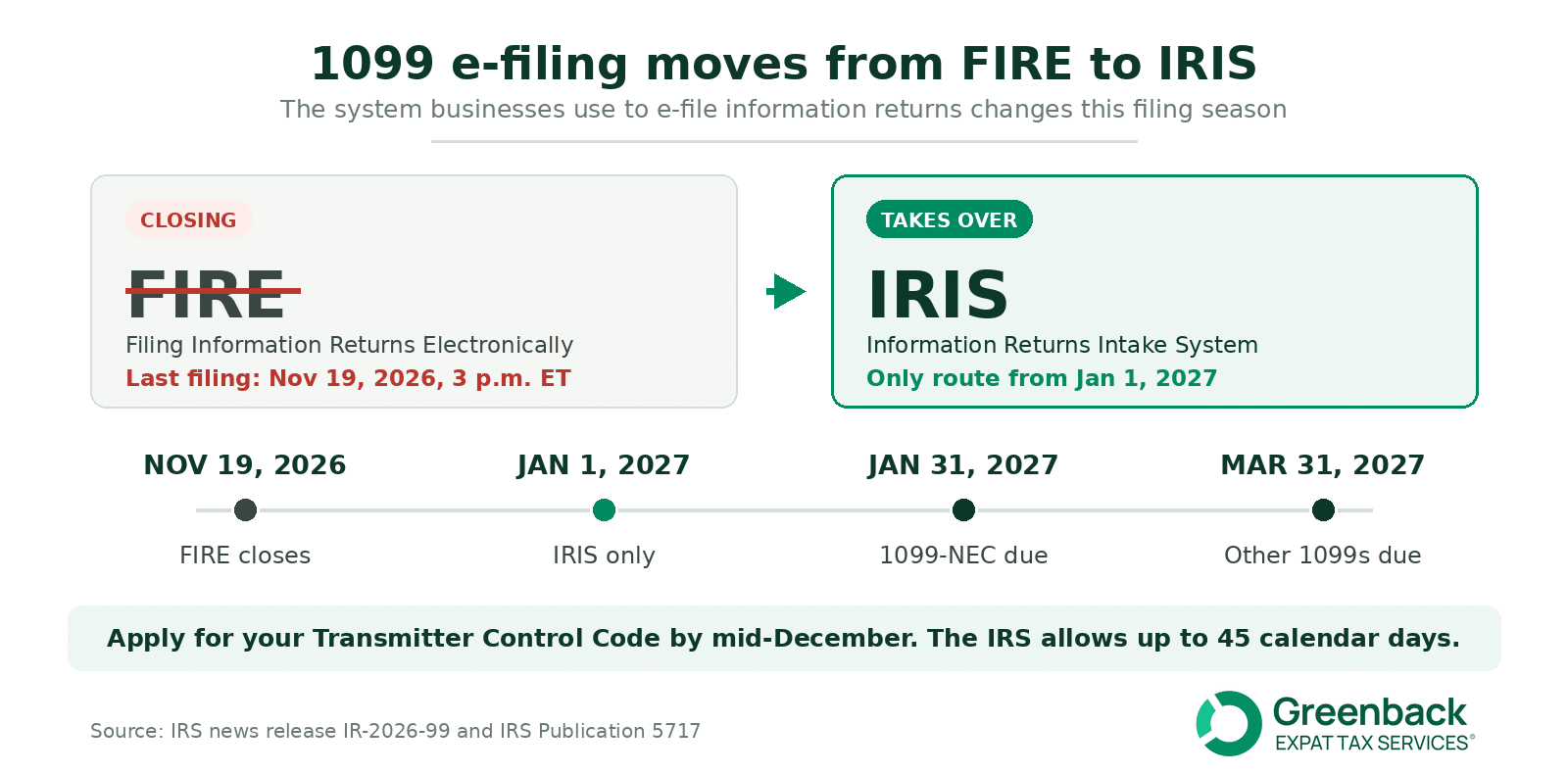
Working backward from those deadlines determines when to apply, as covered in full below. First, what the portal does and which forms it takes.
What Is IRIS, and Which Forms Does It Take?
The IRIS Taxpayer Portal is the IRS’s browser-based system for filing information returns, designed for businesses that send modest volumes of 1099s and do not use third-party software. IRIS has a second channel, A2A, for filers who transmit XML through software. The IRS describes the portal as free and says it requires no special software.
The Portal Takes the 1099, 1098 and 5498 Series, but Not W-2
| Accepted | Not accepted |
|---|---|
| The 1099 series, 1099-A through 1099-SB | Form W-2, which goes to the Social Security Administration |
| The 1098 and 5498 series, Forms 3921, 3922 and W-2G | Employment tax returns |
| Form 1042-S and Form 8809 for automatic extensions | Form 1099-NEC extensions, which are paper only |
Form 1096 belongs on neither list. It is the transmittal that accompanies paper filing, and IRIS does not require it at all.
You Can Prepare, File, Correct and Extend, With Two Exceptions
Beyond filing, the portal handles most corrections, automatic extension requests, and recipient copies. Two things it does not handle: extensions for Form 1099-NEC, and errors in your own issuer name or TIN. Both go by mail.
Who Can Use IRIS, and What ID Does the IRS Require?
Any entity with an Employer Identification Number (EIN) and a physical business address can apply, but the individuals named on the application are subject to a separate requirement. The two requirements are independent.
Your Business Needs an EIN, and You Need an SSN or ITIN
The business applies with an EIN. The IRIS application will not take a Social Security number or an ITIN as the firm’s identifier.
The people on that application are a different matter. The Responsible Official, the Contact, and any Authorized Delegate each need an SSN or an ITIN personally, plus a date of birth. If nobody at your business holds either, two routes are open: the Foreign Filer system or a Form W-7 application for an ITIN.
Issuer and Transmitter Are Different Roles
You pick one. An Issuer files only for its own business, and its EIN has to match the EIN on the application. A Transmitter files for its own business and for others, under a single code. Either way, the code is called a Transmitter Control Code. Issuers need one, too, and the name does not mean you must register as a Transmitter.
How Long Does a Transmitter Control Code Take?
A Transmitter Control Code, or TCC, is the five-character identifier the IRS attaches to whoever sends the file. You cannot file anything in the portal until yours is approved, and the wait is longer than any other step in the process. You apply through the IRS Application for TCC, signing in with an IRS online account.
TCC Approval Takes Up to 45 Calendar Days
Plan against the full 45 calendar days, which is the IRS’s own instruction. If yours is still pending beyond that, the IRS Help Desk is the next step. Approved codes are five-character alphanumeric codes beginning with the letter D, and the IRS mails an approval letter to the address on the application.
Apply by Early November if the Approval Letter Is Going Abroad
Counting back from the January 31 deadline for Form 1099-NEC:
| Your situation | When to apply |
|---|---|
| U.S. address, standard application | Mid-December |
| Approval letter going to a foreign address | Early November, to absorb the international mail time |
| Filing through the Foreign Filer system | As early as you can, since the IRS publishes no processing time for it |
| Already missed it | Apply now. The IRS does not expedite a TCC, and the only Form 1099-NEC extension is a paper Form 8809 |
Before You Apply, Have These Ready
- An EIN for the business, not an SSN or ITIN
- A physical business address, since a PO box will not be accepted
- A Responsible Official with an SSN or ITIN and a date of birth
- A business phone with the country code
- The legal business name and any trading name
If your U.S. entity runs on a registered-agent or mail-forwarding address, confirm with the IRS that it will be accepted before you apply, because the approval letter goes to whatever address is on the application.
A FIRE Code Will Not Work in IRIS
A TCC issued for any other IRS filing system is invalid here, including FIRE. Three FIRE dates matter if you file there now:
- November 1, 2026: the FIRE test system closes
- November 9, 2026: last day to change an existing IR Application for TCC
- November 19, 2026, 3 p.m. ET: last day to file through FIRE
Three Years Without Filing Deletes a TCC
Leave a TCC unused for three consecutive years, and the IRS deletes it. Getting one back means having to apply again from the start.

What If No One at Your Business Has an SSN or ITIN?
Every person named on an IRIS application has to pass an IRS identity check. The credentials a person holds determine which route the business takes.
| What the named person holds | Identity check that works | Which route |
|---|---|---|
| An SSN | Login.gov or ID.me | Standard IRIS |
| An ITIN, no SSN | ID.me’s ITIN path | Standard IRIS |
| Neither, plus a non-U.S. passport | ID.me’s non-U.S. passport path | Foreign Filer registration |
Login.gov Accepts U.S. Documents Only
Login.gov requires a Social Security number for identity verification and accepts only U.S. driver’s licenses, U.S. state identity cards, and U.S. passport books. A passport from any other country will not be verified. It supports international phone numbers for some countries but not others, and the list is revised without notice, so set up a second authentication method before you need it.
ID.me Verifies an ITIN Holder Who Has No SSN
ID.me verifies an ITIN holder without a Social Security number using two primary identity documents or one primary plus a secondary, such as a utility bill or bank statement. It runs a different path for someone holding a non-U.S. passport, which asks you to confirm you have never been issued an SSN or an ITIN. The two paths are mutually exclusive, so establish which one applies before you start.
Foreign Filer Covers 1099s and 1042-S, Not W-2
The Foreign Filer Transmitter Control Code Registration System exists for foreign filers whose authorized users hold neither a Social Security number nor an ITIN. It accepts a Login.gov or an ID.me account, covers Form 1042-S and applicable 1099s, and does not cover W-2. The IRS did not publish a processing time for the Foreign Filer system, so apply as far in advance of the January 31 deadline as the business can.
The test is whether the individuals named on the application hold an SSN or ITIN, not where the business is owned, so a U.S. company whose only officers are non-residents lands here, as do many foreign-owned U.S. corporations. If you withhold on payments to non-U.S. persons, the Form 1042 withholding rules run alongside this.
An ITIN Meets the Identifier Rule and Opens ID.me
Obtaining an ITIN satisfies both requirements at once: the IRS’s identifier rule for a Responsible Official, and ID.me’s ITIN verification path. That is a Form W-7 application with its own timeline and its own cost, and an existing ITIN may have lapsed without you noticing.
How Do You File 1099s Once Your Code Arrives?
The portal offers two ways to enter data and caps the amount that goes into each submission.
1. You Key Data In or Upload a CSV
Keying in suits a handful of forms: add the issuer once, then complete each return in the browser. CSV suits volume: download the IRS template for your form type, complete it, and upload.
2. The 100-Form Submission Cap Governs How You Split a Run
The portal takes up to 100 forms per submission. A CSV file is capped at 250 records, uploaded as a single file, and saved as UTF-8 CSV so special characters survive.
3. You Download Recipient Copies, but Keep Your Own Record
The portal produces a Zip containing a PDF per record and a checklist CSV, capped at 100 records per download. The IRS does not track what you downloaded or whether you sent it. Keep copies for at least three years from the reporting due date, four years where federal tax was withheld, and four years for Form 1099-C.
When Are 1099s Due to the IRS and to Recipients?
The deadlines are split by form and by copy, and the two sets are easy to mix up.
| Form | E-file with the IRS | Recipient copy |
|---|---|---|
| 1099-NEC | January 31 | January 31 |
| Most other 1099s | March 31 | January 31 |
| 1099-B and 1099-S | March 31 | February 15 |
A due date falling on a Saturday, Sunday, or legal holiday moves to the next business day. Our guide to filing deadlines covers the rest of the calendar.
Can You Get an Extension on a 1099 Deadline?
For most forms, yes, automatically and inside the portal. For Form 1099-NEC, the extension is available but is neither automatic nor electronic; it must be requested on paper.
The Extension Window Runs January 1 to March 31
You request an automatic 30-day extension inside the portal, one request per issuer TIN. Outside that window, the portal will not take the request.
Form 1099-NEC Extensions Are Paper Only
There is no automatic extension for 1099-NEC. It gets one non-automatic 30-day extension, requested by mail on a paper Form 8809. For anyone filing from outside the U.S., that means a second document going through international mail.
How Do You Fix a Rejected or Incorrect 1099?
Rejections, corrections, and errors in your own issuer details each have a different fix.
| What went wrong | What you do |
|---|---|
| The submission was rejected | Replace it within 60 days, or late-filing penalties may apply |
| A recipient name or TIN is wrong | One-step correction |
| A payment amount or code is wrong | One-step correction |
| A form should not have been filed | One-step correction, entering zero for all amounts |
| The wrong form type was filed | Two-step: zero out the original, then file fresh on the correct form |
| Your own issuer name or TIN is wrong | Cannot be fixed in the portal. Write to the IRS |
A replacement resends the whole submission. A correction resends only the records you selected.
The Issuer-Error Letter Needs Nine Things
If the mistake is in your own name or TIN rather than a recipient’s, no correction resolves it. The letter to the IRS has to contain:
- Issuer name and address
- The type of error, including the incorrect name or TIN reported
- The tax year
- The correct issuer TIN
- Your TCC
- The type of return
- The number of payees
- The filing method, paper or electronic
- Whether federal income tax was withheld
It goes to the IRS service center in Kearneysville, West Virginia. Like the 1099-NEC extension, it travels by mail, which adds transit time from abroad.
Do You Need IRIS A2A Instead of the Portal?
A2A, or Application to Application, transmits XML rather than CSV, needs software or a third-party provider, and has its own separate application and its own code. Neither code works in the other system. A business filing thousands of returns a year would split each run into dozens of 100-form submissions in the portal, which is why high-volume filers use A2A or a third-party provider instead.
Frequently Asked Questions
Yes. The IRS launched it as a free service in January 2023 and describes it as requiring no special software. You still need an EIN and an approved TCC.
The IRS says to allow up to 45 calendar days. Build the schedule around that figure.
No. Form 1096 is the transmittal form for paper filing, and IRIS does not require it.
Yes, if you hold an ITIN, which ID.me verifies on a separate path. If nobody at the business holds an SSN or an ITIN, the Foreign Filer system is the route, or a Form W-7 application opens the standard one.
No. That one form gets a single non-automatic extension, filed on a paper Form 8809.
The Code Takes 45 Days and the Deadlines Do Not Move
Businesses that miss an information return deadline rarely miss it because filing is hard. The code arrived late, the approval letter was sent to an address they no longer use, or the person named on the application did not hold the identifier the IRS wanted. The application is the part with the longest queue in front of it, and the one you can finish months before anything is due.

U.S. reporting, wherever you run the business from.
The information in this article is for general informational purposes only and does not constitute tax, legal, or financial advice. Tax rules are complex and change frequently. Consult a qualified tax professional with expertise in international filing regarding your specific situation before taking any action.



Featured In