Which States Have No Income Tax?

- The Nine States With No Income Tax
- What the Move Is Worth
- Washington Taxes More Than the Other Eight
- You Have to Change Your Domicile to Get the Saving
- Living Abroad: Which State Return You File
- Mississippi Is Phasing Out Its Income Tax
- Frequently Asked Questions
- Picking the State Is the Easy Part. Closing the Old One Is What Makes the Saving Real.

Nine states charge no personal income tax on wages: Alaska, Florida, Nevada, New Hampshire, South Dakota, Tennessee, Texas, Washington, and Wyoming. Washington is the one to check twice, because it now taxes capital gains and will tax income above $1 million starting January 1, 2028, according to the Washington Department of Revenue.
The income tax savings are the same across all nine. What changes is what each one charges: on the same $350,000 home, property tax runs about $1,570 a year in Tennessee and about $5,120 a year in New Hampshire. None of it touches your federal return, which is due wherever you live once your income clears the filing threshold, as our guide to U.S. expat taxes explains.
You are probably here for one of three reasons:
- Choosing where to live: You want to know what the move is worth before you commit.
- Moving abroad: you want a clean slate behind you.
- Still claimed by your old state: you need to change your domicile, and it takes more than a new address.
The Nine States With No Income Tax
Four of the nine charge more property tax than the national median, and five charge less, so no income tax does not reliably mean low tax. The table compares all nine on an identical $350,000 house because comparing typical bills would only tell you where houses are expensive.
| State | State Sales Tax | Property Tax on a $350,000 Home | Notes |
|---|---|---|---|
| United States median | $3,120 | For comparison | |
| Tennessee | 7% | $1,570 | Lowest property tax and highest sales tax of the nine |
| Nevada | 6.85% | $1,650 | Counties add to the 6.85% statewide minimum |
| Wyoming | 4% | $2,010 | Funded largely by mineral taxes |
| Florida | 6% | $2,640 | Counties add a sales surtax |
| Washington | 6.5% | $2,750 | Capital gains tax now, income tax over $1 million from 2028 |
| South Dakota | 4.2% | $3,550 | Sales tax rate set to rise to 4.5% in 2027 |
| Alaska | None statewide | $3,700 | No statewide sales tax, but 107 municipalities charge 1% to 7%. Pays residents a dividend |
| Texas | 6.25% | $4,590 | No state property tax. Counties and school districts set it |
| New Hampshire | None | $5,120 | No sales tax at all. Highest property tax of the nine |
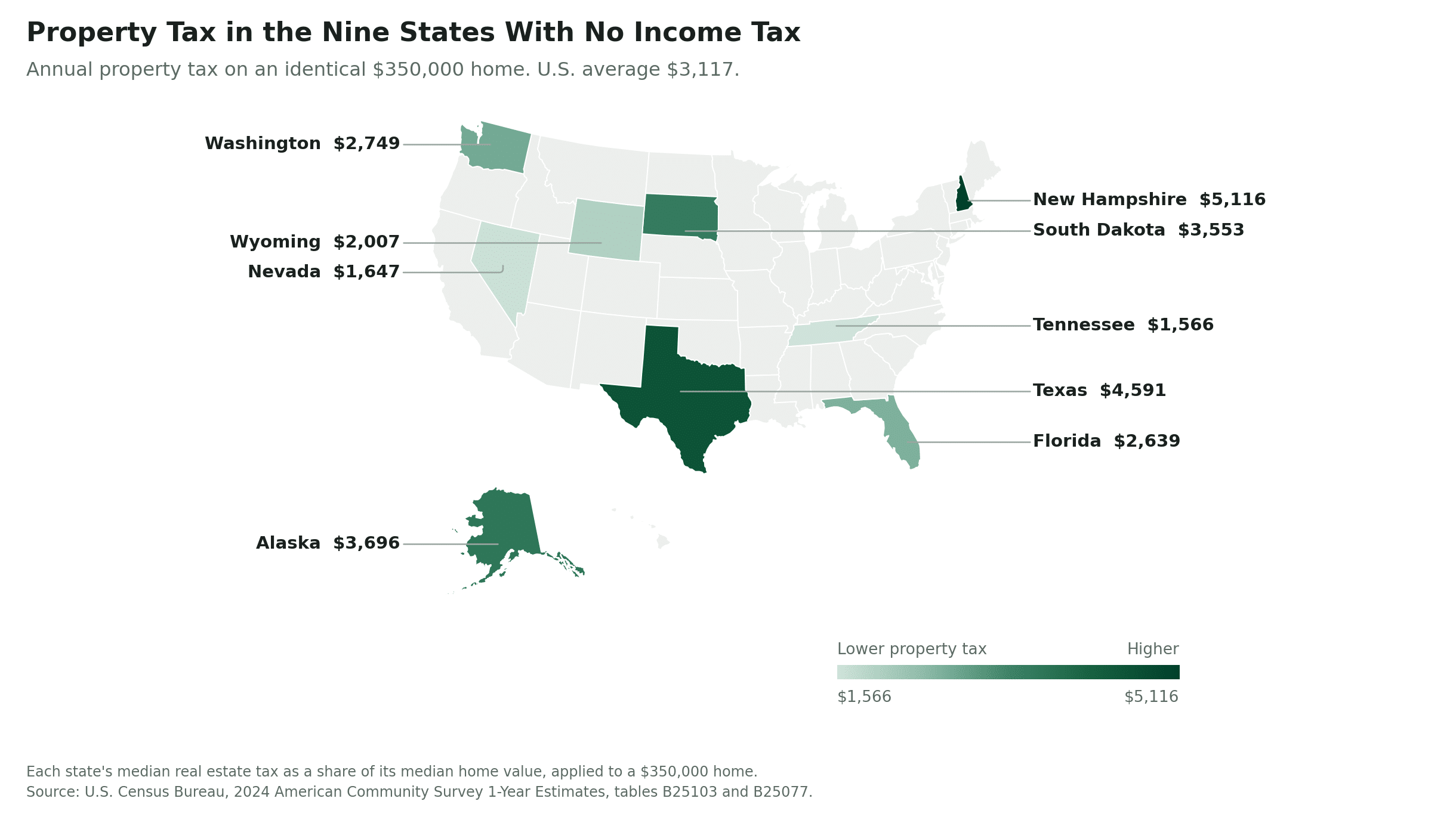
These property tax figures are our own calculation. We take each state’s median real estate tax (Census table B25103) as a share of its median home value (table B25077), both from the 2024 American Community Survey, and apply that share to a $350,000 home. It compares headline rates like-for-like. Your own bill depends on your county and on exemptions, and homestead exemptions and assessment caps are large in Florida and Texas. If your income will come mainly from a pension or a retirement account, the comparison that matters is how each state taxes retirement income.
New Hampshire Joined the List in 2025
New Hampshire is the newest addition to the conventional list, which is why older articles count eight states. The Interest and Dividends Tax applies to investment income and never to wages. It was phased down from 5% to 4% to 3%, then repealed. The New Hampshire Department of Revenue Administration states that the tax “is then repealed for taxable periods beginning after December 31, 2024.”
What the Move Is Worth
Take a married couple earning $120,000 with a $350,000 home who are leaving Illinois. Their Illinois property tax on that house runs about $6,730, on the same measure as the table above. The Illinois Department of Revenue charges a flat 4.95% income tax with a $2,850 personal exemption, then gives back a credit equal to 5% of the property tax on a principal residence, so their income tax lands near $5,320.
| Where they move | Income tax | Property tax | Saved per year |
|---|---|---|---|
| Tennessee | $0 | $1,570 | $10,480 |
| Florida | $0 | $2,640 | $9,410 |
| Texas | $0 | $4,590 | $7,460 |
| New Hampshire | $0 | $5,120 | $6,930 |
The income tax saving of $5,320 is the same wherever they go. Which of the nine they pick decides the other $1,610 to $5,160.
This assumes $120,000 of wage income with no other Illinois adjustments. Illinois does not tax most retirement income, so a retired couple’s figures look very different. Property taxes vary by county.
Washington Taxes More Than the Other Eight
Washington has no income tax today, but it is the one state on this list where that is changing, and it already taxes investment gains.
Income Over $1 Million, From 2028
Engrossed Substitute Senate Bill 6346, enacted in 2026, imposes a 9.9% tax on adjusted gross income above $1 million, starting January 1, 2028, with the first returns due in 2029. It is a separate provision from the capital gains tax below, which shares the same rate and threshold at its top tier. The other eight states charge nothing on personal income.
The 7% Capital Gains Tax That Applies Now
Washington charges 7% on long-term capital gains above a standard deduction of $278,000, rising to 9.9% on gains above $1 million. The $278,000 figure is for 2025, the most recent year the Department of Revenue has published, and it is adjusted for inflation each year.
What the Capital Gains Tax Exempts
Washington’s Department of Revenue exempts real estate, retirement account assets, and depreciable business assets, as well as timber and livestock. Selling a house or drawing down an IRA does not trigger it. Selling a stock portfolio or a business interest can, and recent changes to federal capital gains tax apply on top of the state tax charge.
You Have to Change Your Domicile to Get the Saving
Moving does not lower your tax bill until the state you left accepts that you have gone. That question is decided mainly by domicile.
What Domicile Means
Your domicile is the one place, a U.S. state or a foreign country, that counts as your permanent home for tax purposes. You have exactly one, and you keep it until you establish a new one. Buying a house in Florida while keeping a California license, a California voter registration, and a family home in California does not change it.
Why 183 Days Is Not Enough
Domicile has no day threshold. The 183-day rule is a separate test that establishes statutory residence, allowing a state to tax you because you spent enough time there and maintained a home available to you, whether or not you are domiciled elsewhere. One state can apply both tests to you in the same year, as our guide to domicile against residence walks through.
How to Change Your Domicile: Five Steps
- Get a driver’s license and register to vote in the new state. Where you are registered to vote is one of the first things a state looks at.
- Move your bank accounts, insurance policies, and mailing address.
- Claim a homestead exemption if the new state offers one. It saves money and shows intent.
- Spend most of your time in the new state, especially in the first year, and keep a record.
- File a part-year return in the old state for the year you move. Filing it closes the file cleanly.
States That Examine People Who Leave
Five states look hard at departures, sometimes years later:
- California: treats property, professional licenses, and family remaining in the state as meaningful ties. See California’s residency rules.
- New York: focuses on whether you kept a home available to you, and on where your possessions are. See New York’s residency rules.
- Virginia: often treats a move overseas as temporary unless you show otherwise. See Virginia’s residency rules.
- South Carolina: asks for documentation showing that you became a resident elsewhere. See South Carolina’s residency rules.
- New Mexico: applies tie-breaking rules when you have connections to more than one state. See New Mexico’s residency rules.
None of this is unusual, and a documented move with a part-year return filed is what settles it. Step five varies by state, so check the one you are leaving.
Living Abroad: Which State Return You File
Being domiciled in one of the nine states means no resident state return while you are away, as long as no income is sourced to another state. Federal filing follows your citizenship and continues wherever you live. State filing follows your domicile. A handful of countries charge no income tax either, though the federal return still applies there.
Which States Follow the Foreign Earned Income Exclusion
Most states follow the Foreign Earned Income Exclusion, though none of them adopt it by name. The exclusion is subtracted before your federal adjusted gross income is calculated. Thirty-one states and Washington, D.C., start their own math from that figure, and several more start from federal taxable income, which is derived from it. Either way, the exclusion carries through.
Only four states break that chain. California and Massachusetts add back the excluded amount. New Jersey and Pennsylvania build their own definition of income and never pick it up. Few states of any kind give credit for foreign taxes paid. That relief is federal, and our Foreign Tax Credit guide sets out how to claim it. State taxes while living abroad sets out which four, and what each one adds back.
Change Your Domicile Before You Move Abroad
If you are leaving the U.S. from one of the five states above, establish domicile in a no-income-tax state first and leave from there. Going straight out from California or Virginia leaves the question open, and open questions are harder to settle from another continent. Done in the right order, it is ordinary paperwork. There is a checklist of what to line up first in our guidance for Americans moving abroad.
Moving Back: Pick Your State First
If you have severed your old domicile and spent years overseas, you return with a foreign domicile and no state claiming you, so you choose where to land. That lasts until you spend enough time in a state, with a home available there, to become a statutory resident, which is why the choice is worth making before the first paycheck. The rest of the re-entry is covered in our guidance for expats returning to the U.S.
Mississippi Is Phasing Out Its Income Tax
Mississippi has legislated a path toward zero. A state on that path is not a no-income-tax state yet, and the later steps depend on revenue conditions, so compare the rate you would pay in the years you will be living there.
Mississippi’s Rate by Year
House Bill 1, enacted in 2025, sets this schedule on taxable income above $10,000:
| Tax year | Rate |
|---|---|
| 2025 | 4.4% |
| 2026 | 4.0% |
| 2027 | 3.75% |
| 2028 | 3.5% |
| 2029 | 3.25% |
| 2030 onward | 3.0%, then further cuts if revenue conditions are met |
The Mississippi Department of Revenue publishes the conditions that govern reductions after 2030.
Frequently Asked Questions
On property tax for the same house, Tennessee is the cheapest at about $1,570 a year, followed by Nevada at $1,650 and Wyoming at $2,010. If your income will be mostly from a pension or retirement account withdrawals, how each state taxes retirement income changes the ranking. Tennessee also has the highest sales tax of the nine at 7%, with local governments adding up to 2.75%, so the answer shifts depending on how much of your budget goes on taxable goods.
Usually, but check the whole bill. The income tax saving is real and can run to several thousand dollars a year. Texas and New Hampshire charge enough property tax to provide a meaningful share back, and New Hampshire has no sales tax, while Texas does. Compare based on your own income, your own house, and your own spending.
Yes. Federal and state filings are separate. If you are a U.S. citizen or green card holder with income above the filing threshold, your federal return is due regardless of which state you live in, and regardless of whether you live in the United States at all.
Not while you live in the United States. Every U.S. citizen has a domicile somewhere, and it persists until a new one replaces it; changing it requires deliberate steps. Moving abroad without establishing a foreign domicile leaves your old state’s claim intact, which is why people who left years ago find that state still treating them as residents. It is fixable once a new domicile is established and documented.
One of the nine, if you get a free choice. Being domiciled in a state with no income tax means no resident state return while you are away, and nothing to unwind when you come back. If you still have a home, a license, or a family address in a state that taxes income, that state may treat you as a resident no matter where you live, which is the position worth fixing before you go. State tax filing covers the year you make the change.
New Hampshire is the only one with neither at any level. Alaska has no statewide sales tax, but 107 municipalities charge their own at 1% to 7%, so what you pay depends on the town.
Picking the State Is the Easy Part. Closing the Old One Is What Makes the Saving Real.
On wage income, the savings are identical across all nine, Washington aside, if you hold large investment gains, so choosing between them is not really an income tax decision. It is a decision about what each charges instead: property tax about $3,550 a year apart on the same house between Tennessee and New Hampshire, and sales tax running from nothing in New Hampshire to 7% in Tennessee.
Whether you get any of it is decided somewhere else, by the state you left
- The year you move is the one that matters: it has two states in it, and a part-year return filed in the old state is what closes the file. State tax filing covers both sides of that year.
- Documentation beats intention: a license, a voter registration, and a day log are what a state looks at, and they are easier to gather now than to reconstruct in three years.
- An old gap is fixable: if you have been abroad for years and never filed a state return, catching up is a well-worn path.

This article is for informational purposes only and should not be considered tax advice. State tax rules vary and change frequently, and individual circumstances differ. Consult a qualified tax professional, or an accountant with expertise in state residency and cross-border filing, for advice specific to your situation.



Featured In