The NIE Number in Spain: What It Is and How Americans Get One

- Spain NIE Number at a Glance
- What Is an NIE Number in Spain?
- What Documents Do You Need for an NIE?
- How to Get an NIE Number From the U.S.
- How to Get an NIE in Spain
- Getting Your NIE With a Spanish Visa
- Does an NIE Change Your U.S. Taxes?
- Frequently Asked Questions About the NIE Number
- How Greenback Helps With the U.S. Side of Your Move to Spain

The NIE, or número de identidad de extranjero, is the personal ID number that Spain assigns to any foreigner with economic, professional, or social interests in the country, and it never changes once issued. You need it to sign a lease, buy property, open most bank accounts, take a job, and file taxes in Spain. Americans apply on form EX-15 at the Spanish consulate that serves their state, which charges about $12 and emails the NIE within roughly two to eight weeks; in Spain, the same application costs €9.84.
An NIE is an identity number and nothing more. It gives you no right to live in Spain, it has no bearing on whether Spain taxes you as a resident, and it leaves the U.S. return you file each year unchanged. The visa, residence card, and town hall registration that follow it are part of our hub on living in Spain.
Spain NIE Number at a Glance
| Question | Answer |
|---|---|
| What does NIE stand for? | Número de identidad de extranjero, Spain’s permanent identity number for foreigners, assigned by the national police. |
| How much does an NIE cost? | €9.84 in Spain, and $11 to $12 at most Spanish consulates in the U.S. |
| How long does it take to get an NIE? | The police in Spain must decide within 5 days. U.S. consulates take about two to eight weeks and send the NIE by email. |
| Can I get an NIE without going to Spain? | Yes. Any Spanish consulate in the U.S. accepts applications from residents of its states, in person or through a representative. |
| Does the NIE expire? | No. The number stays the same for good. Only the certificate and the TIE residence card carry dates. |
| Is the NIE the same as a Social Security number? | No. Spain’s social security number is separate from the social security treasury number and is issued when you first start working or join the public health system. |
What Is an NIE Number in Spain?
An NIE number is Spain’s identifier for a foreign person: the Ministry of the Interior calls it personal, unique, and exclusive, and it must appear on every document Spain issues to you. Anyone with economic, professional, or social interests in Spain can ask for one, whether or not they plan to live there. Spanish offices, landlords, and companies ask for it whenever they need to record who you are:
- Housing and utilities: most landlords and electricity, water, and internet providers.
- Banking: Most Spanish banks require you to open and keep an account.
- Property: Spain’s land registry will not record a purchase deed unless every party’s tax number appears on it.
- Work: your employer and the social security system.
- Taxes: for a foreigner, the NIE works as the Spanish tax number on every return and payment.
Two ideas that circulate online are wrong. There is no “temporary” NIE that lapses, and there is no separate resident or non-resident NIE. Your certificate records your status on the day it was issued, but the number on it stays with you if you later move to Spain, leave, or return years later.
Is There an NIE Card?
There is no NIE card. When your NIE is assigned, you receive an NIE certificate: a printed sheet in Spain, or a PDF when a consulate issues it. The card most people mean is the TIE, the residence card you collect once you live in Spain, which carries the same NIE.
NIE vs TIE vs Padrón vs Social Security Number
Four registrations get confused because each is requested at a different time. Only the NIE can be obtained before you arrive.
| Registration | What it is | Who issues it | When you get it |
|---|---|---|---|
| NIE | Your permanent foreigner ID number | Policía Nacional (form EX-15) | Before any financial, work or legal step in Spain |
| TIE | Your physical residence card, showing your NIE and permit | Policía Nacional (form EX-17) | Within one month of arriving on a visa for a stay over six months |
| Padrón | Your registration at the town hall where you live | Your local ayuntamiento | Once you have an address in Spain |
| Social security number (NUSS) | Your number in the Spanish social security system | Tesorería General de la Seguridad Social (form TA.1) | Before your first job, or to join the public health system |
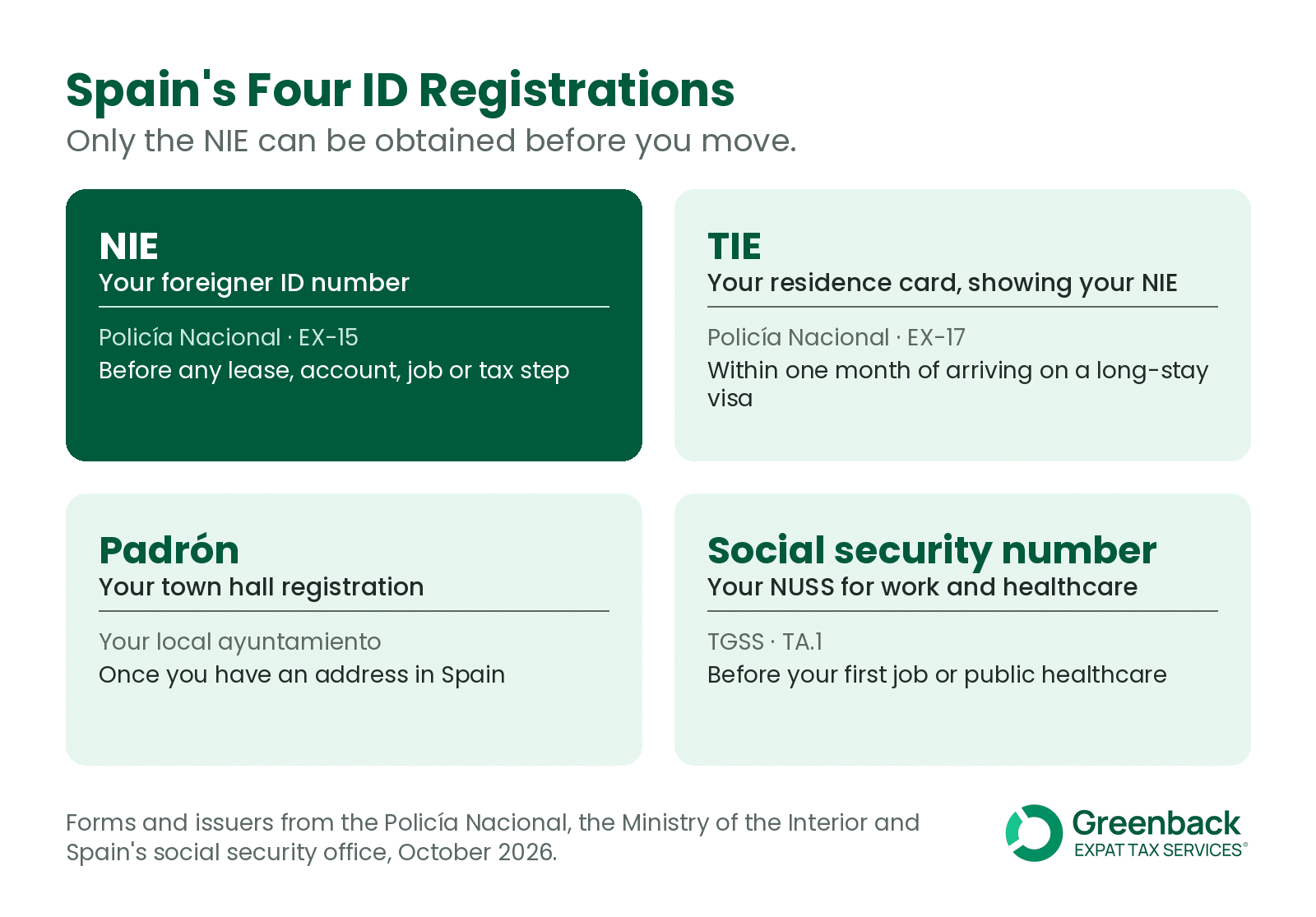
The order of the last three after you land is part of our guide to moving to Spain.
Can You Open a Spanish Bank Account Without an NIE?
Some Spanish banks open a non-resident account using your passport and add the NIE later, but practices vary by bank. Banco de España guidance has non-EU residents identify themselves with their TIE. Because of FATCA, the bank will also ask a U.S. citizen for a U.S. taxpayer number. Account types and bank selection are covered in our guide to opening a Spanish bank account.
What Documents Do You Need for an NIE?
Spanish consulates in the U.S. ask for the same core set of five documents for an NIE, plus a power of attorney if someone applies on your behalf. In Spain, the police ask for the form, your passport, proof of your reason for travel, and the fee.
Form EX-15
The EX-15 is the application form for an NIE and for residence certificates. Bring the original and a copy, both signed; tick the box for an NIE; and state your reason as economic, professional, or social. The Washington consulate wants the reason written in Spanish.
Your Passport
Bring your valid passport and a copy of the photo page. The Washington and New York checklists do not ask for passport photos.
Proof of Your Reason
The consulates do not publish a fixed list of acceptable proof. Applicants commonly bring a rental offer, a letter from a Spanish bank, a job offer, or a notary’s request for an inheritance or sale.
Proof You Live in the Consulate’s District
A U.S. driver’s license or state ID shows you live in the states the consulate covers.
The Fee on Form 790 Código 012
In Spain, the €9.84 fee is paid on form 790 código 012, usually at a bank or online before your appointment. Consulates collect it in dollars, according to the method each one sets.
A Power of Attorney, If Someone Applies for You
A representative brings their own ID and a power of attorney that expressly authorizes them to apply for your NIE. One signed before a U.S. notary generally needs an apostille, plus a sworn translation if it is in English; the Chicago consulate states the apostille requirement on its page.
How to Get an NIE Number From the U.S.
You get an NIE number from the U.S. by presenting the EX-15 and supporting documents at the Spanish consulate that serves your state, either yourself or through a representative. Every consulate requires someone to appear in person, and none lists a mail option.
- Find your consulate: each covers a group of states and posts its own NIE rules on exteriores.gob.es.
- Prepare the forms: fill in the EX-15 and gather the five documents.
- Book or walk in: most consulates need an appointment, while Washington and San Francisco take walk-ins at set hours.
- Apply in person: present the originals and copies and pay the fee.
- Receive the certificate by email: the consulate forwards your file to the police in Spain and emails you the certificate.
Fees, booking, and timing differ by consulate. This is what each consulate’s own NIE page stated on 5 October 2026:
| Consulate | Fee | How to apply | Typical time |
|---|---|---|---|
| Boston | $12, money order | Appointment by email | Within two weeks |
| Chicago | $11 on its fee sheet (dated 2023) | Not stated; a representative’s power of attorney needs an apostille | Within six weeks |
| Houston | $11 | Request by email | Within two weeks |
| Los Angeles | $12 on its fee sheet | Appointment required, one per person | Within two weeks |
| Miami | $12, money order | Appointment required | At least four weeks |
| New York | $12, USPS money order | Appointment required | Within five weeks |
| San Francisco | $12, cash, cashier’s check or money order | Walk-in, Thursdays from noon to 1 p.m. | Two to eight weeks (its page gives both) |
| San Juan, Puerto Rico | Shown in euros (2021) | Request by email | About two weeks |
| Washington, DC | $12, cash, card or money order | Walk-in, weekdays from 9 a.m. to 1 p.m. | 20 to 30 days |
Check your consulate’s page the week you apply, since fees and hours change without notice.
Example: Dana Applies at the Washington Consulate
Dana, a retiree in Richmond, Virginia, plans to spend winters in Málaga, each stay under the 90 days Americans can spend in Spain without a visa. Her landlord and her Spanish bank both want an NIE.
On her EX-15, she writes her reason in Spanish: signing a rental contract and opening a bank account. She brings the form, her passport, her Virginia driver’s license, the landlord’s draft lease, copies of each, and $12. The Washington consulate covers Virginia and takes NIE applications without an appointment on weekday mornings, so she walks in, and her certificate arrives by email within 20 to 30 days. Her NIE covers the lease and the account, and each winter stay still has to fit within 90 days in any 180.
How to Get an NIE in Spain
In Spain, you get an NIE at a police station or foreigners’ office (oficina de extranjería) with an appointment, called cita previa, for €9.84. You bring the same documents, minus the U.S. proof of address, and the police must decide within 5 days of your application. If they do not answer within that time, the application will be considered refused, so follow up if nothing arrives. Many people hand the job to a gestor (an administrative agent) or a lawyer, who applies on their behalf with a power of attorney.
Getting Your NIE With a Spanish Visa
If you move on a Spanish residence visa, your NIE is normally assigned through the visa process, so you usually do not file a separate EX-15. Some consulates handling the Spain digital nomad visa ask for the NIE certificate before the appointment.
Once you arrive, anyone holding a visa valid for more than six months must apply in person for the TIE within one month, according to the Ministry of the Interior, using form EX-17 and paying a €16.08 fee. Retirees and others living on savings usually arrive on the non-lucrative visa.
Does an NIE Change Your U.S. Taxes?
An NIE does not change your U.S. taxes: it is a Spanish identity number, not a U.S. taxpayer number, and holding one plays no part in Spain’s residency tests. Those tests count your days in Spain, with more than 183 in a calendar year, making you resident, and look at where your main economic interests sit, as our page on the Spanish tax system explains.
On U.S. forms, you keep using your Social Security number: your FBAR and Form 8938 ask for a U.S. taxpayer number, never an NIE. A spouse who is not a U.S. person may give their NIE as the foreign tax number on Form W-8BEN. The accounts your NIE opens are a different matter, because a Spanish account is reported on your FBAR once all your foreign balances together exceed $10,000 during the year; that reporting is part of filing U.S. expat taxes in Spain.
Frequently Asked Questions About the NIE Number
The NIE number does not expire. It stays the same even if you leave Spain and return years later. What can date is the certificate, which shows your status on the day it was issued, and the TIE card, which is renewed with your permit.
The NIE application can be prepared online, since the EX-15 and fee form are available on the police’s website, but you or a representative must submit it at a consulate or an office in Spain.
An NIE does not let you live or work in Spain. It identifies you; the right to stay beyond 90 days or to work comes from a visa or residence permit, shown on your TIE.
The NIE serves as the NIF (Spain’s tax identification number) for foreigners. The tax agency issues a temporary NIF starting with “M” only to foreigners who need a tax number before they have an NIE.
How Greenback Helps With the U.S. Side of Your Move to Spain
Greenback’s tax team prepares the U.S. return, FBAR, and Form 8938 for Americans living in Spain, and works out the U.S. side of your move so you don’t pay more than the rules require. When your NIE leads to a Spanish lease, bank account, or job, we include each one in your U.S. reporting. We do not apply for NIEs or prepare Spanish returns; your gestor or lawyer handles that.

Your NIE is ready. Is your U.S. return?
General information only, not legal, immigration, or tax advice. Each Spanish consulate and police office sets its own fees, appointment rules, and processing times, which can change; the figures here come from official pages checked in October 2026. Greenback files U.S. returns for Americans in Spain and handles the U.S. planning around a move; it does not handle NIE applications or Spanish returns. Confirm your application with your consulate or a Spanish adviser, and get advice from a U.S. tax professional on your own circumstances.




Featured In