Expat’s Guide to Living in Spain

- Spain at a Glance for Americans
- Pros of Living in Spain
- Cons of Living in Spain
- Before You Move to Spain
- Settling Into Life in Spain
- Your U.S. Taxes While Living in Spain
- A Typical First Year for an American in Spain
- Frequently Asked Questions About Living in Spain
- How Greenback Helps Americans in Spain


Americans can live in Spain long term on a Spanish residence visa, most often the non-lucrative visa for retirees and people living on savings, or the digital nomad visa for remote workers, and can visit for up to 90 days in any 180-day period without one. Spain has a life expectancy of 84 years compared with 79 in the U.S., household spending at about half the U.S. average, and a public health system, and it asks for patience in return with appointments, paperwork, lower local salaries, and a second tax system.
About 57,000 Americans already live in Spain, up by half since 2021, and Greenback has helped more than 200 clients living in Spain since 2023. Moving to Spain from the U.S. means a visa from your consulate, then an NIE, a TIE residence card, and the padrón once you arrive. You are treated as a tax resident in Spain after 183 days in a calendar year, and you keep filing a U.S. return every year, with credit for the Spanish tax you pay, which our guide to U.S. expat taxes in Spain walks through.
Spain at a Glance for Americans
Spain is a country of about 49.8 million people, where U.S. citizens visit visa-free for short stays and need a residence visa to live. Americans in Spain file a Spanish return each spring once they are residents, and a U.S. return every year.
| Topic | What to know |
|---|---|
| Population | About 49.8 million (INE, 1 July 2026) |
| Americans living in Spain | 57,379 U.S. nationals on 1 January 2025, about 71,000 by 2027 (estimate) |
| Languages | Spanish nationwide, with Catalan, Galician, and Basque co-official in their regions |
| Currency | Euro € |
| Main residence routes | Non-lucrative visa, digital nomad visa, work visas, student visa |
| A couple’s monthly budget | About €3,560 ($3,990) in 2027, rent included (estimate) |
| Healthcare | Public system plus a large private insurance market |
| Spanish tax year | Calendar year, with returns filed from early April to 30 June |
| U.S. filing | Required every year for U.S. citizens and green card holders |
Pros of Living in Spain
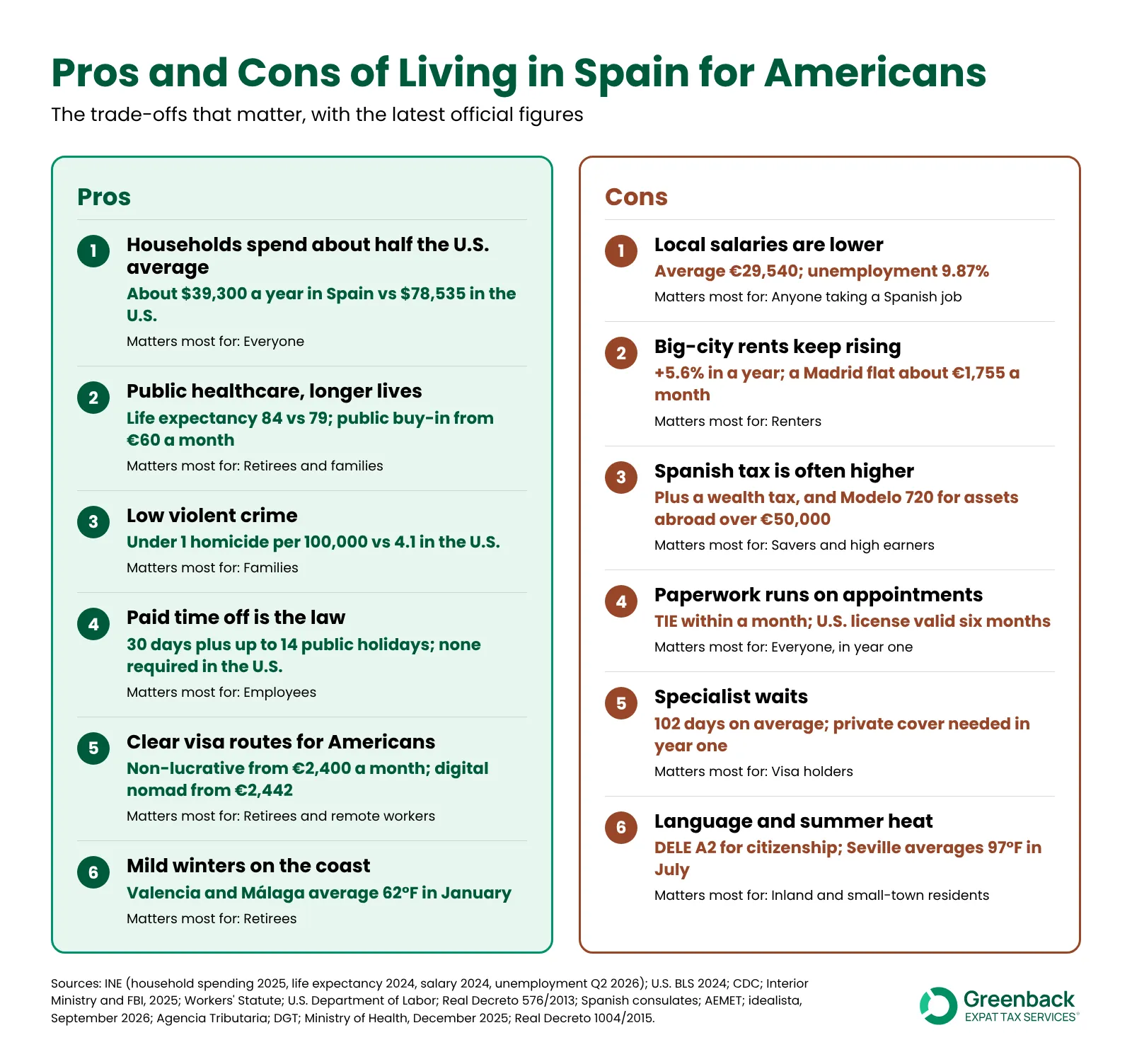
The strongest reasons Americans choose Spain are lower living costs, public healthcare, longer lifespans, low violent crime rates, more paid time off, clear residency routes, and mild winters that support an outdoor daily life.
1. Lower Living Costs Than the U.S.
The average Spanish household spent €35,101 in 2025, about $39,300, while the average U.S. household spent $78,535 in 2024, according to the Bureau of Labor Statistics. Housing, transport, and healthcare explain most of the gap. In 2027, a couple can expect to spend about €3,560 a month, rent included, and a single person about €2,260, with the cost of living in Spain running from about €2,790 a month for a couple in Extremadura to €4,310 in the Madrid region. The best places to live in Spain compares the cities Americans choose on cost, climate and community.
2. Public Healthcare and Longer Lives
Life expectancy at birth in Spain was 84.0 years in 2024, according to INE, against 79 years in the U.S., according to the CDC. Public care is free at the point of care for anyone covered by Spanish Social Security, and residents without that coverage can buy in through the convenio especial for €60 a month after a year. Healthcare in Spain sets out who qualifies, and retiring in Spain covers what it means for a retirement budget.
3. Low Violent Crime
Spain recorded 376 homicides in 2025, a rate under 1 per 100,000 people, according to the Interior Ministry, against 4.1 per 100,000 in the U.S., according to the FBI. Most recorded crime in Spain is theft, especially pickpocketing in tourist areas, and the best places to live in Spain compares crime rates city by city.
4. More Paid Time Off
Employees in Spain are entitled to 30 calendar days of paid holiday a year, plus up to 14 public holidays, under the Workers’ Statute. U.S. federal law requires neither paid vacation nor paid holidays, according to the Department of Labor. Contracts, salaries, and permits are covered in working in Spain, and teaching English in Spain covers the language assistant program that many Americans start with.
5. Clear Residence Routes for Americans
Spain publishes its income floors, so you know before you apply whether you qualify. The non-lucrative visa requires €2,400 per month in passive income for the main applicant, and the digital nomad visa requires €2,442 per month from remote work. Most routes lead to long-term residence after five years, and a Spanish parent or grandparent can open a faster path to Spanish citizenship.
6. Mild Winters and an Outdoor Daily Life
On the Mediterranean coast, Valencia and Málaga average January highs of about 62°F, and Málaga gets about 2,900 hours of sunshine a year, according to Spain’s weather agency, AEMET. Daily life moves outdoors with it: terraces, evening walks, and local fiestas fill the calendar in towns of every size, and Spain has 50 properties on the UNESCO World Heritage List.
Cons of Living in Spain
The downsides of living in Spain are real but manageable, and most of them involve money and paperwork. How much each one affects you depends on how you earn your income and where you settle.
1. Lower Salaries and Fewer Jobs
The average gross salary in Spain was €29,540 in 2024, and the median was €24,497, according to INE, with the average projected at about €32,900 for 2027. Unemployment was 9.87% in the second quarter of 2026, according to INE, and the Banco de España projects 9.7% for 2027. This weighs most on Americans who plan to live on a Spanish salary. Many keep U.S. income on the digital nomad visa or work for themselves as self-employed in Spain, and working in Spain shows what a Spanish salary is after taxes.
2. Rising Rents in the Big Cities
Asking rents in Spain rose 5.6% over the past year, according to idealista, and a 75 m² flat in Madrid now lists at about €1,755 a month. Landlords in popular cities often ask for Spanish payslips or proof of income, while Spain’s tenancy law caps the deposit at one month’s rent, with additional guarantees limited to two months. Rents run lower in Valencia, Alicante, Seville, and Granada, and buying property in Spain outlines the purchase costs and taxes for Americans who would rather own.
3. Higher Taxes and Extra Reporting
Spanish income tax is often higher than U.S. tax on the same income, and part of the rate is set by each region, as explained by how the Spanish tax system works. Spain also has an annual wealth tax on higher net worth, which some regions reduce to nothing, and Modelo 720, a declaration of assets held outside Spain once a category exceeds €50,000; both are covered by wealth tax and Modelo 720. The Spanish tax you pay is credited on your U.S. return under the U.S.-Spain tax treaty, which usually keeps the same income from being taxed twice, and the Beckham Law can replace the progressive scale with a flat rate for people who move for a job.
4. Government Appointments, Forms, and Waiting
Most government steps in Spain need a cita previa, an appointment booked through the government’s cita previa portal, and slots in the big cities can be hard to get. You apply for your TIE within one month of arriving, and your NIE number is needed for almost everything else. Spanish banks ask U.S. citizens for extra tax forms because of FATCA, as banks in Spain explains. A U.S. driver’s license is valid for six months after you become a resident, and because the U.S. is not on the DGT exchange list, keeping your right to drive means passing the Spanish tests.
5. Specialist Waits and the First-Year Medical Insurance Gap
Spain’s public system is strong on primary and emergency care, but a first appointment with a specialist took 102 days on average at the end of 2025, according to the Ministry of Health. Americans on the non-lucrative visa start outside the public system: the visa requires private health insurance, and the public buy-in opens only after a year of registered residence. Many residents maintain a private policy for faster access to specialists, as explained by healthcare in Spain.
6. Language and Summer Heat
English is common in central Madrid, Barcelona, and the coastal areas popular with Americans, and far less so at the town hall, the doctor’s office, or in smaller towns. Spanish at the DELE A2 level is required to apply for Spanish citizenship through residence. Summers inland are hot, with Seville’s average July high at about 97°F, according to AEMET, while many older homes have little insulation for winter. In 2025, 34.4% of households said their home or building needed energy-efficiency work they had not yet done, according to INE.

Before You Move to Spain
Almost every American needs a visa to live in Spain, and the route you choose sets whether you can work, how much income you need to show, and how long you can stay. You apply to the Spanish consulate serving your U.S. state, and each consulate sets its own document checklist, so the list a friend used in another state may not match yours.
Choosing Your Visa Route
- Non-lucrative visa: for retirees and people living on pensions, savings, or investments, with €2,400 a month in passive income and no work allowed.
- Digital nomad visa: for remote employees and freelancers working for companies outside Spain, starting at €2,442 per month.
- Working in Spain: work visas sponsored by a Spanish employer, including the highly qualified professional permit.
- Teaching English in Spain: the NALCAP language assistant program, a cultural exchange grant for U.S. graduates.
- Self-employed in Spain: the self-employment route for Americans starting a business, with autónomo registration.
- Spanish citizenship: by descent from a Spanish parent, or after one to ten years of legal residence.
- Spain golden visa: closed to new applications since 3 April 2025, with rules for existing holders.
Student visas cover enrolled study with limited part-time work. ETIAS, the EU travel authorization that will apply to short stays, is not yet operational, so check its status before a visa-free trip.
Planning the Move
- Moving to Spain from the U.S.: the step-by-step move, from documents and their lead times to shipping and the taxes of the year you arrive.
- NIE number: how to get the foreigner identity number from the U.S. or in Spain, and how it differs from the TIE and padrón.
- Retiring in Spain: the non-lucrative route, after-tax retirement income by region, and what Spain taxes on a U.S. pension.
Settling Into Life in Spain
Daily life in Spain gets easier once your registrations are done, and the city you choose shapes your costs more than anything else.
Cost of Living and Where to Live
- Cost of living in Spain: monthly budgets for 2027 by household, all 17 regions, and eight cities, and the salary each one takes.
- Best places to live in Spain: Madrid and Barcelona, home to 44% of Americans in Spain, weighed against Valencia, Málaga, Alicante, and the cities where the American community is growing fastest.
Your Home in Spain
Most Americans rent for their first year, on a lease that runs up to five years at the tenant’s option.
- Buying property in Spain: the purchase process for Americans, transfer tax or VAT, mortgages, and what you report to the IRS.
Everyday Essentials
- Banks in Spain: opening an account as an American, the documents and FATCA forms, and building a Spanish credit history from zero.
- Healthcare in Spain: who gets public care, the convenio especial, private insurance, and specialist waits by region.
- Schools: children under 18 have the same right to education as Spanish children, with free and compulsory schooling, under Spain’s immigration law; enrollment runs through your town hall’s padrón.
- Driving: six months on a U.S. license after you become a resident, then the Spanish theory and practical tests.
Work and Retirement
- Working in Spain: salaries, contracts paid in 14 installments, and how a Spanish paycheck shows up on your U.S. return.
- Teaching English in Spain: what language assistants are paid and how the allowance is taxed in each country.
- Self-employed in Spain: the autónomo quota, Spanish tax on freelance income, and U.S. self-employment tax.
- Digital nomad visa: keeping a U.S. employer or clients while you live in Spain.
- Retiring in Spain: pensions, Social Security, healthcare, and the regional wealth tax decision.
Your U.S. Taxes While Living in Spain
Living in Spain adds a Spanish tax return to the U.S. one you already file, and the Spanish tax you pay is credited against U.S. tax on the same income. Spain treats you as a tax resident for the whole calendar year if you spend more than 183 days there, if your main economic interests are in Spain, or if your spouse and minor children live there, so the date you arrive decides which year Spain first taxes you in full.
Start With These Three
- U.S. expat taxes in Spain: filing your U.S. return from Spain, the Foreign Tax Credit, and FBAR and FATCA reporting on Spanish accounts.
- How the Spanish tax system works: Spanish tax brackets by region, the residency tests, and the Renta you file each spring.
- U.S.-Spain tax treaty: which country taxes pensions, Social Security, dividends, and other income, and how double tax is avoided.
Spanish Rules With No U.S. Equivalent
- Wealth tax and Modelo 720: the annual tax on larger net worth, the regions that reduce it to nothing, and the declaration of assets held outside Spain.
- Beckham Law: the flat-rate regime for people who move to Spain for work, and what it changes on your U.S. return.
Property, Investments, and Inheritance
- Buying property in Spain: taxes on purchases and on owning a Spanish home.
- Capital gains tax in Spain: how Spain taxes gains on property and investments, for residents and non-residents.
- Inheritance tax in Spain: paid by the person who inherits, with reductions set by each region, alongside the U.S. estate tax.
Work and Self-Employment
- Working in Spain: Spanish payroll tax and social security, and the credit on your U.S. return.
- Self-employed in Spain: which country’s social security you pay into under the totalization agreement.
Catching Up After the Move
Many Americans in Spain learn about the ongoing U.S. filing requirement only after they have settled in. The IRS Streamlined Filing Compliance Procedures let Americans abroad who missed returns without meaning to catch up, so falling behind after the move can be put right.
A Typical First Year for an American in Spain
Most Americans follow a similar path in their first year: the visa before they leave, three registrations in the first weeks, then a bank account and healthcare, with the first Spanish tax return arriving the following spring.
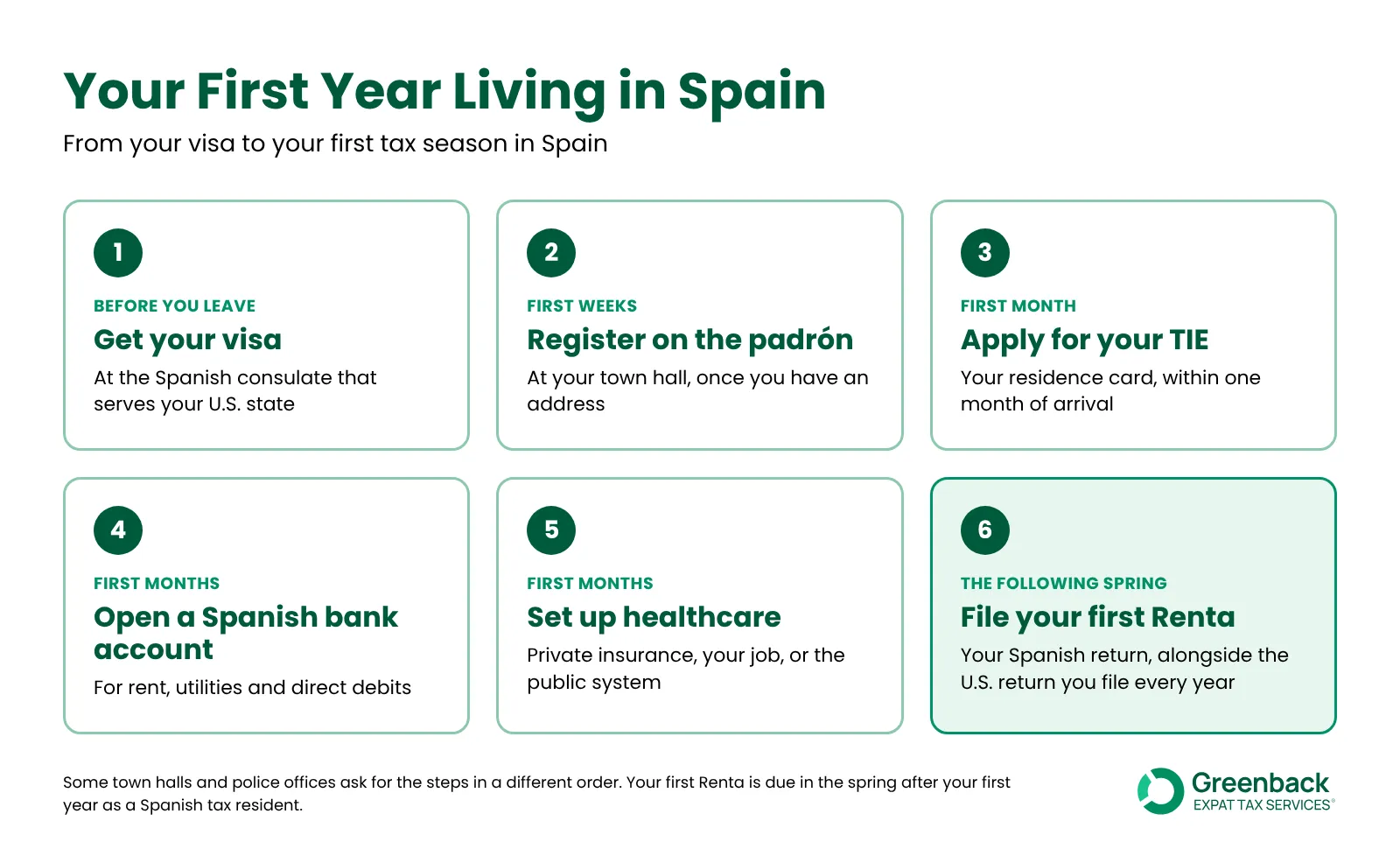
- Get your visa at the Spanish consulate that serves your state, most often the non-lucrative visa or the digital nomad visa.
- Register on the padrón at your town hall once you have an address.
- Apply for your TIE within one month of entering Spain, using the NIE number on your visa.
- Open a Spanish bank account for rent, utilities, and direct debits, with the forms banks in Spain ask Americans for.
- Set up healthcare through private insurance, your job, or the public system, as healthcare in Spain explains.
- File your first Spanish Renta in the spring after your first year as a Spanish tax resident, alongside your U.S. return, as covered in U.S. expat taxes in Spain.
Frequently Asked Questions About Living in Spain
Americans can live in Spain with a residence visa, most often the non-lucrative visa, the digital nomad visa, or a work visa. You apply at the Spanish consulate that serves your U.S. state before you travel, then register for your NIE, TIE, and padrón after you arrive.
U.S. citizens can stay in Spain for up to 90 days in any 180-day period without a visa. Staying longer, or living in Spain, requires a residence visa, and time spent in other Schengen countries counts toward the same 90 days.
Moving to Spain works well for most Americans who can support themselves on a pension, remote income, or a job in Spain: household costs run about half the U.S. average, healthcare is public, and life expectancy is 5 years longer. The trade-offs are paperwork, lower local salaries, and a second tax system, so it suits people who plan the visa and tax side before they go.
There were 57,379 U.S. nationals living in Spain on 1 January 2025, according to INE census data, up from 37,584 in 2021. Madrid and Barcelona provinces hold 44% of them. The count covers U.S. citizenship only, so dual U.S. and Spanish citizens are counted as Spanish, and the real number is higher.
Spain’s homicide rate was under 1 per 100,000 people in 2025, about a fifth of the U.S. rate of 4.1. Most recorded crime in Spain is theft, especially pickpocketing in busy tourist areas, so the usual city precautions apply.
How Greenback Helps Americans in Spain
Greenback is an American company founded by U.S. expats, and we have helped more than 200 clients living in Spain since 2023. Living across two tax systems is manageable, but your Spanish income feeds your U.S. return, your Spanish accounts trigger U.S. reporting, and the credit for Spanish tax only works when the two returns line up.
- U.S. federal tax return: prepared around your Spanish Renta, with the credit your Spanish tax earns.
- FBAR filing: reporting your Spanish bank and investment accounts each year.
- Streamlined Filing Package: Catching up on missed years if you fell behind after the move.
- Expat tax consultation: a short call to determine what your first year in Spain will require.
Learn more about how we help U.S. citizens living abroad.

Living in Spain, Filing With Confidence.
This guide is for informational purposes only and does not constitute tax, legal, or immigration advice. Figures come from the official sources named, and the 2027 figures are estimates. Speak with a qualified professional about your situation.




Featured In