U.S. Expat Taxes in Spain: Filing Requirements for Americans

- U.S. Taxes in Spain at a Glance
- Do Americans Living in Spain Pay U.S. Taxes?
- How Do the U.S. Tax Exclusions and Credits Protect Me?
- Your U.S. Tax Obligations in Spain by Situation
- What Are My Filing Requirements and Deadlines?
- What Are Spain's Tax Rates and How Do They Compare?
- State Taxes After Moving to Spain
- U.S. Taxes When You Leave Spain
- Catching Up on U.S. Filing From Spain
- Frequently Asked Questions about Expat Taxes in Spain
- How Greenback Helps Americans in Spain


U.S. expat taxes in Spain apply to every U.S. citizen and green card holder living in Spain: you file a U.S. tax return every year, even though you also pay Spanish tax. The Spanish income tax you pay is usually claimed as a Foreign Tax Credit, which often covers the full U.S. income tax on Spanish salary, pensions, and investment income. Americans in Spain get an automatic extension to June 15 to file and report Spanish accounts on an FBAR once they total more than $10,000.
For the 2026 tax year, filed in 2027, what your U.S. return from Spain looks like depends on:
- Your status: U.S. citizen, dual U.S.-Spanish citizen, or green card holder.
- Your income: a Spanish employer, remote work, self-employment, retirement, or investments.
- Your household: single, married to another American, or married to a Spanish or other non-U.S. spouse.
The sections on this page cover each situation: what you file, which U.S. relief applies, and what to watch for.
U.S. Taxes in Spain at a Glance
| Question | Answer |
|---|---|
| Do U.S. expats pay taxes in Spain? | Yes, once they become Spanish tax residents, usually after more than 183 days in Spain in a year. |
| Are taxes higher in Spain or the U.S.? | Usually Spain. At €50,000, Spanish rates are about 36% to 38%, compared with 22% in the U.S. for a single filer. |
| Will Spain tax my U.S. Social Security? | Yes, and the U.S. can too. The treaty makes Spain the country that credits the U.S. tax. |
Do Americans Living in Spain Pay U.S. Taxes?
Americans living in Spain file a U.S. return every year once their worldwide income exceeds the filing threshold, whether or not any U.S. tax is due. If you are also a Spanish tax resident, you file in both countries: a Spanish return (the Renta) and a U.S. return. The U.S. taxes its citizens and green card holders wherever they live, so Spanish residence does not eliminate the requirement, and the Foreign Tax Credit usually covers the U.S. tax on income that Spain has already taxed.
U.S. Citizens and Dual U.S.-Spanish Citizens
Every U.S. citizen in Spain files, including Americans who also hold Spanish citizenship. Becoming a Spanish citizen does not end U.S. filing; only formally giving up U.S. citizenship does.
Green Card Holders Living in Spain
A green card holder who moves to Spain stays a U.S. tax resident and files like a citizen, until the green card is formally surrendered or officially treated as abandoned. The U.S.-Spain tax treaty can let a green card holder who is also a Spanish tax resident be treated as a nonresident, but for someone who has held the card in 8 of the last 15 years, that claim can trigger the U.S. expatriation tax.
What Spanish Residency Changes for Your U.S. Taxes
Becoming a Spanish tax resident, generally after more than 183 days in Spain in a calendar year, requires filing a Spanish return and completing Spanish reporting, such as Modelo 720. It does not change what the U.S. expects: you keep filing the same U.S. return, and the Spanish tax you now pay becomes the credit on it. The residency tests themselves are covered in the discussion of how the Spanish tax system works.
2026 Filing Thresholds for Americans in Spain
| Your filing status | You file a U.S. return if gross income is at least |
|---|---|
| Single, under 65 | $16,100 |
| Head of household, under 65 | $24,150 |
| Married filing jointly, both under 65 | $32,200 |
| Married filing separately, common with a Spanish spouse | $5 |
| Self-employed as an autónomo | $400 of net self-employment income |

How Do the U.S. Tax Exclusions and Credits Protect Me?
Americans in Spain avoid double tax with the Foreign Tax Credit, which subtracts Spanish income tax from U.S. tax, or the Foreign Earned Income Exclusion, which removes up to $132,900 of 2026 earned income from U.S. tax. In most years, the Foreign Tax Credit works better in Spain, but the FEIE applies in some situations, and certain types of income can still leave U.S. tax due.
How the Foreign Tax Credit Uses Your Spanish Tax
The Spanish income tax you pay, the IRPF, becomes a credit against your U.S. tax on Form 1116. The credit is capped at the U.S. tax on your foreign income, and Spanish tax above that cap carries forward for up to 10 years, which is common in Spain because Spanish rates run higher. It covers pensions, interest, dividends, and rent as well as salary. Spain and the U.S. also have an income tax treaty, but its saving clause keeps the U.S. right to tax its citizens, so the treaty works alongside the credit and never replaces U.S. filing.
When the Foreign Earned Income Exclusion Fits Better
The Foreign Earned Income Exclusion can suit a year with little Spanish tax, such as a partial first year. Its limits matter in Spain:
- Earned income only: it never covers pensions, Social Security, or investment income.
- No refundable child credit: families lose the Additional Child Tax Credit in any year they use it.
- No IRA contributions from the pay you exclude.
- A 5-year lock: if you stop using it, you generally cannot choose it again for five years without IRS approval.
You qualify through the Physical Presence Test or the Bona Fide Residence Test. The first year in Spain has its own timing questions, covered in moving to Spain.
When Some U.S. Tax Can Remain
- The 3.8% Net Investment Income Tax: Americans in Spain with investment income and total income above $200,000 (single) or $250,000 (joint) may owe it, and the IRS does not allow the Foreign Tax Credit to be applied against it.
- A lower Spanish rate: if you are on the Beckham Law regime, Spain taxes you under its non-resident rules, so income from outside Spain can carry little Spanish tax to credit.
- U.S.-source income: Spanish tax on U.S. pensions or dividends can only be credited on your U.S. return under the treaty’s re-sourcing rule, which requires careful handling. For U.S. Social Security, the treaty puts the credit on the Spanish side instead.
FEIE or Foreign Tax Credit in Spain
| Your situation in Spain | Usual choice | What can change it |
|---|---|---|
| Salary, Spanish tax paid all year | Foreign Tax Credit | Rarely; the excess carries forward |
| Partial first year in Spain | FEIE can fit | Little Spanish tax paid yet |
| Family with children | Foreign Tax Credit | The exclusion blocks the refundable child credit |
| Salary above $132,900 | Foreign Tax Credit | The exclusion leaves the rest taxed at higher U.S. rates |
| Pension, interest, dividends, rent | Foreign Tax Credit only | The exclusion never applies |
| U.S. Social Security | No exclusion; Spain gives the credit | The treaty sets which country credits which |
| Beckham Law regime | Depends | Less Spanish tax on some income to credit |
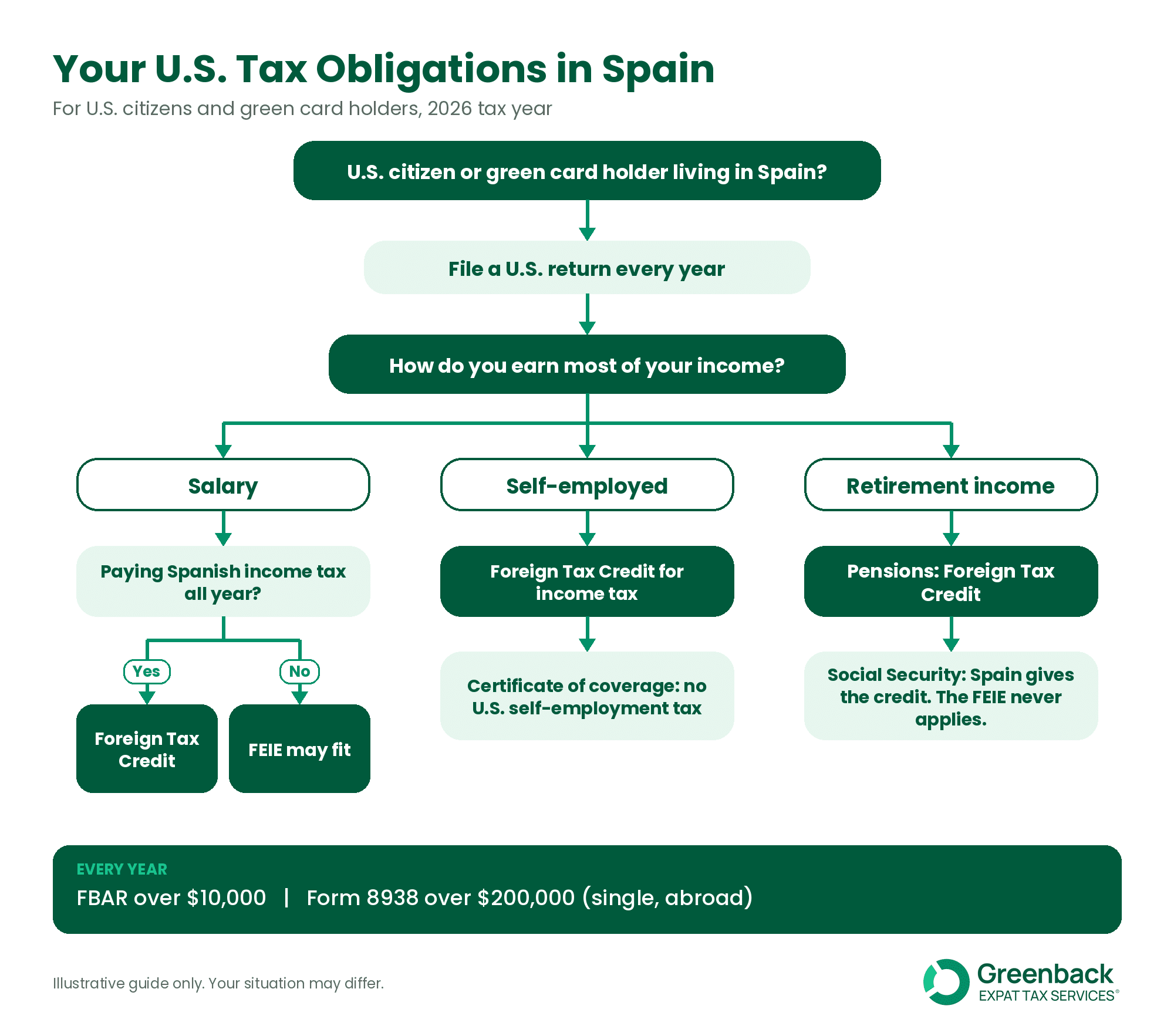
Your U.S. Tax Obligations in Spain by Situation
What goes on your U.S. return depends on how you earn money in Spain and who you file with. Each situation here covers only the U.S. side; the Spanish side has its own guide.
1. Working for a Spanish Employer
Your Spanish salary goes on your U.S. return, and the IRPF withheld from your payslip and settled on your Renta is the tax credit used. You pay into the Spanish Social Security system, not the U.S. system. More on Spanish contracts and payslips is in our guide to working in Spain.
2. Working Remotely for a U.S. Company
If you moved to Spain and work remotely for a U.S. employer, you are usually covered by Spanish Social Security, because the U.S.-Spain agreement follows where you work. If your employer keeps withholding U.S. Social Security and Medicare, you may be paying into both systems. Only an employee your employer sends to Spain temporarily, generally for up to five years, stays in the U.S. system, with a certificate of coverage. The agreement itself is covered in our totalization agreements guide.
3. Working Remotely for a Company Outside the U.S.
Remote workers for non-U.S. companies, often on the Spanish digital nomad visa, report their salary and usually claim the credit for their Spanish tax. The visa’s own U.S. tax points are covered in our digital nomad visa guide.
4. Self-Employed as an Autónomo
Autónomos file a U.S. return once net self-employment income reaches $400. The credit handles the income tax, and a certificate of coverage from Spanish Social Security keeps you out of U.S. self-employment tax. Registration and Spanish contributions are covered in our guide for self-employed individuals in Spain.
5. Retired in Spain
Your U.S. pensions and Social Security remain on your U.S. return, and under the U.S.-Spain tax treaty, Spain can tax them as well. For pensions, the credit sits on your U.S. return; for Social Security, Spain is meant to credit the U.S. tax. The exclusion never applies to retirement income. Retiring in Spain covers which income each country taxes.
6. Investing or Renting Out Property
Rent from a Spanish property is reported on Schedule E, and a sale on Schedule D, both in dollars, with Spanish tax credited. Spanish investment funds, the fondos de inversión, are generally PFICs, which means they require Form 8621 and face harsher U.S. tax treatment, so check before buying a Spanish fund. Spain’s own tax on a sale is covered in our guide to capital gains tax in Spain.
7. Married to a Spanish or Other Non-U.S. Spouse
An American married to a Spaniard usually files as married filing separately, reporting only their own income. The couple can instead elect to treat the Spanish spouse as a U.S. resident and file jointly, which brings the spouse’s worldwide income onto the U.S. return and requires them to have an SSN or ITIN. If you have a qualifying child, you may be able to file as head of household instead.
Example: A Madrid Couple, Filing Separately or Together
Daniel, an American, earns €60,000 at a company in Madrid; his wife, Lucía, a Spanish citizen, earns €30,000. At the IRS’s latest published yearly average rate of 0.886 euros per dollar, Daniel’s salary is about $67,720. These figures are illustrative.
- Filing separately: Daniel reports only his salary. After the $16,100 standard deduction, his taxable income is $51,620, and his U.S. tax is about $6,068.
- His Spanish tax: on a Spanish taxable base of about €52,000, using the 2026 state and Madrid scales, Daniel pays about €13,163, or roughly $14,860.
- The credit: that is well above his U.S. tax, so the credit covers the full $6,068, and about $8,790 carries forward for up to 10 years.
- Filing jointly instead: their combined $101,580, less the $32,200 joint standard deduction, gives about $7,830 of U.S. tax, which their Spanish tax also covers. The result is similar, but Lucía’s income, accounts, and ID number are all entered into the U.S. system.
For this couple, filing separately keeps things simpler with no tax cost. Filing jointly can make sense when it unlocks a benefit that a separate return cannot claim.
What Are My Filing Requirements and Deadlines?
A U.S. return from Spain is a Form 1040 plus the forms for your relief and your Spanish accounts, due June 15, 2027, for the 2026 tax year, or October 15, 2027, with Form 4868. Any tax owed is due April 15, 2027, and the FBAR is due the same day, with an automatic extension to October 15, 2027.
The Forms Behind a U.S. Return From Spain
| Form | When Americans in Spain file it |
|---|---|
| Form 1040 | Every year, once income passes the threshold |
| Form 1116 | To claim the credit for the Spanish tax |
| Form 2555 | Only if you use the exclusion |
| Schedule C and Schedule SE | If you are an autónomo |
| Schedule E or Schedule D | For Spanish rent or sale |
| Form 8621 | For Spanish investment funds |
| FBAR (FinCEN 114) | If Spanish accounts total more than $10,000 at any time |
| Form 8938 | If foreign assets pass the thresholds for filers abroad |
Reporting Spanish Accounts: FBAR and Form 8938
The FBAR and Form 8938 cover most of the same Spanish accounts, but Form 8938 starts much higher: above $200,000 at year-end for a single filer living abroad, versus $10,000 at any time for the FBAR. What each one counts in Spain:
| Spanish account or asset | FBAR | Form 8938 |
|---|---|---|
| Cuenta corriente or depósito a plazo | Yes | Yes |
| Fondos de inversión at a Spanish bank or broker | Yes, as part of the account | Yes, as part of the account |
| Plan de pensiones | Generally yes | Yes, as a foreign pension plan |
| Joint account with a Spanish spouse | Full account value | Full account value |
| Spanish home or rental property in your own name | No | No |
Spain’s own declaration of assets held abroad, Modelo 720, is separate, and filing one never covers the other.
Timing Your U.S. Return Around the Spanish Renta
The Spanish Renta is usually due at the end of June, after the June 15 U.S. deadline for Americans abroad. That timing shapes when Americans in Spain file:
| Your situation in Spain | When to file your U.S. return | Why |
|---|---|---|
| Your Renta is filed before June 15 | By June 15 | Your final Spanish tax is ready for the credit |
| Your Renta is filed in late June | By October 15, with Form 4868 | The credit uses your final Spanish figures |
| You expect some U.S. tax, such as the NIIT or tax on U.S.-source income | Pay by April 15, file later | Interest runs from April 15 on anything unpaid |
How the Spanish calendar works is covered in how the Spanish tax system works.
What Are Spain’s Tax Rates and How Do They Compare?
Spanish income tax rates are higher than U.S. rates at almost every income level, which is why the credit usually covers the U.S. bill for Americans in Spain. Spain’s rate combines a state-level and a regional-level component, so it depends on where you live.
| Taxable income | Spain, Madrid | Spain, Valencia | U.S., single, 2026 |
|---|---|---|---|
| €20,000 (about $22,570) | 24.8% | 23.7% | 12% |
| €50,000 (about $56,430) | 35.9% | 37.9% | 22% |
| €90,000 (about $101,580) | 43% | 48.6% | 22% |
| €350,000 (about $395,030) | 45% | 53.85% | 35% |
Marginal rates. Spanish rates combine the 2026 state scale with the 2026 regional scales, including Valencia’s new scale from the Agencia Tributaria.
State Taxes After Moving to Spain
Moving to Spain does not automatically end your state tax residency. If you keep a home, a driver’s license, or voter registration in your former state, it may still tax your Spanish income, and some states ignore the federal relief: California, for example, adds back income excluded under the FEIE. Our guide to state taxes for expats covers how to break state residency before you move.
U.S. Taxes When You Leave Spain
Moving back to the U.S. from Spain changes your U.S. return in three ways:
- The exclusion ends: once you no longer meet the Physical Presence or Bona Fide Residence Test.
- Carryforwards stay: unused Spanish tax credits remain for 10 years, though you need foreign income to use them.
- State residency returns: the state you move to generally taxes you from your arrival date.
Spain determines residency for the entire calendar year, so Spanish tax for the year you leave can still be credited on your U.S. return.
Catching Up on U.S. Filing From Spain
Many Americans only learn about ongoing U.S. filing after they have settled in Spain. The Streamlined Filing Compliance Procedures let Americans living abroad who missed returns without meaning to file the last three years of returns and six years of FBARs, with no failure-to-file, accuracy, or FBAR penalties. Your Spanish returns, the declaraciones de la renta, are the first papers to gather, because they show the Spanish tax that becomes the credit on each late return.
Frequently Asked Questions about Expat Taxes in Spain
Yes. Americans in Spain file a U.S. return every year once their income passes the filing threshold, even when the Foreign Tax Credit covers the whole U.S. income tax. The credit only applies if you file and claim it.
Americans in Spain who missed returns without meaning to can use the Streamlined procedures to file three years of returns and six years of FBARs without penalties. Your Spanish Renta returns show the Spanish tax that becomes the credit on each late return.
Yes, but not on the same income. Some Americans in Spain set aside part of their salary and claim the credit on the rest, or on pension and investment income. The credit alone is usually the better choice in Spain.
Yes. Green card holders living in Spain file U.S. returns like citizens until the green card is formally surrendered or treated as abandoned. Using the treaty to be treated as a nonresident can trigger the expatriation tax for long-term holders.
Many Americans married to a Spaniard file as married filing separately and report only their own income. You can instead elect to treat your Spanish spouse as a U.S. resident and file jointly, which adds their worldwide income to the U.S. return.
How Greenback Helps Americans in Spain
Greenback prepares U.S. returns for Americans living in Spain, with accountants who work with Spanish payslips, autónomo income, Spanish pensions, Spanish spouses, and the U.S.-Spain treaty every season. We help you choose between the credit and the exclusion, line your U.S. return up with your Renta, report your Spanish accounts correctly, and catch up on past years if you fell behind after moving to Spain. The rest of life in Spain, from visas to healthcare, is covered in our guide to living in Spain.

U.S. Taxes From Spain, Handled
This article is for informational purposes only and should not be considered tax advice. Examples are illustrative, and the Spanish tax depends on your region and personal circumstances. Speak with a qualified professional about your situation.




Featured In