Spain Digital Nomad Visa: Requirements, Income, and U.S. Taxes

- Spain Digital Nomad Visa at a Glance
- What Is Spain's Digital Nomad Visa?
- Who Qualifies for Spain's Digital Nomad Visa?
- How Much Income Do I Need for Spain's Digital Nomad Visa?
- What Documents Do You Need for Spain's Digital Nomad Visa?
- Social Security on the Spain Digital Nomad Visa
- How Do I Apply for Spain's Digital Nomad Visa?
- How Long Is the Spain Digital Nomad Visa Valid?
- How Do Taxes Work on Spain's Digital Nomad Visa?
- Digital Nomad Visa vs Non-Lucrative Visa vs Work Visa
- Bringing Your Family on the Digital Nomad Visa
- Frequently Asked Questions About the Digital Nomad Visa in Spain
- How Greenback Helps Digital Nomads in Spain

Spain’s digital nomad visa lets Americans live in Spain while working remotely for employers or clients based outside Spain, provided you earn at least €2,442 a month gross, which is 200% of Spain’s 2026 minimum wage. You apply either at a Spanish consulate in the U.S. for a one-year visa or from inside Spain for a residence permit of up to three years. This is the remote-work route. It is not a non-lucrative visa, which bars work, nor a Spanish work visa for a job with a Spanish employer.
What decides your application and your taxes:
- Your route: a consulate in the U.S., or the UGE, the Spanish government unit that handles permits for large companies and strategic groups, once you are in Spain.
- Your income: documented earnings from remote work, at the gross figure the UGE publishes.
- Your social security: a certificate of coverage from the U.S. or registration in Spain, depending on how you work.
- Your U.S. return is still due every year if your income exceeds the filing threshold, with self-employment tax handled by whichever side covers you.
This guide covers each step of the visa and the U.S. tax points that come with holding it.
Spain Digital Nomad Visa at a Glance
| Question | Answer |
|---|---|
| Does Spain have a digital nomad visa? | Yes. Spain’s international telework visa lets you live in Spain while working remotely for companies outside Spain. |
| What are the requirements for the Spain digital nomad visa? | A degree or three years of experience, three months with a company operating for a year, and €2,442 a month gross. |
| How long is the Spain digital nomad visa valid? | One year from a consulate, up to three years from inside Spain, then two-year renewals. |
| Can you work for Spanish clients on a digital nomad visa? | Only as a freelancer, and only up to 20% of your work. |
| Do digital nomads pay social security in Spain? | Yes, unless a U.S. certificate of coverage keeps you in the U.S. system. |
| Do digital nomads pay taxes in Spain? | Yes, once they become Spanish tax residents, and Americans still file a U.S. return. |
What Is Spain’s Digital Nomad Visa?
Spain’s digital nomad visa is the international telework visa created by Spain’s Startup Law, Ley 28/2022, which added it to Ley 14/2013. It covers non-EU citizens who work remotely for companies located outside Spain, using computers and telecommunications. There are two products with the same requirements:
| Product | Where you apply | Maximum length | Decision |
|---|---|---|---|
| Telework visa | Spanish consulate covering your U.S. state | One year | Set by the consulate |
| Telework residence permit | The UGE, online, while you are legally in Spain | Three years | 20 days; no answer counts as approval |
Most Americans can enter Spain visa-free for up to 90 days and apply for the three-year permit from inside Spain. Filing the application extends your legal stay until the UGE makes a decision.
Who Qualifies for Spain’s Digital Nomad Visa?
You qualify for Spain’s digital nomad visa if you hold a university degree or professional training, or have at least three years of professional experience, and your work can be done remotely. The company you work for must have operated for at least one year, and your working relationship with it must have run for at least the last three months.
Remote Employees of a Non-Spanish Company
- Who you can work for: only companies based outside Spain.
- What your employer provides: written confirmation that you may work remotely from Spain.
- W-2 employees of U.S. companies qualify. The social security step below is the one to settle with your employer first.
Freelancers and Business Owners
- What you show: commercial contracts covering at least three months of work for one or more clients outside Spain.
- Spanish clients: allowed, as long as that work stays at or below 20% of your total professional activity.
- Who the 20% covers: self-employed professionals only, and it still has to hold when you renew.
If you plan to take a job with a Spanish employer or live on passive income, the comparison table further down shows the route built for you.

How Much Income Do I Need for Spain’s Digital Nomad Visa?
You need to earn income from your remote work equal to 200% of Spain’s minimum wage (SMI) each month, plus 75% of the SMI for the first family member and 25% for each additional family member. With the 2026 SMI at €1,221 a month, the figures are:
| Who | Share of SMI | Euros a month (gross) | Dollars a month |
|---|---|---|---|
| Main applicant | 200% | €2,442 | about $2,756 |
| First family member | 75% | €916 | about $1,034 |
| Each additional family member | 25% | €306 | about $345 |
Dollar figures use the IRS 2025 average annual exchange rate of 0.886 euros per dollar. A couple with one child needs about €3,664 a month.
Is €2,442 a Month Really the Requirement?
It is the figure the UGE publishes: 200% of the monthly SMI, stated gross, before tax withholding. Two things push the practical bar higher.
- The annual reading. Spain’s minimum wage is paid in 14 installments, so the SMI is €17,094 a year. Doubling that gives €34,188 a year, or about €2,849 a month over 12 months. Some advisers and applicants document the annual figure to leave no room for doubt, and it is a sensible margin if your income varies.
- Consulate pages lag. Several U.S. consulates still show 2025 figures (€2,368 per month, based on the 2025 SMI of €1,184). The requirement follows the SMI in force at the time you apply, so check the current figure before you gather documents.
Reviewers can also weigh stability: how long you have been with the employer or clients, whether the contracts continue, and whether the income is traceable in bank statements. A steady €2,600 per month over a year of payslips is a stronger file than a single large invoice.
Does Salary From a U.S. Employer Count?
Yes. Payslips, an employment contract, and a bank certificate showing deposits make up the core of an employee file.
Does Freelance Income From Several Clients Count?
Yes. Contracts and three months of invoices from each client, matched to bank deposits, show the combined total. Spanish clients count toward the total but not past the 20% cap.
Does Income From a Company You Own Count?
It can. You document the company’s activity for at least a year, your contract or role with it, and what it pays you. Owners often use the company’s registration and tax records to show it is real and continuing.
Do Savings, Pensions, or Investment Income Count?
Not toward the main requirement. The UGE tests income from your remote work. Savings can help show you are financially secure, but a file built on savings alone is better suited to the non-lucrative visa.
What Documents Do You Need for Spain’s Digital Nomad Visa?
Every file rests on the same eight documents. Anything not in Spanish needs a sworn Spanish translation, and U.S. public documents need an apostille.
1. Application Form and Passport
The national visa form for a consulate, or the MIT form for the UGE, plus your full passport.
2. Proof of the Working Relationship
Your employment contract, or commercial contracts with clients, covering at least the last three months, and a letter from the company authorizing remote work from Spain. Add proof that the company has operated for at least a year, such as its registration certificate.
3. Proof of Income
Recent payslips or invoices and a bank certificate in your name, stamped or signed by the bank.
4. Qualifications or Experience
A degree certificate, or a CV with evidence of at least three years of experience in the field.
5. Social Security Coverage
Either proof of registration with Spanish social security, a signed commitment to register, or a certificate of coverage from the U.S. The next section explains which one applies to you.
6. Health Insurance
Private insurance from a company authorized to operate in Spain, covering all medical and hospital costs with no co-payments and no benefit limits. Travel insurance is not accepted.
7. FBI Background Check and Apostille
An FBI Identity History Summary, apostilled by the U.S. Department of State and translated into Spanish. The apostille step can take several weeks on its own.
8. NIE Assignment for Consulate Applicants
Some consulates ask for a certificate confirming your NIE (Spain’s foreign identification number) before the appointment.
Consulates set their own checklists. Each Spanish consulate in the U.S. covers specific states and publishes its own list, and the lists differ:
- Washington covers D.C., Maryland, Virginia, West Virginia, and North Carolina, and wants an FBI check issued within the last six months.
- The UGE asks for records covering the last two years.
- Several consulate pages still show 2025 income figures.
Work from the checklist of the consulate that covers the state where you live.
Social Security on the Spain Digital Nomad Visa
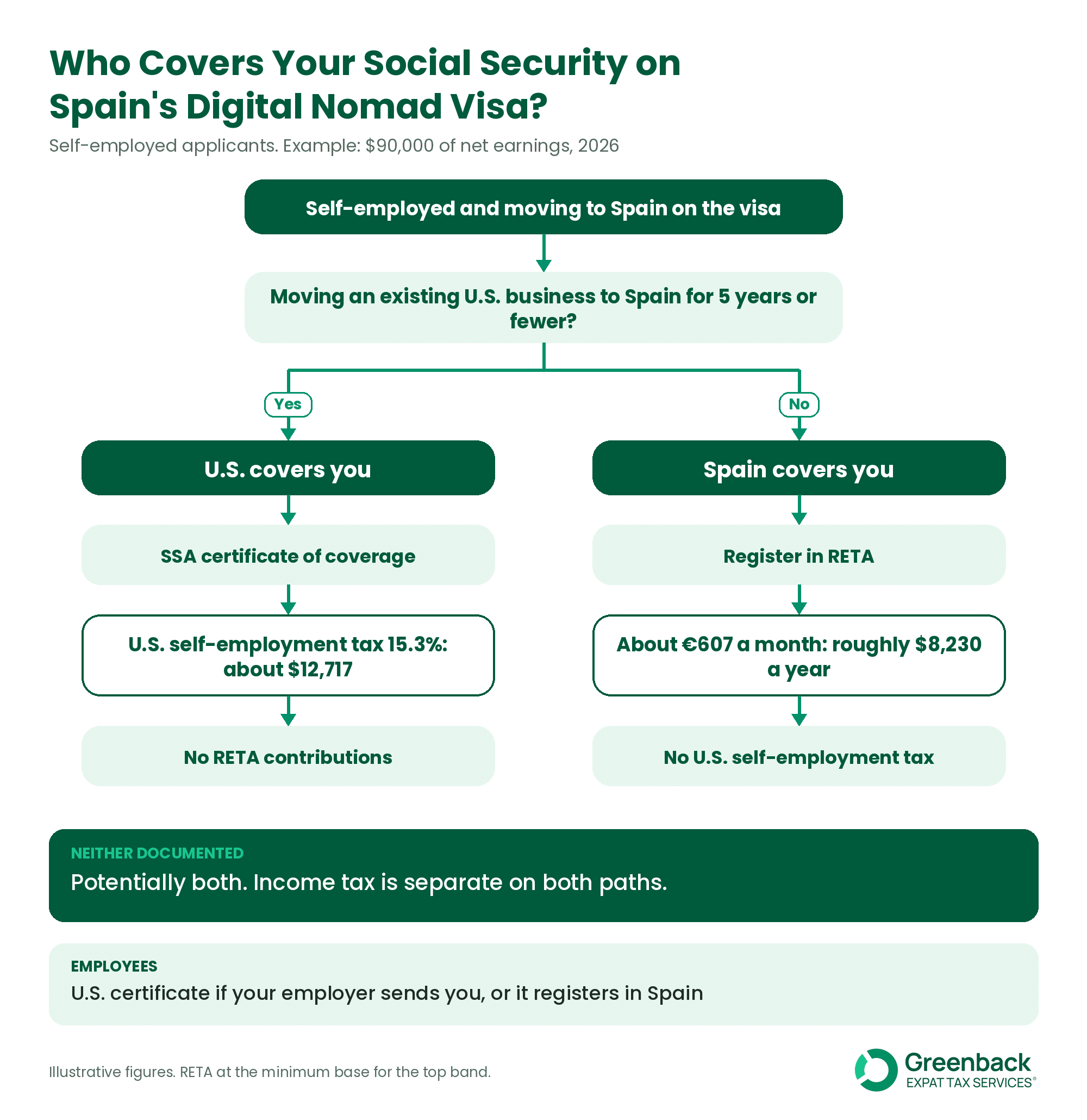
The UGE will not approve the visa without proof of which country covers your social security. The U.S.-Spain totalization agreement decides that, and the answer depends on whether you are self-employed or an employee.
If You Are Self-Employed
Under the totalization agreement, a self-employed person who lives in Spain is covered by Spain. The exception applies to a person normally self-employed in the U.S. who transfers an existing business to Spain for 5 years or fewer. That person stays covered by the U.S.
- U.S. coverage applies: you get a certificate of coverage from the Social Security Administration, submit it with your application, and keep paying the U.S. self-employment tax of 15.3%. You do not join RETA, Spain’s self-employed scheme. You still register with the Spanish tax agency for income tax.
- Spanish coverage applies: you register in RETA and pay a monthly contribution based on your net earnings. A Spanish certificate then exempts you from U.S. self-employment tax, which you claim on your U.S. return.
If you start freelancing in order to qualify, there is no existing U.S. business to transfer, so Spanish coverage is the usual result. The risk is ending up with neither document in place, with Spain asking for RETA contributions and the U.S. still expecting self-employment tax on the same earnings.
If You Are an Employee
Your employer has two options:
- A U.S. certificate of coverage: the agreement supports it when an employer temporarily sends an employee to Spain for up to 5 years.
- Spanish registration: the employer registers with the Spanish Social Security as a non-resident employer and pays the Spanish contributions for you.
Whether a move you arranged yourself counts as being sent depends on the facts, so ask HR which route it will support before you apply. Some U.S. employers hesitate to register in Spain, and knowing that early saves an application.
How Do I Apply for Spain’s Digital Nomad Visa?
- Choose your route. A consulate if you want the visa before you travel, the UGE if you plan to apply after arriving.
- Book the FBI check and apostille first. They take the longest.
- Settle your Social Security document. Request the U.S. certificate or confirm Spanish registration.
- Gather contracts, proof of income, and insurance, then have translations done.
- Submit the application and pay the fee.
- After approval, apply for your TIE (residence card) in Spain.
Applying at a U.S. Consulate
You apply in person at the consulate that covers your state, usually after emailing scanned documents for review. The fee for U.S. citizens is $190, and fees are reviewed quarterly. Washington’s consulate sets a 10-day decision period from the submission date, which may be extended if it requests additional documents or an interview.
Applying From Inside Spain Through the UGE
You apply online while legally in Spain and pay the government fee on form 790-038. The UGE must decide within 20 days of the electronic submission; if it does not, the permit is treated as approved. Your stay is extended while the application is pending.
If You Already Live Outside the U.S.
You apply at the Spanish consulate for the country where you legally reside, with proof of residence there. The FBI check still applies, and the consulate may also ask for a police certificate from your country of residence.
What It Costs
Budget for:
- The visa fee ($190 at a consulate) or the UGE fee on form 790-038
- The FBI check and its apostille
- Sworn Spanish translations
- A year of private health insurance with no co-payments
How Long Is the Spain Digital Nomad Visa Valid?
| Stage | Length | When to act |
|---|---|---|
| Consular visa | Up to one year | Enter Spain and start living there |
| Residence permit | Up to three years | Apply within 60 days before the visa expires, or on arrival via the UGE |
| Renewal | Two years at a time | Apply within 60 days before expiry, with the conditions still met |
| Long-term residence | After five years of legal residence | Generally available once you reach five years |
At renewal, you show:
- Income that meets the requirement at the SMI in force at that time.
- The 20% cap still holds if you are self-employed.
- Up-to-date Spanish tax and social security obligations.
Holding a visa does not, by itself, make you a Spanish tax resident, but living in Spain for more than 183 days in a calendar year generally does. How residency is determined is covered in our guide to how the Spanish tax system works.
How Do Taxes Work on Spain’s Digital Nomad Visa?
In Spain:
- Worldwide income is taxed once you are a Spanish tax resident.
- The Beckham Law is usually open to remote employees who move on this visa. It taxes employment income at a flat 24% up to €600,000, for up to six years. Self-employed applicants generally cannot use it. The Beckham Law guide covers the election and its deadline.
On your U.S. return:
- You keep filing every year, your income passes the filing threshold, which for self-employment is $400 of net earnings.
- Self-employment tax is the point most nomads miss. The Foreign Tax Credit and the Foreign Earned Income Exclusion reduce U.S. income tax, but neither touches self-employment tax. Only the totalization agreement does.
- Credit or exclusion: how the two compare for Americans in Spain is covered in our guide to U.S. expat taxes in Spain.
- Spanish accounts that total more than $10,000 at any point in the year go on an FBAR.
Example: A U.S. Freelancer Moving to Valencia
Jenna is a U.S. graphic designer who has run her business from Denver for six years. She moves to Valencia on the digital nomad visa and nets $90,000 in 2026 from her U.S. clients.
- If she transfers her business for five years or fewer and gets a U.S. certificate, she owes U.S. self-employment tax on 92.35% of her net earnings, about $12,717, and pays nothing into RETA.
- If Spanish coverage applies, at about €6,645 in net earnings per month, she falls into RETA’s top band, where the minimum contribution is an estimated €607 per month, or roughly $8,230 per year, at the 2026 minimum base for that band. With a Spanish certificate, she owes no U.S. self-employment tax.
- Either way: Spain taxes her $90,000 under its standard progressive scale, and that Spanish income tax becomes a Foreign Tax Credit against her U.S. income tax. It does not reduce the self-employment tax in the first case.
The two contributions buy different things. U.S. self-employment tax earns U.S. Social Security credits, and RETA earns Spanish benefits, including access to public healthcare. These figures are illustrative.
Digital Nomad Visa vs Non-Lucrative Visa vs Work Visa
| Criteria | Digital nomad visa | Non-lucrative visa | Spanish work visa |
|---|---|---|---|
| Work allowed | Remote, for employers or clients outside Spain | None, including remote work | For the Spanish employer that sponsors you |
| Income test | €2,442 a month from remote work | Passive income or savings of €2,400 a month | A Spanish job offer and contract |
| Apply from inside Spain | Yes, through the UGE | No | Generally no |
| First permit | Up to three years | One year | Tied to the job |
| Beckham Law | Usually available to employees | Not relevant without work | Usually available |
If you are retiring or living on investments, the non-lucrative visa is the route, and our guide to retiring in Spain covers it.
Bringing Your Family on the Digital Nomad Visa
Your spouse or partner, children, and dependent relatives can apply with you or join later.
- Income: the requirement increases by €916 per month for the first family member and €306 for each additional member, and your income must cover the entire household.
- Work: family members get their own residence permits, which let them work in Spain for any employer or for themselves, without the remote-only limit that applies to you.
- Documents: each needs proof of the relationship (apostilled and translated) and their own health insurance.
Frequently Asked Questions About the Digital Nomad Visa in Spain
The Spanish digital nomad visa is manageable when the file is complete. The parts that take the longest to document are the Social Security certificate or registration, proof of income that matches your bank deposits, and the FBI check with its apostille, so start those first. A working relationship shorter than three months cannot be fixed with paperwork, so time the application after that mark.
For the Spanish digital nomad visa, you need €2,442 a month gross in 2026, about $2,756, from remote work. Add €916 for the first family member and €306 for each additional one. Many applicants document €34,188 a year to leave a margin.
Yes. The Spain digital nomad visa is built for remote employees of U.S. companies. Your employer needs to confirm in writing that you may work from Spain and either obtain a U.S. certificate of coverage or register with Spanish social security on your behalf.
How Greenback Helps Digital Nomads in Spain
Greenback prepares U.S. returns for Americans living in Spain, including remote workers and freelancers on the digital nomad visa. We work out which country covers your social security and claim the self-employment tax exemption where it applies. We choose between the Foreign Tax Credit and the exclusion each year, and report your Spanish accounts correctly. Learn more about how we help digital nomads.

Remote Work in Spain, U.S. Taxes Handled
This article is for informational purposes only and does not constitute tax, legal, or immigration advice. Spanish visa requirements, fees, and social security figures change often. Examples are illustrative. Speak with a qualified professional about your situation.




Featured In





