Spain Tax Brackets and Tax Residency: How Spanish Income Tax Works

- Spain Income Tax at a Glance
- What Are the Tax Brackets in Spain?
- How Much Is Income Tax in Spain?
- What Lowers Your Spanish Income Tax?
- When Do You Become a Tax Resident in Spain?
- Why Your Residence Card and Tax Residency Are Different Tests
- When Is the Spanish Tax Return Due?
- How Do You File a Spanish Tax Return?
- Frequently Asked Questions About the Spanish Tax System
- How Greenback Helps Americans in Spain With Their U.S. Return

Spain’s income tax brackets for the 2026 tax year combine six state bands, from 9.5% to 24.5%, with your region’s own bands, for a combined rate of about 18% to 54% on salary, pensions, and rent. The brackets apply to you once you are a Spanish tax resident, which covers the whole year if you spend more than 183 days of a calendar year in Spain or when Spain is the main base of your business or economic interests. Spain also presumes you are resident when your spouse and minor children live in Spain, unless you show otherwise. Savings income, such as dividends, interest, and gains, is taxed separately, at 19% to 30% in every region.
The IRS still expects a return from Americans who file in Spain, and our guide to U.S. expat taxes in Spain covers that side. This page sits within our living in Spain hub, alongside our guides to visas, retiring, and moving.
Spain Income Tax at a Glance
| Question | Answer |
|---|---|
| What is the income tax rate in Spain? | For the 2026 tax year, a combined rate of about 18% to 54% on salary and pensions, depending on your region and income. |
| What are the tax brackets in Spain? | Six state bands, with your region’s own bands added on top, so your total depends on where you live. |
| What makes you a tax resident in Spain? | Any one of three tests: spending over 183 days of the year in Spain, having your main economic interests there, or your spouse and minor children living there (unless you prove you live elsewhere). Whichever applies, you are resident for the whole year. |
| Do non-residents pay tax in Spain? | Non-residents pay Spanish tax only on income from Spain, such as rent from a Spanish home, at a flat 24% (19% if you live in the EU or EEA). |
| When is the Spanish tax return due? | By 30 June of the following year, so the 2026 return is due by 30 June 2027. |
What Are the Tax Brackets in Spain?
Spain’s income tax, the IRPF (Impuesto sobre la Renta de las Personas Físicas), taxes your income in slices, and each slice carries a state rate plus a regional rate, added together. The rates apply to your taxable base, which is your income after deductions and allowances. You will often see Spain’s income tax rates quoted as 19% to 49%, which is the state scale doubled, as if every region matched it. No region does.
The Spanish tax system splits your income into two bases. The general base covers salary, pensions, self-employment, and rent. The savings base covers dividends, interest, and gains, and has its own scale.
This is the state part of the general scale for the 2026 tax year:
| Taxable base | State rate |
|---|---|
| Up to €12,450 | 9.5% |
| €12,450 to €20,200 | 12% |
| €20,200 to €35,200 | 15% |
| €35,200 to €60,000 | 18.5% |
| €60,000 to €300,000 | 22.5% |
| Above €300,000 | 24.5% |
Your Region Can Raise or Lower Your Rate
Each region adds its own scale on top of the state scale, so the same income can face a combined rate several points higher in Valencia than in Madrid. You pay the tax rate of the region where you spent most of the year, which Spain presumes is your main home. The table below uses Valencia’s new, lower scale for 2026.
| Taxable base | Madrid | Catalonia | Valencia | Andalusia |
|---|---|---|---|---|
| €10,000 | 18% | 19% | 18.3% | 19% |
| €30,000 | 27.8% | 31% | 29.6% | 30% |
| €50,000 | 35.9% | 37.5% | 37.9% | 37% |
| €80,000 | 43% | 44% | 48.6% | 45% |
| €150,000 | 43% | 47% | 50.85% | 45% |
| Top rate, from €300,000 | 45% | 50% | 53.85% | 47% |
These are marginal rates on the next euro you earn. Your overall rate is lower.
The Basque Country and Navarre set their own income tax rules under a separate system, called foral, so these tables do not apply there.
The Savings Income Scale
Savings income is taxed from 19% to 30%, on bands that are the same in every region.
| Savings income | Rate |
|---|---|
| Up to €6,000 | 19% |
| €6,000 to €50,000 | 21% |
| €50,000 to €200,000 | 23% |
| €200,000 to €300,000 | 27% |
| Above €300,000 | 30% |
Selling property or shares follows the same scale, which our guide to capital gains tax in Spain sets out with examples.
How Much Is Income Tax in Spain?
On a taxable base of €40,000, a single resident under 65 pays between about €8,860 and €9,660 in Spanish income tax for 2026, depending on the region, an overall rate of 22% to 24%. The gap widens as income rises: on €80,000, the bill runs from about €24,720 in Madrid to about €26,430 in Valencia.
| Taxable base | Madrid | Catalonia | Valencia | Andalusia |
|---|---|---|---|---|
| €40,000 | €8,855 (22.1%) | €9,661 (24.2%) | €9,232 (23.1%) | €9,383 (23.5%) |
| €80,000 | €24,718 (30.9%) | €26,136 (32.7%) | €26,430 (33.0%) | €25,783 (32.2%) |
The figures use each region’s 2026 scale and personal allowance, before regional deductions. On a salary, the taxable base is lower than your gross pay, because Social Security contributions and the work reductions below come off first.
Madrid comes out lowest at both levels. Valencia’s new 2026 scale beats Catalonia’s on middle incomes but costs more once the taxable base passes about €74,000.
What Lowers Your Spanish Income Tax?
Allowances for you and your family, reductions for work, joint filing, and pensions, and credits against the tax itself all lower your Spanish bill. The main ones:
- Personal allowance: €5,550, in effect a tax-free first slice of income. It rises by €1,150 over 65 and by a further €1,400 over 75. Some regions raise it for the regional part of the tax: Madrid to €5,956.65, Andalusia to €5,790, and Valencia to €6,105. How Spain taxes pensions is covered in our guide to retiring in Spain.
- Children: €2,400 for the first child under 25 living with you, €2,700 for the second, €4,000 for the third, and €4,500 for each one after that, plus €2,800 for each child under 3. Some regions raise these amounts for the regional part of the tax.
- Work expenses: employees deduct €2,000 per year for general expenses, in addition to their Social Security contributions. Lower earners with net work income under €19,747.50 and other income of €6,500 or less receive an additional reduction of up to €7,302.
- Joint filing: a married couple can file a joint return and deduct €3,400 from the base, which usually pays off only when one spouse earns little or nothing.
- Pension contributions: up to €1,500 a year into a Spanish personal pension plan, plus up to €8,500 more through an employer plan, within an overall cap of €10,000 or 30% of your net work and business income, whichever is lower. Only Spanish plans and certain EU workplace plans qualify, so contributions to a U.S. 401(k) or IRA do not reduce your Spanish tax.
- Mothers of young children: working mothers can claim up to €1,200 per child under 3.
- Tax already paid abroad: if income from another country was taxed there, such as rent from a U.S. property, Spain deducts the lower of that foreign tax and the Spanish tax on the same income. That is Spain’s side of avoiding double taxation.
If a job brought you to Spain, the Beckham Law may replace these scales with a flat rate on most of your salary.
When Do You Become a Tax Resident in Spain?
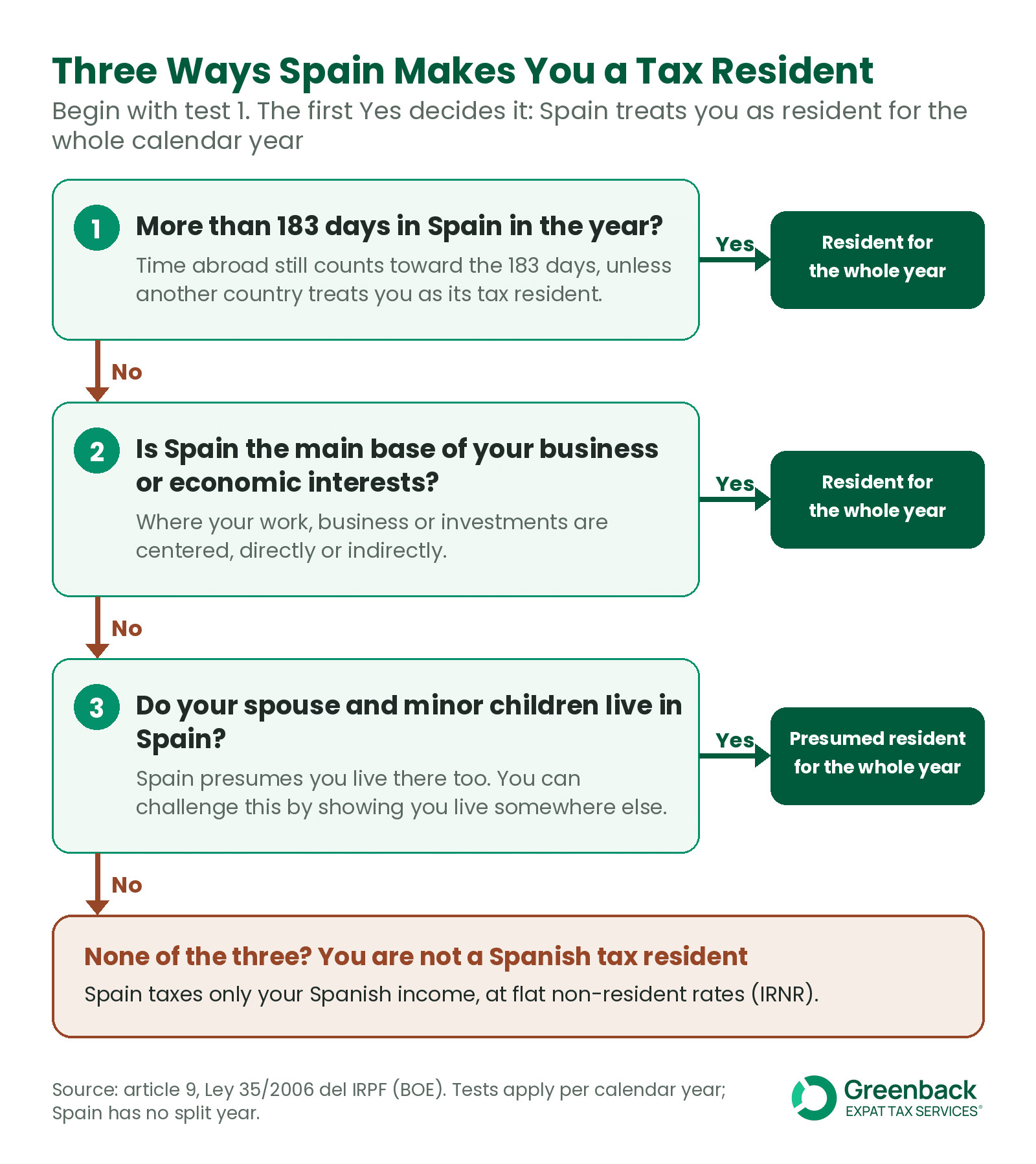
Meeting any one of three tests makes you a Spanish tax resident for all of the calendar year. The tests come from Article 9 of Spain’s Personal Income Tax Law:
- The 183-day rule: you are in Spain for more than 183 days of the year. Spain counts short trips abroad as time spent in Spain, and only a tax residence certificate from another country can exclude them. If you are still a U.S. tax resident, that certificate is IRS Form 6166, which you request with Form 8802.
- Your economic base: the main center of your business or economic interests is in Spain, directly or indirectly.
- Where your family lives: your spouse, if you are not legally separated, and your minor children live in Spain. Spain then presumes you live there, too, but proof that you live elsewhere overrides this presumption.
Spain has no split year: residency is determined for the calendar year as a single unit, regardless of the month you arrive or leave. Our guide to moving to Spain covers how to choose the arrival date.
Income Tax in Spain for Foreigners and Non-Residents
A foreigner who is tax-resident in Spain pays the same tax brackets as a Spaniard because Spain taxes by residency. If you are not a resident, Spain taxes only your Spanish income, under a separate tax for non-residents called the IRNR. The non-resident rates are flat: 24% on most income, or 19% if you live in the EU or EEA, and 19% on dividends, interest, and gains. There are no bands and no personal allowance.
Why Your Residence Card and Tax Residency Are Different Tests
Your residence card decides whether you may live in Spain. Your tax residency decides whether Spain taxes your worldwide income. The card is an immigration permit, issued under Spain’s immigration rules, Real Decreto 1155/2024. Tax residency is a separate test that the Agencia Tributaria applies each calendar year. Holding a card does not make you a tax resident, and you can be a tax resident even if your card says otherwise.
| Residence card | Tax residency | |
|---|---|---|
| What it decides | Whether you live in Spain | Whether Spain taxes your worldwide income |
| Who decides | Spain’s immigration office | The Agencia Tributaria |
| When it is checked | When you apply for or renew your permit | Every calendar year, using the three tests above |
| If you spend most of a year abroad | A long-term card is lost after 12 months in a row outside the EU | You may stop being a tax resident that year, even with a valid card |
The two most often line up on the non-lucrative visa. Renewing it requires living in Spain for more than 183 days a year, which also makes you a Spanish tax resident. Other permits, such as the digital nomad visa, set their own conditions, so check the tax tests each year separately from your permit.
When Is the Spanish Tax Return Due?
Your 2026 Spanish return is due by 30 June 2027. The return is Modelo 100, called the Renta, and the Agencia Tributaria confirms the exact dates each spring.
Not every resident has to file. If your only income is a salary from one payer, you file only above €22,000 a year. The limit drops to €15,876 if, for example, you had more than one employer and the second and later ones together paid you more than €1,500. Anyone registered as self-employed files their earnings.
The Spanish and U.S. calendars for the 2026 tax year:
| Date | Spain | U.S. |
|---|---|---|
| Tax year | 1 January to 31 December 2026 | January 1 to December 31, 2026 |
| Return due | 30 June 2027 (the window usually opens in early April) | April 15, 2027 |
| Americans living abroad | No extra time | Automatic extension to June 15, 2027 |
| Further extension | None | October 15, 2027, with Form 4868 |
The full U.S. calendar is on our U.S. tax deadlines page, and our guide to U.S. expat taxes in Spain explains which one to aim for once your Renta is filed.
How Do You File a Spanish Tax Return?
Most residents file the Renta online through Renta WEB, the Agencia Tributaria’s filing service, starting with the borrador, the pre-filled draft that the Agencia Tributaria prepares based on what Spanish taxpayers and banks report.
- Get access: log in with Cl@ve, the government’s online ID system, using a digital certificate or a reference number. For a reference number, you need your NIE and its support number, plus either box 505 of last year’s return or, if you did not file last year, the last five digits of the IBAN of a Spanish account you held during the year.
- Check the draft: the borrador only holds what Spain’s records show. As a resident, you declare your worldwide income, so add any items that may be missing, such as a U.S. pension, U.S. dividends, or rent from a U.S. home.
- Claim what lowers your tax: add your children, joint filing if it helps, pension contributions, regional deductions, and the deduction for tax you have already paid abroad.
- Submit and pay: pay in full, or usually 60% when you file, and the other 40% in early November. If Spain owes you a refund, it will be paid by bank transfer to the account you give on the return.
Frequently Asked Questions About the Spanish Tax System
The main one is the IRPF, the income tax on this page. Homeowners also pay a yearly local property tax, the IBI, to their town hall. Wealth tax applies above a regional threshold, which our guide to retiring in Spain covers. Residents with assets outside Spain exceeding the set limits file Modelo 720, an information return that lists them.
Yes. The Agencia Tributaria offers Renta WEB Open, a free simulator that needs no identification. The examples above also provide a rough guide, as long as you start with your taxable base.
Yes. Crypto gains, including coin-to-coin swaps, are savings income at the rates above, and our guide to capital gains tax in Spain covers how gains are calculated. The IRS taxes the same gains, too, and our guide to crypto taxes for Americans abroad covers the U.S. rules. If you hold crypto with a provider outside Spain that is worth more than €50,000 on 31 December, you must also file Modelo 721 between 1 January and 31 March.
How Greenback Helps Americans in Spain With Their U.S. Return
Greenback’s accountants handle the U.S. side for Americans who are tax residents in Spain. Your Renta is filed in Spain, and once it is, we use the Spanish tax on your Modelo 100 to claim the Foreign Tax Credit on your U.S. return with Form 1116, with salary in the general category and dividends and interest in the passive category. Visas, housing, healthcare, and other information for living in Spain are in our guide.

Know Your Spanish Rate, Then Plan Your U.S. Return
This article is for informational purposes only and does not constitute tax or legal advice. Spanish rates are the state and regional scales in force for the 2026 tax year, and what you pay depends on where you live, your deductions, and your family. Speak with a qualified professional about your situation.




Featured In