TN Visa for Canadians and Mexicans: Requirements, Application & U.S. Taxes

- What Is a TN Visa?
- How Do Canadians and Mexicans Apply for a TN Visa?
- How Long Does TN Status Last, and Can It Lead to a Green Card?
- Do TN Visa Holders Pay U.S. Taxes?
- How Do You File Taxes in Your First and Last Year on a TN?
- Do TN Visa Holders Pay Social Security and Medicare Tax?
- What Happens to Your Accounts in Canada or Mexico?
- How Do Married TN Holders File Their Taxes?
- Can Americans Use USMCA to Work in Canada or Mexico?
- Frequently Asked Questions about the TN Visa
- Greenback Helps TN Professionals File With Confidence


A TN visa is a U.S. work status for citizens of Canada and Mexico under the USMCA trade agreement. It lets you work in one of about 60 listed professions for up to three years at a time, with no limit on renewals. Canadians apply at the border or at an airport preclearance, while Mexicans apply for a TN visa at a U.S. consulate.
For U.S. tax purposes, your days in the country determine your status, not the visa itself. Most TN professionals pass the substantial presence test in their first year, become resident aliens, and file Form 1040 on worldwide income, the same return a U.S. citizen files. Social Security and Medicare tax generally apply from your first paycheck, and tax treaties keep the same income from being taxed twice.
This guide covers who qualifies, how to apply and renew, and how TN holders file U.S. taxes from their first year to their last.
What Is a TN Visa?
The TN visa is a U.S. work status created under the USMCA (formerly NAFTA) for citizens of Canada and Mexico, as the State Department explains. It requires a prearranged job in a listed profession, the credential that profession lists, and a temporary stay. Permanent residents of Canada or Mexico do not qualify. There is no annual cap and no lottery.
| Requirement | What it means |
|---|---|
| Citizenship | You are a citizen of Canada or Mexico |
| Prearranged job | A full-time or part-time position with a U.S. or foreign employer, offered before you apply |
| Listed profession | Your job is on the USMCA professions list, and you hold the credential it lists |
| Temporary stay | You intend to stay for a defined period, not permanently |
The rules come from 8 CFR 214.6, and USCIS summarizes them for applicants.
1. The TN Professions List
The TN professions list covers about 60 professions in four groups: general, medical and allied, scientist, and teacher. It sits in Appendix 2 to Annex 16-A of the USMCA, published in full by Global Affairs Canada. Examples include accountant, engineer, management consultant, computer systems analyst, registered nurse, pharmacist, and university teacher. Each one carries a minimum credential, usually a bachelor’s degree or a licenciatura. Your actual duties have to match the profession, not just your job title.
2. Contracts and 1099 Work Have Limits
A TN can rest on a contract as well as a job offer, but it cannot cover your own U.S. business. The State Department’s visa manual accepts “an employment letter from a U.S. or foreign employer, or contract.” TN status “does not authorize the establishment of a business or practice in the United States” in which you are self-employed. Providing services through a company you solely or mainly own counts as self-employment. Each new client also needs its own TN approval before you start. If you want to run your own U.S. business, the visa manual points you to investor visas, such as the E-2 investor visa. The tax side of 1099 pay is covered in the Social Security section below.
3. TD Status for Your Spouse and Children
Your spouse and unmarried children under 21 can join you in TD status for the same period as your TN. TD family members cannot work in the U.S., but they can study full-time. Canadian family members need no visa. Family members who are not Canadian, including Mexican citizens, apply for a TD visa at a U.S. consulate.
How Do Canadians and Mexicans Apply for a TN Visa?
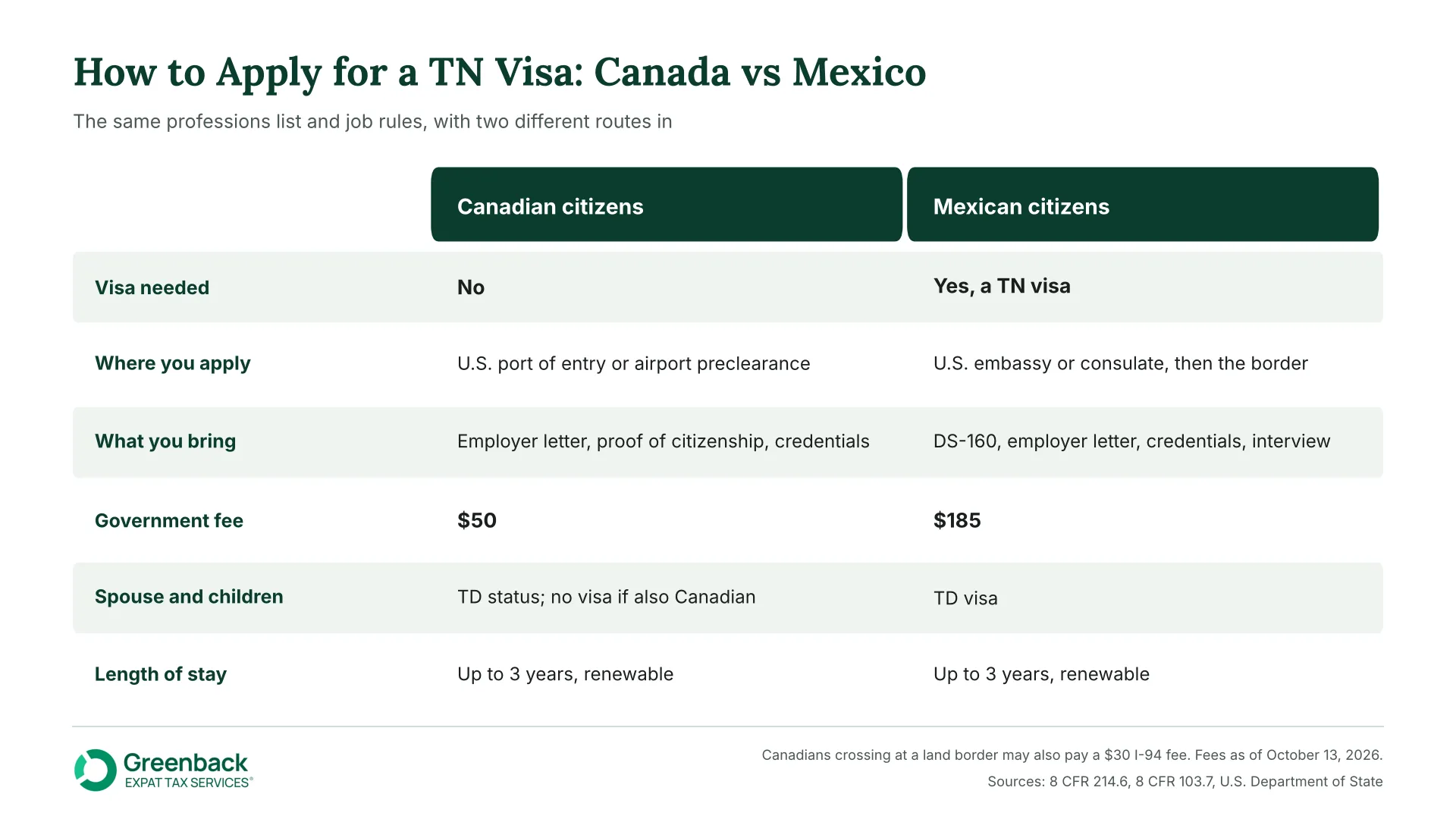
Canadians do not need a visa and apply directly to U.S. Customs and Border Protection at a port of entry or airport preclearance. Mexicans first apply for a TN visa at a U.S. embassy or consulate, then present it at the border. In both cases, an officer reviews your employer letter and credentials and decides whether you qualify.
| Step | Canadian citizens | Mexican citizens |
|---|---|---|
| Visa needed | No | Yes |
| Where you apply | Port of entry or airport preclearance (CBP) | U.S. embassy or consulate |
| What you bring | Employer letter, proof of citizenship, credentials | DS-160 confirmation, employer letter, credentials, interview |
| Government fee | $50 | $185 |
| Spouse and children | TD status; no visa or fee if they are Canadian too | TD visa |
1. Applying From Canada
Your employer letter does most of the work at the border. It describes your duties, how long you will be employed, your pay, and your qualifications, and CBP reviews it with your proof of citizenship. The $50 fee is set in federal regulations. At a land border, you may also pay a $30 I-94 fee, which does not apply at airports, according to the Federal Register.
2. Applying From Mexico
Mexican citizens complete Form DS-160, pay the $185 visa fee, and attend an interview. The State Department now generally requires an interview for all visa applicants. You apply in your country of nationality or residence.
3. Social Media Screening Since October 1, 2026
Since October 1, 2026, TN and TD visa applicants are told to set every social media profile to “public.” The State Department extended its online presence review to these categories on that date. The announcement applies to visa applicants, including Mexican TN applicants and family members who need a TD visa.
How Long Does TN Status Last, and Can It Lead to a Green Card?
TN status lasts up to three years per admission, and the regulations set no limit on how many times you can extend it. TN is not a “dual intent” status, so you must show a temporary stay each time you apply or renew. A green card is possible later, but the TN itself is not built as a path to one.
1. Renewing, Changing Employers and Grace Periods
You can extend through USCIS from inside the U.S. or be readmitted at the border with a new employer letter. A new or added employer must be approved before you start work for it. You also have a grace period of 10 days before and after your approved dates, plus up to 60 days after a job ends, once per validity period, under federal regulations.
2. TN Is Not a Dual-Intent Status
You must show that your stay is temporary every time you apply. The State Department’s visa manual notes that a future intent to immigrate, unrelated to this stay, does not, by itself, defeat a temporary stay. Starting a green card process also affects your taxes: once you take steps toward a green card, you can no longer claim the closer connection exception described below.
Do TN Visa Holders Pay U.S. Taxes?
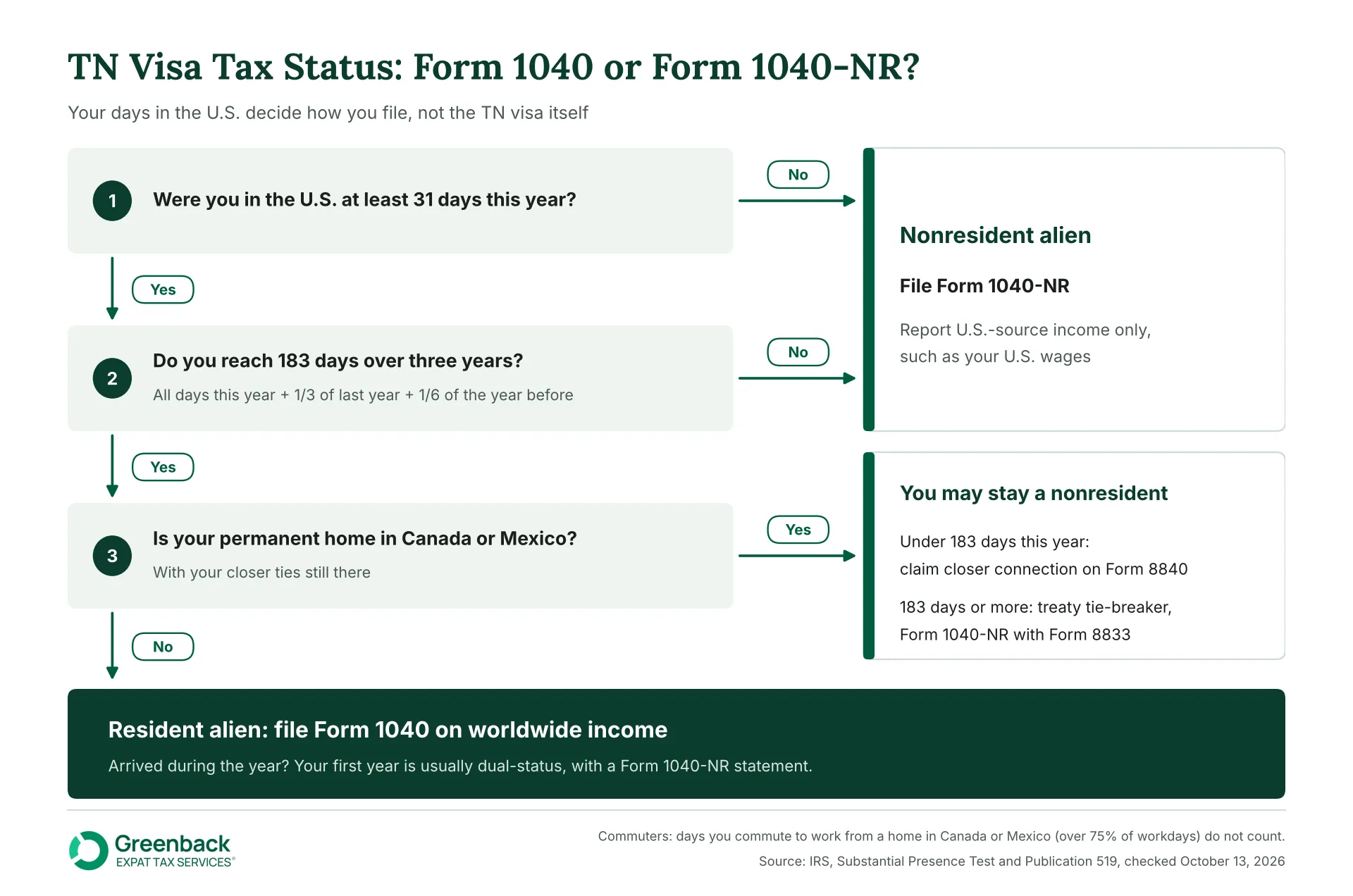
Yes. TN days count toward the substantial presence test, which exempts only F, J, M, and Q visa holders. If you are present at least 31 days this year and 183 weighted days over three years, you are a resident alien who files Form 1040 on worldwide income. Otherwise, you file Form 1040-NR on U.S. income only.
| Your situation | Tax status | Return you file |
|---|---|---|
| In the U.S. all year | Resident alien | Form 1040 |
| Arrived mid-year and passed the test | Dual-status for that year | Form 1040 with a 1040-NR statement |
| Arrived late, under 183 days | Nonresident alien | Form 1040-NR |
| Commute daily from Canada or Mexico | Usually nonresident | Form 1040-NR |
| Keep your main home in Canada or Mexico | Possibly nonresident by exception or treaty | Form 1040-NR with Form 8840 or Form 8833 |
The IRS lists TN among the visa types taxed under these rules, and our visa taxation chart compares TN with other common visas. If you live in Canada or Mexico and cross the border for work, our guide to commuting to a U.S. job on a TN explains why those days do not count.
1. How the 183-Day Test Applies to You
Every day you are physically in the U.S. counts, including weekends. A TN professional who arrives on August 1 and stays through December has 153 days, so they are a nonresident for that first year. A full year the following year makes them a resident. The difference between resident and nonresident aliens shapes everything from your deductions to whether you can file jointly, and the Form 1040 vs Form 1040-NR comparison shows what changes on the return itself.
2. Staying a Nonresident on Purpose
You can stay a nonresident after passing the test in two situations.
- The closer connection exception applies only if you were here for fewer than 183 days in the year, keep your tax home and closer ties in Canada or Mexico, and file Form 8840 on time, as the IRS explains. It is not available once you take steps toward a green card.
- The treaty tie-breaker: if you pass the test but your permanent home is in Canada or Mexico, the treaty may treat you as a resident of that country. You then file Form 1040-NR with Form 8833. A Form 1040-NR does not allow a joint return.

How Do You File Taxes in Your First and Last Year on a TN?
Your first year on a TN is usually a dual-status year: nonresident before your first day in the U.S., resident after it. The year you leave works the same way in reverse. A dual-status return splits the year at those dates, and our first-year guide for new resident aliens covers what else changes once you become a resident.
1. A Canadian Engineer Who Starts on May 1
Maya, a Canadian engineer, starts a TN job in Seattle on May 1, 2026, and stays for the rest of the year. That is 245 days, so she passes the test and becomes a resident from May 1. Her January to April salary from her Canadian employer is not included on her U.S. return because she earned it while she was a nonresident. Her U.S. salary from May onward goes on it.
If Maya were married, she and her spouse could instead choose to be treated as U.S. residents for all of 2026 and file jointly, as the IRS allows. That brings her January-to-April pay onto the U.S. return as well, with a credit for the Canadian tax paid on it. Someone who arrives too late in the year to pass the test may be able to make a first-year choice instead, covered in our guide to mid-year tax filing.
2. Canada’s Departure Tax When You Move
When you cease to be a Canadian resident, Canada treats certain property, such as non-registered investments, as sold at fair market value on the day you leave. RRSPs, RRIFs, TFSAs, pensions, and Canadian real estate are exempt, according to the CRA. You report the deemed sale on Form T1243, file Form T1161 if your property is worth more than CAD $25,000, and can defer payment with Form T1244. On the U.S. side, the U.S.-Canada treaty lets you elect to step up the U.S. cost basis of that property, so the U.S. taxes only later gains, as Treasury’s technical explanation of the treaty describes. A preparer can confirm how to make that election on your return.
3. Your Last Year on a TN
The year you leave the U.S. is another dual-status year, with your residency ending on your last day here. The U.S. exit tax does not apply to you, because it applies only to U.S. citizens and long-term green card holders.
Do TN Visa Holders Pay Social Security and Medicare Tax?
Yes. TN holders generally pay Social Security and Medicare tax from their first paycheck. TN is not one of the visa categories exempt from these taxes, so your employer withholds both. The Social Security portion applies to the first $184,500 of 2026 wages, according to the SSA. Canada’s agreement with the U.S. can keep you in the Canada Pension Plan only if a Canadian employer sends you. Mexico has no agreement in force.
1. Workers Sent by a Canadian Employer
If a Canadian employer sends you to the U.S. temporarily and keeps paying you, you can stay in the Canada Pension Plan with a certificate of coverage. You request it with Form CPT56, according to the SSA. TN professionals hired directly by a U.S. employer pay U.S. Social Security instead. Totalization agreements like this one exist so you do not pay into two Social Security systems for the same work.
2. If You Are Paid on a 1099
When a client pays you as a contractor, no one withholds Social Security for you, and your tax status decides what you owe. U.S. clients usually ask a resident for Form W-9 and a nonresident for a W-8 form, as our guide to Form W-8 vs Form W-9 explains.
| Your status | How 1099 pay is taxed |
|---|---|
| Resident alien | Self-employment tax of 15.3% (12.4% Social Security up to the wage base, 2.9% Medicare), reported on Schedule SE, with quarterly estimated payments |
| Nonresident alien | Generally no self-employment tax; the client withholds 30% unless you file Form 8233 to claim a treaty exemption |
The IRS confirms that nonresident aliens are generally not subject to self-employment tax. Our guide to Form 8233 covers the treaty exemption. Under the Canada agreement, a self-employed person living in the U.S. pays U.S. self-employment tax.
What Happens to Your Accounts in Canada or Mexico?
Once you are a resident alien, you report worldwide income on your U.S. return, including interest and gains from accounts back home. The U.S. tax treaties with Canada and Mexico, together with the Foreign Tax Credit, keep the same income from being taxed twice.
| Account or income | U.S. treatment | What you file |
|---|---|---|
| Canadian or Mexican bank accounts | Interest is taxable | Form 1040; FBAR and possibly Form 8938 |
| RRSP and RRIF | Growth stays tax-deferred automatically | FBAR; no Form 8891 or Form 3520 |
| TFSA | No treaty protection; income is taxable | Form 1040; FBAR; possible extra reporting |
| AFORE | No specific IRS guidance | FBAR; ask a preparer |
| Rental property back home | Rental income is taxable | Form 1040, with credit for foreign tax |
1. FBAR and Form 8938
You file an FBAR if your foreign accounts total more than $10,000 at any time in the year. You also file Form 8938 as a U.S. resident if your foreign assets top $50,000 on the last day of the year or $75,000 at any time, or $100,000 and $150,000 on a joint return, according to the IRS.
2. RRSPs Keep Their Deferral; TFSAs and AFOREs Need Care
Your RRSP keeps its tax deferral automatically under Rev. Proc. 2014-55, with no election to file. It still belongs on your FBAR (see reporting an RRSP on the FBAR). A TFSA has no treaty protection, so its income is taxable in the U.S., and whether it requires foreign trust reporting remains debated, as our guide to the TFSA and Form 3520 explains. The IRS has issued no specific guidance on Mexican AFORE accounts.
How Do Married TN Holders File Their Taxes?
Once you are a resident alien, you can file jointly with your spouse, even if your spouse is a nonresident in TD status. To do that, you elect to treat your spouse as a U.S. resident, which brings their worldwide income onto the return. A TN holder married to a U.S. citizen follows the same rules as any joint return with a foreign spouse.
1. Filing Jointly With a TD Spouse
The Section 6013(g) election allows a nonresident spouse to be treated as a resident for the entire year. Both of you then report worldwide income. Your spouse needs an SSN or an ITIN. A TD spouse cannot work in the U.S., so they usually apply for an ITIN with Form W-7.
2. Children and the Child Tax Credit
The child tax credit requires a Social Security number for each child. A child with an ITIN may qualify for the $500 credit for other dependents instead. Our guide to the child tax credit with an ITIN or SSN walks through who qualifies.
Can Americans Use USMCA to Work in Canada or Mexico?
There is no TN visa for Americans, but the USMCA also allows U.S. professionals to work in Canada and Mexico. Canada issues a CUSMA Professional work permit for the same list of professions. Mexico has committed under the treaty to admit them, and uses its standard employer-sponsored work permit process to do so.
1. Canada’s CUSMA Professional Work Permit
U.S. citizens with a prearranged job in a listed profession can get a Canadian work permit without a labor market test, according to IRCC. You apply at the port of entry; the permit lasts up to three years and can be extended, and the fee is CAD $155. You keep filing U.S. returns while you live there, and the treaty and credits for U.S. expat taxes in Canada help keep the same income from being taxed twice.
2. Mexico Uses Its Standard Work Permit Process
Mexico’s published immigration rules do not set out a separate USMCA route for U.S. professionals. Your Mexican employer obtains authorization from Mexico’s immigration institute (INM) based on your job offer. You then get either a visitor permit to work for up to 180 days or a temporary residence permit for up to 4 years, under Mexico’s Migration Law (Ley de Migración). A Mexican consulate can confirm the current steps. U.S. filing continues there as well, under the rules for U.S. expat taxes in Mexico.
Frequently Asked Questions about the TN Visa
For a qualifying job, getting TN status is usually quick for Canadians. You apply in person at the border or an airport preclearance and get a decision during that visit, with no cap or lottery. Officers look closely at whether your duties match a listed profession and whether you hold the listed credential.
Generally not, because TD status does not allow work. For U.S. taxes, a TD spouse uses an Individual Taxpayer Identification Number instead, which lets you file jointly and claim them on your return.
The main difference is who can use them: the TN is only for citizens of Canada and Mexico, while the H-1B is open to workers from any country. A TN also has no annual cap or lottery, but it does not allow dual intent, while an H-1B does. Once you are a resident alien, the U.S. tax rules are the same for both, because the test that decides whether an H-1B holder is a resident alien applies to TN holders too. Our guide to H-1B taxes covers the same filing rules from the H-1B side.
Greenback Helps TN Professionals File With Confidence
Many TN professionals file a dual-status return in their first year, then a standard Form 1040 for each subsequent year. Greenback’s U.S. accountants, with expertise in cross-border returns, prepare your U.S. return, FBAR, and treaty forms so that the first year and every year after are done right. Learn more about how we help visa and green card holders.

Working in the U.S. on a TN Visa?
This article provides general information and is not tax, legal or immigration advice. Immigration rules and fees change, and border and consular officers decide each application. Speak with a qualified tax professional about your taxes and an immigration attorney about your status.



Featured In


